By Steven Goddard
Last month we discussed how NASA continues to spread worries about the Antarctic warming and melting.
A January 12, 2010 Earth Observatory article warns that Antarctica
“has been losing more than a hundred cubic kilometers (24 cubic miles) of ice each year since 2002” and that “if all of this ice melted, it would raise global sea level by about 60 meter (197 feet).“
[Note that is continental ice, not sea ice, – Anthony]

NASA’s 1982-2007 map showing Antarctica warming

But NSIDC seems to be thinking differently in their March 3, 2010 newsletter. They say Antarctica is cooling and sea ice is increasing (makes sense – ice is associated with cold.)
Sea ice extent in the Antarctic has been unusually high in recent years, both in summer and winter. Overall, the Antarctic is showing small positive trends in total extent. For example, the trend in February extent is now +3.1% per decade. However, the Amundsen and Bellingshausen Seas show a strong negative trend in extent. These overall positive trends may seem counterintuitive in light of what is happening in the Arctic. Our Frequently Asked Questions section briefly explains the general differences between the two polar environments. A recent report (Turner, et. al., 2009) suggests that the ozone hole has resulted in changes in atmospheric circulation leading to cooling and increasing sea ice extents over much of the Antarctic region.
The NSIDC graph below shows the upwards trend in Antarctic Sea Ice. Some recent years have shown anomalies as high as +30%.

http://nsidc.org/data/seaice_index/images/s_plot_hires.png
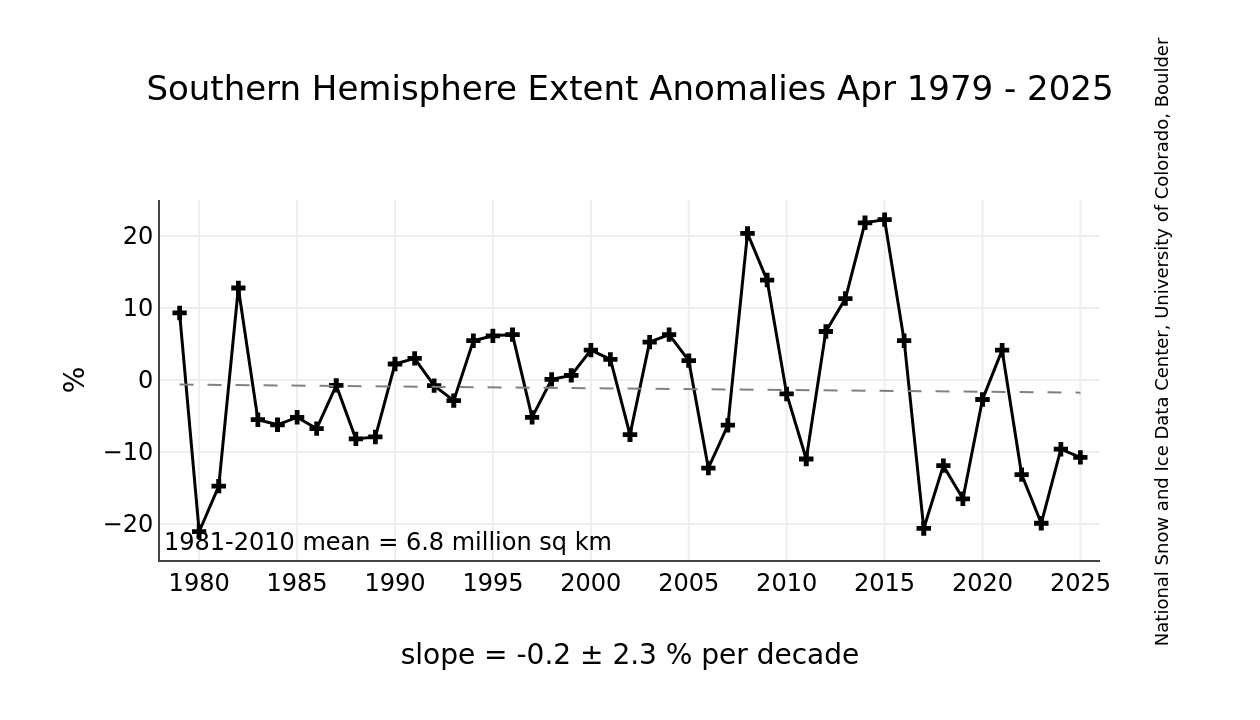
UAH satellite data also shows Antarctica cooling, as seen in their map below. (This map is dated November, 2006 – if anyone knows where to get a more recent version, please let me know.)


UAH 25 Year Temperature Trends
Perhaps NASA should have stuck with their original 2004 map below, showing Antarctica’s interior cooling?

NASA’s 1982-2004 map showing Antarctica cooling

While there’s no dispute that there’s some sea ice loss in the Antarctic peninsula, all signs seem to point in the opposite direction of what some what have you believe about Antarctica as a continent.
Sponsored IT training links:
We offer self paced 312-50 training with up to date 642-611 dumps and 70-450 practice test to provide guaranteed success in first dive.
Ref – D. Patterson (08:02:52) :
Pascvaks (07:38:45) :
“This is an extremely unusual and cold event and experience for the Earth this past 20-30 million years. Do not underestimate its danger with respect to a collapse of the biosphere in the event of the carbon dioxide levels in the atmosphere falling too low at 150ppm and less.”
______________________
I know, it is a lot like being on the Titanic and standing at the bow with my hands stretched out like a bird and the cold North Atlantic winds chilling me to the bone. You’re right. But at the moment, I feel fine; the freezing ocean waves are a problem for another day. Tonight we dine at the Captain’s Table and dance till dawn. Hoohah!
PS: Our DNA says we’re all related so I have no doubt that some of the family will survive whatever happens. Ain’t life a beach?
Here is how NASA Satellite Grace works:
http://www.csr.utexas.edu/grace/science/gravity_measurement.html
If the Antartic ice sheet is really 300,000,000 km3 and they can distinguish 100km3 it means they have invented an instrument capable of get a resolution of at least 1/3,000,000 of the ice sheet.
This is amazing, especially if they get it by the gravity changes.
Being the ice specific weight 917kg/m3 @0°C and water specific weight 999,8kg/m3. The difference measured should be just 82.8kg/m3, or 82,800,000,000kg/km3 which in our case gives 8,280,000,000,000kg that is 8.28×10^12kg.
But let’s imagine, the ice goes directly into the air without melting has they suppose.
So imagine the whole 917kg/m3 disappears (the ice sublimates, so I istantiate that the vapour mass is negligible respect to the ice), it means the satellites measures -9.17×10^13kg.
I both cases, I can’t imagine how they reject the whole earth mass which is about 6×10^24kg.
They must have a resolution of at least 1.526×10^-11 of the Earth mass to appreciate the change.
Note also that if the ice doesn’t melt but sublimate, the mass variation changes of sign, so how do they know if the ice is increased or decreased by the gravitational measurements?
Where I’m wrong?
Does anybody know how they do?
The map link in my comment above doesn’t work, this may be better since I remembered to put the c in arctic
http://www.amap.no/?main=http%3A//www.amap.no/mapsgraphics/go/graphic/the-predominant-currents-in-the-arctic-ocean-and-their-major-routes-around-the-basin-edges-of-the-arctic
Leif Svalgaard (08:33:57) :
vukcevic (08:10:07) :
reverse MF impacting on velocity.
OK, so you change the story.
What a nonsense you just wrote (perhaps you should apologise). Nowhere have I mentioned heating of water by electric currents now or before. When climatologists talk about heat transfer they talk about this:
http://forces.si.edu/arctic/images/02_02_04_a.gif
http://icons-pe.wxug.com/data/climate_images/conveyor.jpg
Some time ago I wrote this:
http://hal.archives-ouvertes.fr/docs/00/41/83/04/PDF/NATA.pdf
from which I quote again:
The warm water current branching of the North Atlantic Current and combination of the Arctic cold currents create Labrador Sea currents; which tightly governs the strength of the Subpolar gyre’s circulation, which is the engine of the heat transport across the North Atlantic Ocean.
“So, you are now saying that the Earth magnetic field is slowing the ocean current, so a weaker magnetic field [as today] should slow the current relative to 1650. The ocean current now being slower meaning more warm water flowing to the pole.”
Exactly oposite. Stronger field reduces more the velocity of conductor: remind yourself of your “so we’ll try some hand waving instead” try to move a conductor in stronger and weaker field: which requires more force, think of a frictionless electromagnetic brake.
vukcevic (06:38:42) :
I made a couple attempts to link to a more current map of the BG and TPD, but couldn’t get the links to work. I’ll give it one more try with a link to the list of maps I got the other link from
http://www.amap.no/?main=http%3A//www.amap.no/mapsgraphics/go/graphic/the-predominant-currents-in-the-arctic-ocean-and-their-major-routes-around-the-basin-edges-of-the-artic
Dave Wendt (08:48:04) :
Here is a link to a map that shows a more current representation of the BG and TPD
gives a ‘not found’ error
Dave Wendt (08:30:53) :
Thanks for the link. I do occasionally go through the Amap website. If BG moves to Canada-Alaska side it would presumably counter interact and slow down the cold Davis Strait current
http://www.vukcevic.talktalk.net/LFC16.htm
and so contribute to higher temp as it was case since 80’s.
You are correct, my knowledge is not that robust either (now retired electronic engineer), but it is supplanted by intuition, logic (Dr. S. may characterise it as ‘reverse’) and of cause internet. Just a hobby, no scientific reputation to defend.
Incidentally, the size of Antartica can be roughly said to be similar to the size of the US. So imagine that all the rainfall in the US that contributes to the Mississippi, the Colarado and America’s other great rivers were in fact falling as snow on the Rocky Mountains, and then compacting into ice super-frozen at -50Celsius. And this was happening every year, that huge volume of water from all the rivers of the US compacting as hard-frozen ice in the Rockies, and basically staying there because it can’t readily flow away as water.
That is basically what is happening in Antartica right now. And the AGW proponents would have you believe that the small amount of ice that gets squeezed off into the sea from the pressure of all this newly created ice inland where it then melts is going to mean London gets drowned. Let’s face it, there is no physical reason for believing that this will ever happen.
Ref – Dave Wendt (09:16:35) :
vukcevic (06:38:42) :
_________________________
Try this link and then click link to “The predominant currents in the Arctic Ocean and their major routes around the basin edges of the Arctic”
http://www.amap.no/?main=http%3A//www.amap.no/mapsgraphics/go/searchregion/regionid/arcticocean
vukcevic (09:10:10) :
Nowhere have I mentioned heating of water by electric currents now or before.
I distinctly remember having this discussion several times over the last year or so, but do not need to take the time to dig it up since you now don’t believe that anymore.
Exactly oposite. Stronger field reduces more the velocity of conductor
Vertical field, latitudinal flow: which way does the Lorentz force v x B point?
Pascvaks (09:59:57) :
Thanks for that. I made several more attempts which also didn’t work, so I had them deleted. The specific map I was referring to is figure 3-27. Figure 2-20 also show similar information
Leif Svalgaard (10:00:29) :
“I distinctly remember having this discussion several times over the last year or so, but do not need to take the time to dig it up since you now don’t believe that anymore.”
No sir, you got it wrong, not then, not before I suggested electrical heating. You got it wrong then, you kept getting it wrong, and got it wrong now. Here some extracts from my first ever posting on the matter:
(NASA now saying that a Dalton Minimum repeat is possible- WUWT )
vukcevic (12:39:16) :
….. but that is not point! Electrical heating is not the point !!!…
vukcevic (04:27:37) :
Copper plate will spin freely until you bring a permanent magnet close to it, in which case it will slow down and stop, due to induction of a counter emf ! (basic physics).
vukcevic (14:31:13) :
You cannot help putting wrong interpretation in order to supposedly ‘win’ the argument. ELECTRIC CURRENTS DO NOT DRIVE OCEAN’S CURRENTS ! Induced counter emf slows fractionally polar current down. Emf is not energy source, it acts as an electric break. Solar energy is nothing to do with Beaufort gyre, it is most of the time entirely under ice cap, and its waters are not exposed to solar heating.
http://wattsupwiththat.com/2009/07/28/nasa-now-saying-that-a-dalton-minimum-repeat-is-possible/
(when I get the wrong end of the stick I do say the word ‘sorry’)
vukcevic (09:28:44) :
I can’t say I really “grok” the subtleties of your argument with Dr Svaalgard, but I have been attending to Arctic circulation patterns since I came across the Rigor and Wallace paper I referenced above more than a year ago. One of the resources I’ve found interesting, and you might also, is the daily ice drift maps at the DMI site
http://ocean.dmi.dk/arctic/icedrift/index.uk.php
To my eye at least the drift patterns since the beginning of the year suggest the BG may be attempting to return to a pattern closer to one on the map you linked. It’s probably too early to tell, but if that pattern does reemerge it would suggest that the uptrend in Arctic sea ice will be stronger in the future.
Personally I wouldn’t choose to go head to head with Leif on anything within his scientific purview, but as Grandpa used to say, “you can’t sharpen your knife on a stick of butter”.
Wow! My link even worked. That’s one in a row!
vukcevic (09:10:10) :
Exactly oposite. Stronger field reduces more the velocity of conductor
Gregory Ryskin believes just the opposite, namely that ocean currents are the CAUSE of the secular variation:
http://www.iop.org/EJ/article/1367-2630/11/6/063015/njp9_6_063015.html
His calculations [but you do not believe in mathematics anyway] are highly mathematical and not correct [we can go through them step for step if you like]. Ryskin also proposes [elsewhere] than methane explosions on the ocean floor “Similar, smaller-scale events could have happened since, which might explain the Biblical flood, for example, suggests Gregory Ryskin of […] it’s too important to ignore,” says Ryskin. Ryskin is usually considered a crank. You know with the usual signs: ‘conventional science opposes what I say, so there must be something to it…’.
Perhaps you could reverse your suggested direction of causation and join Ryskin’s bandwagon…
vukcevic (10:51:24) :
(when I get the wrong end of the stick I do say the word ‘sorry’)
I can say sorry too. What confuses me is the constant lack of clarity as to what you propose. But it is good to have on record that you do not think electric currents are heating the oceans. This is at last something concrete.
You did not answer my question about the direction of the Lorentz force.
Dave Wendt (10:57:27) :
Personally I wouldn’t choose to go head to head with Leif on anything within his scientific purview, but as Grandpa used to say, “you can’t sharpen your knife on a stick of butter”.
You may be right, we had ‘friendly’ exchange of views for some time now. I do not mind being flattened by someone of his stature, knowledge and experience, but however much he tries, I do not give up. I have great respect for good old doc, I value his views, but that doesn’t mean I have to agree, if I see a reason not to.
Thanks for the DMI link, I shall look it up, it looks it might have some good stuff.
Leif Svalgaard (11:06:11) :
Gregory Ryskin believes just the opposite, namely that ocean currents are the CAUSE of the secular variation
Without going through the mathematics [which nobody here has the patience for] a simple argument can be given why ocean currents are not the cause of the secular variation of the Earth’s field: polarity reversals. which would require the global ocean currents to flow the other way from time to time.
vukcevic (11:29:51) :
but however much he tries, I do not give up.
Cranks never do 🙂
We have our flock of resident cranks on this blog and they at times provide needed levity.
D. Patterson said:
“So, how does the mid-upper troposphere undergo such a dramatic warming as it dumps this warmth into space from the preciptiatation of rain, frozen rain and snow without contributing to the cooling of the Earth? Oh, right, you’ve repealed the fundamental laws of thermodynamics just to satisfy your special pleading. Silly us.”
First of all, the troposphere is a dynamic system, (like everything else on this planet) and it isn’t just “dumping warmth into space” during precipitation events. This doesn’t even make any sense from any perspective. As a dynamic system, the heat in the troposhere is constantly in flux, from oceans, solar radiation, etc. Heat coming in and going out all the time. But as we all should know, the stratosphere has been cooling over the last few decades, just as predicted by AGW models. Why? Well of course precisely because more heat has been “trapped” in the troposphere, meaning of course that the GH gases are doing exactly what GH gases do, and delaying the transfer of heat from the troposphere to the stratosphere. So there is more heat staying in the troposphere then leaving on a net basis…exactly as predicted by AGW models. The heat transfer out of the troposphere, on a net basis, is slowed down. To sugget that precipitation events in the troposphere, when looked at from a global basis, should suddenly cool down the tropopshere, would forget the fact that simultaneously heat is being transferred into it from the oceans and solar radiation…and the net heat gain, if the AGW hypothesis is corrrect, tips the scale toward warming.
Leif Svalgaard (11:15:21) :
“But it is good to have on record that you do not think electric currents are heating the oceans. This is at last something concrete.”
You are trying to dig yourself out of a hole again. Perhaps you should read again the post I just put up: vukcevic (10:51:24); It was clearly explained 3 or more times as long ago as July 2009
http://wattsupwiththat.com/2009/07/28/nasa-now-saying-that-a-dalton-minimum-repeat-is-possible/
I have no business with Gregory Ryskin, I have enough ‘nutty’ ideas of my own.
“You did not answer my question about the direction of the Lorentz force.”
Elementary physics.
http://en.wikipedia.org/wiki/File:Solid_Faraday_disc.PNG
Considering oscillations occur in both the Atlantic and Pacific, (PDO and AMO,) I do not see why reflections of these oscillations shouldn’t be seen in both the Arctic and Antarctic.
Considering the PDO has warm and cool cycles, I don’t see why the Antarctic shouldn’t also have cycles which are either relatively warm and moist or relatively cold and dry. If the Pacific cycle lasts 30 years warm and 30 years cold, it would seem the Antarctic reflection should also have thirty years of one pattern and 30 years of another.
Now consider what the effects of thirty years of cold and dry might be. It seems it would be a drought. Just as a reservoir of water shrinks in a drought, the reservoir represented by the huge mass of Antarctic ice would also shrink.
Evaporation would be replaced by sublimation. Over a surface area as huge as Antarctica the amount of H2O turned directly from solid to gas would be enormous.
Unless a reservoir’s floodgates are completely closed, a reservoir continues to lose water even during a drought due to the simple fact water flows away downstream faster than it is replaced. There is no way to close Antarctica’s “floodgates,” which are its glaciers, and the amount of “runoff” via glaciers during a drought could easily exceed the amount added by sparse snowfall.
Using this simple way of viewing things, it is quite easy to image a drought causing the mass of Antarctica to shrink, even with the weather turning colder and drier.
There’s no need to bring up global warming at all.
The Nansen Sea Ice Area and Sea Ice Extent graphs for the Arctic have swung up through the average, so both polar caps are cooling nicely.
http://arctic-roos.org/observations/satellite-data/sea-ice/ice-area-and-extent-in-arctic
Gail Combs (04:49:43) :
Anu (19:17:23) :
You quote a lot of alarmist “rapidly sea level rise” information.
I quoted NSIDC and NASA.
If you prefer to call scientists “alarmists”, that is your personal, emotional response. Personally, I call NFL players “spoiled, steroid-laden millionaires”.
I have a couple of problems with it. Given the size of the Larsen B shelf there should have been a measurable effect in increase of sea ice and sea level rise to prove the theory correct.
Oh, is ice shelf collapse and releasing the dammed up glacier a “theory” now ? Some parts of science are just measurements.
Do the math.
The GRACE satellite measured 24 cubic miles of ice lost from Antarctica in 2002 (see the quote above). If the Larsen B ice shelf was responsible for HALF of that ice loss (generous), how much would you expect the world’s oceans to rise ?
The world’s oceans are 141,600,000 square miles.
If 12 cubic miles of new water are dumped into it, its height will rise 0.005369 inches. Also known as 0.13638 mm
Just what do you think is causing the measured sea level rise these days ?
First the Larsen B Ice Shelf disintegration took place in 2002. A look at the global sea ice variation shows no real impact. http://noconsensus.files.wordpress.com/2008/12/global-sea-ice-area-variation-nasateam-algorithm.jpg
What makes you think glaciers and icebergs flowing into the Southern Ocean in summer will not melt ?
http://nsidc.org/news/press/larsen_B/2002_animation.html
The oceans of the world, as measured by satellite, are rising about 3 mm/year in the last 16 years. These melting ice shelfs, which release continental, non-floating ice into the oceans to melt, are certainly part of this measured rise.
http://arstechnica.com/science/news/2009/03/scientists-track-the-oceans-rise-as-the-globe-warms.ars
I notice the articles talk about “accelerated and thinned” they do not talk about the total volume of ice going into the sea per unit time. Perhaps this is why there has been no impact. The glaciers are moving faster but due to thinning the amount of ice dumped into the sea remains about the same.
I’m glad to see your curiosity. Try to find the actual papers of research, not just write-ups, if you want to see actual volume of ice flowing per ice shelf collapse – there are studies on this.
Before the ice shelf breaks up, it is holding back the glaciers from flowing into the ocean, except for the basically steady-state condition of icebergs calving and snow falling onto the continent.
http://nsidc.org/news/press/glac/why.html
Of course, you’d need lots of ice shelves to breakup to really affect glacier flow:
http://nsidc.org/news/press/20080325_Wilkins.html
The Wilkins is one of a string of ice shelves that have collapsed in the West Antarctic Peninsula in the past thirty years. The Larsen B became the most well-known of these, disappearing in just over thirty days in 2002. The Prince Gustav Channel, Larsen Inlet, Larsen A, Wordie, Muller, and the Jones Ice Shelf collapses also underscore the unprecedented warming in this region of Antarctica.
vukcevic (12:04:04) :
“You did not answer my question about the direction of the Lorentz force.”
Elementary physics.
http://en.wikipedia.org/wiki/File:Solid_Faraday_disc.PNG
Then you see that the force is radial and not retarding the rotation at all.