Guest post by Steven Goddard

The climate panic headline this week has been that the warming Arctic is burping out dangerous quantities of greenhouse gas Methane.
Published on Friday, March 5, 2010 by Agence France Presse
Huge Methane Leak in Arctic Ocean: Study
WASHINGTON – Methane is leaking into the atmosphere from unstable permafrost in the Arctic Ocean faster than scientists had thought and could worsen global warming, a study said Thursday. From 2003 to 2008, an international research team led by University of Alaska-Fairbanks scientists Natalia Shakhova and Igor Semiletov surveyed the waters of the East Siberian Arctic Shelf, which covers more than 772,200 square miles (two million square kilometers) of seafloor in the Arctic Ocean. “This discovery reveals a large but overlooked source of methane gas escaping from permafrost underwater, rather than on land,” the study said. “More widespread emissions could have dramatic effects on global warming in the future.”
Methane is 30X more potent a greenhouse than CO2, so this sounds very alarming. Or does it? From the New York Times:
Dr. Shakhova said that undersea methane ordinarily undergoes oxidation as it rises to the surface, where it is released as carbon dioxide. But because water over the shelf is at most about 50 meters deep, she said, the gas bubbles to the surface there as methane. As a result, she said, atmospheric levels of methane over the Arctic are 1.85 parts per million, almost three times as high as the global average of 0.6 or 0.7 parts per million.
The first problem with the statement is that it is incorrect. The average global methane concentration is ~1.8 ppm, (1786 ppb) not 0.6 ppm as seen below in this graph from NOAA:

http://www.noaanews.noaa.gov/stories2008/images/methanetrend.jpg

The author also says that the Arctic is belching out nearly eight million tons of methane per annum.
She estimated that annual methane emissions from the East Siberian Arctic Shelf total about seven teragrams. (A teragram is 1.1 million tons.)
Sounds like a big number – except that burping/flatulating cattle produce ten times more methane than the Arctic. According to the EPA:
Globally, ruminant livestock produce about 80 million metric tons of methane annually
Is 1.85 ppm a large number? Let’s look at an analogy of what a population concentration of 1.85 parts per million really represents. If the population of Wyoming (544,270) represented all the molecules in the atmosphere, there would be only one methane molecule in the entire state. At 1.85 ppm, there would be fifteen methane molecules in New York City, out of population eight million. There would be on average zero in Nunavut, Canada.
I wonder how much methane Taco Bell indirectly generates per annum? I also wonder why so many Arctic/Greenland studies include only the years 2003-2008. Perhaps they are only interested in reporting data from unusually warm years in the Arctic?
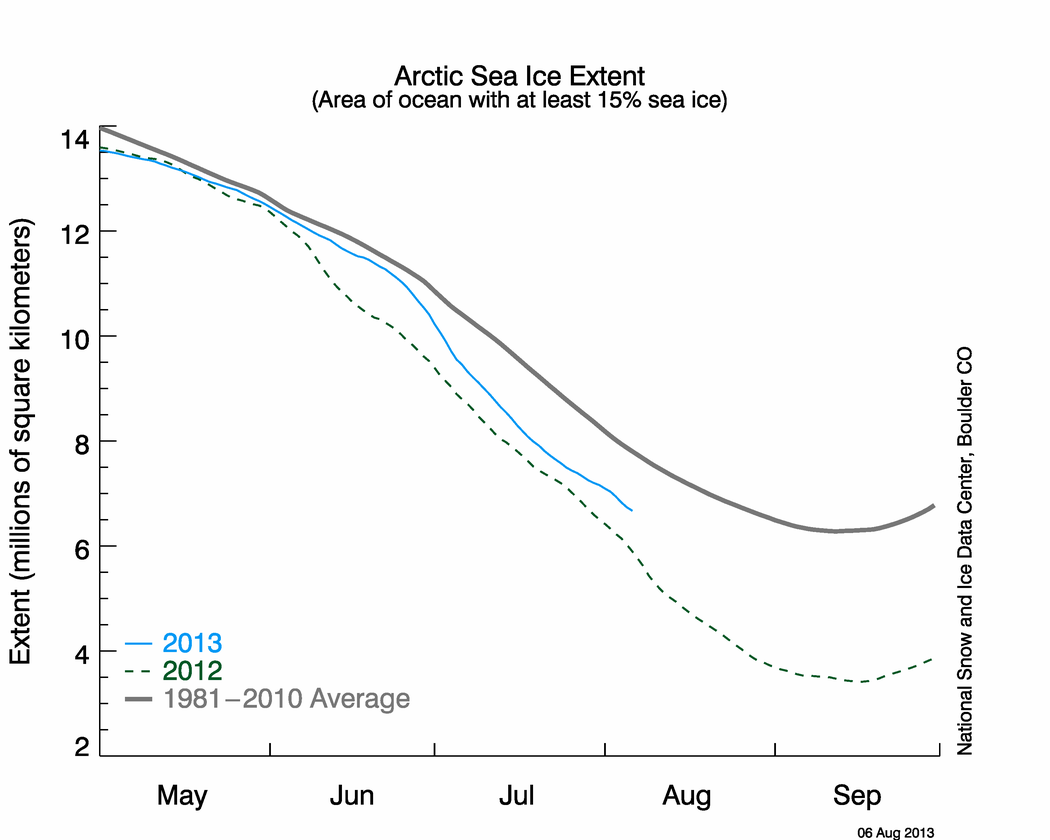
Speaking of the Arctic. What is up with this?

http://nsidc.org/data/seaice_index/images/daily_images/N_timeseries.png
Methane, The Panic Du Jour
The climate panic headline this week has been that the warming Arctic is burping out dangerous quantities of greenhouse gas Methane.
Published on Friday, March 5, 2010 by Agence France Presse
Huge Methane Leak in Arctic Ocean: Study
WASHINGTON – Methane is leaking into the atmosphere from unstable permafrost in the Arctic Ocean faster than scientists had thought and could worsen global warming, a study said Thursday. From 2003 to 2008, an international research team led by University of Alaska-Fairbanks scientists Natalia Shakhova and Igor Semiletov surveyed the waters of the East Siberian Arctic Shelf, which covers more than 772,200 square miles (two million square kilometers) of seafloor in the Arctic Ocean. “This discovery reveals a large but overlooked source of methane gas escaping from permafrost underwater, rather than on land,” the study said. “More widespread emissions could have dramatic effects on global warming in the future.”
Methane is 30X more potent a greenhouse than CO2, so this sounds very alarming. Or does it? From the New York Times:
Dr. Shakhova said that undersea methane ordinarily undergoes oxidation as it rises to the surface, where it is released as carbon dioxide. But because water over the shelf is at most about 50 meters deep, she said, the gas bubbles to the surface there as methane. As a result, she said, atmospheric levels of methane over the Arctic are 1.85 parts per million, almost three times as high as the global average of 0.6 or 0.7 parts per million.
The first problem with the statement is that it is incorrect. The average global methane concentration is 1.8 ppm, not 0.6 ppm.
http://www.noaanews.noaa.gov/stories2008/images/methanetrend.jpg
The author also says that the Arctic is belching out nearly eight million tons of methane per annum.
She estimated that annual methane emissions from the East Siberian Arctic Shelf total about seven teragrams. (A teragram is 1.1 million tons.)
Sounds like a big number – except that burping/flatulating cattle produce ten times more methane than the Arctic. According to the EPA:
Globally, ruminant livestock produce about 80 million metric tons of methane annually
Is 1.85 ppm a large number? Let’s look at an analogy of what a population concentration of 1.85 parts per million really represents. If the population of Wyoming (544,270) represented all the molecules in the atmosphere, there would be only one methane molecule in the entire state. At 1.85 ppm, there would be fifteen methane molecules in New York City, out of population eight million. There would be on average zero in Nunavut, Canada.
I wonder how much methane Taco Bell indirectly generates per annum? I also wonder why so many Arctic/Greenland studies include only the years 2003-2008. Perhaps they are only interested in reporting data from unusually warm years in the Arctic?
Speaking of the Arctic. What is up with this?
http://nsidc.org/data/seaice_index/images/daily_images/N_timeseries.png
Love the cartoon! 😉
Let’s assume that the methane emissions in the Arctic is “worse than we thought”. Doesn’t that mean that the sensitivity of the climate is likely less than was previously modeled, since a huge source of greenhouse gas was not accounted for, with apparently little effect?
I am surprised beyond words…
The phase angle between Warmists and Objective Reality has got to be approaching Pi over two.
I thought Steller’s sea cow was extinct, but perhaps some are surviving in the arctic, emitting dangerous amounts of methane. It’s time to hunt them down and make the extinction permanent!
Also, how can global warming affect the temperature of the sea floor under 150 feet of water and a layer of floating ice?
Hrm… Unless the bottom sediments are being distrubed BY GRAZING SEA COWS!
I assume that Natalia and Igor want much more money to study it in detail ?
If Methane ice is held in solid form in the Gulf of Mexico, How does methane escape from the Arctic??
Josh, I love the cartoon.
This is what I really hate about some of the science around Climate Change, there is an almost pathological attempt to _not_ put things in a global context. Without context the study sounds frightening, but once you put it in the global context (plus whatever nature is burping, winding, or decomposing out) it turns into something a lot less frightening.
Grasping at Straws -again “Its worse than imagined!”….
Nice counter-points…
aw man…. after that earthquake shortened our days I was gettin’ all set up to point the cows to the east to give us a little…uhm…”push” to rev us back up again.
I didn’t realize the bovine flatuence problem was that big. Guess I need a new plan now.
How is this news significantly different from this from the same people in 2006?
http://www.iarc.uaf.edu/highlights/2006/arctic_ocean_methane/index.php
I estimate that one beano bill would be sufficient to handle this trival amount of methane
Love that cartoon. So, let’s see, it’s a gigantic volume ….unless you compare it to the REALLY gigantic volume of bovine indigestion…. and this ultimately results in less than 2ppm? Oh! almost forgot… it’s UNSTABLE… and, of course, it’s worse than we thought. Can somebody check with Al to see how much longer we have now with this new info?
“Speaking of the Arctic. What is up with this?”
Obviously the guys cat ran across the table, bumped his arm, while he was drawing the little blue line.
IDC will correct it next month.
(love that cartoon!)
thats pill not bill, sorry
One other thing- isn’t Catlin supposed to go on another search for the elusive
Arctic Snipe of something like that?. I fear given this new paradigm of cold and
Ice- it may not end as neatly as the last one….
This shows yet another “tipping point” that we’ve already passed — without the expected catastrophe.
After a third of a century of claims that the world will end any minute now, the rants are getting old.
Permafrost in the ocean???
OT….Today’s sunspot number is officially stated ZERO, but I see two small moles on It’s face:
http://sohowww.nascom.nasa.gov/data/realtime/mdi_igr/1024/latest.html
Surely my plesbytism is taking its course these months.
Notice with AGW promoters, it is always worse than thought?
Google the term and see just how often it is used in the context of AGW promotion.
Anyone know how much methane termites emit annually? I read somewhere once that this was the largest natural source of methane emissions.
Carbon-based life form (18:11:47) :
Let’s assume that the methane emissions in the Arctic is “worse than we thought”. Doesn’t that mean that the sensitivity of the climate is likely less than was previously modeled, since a huge source of greenhouse gas was not accounted for, with apparently little effect?
As this release has only just started it would suggest that Climate sensitivity is greater, as sea-floor release of Methane was not expected for some time yet.
No doubt the accolades will start poring in for Climate scientists who have identified this extinction level threat to humanity, it is extinction level as the amount of methane stored would raise current methane levels by 300 times if released.
I don’t understand: under what conditions does one have permafrost under the sea?
This is precisely why I am now to the point, where, a scientist could come up to me and claim that the sun will rise tomorrow, and I wouldn’t believe them.
Science has become worse than sad… 🙁