From Spaceweather.com with apologies to Linus and Charles Schulz

The Solar and Heliospheric Observatory (SOHO) is tracking an enormous magnetic filament on the sun. It stretches more than one million kilometers from end to end, which makes it an easy target for backyard solar telescopes. For the seventh day in a row, an enormous magnetic filament is hanging suspended above the surface of the sun’s southern hemisphere. The Solar and Heliospheric Observatory (SOHO) has a great view. How long can it last? Solar filaments are unpredictable. If this one collapses and hits the stellar surface, the impact could produce a powerful Hyder flare.
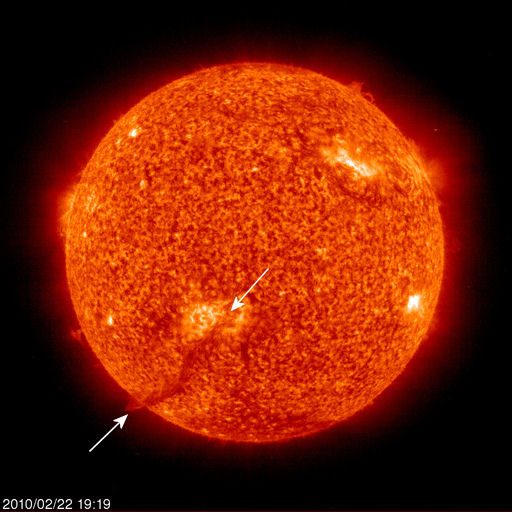


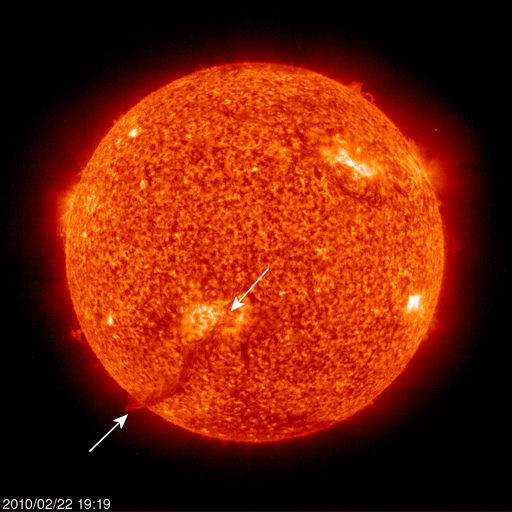
The most recent SOHO image is here
Hyder Flares: from Australian IPS 1. What is a Hyder flare?
Flares are intense brightenings that occur in the solar chromosphere. Flares are generally observed from Earth using narrow band filters, typically with a bandwidth of less than 0.1 nm, and often centred on the Hydrogen-Alpha wavelength of 656.3 nm. (Flares also have counterparts, that is, sudden outbursts, in the radio and X-ray spectrum).
Most flares occur around active regions associated with sunspot groups. However, occasionally a flare (sudden brightening) is observed well away from an active region or sunspot group. These flares are invariably associated with the sudden disappearance of a large (thick, long, ‘bushy’) dark solar filament, and are termed Hyder flares.
2. Why are Hyder flares so named?
Max Waldmeier wrote a paper in 1938 which described the phenomenon of suddenly disappearing filaments (disparition brusque), and mentioned that these can be associated with flare-like brightenings, but it was left to Charles Hyder to postulate the first comprehensive mechanism for the such flares.
Following on work from his doctoral thesis with the University of Colorado in Boulder (1964), Hyder published two papers in the second volume of the journal Solar Physics (1967) in which the mechanism by which Hyder flares might occur was discussed in detail. Hyder was then on the staff of the (US) Air Force Cambridge Research Laboratories at the Sacramento Peak Observatory in New Mexico.
It was these papers in Solar Physics by which Hyder’s name became associated with the flares in question, even though he was by no means the first to observe them.
3. What are the characteristics of Hyder flares?
As previously mentioned, the name Hyder flare is given to a flare that occurs away from an active region or sunspot group and that is associated with the sudden disappearance of a dark filament. The appearance of these flares can range from a string of bright knots on one or both sides of the filament (or rather, the position previously occupied by the filament, sometimes called the filament channel), to a single or double ribbon flare. The ribbons are parallel to the filament channel. If only one ribbon is present, it will lie to one side of the channel, whereas if two parallel ribbons occur, one ribbon will lie on one side of the filament channel, and the other ribbon will lie on the opposite side.
One interesting characteristic of Hyder flares is that they usually develop or rise to maximum brightness much more slowly than do the more common flares associated with active regions. The larger Hyder flares may take 30 to 60 minutes to rise to a peak intensity, and then they may last for several hours. Although they may attain a large area, they usually have a relatively low intensity. Thus, classifications for a large Hyder flare may read 2F, 2N or possibly even 3F. This contrasts to an active region flare in which 3F is very rare. An active region flare that attains sufficient area to put it into the importance class 3, will invariably have either a Normal or more usually a Brilliant brightness classification.
X-ray flares and radio (microwave) bursts associated with the optical Hyder flare, are also generally long lived phenomenon and are classified as the gradual rise and fall type of event (in contrast to the impulsive and complex events associated with large active region flares).
Generally Hyder flares are not associated with energetic particle emission or geomagnetic storms (implying that they may not be associated with a coronal mass ejection). However, this is not always the case, as a large halo CME observed by the LASCO solar coronagraph on board the SOHO spacecraft was most definitely associated with a Hyder flare (2N/M1) observed on 12 September 2000. This same complex also appeared to have produced energetic protons at geosynchronous orbit with energies in excess of 100 MeV, and in substantial numbers at energies of 10 MeV. It is believed that the sudden storm commencement observed at 0450UT 15 September, and the subsequent minor geomagnetic storm was produced by this particular CME.
4. What produces Hyder flares?
Hyder’s explanation of the flare type now named after him depended on the observational evidence that (1) often the flare was a parallel ribbon flare with one ribbon each side of the filament channel, and (2) that geomagnetic storms were not associated with these flares. This led to the speculation that the filamentary material was not ejected far into the corona, but in fact fell back to the chromosphere producing the flare.
Stable or quiescent filaments are believed to lie in and along a magnetic trough. It is thought that the sudden disappearance of such a filament is due to a reconfiguration of the field. In essence, the magnetic trough becomes a magnetic ridge (the bottom of the trough elevating in a period of tens of minutes to become the peak of the ridge). In this process, the filamentary material (cooler gas) is thought to be accelerated into the corona. Hyder’s explanation is that, in the case of the Hyder flare, some or even most of the filament material, instead of suffering acceleration and ejection, falls down the sides of the magnetic ridge and interacts with the lower chromospheric material producing the flare. If the infall process is symmetrical, then the double parallel ribbon flare will result, if asymmetrical, then only one ribbon results. If the infall is sporadic, or the material insufficient, then only bright knots of flare are produced. Hyder did calculations to show that the kinetic energy of the infalling material should be sufficient to provide the required flare energy release observed.
Of late, the Hyder mechanism has come into question. Some people (notably Zirin) have questioned whether infall occurs, stating that the magnetic reconfiguration must always produce ejection. The respective roles of flares and CME’s in solar active processes has also been hotly debated, and this has implications for the exact mechanism of Hyder flares. We certainly have enough observational evidence to show that Hyder flares can be associated with both CME’s and energetic particle production. For the moment, the question of Hyder flare production mechanism appears unresolved, and will probably be sidelined until the more significant (and undoubtedly related) issue of CME – flare production mechanism is sorted out.
The bottom line is that at this stage in solar physics we do not really know what produces a flare nor what produces a CME. There are competing theories, but all tend to have deficiencies with respect to matching the observational evidence. We certainly believe that they all depend on the reconfiguration of magnetic fields as their primary energy source, but in the final analysis, we really only believe this because we can conceive of no other solar energy source of sufficient magnitude.

Leif Svalgaard (08:32:10) :
6. The total mass in a [or just a few] large filament is comparable to that in the rest of the corona.
7. The ‘coronal rain’ [seen in the video] drains the filament at a rate sufficient to deplete the whole corona within a few hours.
8. Those two observational results imply that there is continual circulation of plasma that readily condense [because space is basically cold] into the prominences. And that the equilibrium that allows the filament to exist as a structure [even though its material is continually recycled] is a dynamic one played out as the interaction of magnetism and gravity.
tallbloke (08:54:01) :
How would we know if we were less or more than halfway to understanding the universe?
Granted that some people do not understand even the tiniest bit of the universe, the appropriate answer is that ‘it is turtles all the way down’.
Pamela Gray (08:54:24) :
“…Without that, science is just [a] butterfly collection.”
Very cool quote from Leif.
I deliberately did NOT have the [a] you added. Science is a process, not just a finished collection. Perhaps I should have said:
“…Without that, science is just butterfly collecting.” to make that clear.
James F. Evans (08:25:16) :
And in terms of the Sun — even Dr. Svalgaard won’t deny the 99.99% figure.
In the solar photosphere the degree of ionization is only 1 part in 10,000 or so. Thus 99.99% is not ionized at all. If you adopt the convention that ANY partially ionized medium is a plasma no matter how small the degree of ionization is, then the Sun would be 100% plasma, but so would ordinary sea water [which incidentally has the same electrical conductivity as the solar photosphere].
Painful explanation of the obvious is a very successful evasion tactics.
However, the noticeable warming of Earth in the second half of 1990s followed the noticeable increase in solar activity. And the currently observed noticeable cooling of Earth follows the prolonged quiet period in solar activity.
If Earth’s temperature is completely independent of solar activity, as Dr. Svalgaard stipulates, how does he explain this correlation? Or would he rely on patently falsified CRU data to claim that currently there is no cooling?
Reviewing what Dr. Svalgaard has listed (up through 8 points) notice not once does he refer to electric fields or electric currents.
This is fundamentally wrong and does not reflect empirical observation & measurement (as stated in the scientific papers I provided) or even theoretical premises such as Maxwell’s equations (which were formulated and verified by empirical observation & measurement) which clearly state by mathematical equations that magnetic fields and electric fields are reciprical (you can’t have one without the other).
Dr. Svalgaard uses the term “rain”.
This is instructive to his view-point: “rain” is a code-word for mechanical physical relationships, it’s a reference to neutral matter fluid dynamics, “rain” has no meaning in terms of electromagnetic phenomenon.
In terms of the Sun’s dynamics, it’s an obfiscation.
At this point, it’s important to note I invited Dr. Svalgaard to challenge and refute the conclusions of the Carlqvist & Alfven and the One & Mann peer-reviewed papers, both discuss and explain the electric circuit model of solar filaments — Dr. Svalgaard failed to either challenge or refute these two papers.
When a scientist can’t respond to scientific papers that contradict his opinion that is evidence that his opinion can’t encompass the observations & measurements provided or the conclusions stated in the papers.
Therefore, that should be taken into consideration when deciding how much weight to give that scientist’s opinion or as Dr. Svalgaard like to say, “assessment”.
“A model of magnetized plasma can be based either on a magnetic field description or on an electric field description.” — Carlqvist & Alfven
“The study of these alternative approaches (Alfven, 1968, 1979a) shows that the [electric] current description is necessary for the understanding of the formation of double layers, explosive phenomenon, and transfer of energy from one region to another.” — Carlqvist & Alfven
Filaments and their development into CME’s is a transfer of energy from one region to another, and often is an explosive phenomenon. And, as Alfven has stated the release of energy by CME’s is accomplished by electrical double layers.
Dr. Svalgaard will you respond to the two papers provided or will you ignore them?
At this point I’ll pause until the [or some of the] participants have acknowledged that they have absorbed the 8 points so far.
Leif Svalgaard (09:15:25) :
I’m along for the ride and everything is comprehensible thus far. At some point I think this course will deserve its own thread, but it doesn’t hurt to flesh out some of the concepts and materials here before opening it up to a larger audience.
Alexander Feht (09:43:19) :
However, the noticeable warming of Earth in the second half of 1990s followed the noticeable increase in solar activity. And the currently observed noticeable cooling of Earth follows the prolonged quiet period in solar activity.
The noticeable warming? perhaps that was ‘patently falsified CRU data’?
Since the Sun is now becoming more active again we must then expect a noticeable warming in the coming years, right?
James F. Evans (09:44:58) :
Dr. Svalgaard will you respond to the two papers provided or will you ignore them?
If you would stick to the format for the discussion, I’ll be glad to answer any questions.
As far as the two papers are concerned, as you will see later on [and as we have already discussed ad nauseam] almost all energetic phenomena are due to electric currents due to mechanical forces that cause plasma to move across magnetic field lines. Stick around, pay attention, and observe the format.
Leif Svalgaard (09:41:06) :
Evans (08:25:16) : “And in terms of the Sun — even Dr. Svalgaard won’t deny the 99.99% figure.”
Dr. Svalgaard (09:41:06) responded: “In the solar photosphere the degree of ionization is only 1 part in 10,000 or so.”
Okay, I’m open-minded about the evidence. Other than just your say so, Dr. Svalgaard, do you have some independent verification of your figure?
And, what I mean is something other than a paper authored by you.
Dr. Svalgaard, do you have a peer-reviewed paper (or any paper) that offers authority for your assertion?
And, perhaps, it’s relevant to this discussion to include the corona, as that is where much of the energy that comes from the Sun to the Earth is generated which in turn warms the Earth. Dr. Svalgaard, do you dispute the assertion that the corona is 99.99% ionized plasma?
Possibly this will help clarify the magnetism/plasma/electric components of the Sun ~ written by a beautiful Australian woman back in 2004:
“The principle upon which the sun operates is simple, and in its simplicity rings the truth of how it functions. The common belief that the sun is a huge sphere of gases that collapsed upon themselves and began burning a mixture of gases as a “nuclear furnace” is erroneous.
Instead, the Designer placed a huge material cube into space and set the cube into motion. This motion is a speedy, spinning, gyrating motion that revolves upon a SINGLE POINT in the centre of the cube (slightly off centre point). This POINT should NOT be construed as meaning a single axis that runs through the cube, but instead it should be viewed as a single point in the middle of the cube.
The motion spins the cube (sun) so rapidly that its corners appear to touch nearly all points of the perceived sphere, thus giving the illusion that the object in the sky is a sphere. By analogy, consider that a fan has blades, but when it is set into fast motion, the blades of the fan seem to disappear and an illusion is created which makes the blades look like a circle. This illusion can also be seen in airplane propellers, which also appear to be circles as the propellers spin rapidly. It should also be mentioned that at various speeds, the circles of the propellers seem to change their direction of rotation. This two-dimensional circular type of illusion is the principle behind the cubed-sun’s three-dimensional illusion that it is a sphere and that the sphere is rotating.
However, the sun appears to be aflame, while propellers and fan blades do not. This is partly because the Designer created gravity, which attracted particles of atmosphere to the cube (sun). These particles of air were thereafter trapped by the sun’s gravity and forced to stay with the cube. The flaming sun is primarily due to the vast differences in velocities of the spinning of the objects. Thus, the sun’s atmosphere blazes while the fans’ and propellers’ do not. When the cubed sun spins ferociously fast, it creates a great deal of friction coupled with the fact that the 12 “sharp” edges and 8 “hard” corners of the cube heighten the friction.
The apparent rotation of the sun on an axis has been called “differential rotation” because it appears to take 25 days for the sun to rotate around its equator and 35 days at its poles. This has erroneously been accepted by science as a phenomenon of a gaseous sphere. It is actually an illusion that the sun has a spheroid rotation. This is much like the example of the spinning fan blades. The spinning cube gyrates in such a way that it appears that there is a sphere and that the sphere is rotating irregularly. Thus, an illusion of a differential rotation is created by the spinning cube.”
Possibly we’ve been taught all the wrong science about the nature of the Sun!
I hope you’ll forgive my rant here Dr Svalgaard and Mr Evans, but maybe this is why you guys have a difference of opinion.
Skylurker Suranda
Leif Svalgaard (09:51:44) :
Carry on, Doc.
Alexander Feht (00:02:07) :
” Every winter is colder than summer”
C’mon, even you must know that is a function of Earth’s tilt and has nothing to do with solar activity.
” and every night is colder than midday”
Not true, besides you are talking about weather. Are you suggesting that if I sit in a chair at noon and stay there til midnight the temperature change is due to change in solar activity and not the Earth’s rotation moving me out of direct sunlight?
“Any change in Earth’s insolation results in a change of Earth’s temperature”
Changes in insolation are overwhelmingly due to the conditions of Earth. Changes in the orbit, obliquity, cloud cover, aerosols all result in insolation changes. If you held your uncovered arm out in the direct sunlight in June in Florida you would feel intense heat. If you move into the shade that intense heat goes away yet the Sun didn’t do a thing.
This concept is so easy to understand even a caveman can do it.
James F. Evans (10:16:38) :
Dr. Svalgaard, do you have a peer-reviewed paper (or any paper) that offers authority for your assertion?
You shouldn’t be appealing to authority all the time [and I’m your authority on this]. Independent thinking and understanding are much better. The extremely weak degree of ionization of the photosphere [and of the interstellar gas too, BTW] has been known for almost a century [since Saha published the Saha Equation in 1920], so this fact you will today find in textbooks rather than derived in peer-reviewed modern papers [find me a recent peer-reviewed paper purporting to convince people the Earth is round]. So people simply refer to the weak ionization as the well-known fact it is. Here is a modern paper doing just that: http://www.leif.org/EOS/2000JA000005.pdf scroll to page 23,155 [top line]. You will also in that paper see how the motions of the photospheric plasma across magnetic fields help generate the electric currents that propel the CMEs [as we shall also see later on in the thread].
include the corona, as that is where much of the energy that comes from the Sun to the Earth is generated which in turn warms the Earth.
The corona shines with an intensity less that 1/1000,000 of the photosphere so does not heat the Earth measurably.
Dr. Svalgaard, do you dispute the assertion that the corona is 99.99% ionized plasma?
Absolutely, it is 100% ionized plasma.
Alexander Feht (00:02:07) :
You are on the right track.
NASA had something to say in this regard just recently:
http://science.nasa.gov/headlines/y2010/05feb_sdo.htm
“February 5, 2010: For some years now, an unorthodox idea has been gaining favor among astronomers. It contradicts old teachings and unsettles thoughtful observers, especially climatologists.”
“The sun,” explains Lika Guhathakurta of NASA headquarters in Washington DC, “is a variable star.”
Dr. Svalgaard’s response was to call this statement “hype” and offer a century old paper which did conclude the energy of the Sun was variable.
To make sure I’m not taking Dr. Svalgaard’s comment out of context let me lay out that context:
Dr. Svalgaard presented a NASA statement from this article that I had quoted:
Evans (12:14:48) 2/20/10 quoted NASA: “February 5, 2010: For some years now, an unorthodox idea has been gaining favor among astronomers. It contradicts old teachings and unsettles thoughtful observers, especially climatologists.”
“The sun,” explains Lika Guhathakurta of NASA headquarters in Washington DC, “is a variable star.”
Dr. Svalgaard (12:32:50) 2/20/10 responed: “This is just the usual NASA hype and this is nothing new or unorthodox or contradictory. Abbot showed this 100 years ago:
http://www.leif.org/EOS/Abbot-Variation-Sun.pdf
Riccioli claimed that much in 1651 and Herschel in 1801.”
The paper is good and I’m happy Dr. Svalgaard presented it.
But one paper, while it can set out the physical reality, does not speak for an entire community, as Dr. Svalgaard would likely be quick to point out in reference to the papers I presented, here, in this comment thread. NASA’s statement about “solar constant” was reflecting the “consensus”.
Any internet Google search for “solar constant” will bring up a whole list of hits for “solar constant” and discussions concluding there is a “solar constant” of energy output of the Sun.
NASA was clear: The prevailing consensus was wrong.
(What does that say about the possibility that other astrophysics’ “consensus” is wrong?)
Indeed, Dr. Svalgaard’s position that solar acitivity has little or not impact on climate rests on the assumption of a “solar constant” of the Sun’s energy output.
This is a good example of the consensus being wrong. Consensus does not trump physical reality — and physical reality can be demonstrated by one set of observations & measurements (one scientific paper).
What is amusing about this is that Dr. Svalgaard’s long-held position that .1% change in TSI between solar minimum and maximum does not make a difference in Earth’s climate is directly contradicted by one of the NASA scientists.
And, as the NASA scientist makes clear TSI is more than infrared:
“Astronomers were once so convinced of the sun’s constancy, they called the irradiance of the sun “the solar constant,” and they set out to measure it as they would any constant of Nature. By definition, the solar constant is the amount of solar energy deposited at the top of Earth’s atmosphere in units of watts per meter-squared. All wavelengths of radiation are included—radio, infrared, visible light, ultraviolet, x-rays and so on. The approximate value of the solar constant is 1361 W/m2.”
“‘Solar constant’ is an oxymoron,” says Judith Lean of the Naval Research Lab. “Satellite data show that the sun’s total irradiance rises and falls with the sunspot cycle by a significant amount.”
“At solar maximum, the sun is about 0.1% brighter than it is at solar minimum. That may not sound like much, but consider the following: A 0.1% change in 1361 W/m2 equals 1.4 Watts/m2. Averaging this number over the spherical Earth and correcting for Earth’s reflectivity yields 0.24 Watts for every square meter of our planet.”
“Add it all up and you get a lot of energy,” says Lean. “How this might affect weather and climate is a matter of—at times passionate—debate.”
This would seem to directly contradict Dr. Svalgaard’s position and falls in line with numerous other scientist’s observations & meaurements and conclusions.
Sometimes, I wonder if Dr. Svalgaard plays both ends against the middle depending on what discussion he is in.
Remember, just because Dr. Svalgaard says something doesn’t make it right.
Hold Dr. Svalgaard to the same standards you would hold any other scientist to.
Suranda (10:25:11) :
Instead, the Designer placed a huge material cube into space and set the cube into motion.
This sounds like a question Evans is well equipped to tackle. What does Peratt have to say on that?
Or Oliver?
Evans (09:44:58) : “Dr. Svalgaard will you respond to the two papers provided or will you ignore them?”
Dr. Svalgaard (10:00:11) responded: “If you would stick to the format for the discussion, I’ll be glad to answer any questions.”
I don’t think there is any “format”, that’s just a dodge to get away from answering the question.
However, Anthony Watts has kindly offered to set up a post for Dr. Svalgaard to lay out a “tutorial”.
And, no, we haven’t gone over the Carlqvist & Alfven paper and the One & Mann paper “ad nauseam”.
In fact, I’ve requested you respond several times, now, but each time you have avoided doing so.
Leif Svalgaard:
Since the Sun is now becoming more active again we must then expect a noticeable warming in the coming years, right?
Right. We should expect a modest natural warming starting in 2012 or 2013. Lag seems to be 3-4 years.
Do you refuse to admit that there was a warming in 1990s? Or that there is a cooling now?
Tom in Florida:
Cavemen knew very well that their well-being depended on the Sun. That’s why they addressed their prayers to the Sun. Some modern scientists, on the other hand, are too preoccupied with their ego to be bothered by reality.
About ‘plasma’. One can adopt the definition that any mixture of positive, negative, and neutral particles is a plasma. This is perfectly reasonable and is often done. With this definition, it doesn’t make sense to state that the Sun is 99.99% plasma. The Sun is 100% plasma, but so is sea water. We usually do not consider sea water to be a plasma, reserving the word for a medium with a high temperature. Because a plasma contains electrically charged particles [even if only in very small concentrations like in the solar photosphere], a plasma interacts with electromagnetism. Because 5/6 of the observable universe does not, at least 5/6 of the observable universe is not a plasma, under any definition. What does ‘observable’ mean? It means that it is ‘detectable’ using suitable devices like telescopes, magnetometers, our eyes, etc. If we use our eyes [eventually augmented by a telescope or photographic plate or a CCD] to detect a change in the position of a star as the Sun passes near it in the sky, that is an ‘observation’ and the star is a part of the observable universe as is the body [the Sun in this case] that causes the deflection.
The Onel & Mann paper [being the newest] says:
“Due to the photospheric plasma motion [with velocity u across the magnetic field B] the Lorentz force q u x B acts on the charges q of the plasma and leads to generation of an electric current”.
This is the mechanism that I have been trying to make you understand for months now [‘ad nauseam’]. I really wish you were not so education-resistant.
Dr. Svalgaard:
No, with all due respect, you aren’t my authority.
However, I appreciate the paper you provided to support your assertion regarding the ionization percentage of the Sun’s photosphere.
But, upon review that paper doesn’t provide any discussion of observations & measurements which support that position. It makes an unsupported assertion, just like your unsupported assertion.
Please provide a paper that discusses observations & measurements which relate and shed light on the ionization level of the photosphere of the Sun.
Again, I’m open-minded about it, but I have to see observation & measurement and analysis & interpretation that comes to that conclusion.
I will state that with the Sun’s photosphere at roughly 5,800 degrees Kelvin, which seems could support a lower level of ionization, but count me from Missouri, “the show me” state.
Here is a link to an academic textbook:
Introduction to Plasma Physics: With Space and Laboratory Applications, by Donald A. Gurnett, Published 2005, Cambridge University press:
http://books.google.com/books?vid=ISBN0521364833&id=VcueZlunrbcC&pg=PA2&lpg=PA2&dq=sun++plasma&sig=lYOjlHeChWHPVrPr2ALsv_OcSSQ#v=onepage&q=sun%20%20plasma&f=false
“It is an interesting fact that most of the material in the visible universe, as much as 99% according to some estimates, is in the plasma state. This includes the Sun…”
So, no, not all textbooks take it for granted that the Sun’s photosphere has a low state of ionization percentage.
James F. Evans (11:17:51) :
the Carlqvist & Alfven paper
says [page 204]:
“If photospheric motion in the presence of magnetic fields produces voltage differences […] a current starts to flow”.
again, this is the mechanism that I have been trying to make you understand for months now [‘ad nauseam’].
Perhaps we can put those two papers to rest now. Or do you have more that show the same thing that you want to have confirmed?
The important issue that mechanical forces, gravity and temperature [kinetic energy] push plasma across magnetic field lines and thereby generate electric currents with all the phenomena that flow from that. This is the way Nature works as Carlqvist, Alfven, Onel, Mann, and thousands of other scientists know so well, and as all our emiprical evidence shows.
Suranda (10:25:11) :
Instead, the Designer placed a huge material cube into space and set the cube into motion.
Mr Evans, but maybe this is why you guys have a difference of opinion.
Evans, are you avoiding addressing the paper posted by Suranda?
Leif Svalgaard (09:15:25) :
OK, we can then continue.
9. The delicate balance between gravity and the magnetic field can be upset in several ways, e.g.
10. A new active region can emerge nearby, adding to or disturbing the existing magnetic field [like twisting the support of the hammock you a relaxing in]
11. Alfven waves travelling up the legs of the magnetic field [caused by twisting/movements of the foot points by the photospheric plasma pushed around by convection can also upset the balance and add energy to the configuration.
Dr. Svalgaard (07:28:12) wrote: “They [filaments] are cool clouds suspended in the hot corona by magnetic fields.”
I missed this reference.
Again, “clouds”, like “rain” is a mis-nomer. Reference to “clouds” is an obfiscation which obscures the electrical nature of a filament, and, again, “clouds” is code-speak to fluid dynamics in neutral matter.
But a filament is not neutral matter, it is plasma, charged particles, which respond to electromagnetic forces.