From Spaceweather.com with apologies to Linus and Charles Schulz

The Solar and Heliospheric Observatory (SOHO) is tracking an enormous magnetic filament on the sun. It stretches more than one million kilometers from end to end, which makes it an easy target for backyard solar telescopes. For the seventh day in a row, an enormous magnetic filament is hanging suspended above the surface of the sun’s southern hemisphere. The Solar and Heliospheric Observatory (SOHO) has a great view. How long can it last? Solar filaments are unpredictable. If this one collapses and hits the stellar surface, the impact could produce a powerful Hyder flare.
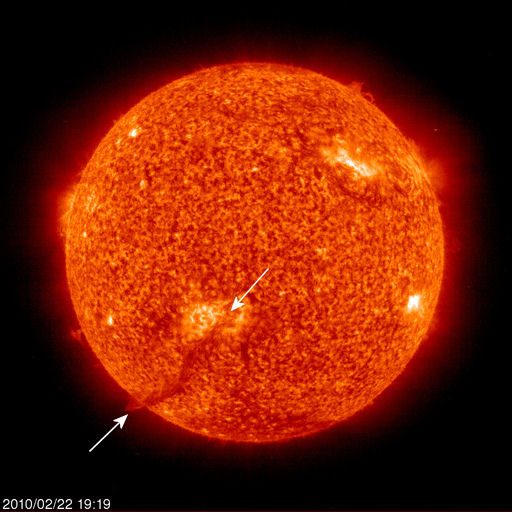


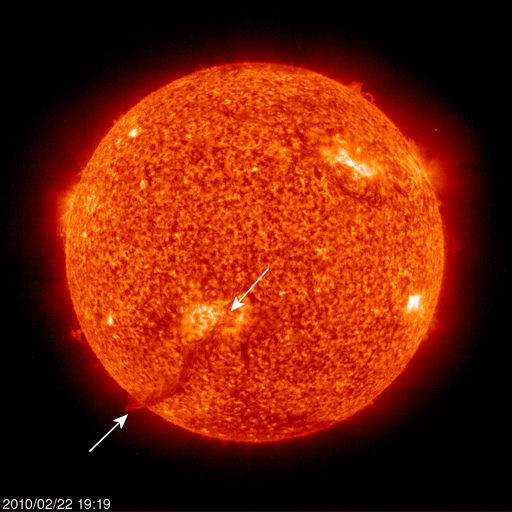
The most recent SOHO image is here
Hyder Flares: from Australian IPS 1. What is a Hyder flare?
Flares are intense brightenings that occur in the solar chromosphere. Flares are generally observed from Earth using narrow band filters, typically with a bandwidth of less than 0.1 nm, and often centred on the Hydrogen-Alpha wavelength of 656.3 nm. (Flares also have counterparts, that is, sudden outbursts, in the radio and X-ray spectrum).
Most flares occur around active regions associated with sunspot groups. However, occasionally a flare (sudden brightening) is observed well away from an active region or sunspot group. These flares are invariably associated with the sudden disappearance of a large (thick, long, ‘bushy’) dark solar filament, and are termed Hyder flares.
2. Why are Hyder flares so named?
Max Waldmeier wrote a paper in 1938 which described the phenomenon of suddenly disappearing filaments (disparition brusque), and mentioned that these can be associated with flare-like brightenings, but it was left to Charles Hyder to postulate the first comprehensive mechanism for the such flares.
Following on work from his doctoral thesis with the University of Colorado in Boulder (1964), Hyder published two papers in the second volume of the journal Solar Physics (1967) in which the mechanism by which Hyder flares might occur was discussed in detail. Hyder was then on the staff of the (US) Air Force Cambridge Research Laboratories at the Sacramento Peak Observatory in New Mexico.
It was these papers in Solar Physics by which Hyder’s name became associated with the flares in question, even though he was by no means the first to observe them.
3. What are the characteristics of Hyder flares?
As previously mentioned, the name Hyder flare is given to a flare that occurs away from an active region or sunspot group and that is associated with the sudden disappearance of a dark filament. The appearance of these flares can range from a string of bright knots on one or both sides of the filament (or rather, the position previously occupied by the filament, sometimes called the filament channel), to a single or double ribbon flare. The ribbons are parallel to the filament channel. If only one ribbon is present, it will lie to one side of the channel, whereas if two parallel ribbons occur, one ribbon will lie on one side of the filament channel, and the other ribbon will lie on the opposite side.
One interesting characteristic of Hyder flares is that they usually develop or rise to maximum brightness much more slowly than do the more common flares associated with active regions. The larger Hyder flares may take 30 to 60 minutes to rise to a peak intensity, and then they may last for several hours. Although they may attain a large area, they usually have a relatively low intensity. Thus, classifications for a large Hyder flare may read 2F, 2N or possibly even 3F. This contrasts to an active region flare in which 3F is very rare. An active region flare that attains sufficient area to put it into the importance class 3, will invariably have either a Normal or more usually a Brilliant brightness classification.
X-ray flares and radio (microwave) bursts associated with the optical Hyder flare, are also generally long lived phenomenon and are classified as the gradual rise and fall type of event (in contrast to the impulsive and complex events associated with large active region flares).
Generally Hyder flares are not associated with energetic particle emission or geomagnetic storms (implying that they may not be associated with a coronal mass ejection). However, this is not always the case, as a large halo CME observed by the LASCO solar coronagraph on board the SOHO spacecraft was most definitely associated with a Hyder flare (2N/M1) observed on 12 September 2000. This same complex also appeared to have produced energetic protons at geosynchronous orbit with energies in excess of 100 MeV, and in substantial numbers at energies of 10 MeV. It is believed that the sudden storm commencement observed at 0450UT 15 September, and the subsequent minor geomagnetic storm was produced by this particular CME.
4. What produces Hyder flares?
Hyder’s explanation of the flare type now named after him depended on the observational evidence that (1) often the flare was a parallel ribbon flare with one ribbon each side of the filament channel, and (2) that geomagnetic storms were not associated with these flares. This led to the speculation that the filamentary material was not ejected far into the corona, but in fact fell back to the chromosphere producing the flare.
Stable or quiescent filaments are believed to lie in and along a magnetic trough. It is thought that the sudden disappearance of such a filament is due to a reconfiguration of the field. In essence, the magnetic trough becomes a magnetic ridge (the bottom of the trough elevating in a period of tens of minutes to become the peak of the ridge). In this process, the filamentary material (cooler gas) is thought to be accelerated into the corona. Hyder’s explanation is that, in the case of the Hyder flare, some or even most of the filament material, instead of suffering acceleration and ejection, falls down the sides of the magnetic ridge and interacts with the lower chromospheric material producing the flare. If the infall process is symmetrical, then the double parallel ribbon flare will result, if asymmetrical, then only one ribbon results. If the infall is sporadic, or the material insufficient, then only bright knots of flare are produced. Hyder did calculations to show that the kinetic energy of the infalling material should be sufficient to provide the required flare energy release observed.
Of late, the Hyder mechanism has come into question. Some people (notably Zirin) have questioned whether infall occurs, stating that the magnetic reconfiguration must always produce ejection. The respective roles of flares and CME’s in solar active processes has also been hotly debated, and this has implications for the exact mechanism of Hyder flares. We certainly have enough observational evidence to show that Hyder flares can be associated with both CME’s and energetic particle production. For the moment, the question of Hyder flare production mechanism appears unresolved, and will probably be sidelined until the more significant (and undoubtedly related) issue of CME – flare production mechanism is sorted out.
The bottom line is that at this stage in solar physics we do not really know what produces a flare nor what produces a CME. There are competing theories, but all tend to have deficiencies with respect to matching the observational evidence. We certainly believe that they all depend on the reconfiguration of magnetic fields as their primary energy source, but in the final analysis, we really only believe this because we can conceive of no other solar energy source of sufficient magnitude.

””””Leif Svalgaard (14:17:44) : . . . I have many times offered to take you through the correct physics, step by painful step. This offer still stands [because it might also be interesting to a wider audience], so if you really want to join me in that I would welcome your interest and dedication. I suggest the following format: each step [and we alternate until done] is a text of no more than 100 words with no links except at most one to an image or formula and no parroting, but original words showing understanding and substance. Agreed?”””’
Leif,
If James F. Evans doesn’t take you up on your offer, could you find a scientist you respect to play a “devil’s advocate” role in place of James F. Evans?
Of course, down side of doing that is James could claim the “devil’s advocate” is not doing sincere/accurate job.
Bottome line is that I would love you to lead me through all the physics. Many others, I am sure, would too.
John
Just The Facts (18:05:33) : “No, it’s like I said originally. Read this article, particularly the Hathaway interview portion;
http://www.earthfiles.com/news.php?ID=1635&category=Science
and note the context when Nasa’s top solar scientist says that,
“But there also were people back at that time saying otherwise. A group of colleagues led by Leif Svalgaard, Ph.D., were looking at the sun’s polar fields and saying even at that point, the sun’s polar fields were significantly weaker than they had been before and those scientists back then predicted it was going to be a small cycle.” and take special note of how”
Are we talking apples and oranges?
From the article:
“Our Variable Sun
WHICH IS KIND OF EERIE FOR EARTH LIFE DEPENDENT ON THAT SUN.
Yeah, the good thing is that when you look at what we really depend upon, which is the radiant energy from the sun – even over the full extent of the sunspot cycle, that only varies by 1/10th of 1%. So, we’re lucky in that regard. It’s a small change. If it were big, I think in terms of evolution, we wouldn’t be here talking about it. But the fact is when it comes to variable stars, our sun’s variability is tiny. Any big solar variations could really wreak havoc on our climate and survivability.”
Isn’t that the point, that the variance is only 1/10th of 1% and therefore does not correlate to Earth’s huge temperature swings let alone long ice ages that contain 10,000 year periods of warmth?
James F. Evans (18:28:47) :
I’m not inclined to accept your invitation to be indoctrinated.
So much for “The parameters of the Empirical Scientific Method allows for vigorous debate”.
I’m not surprised, though.
Tom in Florida (19:20:06) :
Isn’t that the point, that the variance is only 1/10th of 1% and therefore does not correlate to Earth’s huge temperature swings let alone long ice ages that contain 10,000 year periods of warmth?
The Ice Age swings have nothing to do with variations of the Sun, but with variations in the orbit and tilt of the Earth.
John Whitman (19:11:56) :
could you find a scientist you respect to play a “devil’s advocate” role in place of James F. Evans?
Hardly, because the EU/PU stuff doesn’t make sense and scientists have a hard time simulating nonsense.
Bottom line is that I would love you to lead me through all the physics. Many others, I am sure, would too.
This is another matter. I would gladly do this if you [and/or others] could be that antagonist [or at least seeking knowledge]. I don’t know if this will suit Anthony or if a separate thread would be needed. The present one looks as it might work OK.
Perhaps, we should wait a bit and see how many ‘sign up’.
Carla (18:33:19) :
Just The Facts (18:05:33) :
“I understand the point you are trying to make, but earthifles? I did a little tour and got some knee jerks goin on.”
Hello Carla
I can’t control who Hathaway does interviews with and who publishes their work, but knowing some of the background on the situation, the interview with Hathaway seems legitimate to me. Are you questioning the veracity of the Hathaway interview included on this page:
http://www.earthfiles.com/news.php?ID=1635&category=Science
Just The Facts (18:05:33) :
: “But there also were people back at that time saying otherwise. A group of colleagues led by Leif Svalgaard, Ph.D., were looking at the sun’s polar fields and saying even at that point, the sun’s polar fields were significantly weaker than they had been before and those scientists back then predicted it was going to be a small cycle.”
and take special note of how
Chistyakov, 1983 and Badalyan 2000 also predicted a low 24 cycle amplitude,albeit using different techniques and datasets and have a different POV on the effects (if persistent) so one cannot yet draw conclusions.
“Leif Svalgaard (20:07:41) :”
Leif,
I sign up.
John
Leif Svalgaard (20:07:41) : Perhaps, we should wait a bit and see how many ’sign up’.
I will sign up as a “listener” endeavouring to gain knowledge from a very low level of understanding but a high level of thirst…
Leif,
I am signing up in the category “. . . or at least seeking knowledge”.
Sorry that I could not credibly be an EU theory advocate. One reason is I do not have it scoped out and probably won’t ever (so much to do and so little time). Second reason is I only have a BS in nuclear engineering (engineering science with nuclear focus) & am a loooooongggggg time out of school.
Although my wife says I can be extremely antagonistic in discussion, I am sure she does not mean in the good logical/scientific sense.
John
Dr. Svalgaard, we disagree, again.
Why am I not surprised?
Not wanting to be indoctrinated is totally different than not wanting to debate or present contrary arguments with supporting facts and evidence.
Although, I do agree with your discussion of the Scientific Method. My point has been that empirical observation & measurement is paramount, however, as you correctly point out, theory is important as is physical explanation. And, as you state, “initial points of departure for exploration and creation of new ideas and knowledge” is also important. I’d call these, “initial points of departure,” hypothesis.
But it’s only by testing a hypothesis through either repeated laboratory experiments or repeated in situ or remote field observations & measurements that Science validates or falsifies a hypothesis.
Hypothesis that can’t be falsified by observation & measurement is non-scientific.
I presented Alfven’s position that all components of electromagnetism need to be analyzed: Electric field, magnetic field, and electric currents.
In this thread I presented Hyder’s original paper, B. C. Low’s paper discussing filaments’ “internal electric current”, Carlqvist & Alfven’s paper discussing the electric circuit model of filaments, H. One and G. J. Mann’s paper discussing the electric circuit model of CME’s (thanks Carla for the link to the full paper), and the Abstract for Subramanian & Vourlidas’ paper discussing driving currents for flux rope CME’s.
These papers combine the factors that Dr. Svalgaard listed in his discussion of the Scientific Method, hypothesis, observation & measurement, theory, and physical explanation.
As impressive as the physical spectacle of the huge filament is upon viewing, to Science it’s just as important to understand & explain the physical processes (know what we are viewing).
Hopefully, the above papers have helped do that.
Tom in Florida,
The Earth’s climate depends on solar activity for the very simple reason that there is nothing but the Sun to warm the Earth.
Long-time correlation between the Earth’s climate and the Sun activity may be very complex, because the Earth is a very complex system with a multitude of oceanic, atmospheric, and biological feed-backs and lags, but it’s there. Every winter is colder than summer, and every night is colder than midday. Any change in Earth’s insolation results in a change of Earth’s temperature. We have no explanation of how exactly it happens — there are too many variables, and not enough data — but it doesn’t mean that it doesn’t happen.
If the minuscule amount of data gathered up to date “doesn’t support” the obvious in the eyes of people who prefer not to see the woods for the trees, it means that the data is insufficient but in no way confutes the obvious.
I sign up! I’d like for James Evans to participate too, though. I’m an electric universe plasma type person.
Leif Svalgaard (07:05:28) :
Carla (06:34:00) :
Thanks to Evans and the “bad boys,” who lurk here too!
The dumbing down that he represents is a blot on the greatest human achiement: The understanding of our Universe.
Too cut’n’dried for me.
The understanding of our Universe is an ongoing endeavour, not yet an achievement.
tallbloke (04:52:51) :
The understanding of our Universe is an ongoing endeavour, not yet an achievement.
The achievement is how far we have come already.
OK, we then start. First we need to establish some facts based on observations. Filaments [and prominences = filaments seen at the edge of the Sun] can last for weeks. They are cool clouds suspended in the hot corona by magnetic fields. The clouds condense out of the corona and although the matter seems to ‘hang’ there for weeks, it is really a very dynamical phenomenon: the material is continually falling down onto the surface, but being replaced by new material condensing out of the corona. This is seen clearly in this video: http://www.youtube.com/watch?v=mZkJcAB2aSQ
1: they are cool because we can see them in lines of Hydrogen
2: they are suspended temporarily by magnetic fields as can be seen from the gracefully curved field lines lit up by the material.
3: gravity is pulling the material down [as it always does no matter where].
“Leif Svalgaard (07:28:12) :
[…]
This is seen clearly in this video: http://www.youtube.com/watch?v=mZkJcAB2aSQ
”
Great video, thanks, i sign up as well.
Leif Svalgaard (20:07:41) : ” The Ice Age swings have nothing to do with variations of the Sun, but with variations in the orbit and tilt of the Earth.”
That’s what I said.
I’m happy to provide a separate thread for this purpose is Dr. Svalgaard wants to write a tutorial.
– Anthony
Tom in Florida (08:03:54) :
That’s what I said.
What you said fooled me 🙂
Anthony Watts (08:06:02) :
I’m happy to provide a separate thread for this purpose is Dr. Svalgaard wants to write a tutorial.
A tutorial is less useful, because most people’s attention span is not large enough [we are all busy, right?]. The short ~100 word exchanges seems to be a better format. And since we start out with ‘filaments’, the current thread seems appropriate. Let’s see how the experiment turns out.
Suranda (03:36:32) :
A number of commenters have indicated a desire to have Dr. Svalgaard expand on his views seemingly in a lecture style format (I’m paraphrasing)– Dr. Svalgaard lectures and readers accept his view-point.
But if the view-point starts with a faulty premise and builds on erroneous assumptions then all it does is lead readers astray from understanding the actual physical reality.
Dr. Svalgaard’s starting premise (based on past discussions/debates) is primarily mechanical: “hot gas”, fluid dynamics, “wind”, and gravity are Dr. Svalgaard’s starting premise.
Which would be appropriate in a physical environment consisting of neutral gas, liquids, and solids. But the solar environment (assuming that is what Dr. Svalgaard would concentrate on) does not consist of neutral gas, liquids, and solids, rather, it is over 99.99 % plasma.
(And in terms of the Sun — even Dr. Svalgaard won’t deny the 99.99% figure.)
Indeed, the physical relationship between the Sun and the Earth is dominated by plasma dynamics (excluding the constant of gravity which maintains the orbit, obviously, an important element).
As the Sun is over 99.99% plasma, its processes are dominated by plasma dynamics.
What dominates plasma dynamics?
Well, as all readers, here, know, plasma consists of charged particles, free electrons & ions and the physical relationships of these charged particles are dominated by the fundamental force of electromagnetism.
Caveat: Yes, temperature, velocity, and gravity still play a role, but within an overarching electromagnetic environment.
Until Dr. Svalgaard comes to terms with this physical reality, and it seems he still hasn’t (many of his premises are pre-space age), his indoctrination will fail to be intellectually fruitful for understanding the physical reality of our Sun or the Sun/Earth physical relationship — which is important for understanding the Earth’s climate.
The Sun is a plasmoid: Plasma-Magnetic-Entiy.
Dr. Svalgaard rejects the plasmoid term, but what have observation & measurement informed Science about the Sun’s nature?
The Sun is over 99.99% plasma, magnetic fields are ubiquitous in the Sun’s immediate environment, and Maxwell’s equations tell us that where there are magnetic fields, there will be electric fields. And sophisticated modelling and observation & measurement demonstrate electric currents play a powerful role — indeed, CME’s the most disruptive “event” to Man’s technology are giant plasma flows of electrical current.
That’s why CME’s are so disruptive to Man’s electromagnetic technology.
I vote new thread. Kinda like to clear my head.
I’d leif learn as shake the dead. Interesting days lie ahead.
===============================
Leif Svalgaard (07:28:12) :
Since there were no objections or questions [feel free at all times to return to points you want clarified or objects to – I’ll number all conclusions], I’ll press on.
4. From these observations [and from theory – Alfven’s discovery] it is clear that the plasma at least at times is trapped or tied to the field lines – as it doesn’t fall down right away.
5. Since gravity pulls the plasma down, there is a downwards force which is balanced by the magnetic force holding the plasma up [at least temporarily]. The net result is a deformation of the magnetic field as seen in one of the Figures at the top of the page: http://www.ips.gov.au/Images/Educational/The%20Sun%20and%20Solar%20Activity/Solar%20Flares/hyderflr.gif
Anthony Watts (08:06:02) :
I’m happy to provide a separate thread for this purpose is Dr. Svalgaard wants to write a tutorial.
– Anthony
~
Thank you Anthony!
Far out and solid.
Leif Svalgaard (06:34:36) :
tallbloke (04:52:51) :
The understanding of our Universe is an ongoing endeavour, not yet an achievement.
The achievement is how far we have come already.
How would we know if we were less or more than halfway to understanding the universe?
“…Without that, science is just [a] butterfly collection.”
Very cool quote from Leif. Trouble with that is half the temperature data collection has missing wings. And in some cases, entire butterflyies are missing. But no problem. The collector copied the wing pattern from a whole Monarch and pasted it onto the missing body parts area of a Adonis Blue and presented the once more completed tray for all to admire and study.