From Spaceweather.com with apologies to Linus and Charles Schulz

The Solar and Heliospheric Observatory (SOHO) is tracking an enormous magnetic filament on the sun. It stretches more than one million kilometers from end to end, which makes it an easy target for backyard solar telescopes. For the seventh day in a row, an enormous magnetic filament is hanging suspended above the surface of the sun’s southern hemisphere. The Solar and Heliospheric Observatory (SOHO) has a great view. How long can it last? Solar filaments are unpredictable. If this one collapses and hits the stellar surface, the impact could produce a powerful Hyder flare.
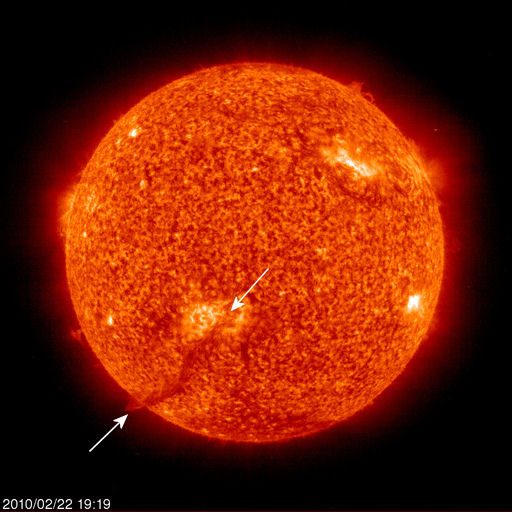


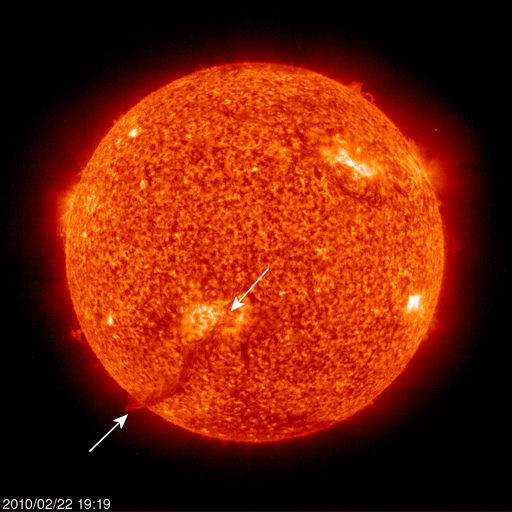
The most recent SOHO image is here
Hyder Flares: from Australian IPS 1. What is a Hyder flare?
Flares are intense brightenings that occur in the solar chromosphere. Flares are generally observed from Earth using narrow band filters, typically with a bandwidth of less than 0.1 nm, and often centred on the Hydrogen-Alpha wavelength of 656.3 nm. (Flares also have counterparts, that is, sudden outbursts, in the radio and X-ray spectrum).
Most flares occur around active regions associated with sunspot groups. However, occasionally a flare (sudden brightening) is observed well away from an active region or sunspot group. These flares are invariably associated with the sudden disappearance of a large (thick, long, ‘bushy’) dark solar filament, and are termed Hyder flares.
2. Why are Hyder flares so named?
Max Waldmeier wrote a paper in 1938 which described the phenomenon of suddenly disappearing filaments (disparition brusque), and mentioned that these can be associated with flare-like brightenings, but it was left to Charles Hyder to postulate the first comprehensive mechanism for the such flares.
Following on work from his doctoral thesis with the University of Colorado in Boulder (1964), Hyder published two papers in the second volume of the journal Solar Physics (1967) in which the mechanism by which Hyder flares might occur was discussed in detail. Hyder was then on the staff of the (US) Air Force Cambridge Research Laboratories at the Sacramento Peak Observatory in New Mexico.
It was these papers in Solar Physics by which Hyder’s name became associated with the flares in question, even though he was by no means the first to observe them.
3. What are the characteristics of Hyder flares?
As previously mentioned, the name Hyder flare is given to a flare that occurs away from an active region or sunspot group and that is associated with the sudden disappearance of a dark filament. The appearance of these flares can range from a string of bright knots on one or both sides of the filament (or rather, the position previously occupied by the filament, sometimes called the filament channel), to a single or double ribbon flare. The ribbons are parallel to the filament channel. If only one ribbon is present, it will lie to one side of the channel, whereas if two parallel ribbons occur, one ribbon will lie on one side of the filament channel, and the other ribbon will lie on the opposite side.
One interesting characteristic of Hyder flares is that they usually develop or rise to maximum brightness much more slowly than do the more common flares associated with active regions. The larger Hyder flares may take 30 to 60 minutes to rise to a peak intensity, and then they may last for several hours. Although they may attain a large area, they usually have a relatively low intensity. Thus, classifications for a large Hyder flare may read 2F, 2N or possibly even 3F. This contrasts to an active region flare in which 3F is very rare. An active region flare that attains sufficient area to put it into the importance class 3, will invariably have either a Normal or more usually a Brilliant brightness classification.
X-ray flares and radio (microwave) bursts associated with the optical Hyder flare, are also generally long lived phenomenon and are classified as the gradual rise and fall type of event (in contrast to the impulsive and complex events associated with large active region flares).
Generally Hyder flares are not associated with energetic particle emission or geomagnetic storms (implying that they may not be associated with a coronal mass ejection). However, this is not always the case, as a large halo CME observed by the LASCO solar coronagraph on board the SOHO spacecraft was most definitely associated with a Hyder flare (2N/M1) observed on 12 September 2000. This same complex also appeared to have produced energetic protons at geosynchronous orbit with energies in excess of 100 MeV, and in substantial numbers at energies of 10 MeV. It is believed that the sudden storm commencement observed at 0450UT 15 September, and the subsequent minor geomagnetic storm was produced by this particular CME.
4. What produces Hyder flares?
Hyder’s explanation of the flare type now named after him depended on the observational evidence that (1) often the flare was a parallel ribbon flare with one ribbon each side of the filament channel, and (2) that geomagnetic storms were not associated with these flares. This led to the speculation that the filamentary material was not ejected far into the corona, but in fact fell back to the chromosphere producing the flare.
Stable or quiescent filaments are believed to lie in and along a magnetic trough. It is thought that the sudden disappearance of such a filament is due to a reconfiguration of the field. In essence, the magnetic trough becomes a magnetic ridge (the bottom of the trough elevating in a period of tens of minutes to become the peak of the ridge). In this process, the filamentary material (cooler gas) is thought to be accelerated into the corona. Hyder’s explanation is that, in the case of the Hyder flare, some or even most of the filament material, instead of suffering acceleration and ejection, falls down the sides of the magnetic ridge and interacts with the lower chromospheric material producing the flare. If the infall process is symmetrical, then the double parallel ribbon flare will result, if asymmetrical, then only one ribbon results. If the infall is sporadic, or the material insufficient, then only bright knots of flare are produced. Hyder did calculations to show that the kinetic energy of the infalling material should be sufficient to provide the required flare energy release observed.
Of late, the Hyder mechanism has come into question. Some people (notably Zirin) have questioned whether infall occurs, stating that the magnetic reconfiguration must always produce ejection. The respective roles of flares and CME’s in solar active processes has also been hotly debated, and this has implications for the exact mechanism of Hyder flares. We certainly have enough observational evidence to show that Hyder flares can be associated with both CME’s and energetic particle production. For the moment, the question of Hyder flare production mechanism appears unresolved, and will probably be sidelined until the more significant (and undoubtedly related) issue of CME – flare production mechanism is sorted out.
The bottom line is that at this stage in solar physics we do not really know what produces a flare nor what produces a CME. There are competing theories, but all tend to have deficiencies with respect to matching the observational evidence. We certainly believe that they all depend on the reconfiguration of magnetic fields as their primary energy source, but in the final analysis, we really only believe this because we can conceive of no other solar energy source of sufficient magnitude.

tallbloke (00:33:10) :
The firmament of scientific intellect isn’t so neatly divided into labelled constellations as you like to think. The course I did on the development of European science, and the course on methods and problems in historiography revealed al sorts of interesting influences on the thinking of apparently ‘objective’ practitioners.
~
..”revealed al sorts of interesting influences on the thinking of apparently ‘objective’ practitioners.”..
Rings true for all walks of life, doesn’t it?
~
Roger Carr (22:02:26) :
Lotta noise in this signal…
Leif is at his most informative when being challenged. My thanks to all contributors to this thread.
~
DeNihilist (00:18:34) :
point 18 – Supersonic as based upon the speed of sound?
Good question. In the solar wind the density is so low that ordinary sound [a pressure wave] does not propagate. But changes in the magnetic field do propagate by the way of ‘Alfven’ waves [ http://en.wikipedia.org/wiki/Alfv%C3%A9n_wave ]. These waves propagate at the Alfven speed. Just as for sound, one can define a ‘Mach’ number as the speed at which something moves divided by the Alfven speed [rather than the sound speed]. The solar wind at the Earth has an Alfvenic Mach number of about 11. This means that knowledge of obstacles [e.g. the Earth’s magnetic field] cannot travel upstream as they are swept downstream 11 times faster than they propagate. Very similar to sound in that respect.
tallbloke (00:33:10) :
“Russell was a mathematician. Proved that 1+1 = 2.”
The firmament of scientific intellect isn’t so neatly divided into labelled constellations as you like to think.
That is often true, except for Russell. A thousand years from now, only his mathematics will remain. the rest of his activity having faded into irrelevance.
tallbloke (00:33:10) :
Roger Carr (22:02:26) :
“Lotta noise in this signal…”
Leif is at his most informative when being challenged.
The noise is more like flies to be swatted than challenges to be met.
”””tallbloke (00:33:10) : The firmament of scientific intellect isn’t so neatly divided into labelled constellations as you like to think. . . . . ”””’
tallbloke,
Stereotyping individual scientists was not intended.
In the readings I have done in the history of philosophy, I was impressed by the surprisingly consistent stream of fundamental ideas in all areas of philosophy [~5] propagating down from pre-Greek to modern era. I find that at the most fundamental [highest] conceptions, the number of philosophic traditions is rather small. There are just a few dominate philosophic traditions that span the length of the Western civilization. In the last 200 years one tradition has dominated virtually all the philosophy departments of the premier universities in USA and especially Europe.
John
Leif Svalgaard (21:59:49) :
Now that we have some background, the following paper should make sense:
20. http://arxiv.org/PS_cache/arxiv/pdf/1002/1002.4962v1.pdf
This is an observational study of a well-observed filament and CME.
And we can close the ‘tutorial’ on this note.
Leif Svalgaard (06:00:28) :
tallbloke (00:33:10) :
“Russell was a mathematician. Proved that 1+1 = 2.”
The firmament of scientific intellect isn’t so neatly divided into labelled constellations as you like to think.
That is often true, except for Russell. A thousand years from now, only his mathematics will remain. the rest of his activity having faded into irrelevance.
As any engineer with a slide rule knows, 2+2 is approximately 4.
Who knows, in the future, Russell may well be remembered more for his anti-nuclear stance than his facile extention of Peano’s axioms.
tallbloke (14:43:42) :
As any engineer with a slide rule knows, 2+2 is approximately 4.
It shows that you are not an engineer. A slide-rule cannot [easily] be used for addition.
And Russell showed that 1+1 is EXACTLY 2, and that is the important bit. In a thousand years I don’t think anybody would care about anybody’s anti-nuclear stance.
tallbloke (14:43:42) :
his facile extention of Peano’s axioms.
And if you knew even a smattering of mathematics, you wouldn’t call his work ‘facile’. You can find the proof on page 86 of Russell’s Principia Mathematica, proposition 110.643. He remarks that the result is ‘occasionally useful’.
“Leif is at his most informative when being challenged.”
Dr. Svalgaard (06:02:57) : “The noise is more like flies to be swatted than challenges to be met.”
More like arrogance or is it “hype”?
Like when Dr. Svalgaard characterized NASA’s press release regarding solar constant as “hype”.
Let me suggest a scientist having confidence about his ideas is positive, but being arrogant and dismissive about rival ideas is negative and does not speak well for that scientist.
Good scientists allow for the possibility they could be wrong.
The fact that plasma motion is causes electric currents is unremarkable.
The quotes I presented, here, and in previous posts stands for the proposition that plasma motion causes charge-seperated electric currents.
“The moving plasma, i.e., charged particles flows, are currents that produce self-magnetic fields, however weak.” — Dr. Anthony L. Peratt, Los Alamos National Laboratory
“An electromotive force [mathematical equation] giving rise to electrical currents in conducting media is produced wherever a relative perpendicular motion of plasma and magnetic fields exists.” — Dr. Anthony L. Peratt, Los Alamos National Laboratory
And, essentially, two colliding bodies of space plasma will cause electric currents.
That is why electric currents are ubiquitous in the Universe as are magnetic fields which reflects the physical relationships expressed in Maxwell’s equations.
The papers I’ve presented discussed the filaments and solar flares.
Even Dr. Svalgaard in a regard action has now acknowledged that the filaments are a product of electric currents.
In other words, but for the presence of electric currents there would not be filaments.
Another way to state it, is to say, the electric current caused the filament.
I presented this peer-reviewed, published scientific paper:
Title: The field and plasma configuration of a filament overlying a solar bipolar magnetic region
Authors: Low, B. C.
Journal: Astrophysical Journal, (1981):
http://adsabs.harvard.edu/full/1981ApJ…246..538L
And highlighted these two quotes from the paper:
“The filament temperature can take values ranging from a small fraction to a few times the coronal temperature, depending on the internal electric current of the filament.”
“The physical state of the filament plasma and its associated internal electric current system required for force balance are determined by the specific heating and cooling processes taking place in the filament.”
Even with one of these quotes making the direct statement that there was an “internal electric current of the filament” and the other quote stating the filament had an “internal electric current system”, Dr. Svalgaard still tried to deny that the filament consisted of an electric current.
Dr. Svalgaard offered a lot of tortured explanations for why the filaments were not electric currents.
(Why should a scientist need to engage in tortured explanations to refute obvious direct statements? Dr. Svalgaard sounded a lot like somebody going into what the definition of “is” is…if you know what I mean…
Only after I presented two more peer-reviewed published papers:
Title: Energy source of the solar wind (1980)
Authors: Per Carlqvist & Hannes Alfven
Journal: Astrophysics and Space Science
http://articles.adsabs.harvard.edu/full/seri/Ap%2BSS/0071/0000203.000.html
And:
Title: Generation of Large Scale Electric Fields in Coronal Flare Circuits
Authors: H. One and G. J. Mann, Astrophysical Institute Potsdam
Published: Cen. Eur. Astrophys. Bull. (2009)
http://arxiv.org/PS_cache/arxiv/pdf/0908/0908.0813v1.pdf
Did Dr. Svalgaard relent and acknowledge that filaments are electric currents, because both papers made explicit reference to the filaments being electric currents and expained in detail why the filaments are electric currents.
Both Alfven & Carlqvist and One & Mann are clear: Filaments are flowing plasma consisting of electric current
That’s called a painful acknowledgement.
Let’s go back to the issue of causation:
The electric current causes the filament as explicitly stated in the Carlqvist & Alfven paper:
“If photopheric motion in the presence of a magnetic field produces voltage differences between two points of intersection of a magnetic field line with the photosphere, a [electric] current starts to flow along this field line.”
The above is just an applied (stating the specific physical conditions) version of this statement:
“An electromotive force [mathematical equation] giving rise to electrical currents in conducting media is produced wherever a relative perpendicular motion of plasma and magnetic fields exists.” — Dr. Anthony L. Peratt, Los Alamos National Laboratory
Which as Dr. Svalgaard acknowledges I have presented before.
Carlqvist & Alfven goes on:
Due to the drift motions caused by crossed electric and magnetic fields, matter from the corona is sucked in by this [electric] current so that a prominence [filament] is formed (Alfven, 1961; Marklund, 1979).
In other words, the electric current causes the filament.
Why is Dr. Svalgaard so intent to dispute this causation?
Because Dr. Svalgaard is in the so-called “magnetic reconnection” school of thought and Carlqvist & Alfven are in the double layer school of thought.
Dr. Svalgaard ends his “tutorial” with a paper that runs up the so-called magnetic reconnection” school of thought.
Dr. Svalgaard takes the arrogant approach that there is no double layer school of thought in astrophysics regarding the solar flare propogation and charged particle acceleration.
One has to ask why Dr. Svalgaard doesn’t want readers of this website to know there is a double layer school of thought in astrophysics?
Is that the approach of an objective scientist?
It is also interesting that Carlqvist & Alfven identify something significant in the above passage:
“Due to the drift motions caused by crossed electric and magnetic fields, matter from the corona is sucked in by this [electric] current so that a prominence [filament] is formed.”
The “crossed electric and magnetic fields” is the so-called neutral “X” point in magnetic reconnection.
So-called “magnetic reconnection” is the erroneous lable given to an Electric Double layer:
http://en.wikipedia.org/wiki/Double_layer_(plasma)
And, yes, there is a double layer school of thought in astrophysics, including as the acceleration process and explosion mechanism for solar flares and CME’s.
Google search webpage for double layer in solar flares:
http://search.hp.my.aol.com/aol/search?s_it=topsearchbox.search&query=double+layers+in+solar+flares
And abstracts for double layers for solar flares:
http://articles.adsabs.harvard.edu/full/1989PASAu…8…29K
http://meetings.aps.org/Meeting/APR06/Event/48086
http://www.agu.org/pubs/crossref/1982/GL009i006p00680.shtml
Dr. Svalgaard knows there are two rival schools of thought on this issue, but does not see fit to inform the readers of this website of that fact.
“The noise is more like flies to be swatted than challenges to be met.”
Dr. Svalgaard, why do you intentionally mislead the readers of this website?
Leif Svalgaard (15:43:46) :
And if you knew even a smattering of mathematics, you wouldn’t call his work ‘facile’.
He remarks that the result is ‘occasionally useful’.
Keeping a sense of proportion is occasionally useful too.
One infinity of turtles plus another infinity of turtles does not make two infinities of turtles.
Ask the little old lady.
By the way Leif, I note we have had a couple of pretty big earthquakes recently.
The 12 biggest earthquakes of the C20th all occurred when the sunspot number was well below the average.
Has the standard mainstream model got any good explanation for why these big earthquakes happen when the sunspot number is low?
tallbloke (16:08:16) :
Keeping a sense of proportion is occasionally useful too.
Russell’s result is momentous.
One infinity of turtles plus another infinity of turtles does not make two infinities of turtles.
Ask the little old lady.
The number of subsets of the infinity of turtles is infinitely larger than the infinity of those turtles. Ask Georg Cantor.
tallbloke (16:11:50) :
Has the standard mainstream model got any good explanation for why these big earthquakes happen when the sunspot number is low?
Is an explanation needed?
James F. Evans (15:57:56) :
Dr. Svalgaard, why do you intentionally mislead the readers of this website?
I think most readers of this website are capable of separating the wheat from the chaff and are thus hard to mislead.
Physics Today has an interesting article about plasmas
http://www.leif.org/EOS/Ultracold%20neutral%20plasmas.pdf
They note: Not every ionized gas is a plasma. Qualitatively, a system of charged particles becomes a plasma when collective motions and responses to external perturbations become organized and dominate over the behavior of individual particles. For example, charges in a plasma must be able to rearrange themselves to screen electric fields from penetrating significantly into the system.
The article is fascinating.
Earthquakes and sunspot numbers????? Just spit my red wine all over the screen. Please tell me that question is just to get a sinus congested sick redhead to laugh.
Pamela Gray (18:28:33) :
Earthquakes and sunspot numbers????? Just spit my red wine all over the screen. Please tell me that question is just to get a sinus congested sick redhead to laugh.
you know, the planets are doing it [to both sun and earth and brains]
Why not more earthquakes? From what I’ve observed in my travels the planet goes from having less clouds and more drought during a strong solar cycle to much more cloudiness and precipitation during the minimums in between. That’s a big transfer of weight when going from dry conditions to saturated with moisture. Throw a few large volcanoes in and the rain and snow really falls, like here in the last couple of years.
http://www.volcano.si.edu/world/largeeruptions.cfm
Name – Location – Date – Volcano Explosivity Index
CHAITEN Southern Chile 2008 May 2 VEI 4
OKMOK Aleutian Islands 2008 Jul 12 4?
KASATOCHI Aleutian Islands 2008 Aug 7 4
REDOUBT Southwestern Alaska 2009 Mar 22 4
SARYCHEV PEAK Kuril Islands 2009 Jun 11 4
That’s a number of larger eruptions in just a couple of years.
Old Zen saying…
“Before enlightenment chop wood and carry water.
After enlightenment, chop wood and carry water.” — Wu Li
””””Leif Svalgaard (15:33:55) : As any engineer with a slide rule knows, 2+2 is approximately 4. It shows that you are not an engineer. A slide-rule cannot [easily] be used for addition.”””’
Leif,
Yes you are correct about slide rule functionality with regards to addition [subtraction]. HA HA, you date yourself by your knowledge of slide rules.
Digital electronic calculators were not yet available during my undergraduate years so my old Paint Stirrer was my weapon of mass calculation in science classes. It served me well. It was a cheaper model K&E.
John
Leif & Tallbloke,
Please stop flogging the turtles.
Instead, use a physics reference on your chosen topic of contention. Instead of turtles lets discuss about the possibility whether we can infinitely keep breaking up subatomic particle into smaller fragments (sub-subatomic particle) and then break those sub-subatomic particles in sub-sub-subatomic particles, etc, etc.
Hey, it was a question I always had in the back of my mind in school and during my nuclear engineering related work.
The turtle thing doen’t do much for me and applying your minds to this other task might be more scientifically interesting.
OK?
John
John Whitman (19:03:35) :
you date yourself by your knowledge of slide rules.
One could also use Napier’s Bones 🙂
OMG, my first look at a slide ruler in college sent me into garlic mode around my neck. I could not fathom how to get the damnable thing to work. I was literally left in tears with the frustration I felt over that thing.
My first look at a calculator: The principal at the little high school in Wallowa had made a big deal of presenting a calculator to the school. It was as big as a student’s desk top. The school bought ONE. We never used it.
John Whitman (19:12:58) :
break those sub-subatomic particles in sub-sub-subatomic particles, etc, etc.
Hey, it was a question I always had in the back of my mind in school and during my nuclear engineering related work.
Once we get down to the Planck Length, presumably space itself cannot be broken up further, but we don’t really know. The turtles was related to the fundamental problem of knowledge itself. My own view is that at any given time we have a certain amount of empirical knowledge [i.e. observations] and we can have a certain understanding of that [and today we are doing pretty well in that department]. In the distant future our observations will have discovered new things that we today do not know about, and at that time we will have expanded our knowledge to explain most of those as well. So, our ‘understanding’ at any given time should be seen in relation to what we need to explain, i.e. our observations at that time. To worry about even lower turtles, until we have seen them is not very fruitful.
Since there really isn’t any universal up or down, it can’t be turtles all the way down anyway. Can it?
What we know of the physical universe is like air filling a balloon, and what we don’t know about the universe is the outside of the balloon. As we get more knowledge, the balloon expands. So we know more – but what we don’t know also expands. The bigger the balloon gets, the bigger the unknown area outside of it gets.
Maybe not a good analogy, but no worse than the turtles.
Smokey (20:18:15) :
So we know more – but what we don’t know also expands.
What we haven’t yet observed, we don’t need to explain, so our ‘understanding’ is not diminished by whatever unknown lies ahead.
I didn’t mean to imply that our knowledge is diminished. Knowledge is good for its own sake, in addition to making life better: penicillin is better than bleeding patients. I was just trying to provide an alternate turtle analogy, since the ‘down’ part bothered me.
I’ll butt out now.