From Spaceweather.com with apologies to Linus and Charles Schulz

The Solar and Heliospheric Observatory (SOHO) is tracking an enormous magnetic filament on the sun. It stretches more than one million kilometers from end to end, which makes it an easy target for backyard solar telescopes. For the seventh day in a row, an enormous magnetic filament is hanging suspended above the surface of the sun’s southern hemisphere. The Solar and Heliospheric Observatory (SOHO) has a great view. How long can it last? Solar filaments are unpredictable. If this one collapses and hits the stellar surface, the impact could produce a powerful Hyder flare.
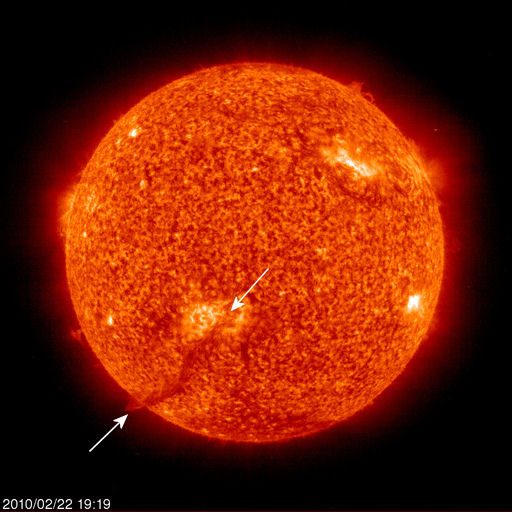


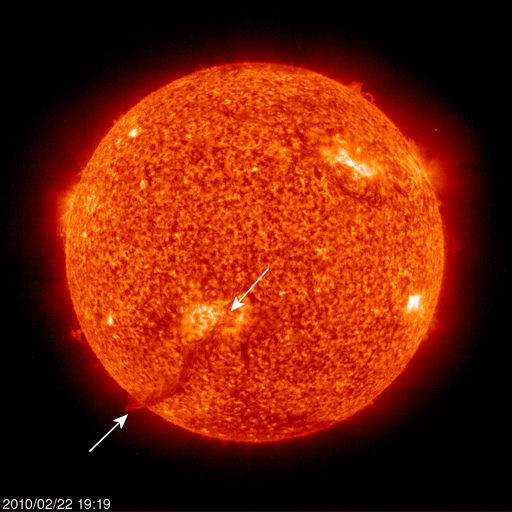
The most recent SOHO image is here
Hyder Flares: from Australian IPS 1. What is a Hyder flare?
Flares are intense brightenings that occur in the solar chromosphere. Flares are generally observed from Earth using narrow band filters, typically with a bandwidth of less than 0.1 nm, and often centred on the Hydrogen-Alpha wavelength of 656.3 nm. (Flares also have counterparts, that is, sudden outbursts, in the radio and X-ray spectrum).
Most flares occur around active regions associated with sunspot groups. However, occasionally a flare (sudden brightening) is observed well away from an active region or sunspot group. These flares are invariably associated with the sudden disappearance of a large (thick, long, ‘bushy’) dark solar filament, and are termed Hyder flares.
2. Why are Hyder flares so named?
Max Waldmeier wrote a paper in 1938 which described the phenomenon of suddenly disappearing filaments (disparition brusque), and mentioned that these can be associated with flare-like brightenings, but it was left to Charles Hyder to postulate the first comprehensive mechanism for the such flares.
Following on work from his doctoral thesis with the University of Colorado in Boulder (1964), Hyder published two papers in the second volume of the journal Solar Physics (1967) in which the mechanism by which Hyder flares might occur was discussed in detail. Hyder was then on the staff of the (US) Air Force Cambridge Research Laboratories at the Sacramento Peak Observatory in New Mexico.
It was these papers in Solar Physics by which Hyder’s name became associated with the flares in question, even though he was by no means the first to observe them.
3. What are the characteristics of Hyder flares?
As previously mentioned, the name Hyder flare is given to a flare that occurs away from an active region or sunspot group and that is associated with the sudden disappearance of a dark filament. The appearance of these flares can range from a string of bright knots on one or both sides of the filament (or rather, the position previously occupied by the filament, sometimes called the filament channel), to a single or double ribbon flare. The ribbons are parallel to the filament channel. If only one ribbon is present, it will lie to one side of the channel, whereas if two parallel ribbons occur, one ribbon will lie on one side of the filament channel, and the other ribbon will lie on the opposite side.
One interesting characteristic of Hyder flares is that they usually develop or rise to maximum brightness much more slowly than do the more common flares associated with active regions. The larger Hyder flares may take 30 to 60 minutes to rise to a peak intensity, and then they may last for several hours. Although they may attain a large area, they usually have a relatively low intensity. Thus, classifications for a large Hyder flare may read 2F, 2N or possibly even 3F. This contrasts to an active region flare in which 3F is very rare. An active region flare that attains sufficient area to put it into the importance class 3, will invariably have either a Normal or more usually a Brilliant brightness classification.
X-ray flares and radio (microwave) bursts associated with the optical Hyder flare, are also generally long lived phenomenon and are classified as the gradual rise and fall type of event (in contrast to the impulsive and complex events associated with large active region flares).
Generally Hyder flares are not associated with energetic particle emission or geomagnetic storms (implying that they may not be associated with a coronal mass ejection). However, this is not always the case, as a large halo CME observed by the LASCO solar coronagraph on board the SOHO spacecraft was most definitely associated with a Hyder flare (2N/M1) observed on 12 September 2000. This same complex also appeared to have produced energetic protons at geosynchronous orbit with energies in excess of 100 MeV, and in substantial numbers at energies of 10 MeV. It is believed that the sudden storm commencement observed at 0450UT 15 September, and the subsequent minor geomagnetic storm was produced by this particular CME.
4. What produces Hyder flares?
Hyder’s explanation of the flare type now named after him depended on the observational evidence that (1) often the flare was a parallel ribbon flare with one ribbon each side of the filament channel, and (2) that geomagnetic storms were not associated with these flares. This led to the speculation that the filamentary material was not ejected far into the corona, but in fact fell back to the chromosphere producing the flare.
Stable or quiescent filaments are believed to lie in and along a magnetic trough. It is thought that the sudden disappearance of such a filament is due to a reconfiguration of the field. In essence, the magnetic trough becomes a magnetic ridge (the bottom of the trough elevating in a period of tens of minutes to become the peak of the ridge). In this process, the filamentary material (cooler gas) is thought to be accelerated into the corona. Hyder’s explanation is that, in the case of the Hyder flare, some or even most of the filament material, instead of suffering acceleration and ejection, falls down the sides of the magnetic ridge and interacts with the lower chromospheric material producing the flare. If the infall process is symmetrical, then the double parallel ribbon flare will result, if asymmetrical, then only one ribbon results. If the infall is sporadic, or the material insufficient, then only bright knots of flare are produced. Hyder did calculations to show that the kinetic energy of the infalling material should be sufficient to provide the required flare energy release observed.
Of late, the Hyder mechanism has come into question. Some people (notably Zirin) have questioned whether infall occurs, stating that the magnetic reconfiguration must always produce ejection. The respective roles of flares and CME’s in solar active processes has also been hotly debated, and this has implications for the exact mechanism of Hyder flares. We certainly have enough observational evidence to show that Hyder flares can be associated with both CME’s and energetic particle production. For the moment, the question of Hyder flare production mechanism appears unresolved, and will probably be sidelined until the more significant (and undoubtedly related) issue of CME – flare production mechanism is sorted out.
The bottom line is that at this stage in solar physics we do not really know what produces a flare nor what produces a CME. There are competing theories, but all tend to have deficiencies with respect to matching the observational evidence. We certainly believe that they all depend on the reconfiguration of magnetic fields as their primary energy source, but in the final analysis, we really only believe this because we can conceive of no other solar energy source of sufficient magnitude.

James F. Evans (10:20:32) :
So, Dr. Svalgaard’s time has been divided and it’s unclear how much influence, prestige, high regard, or scientific value Dr. Svalgaard’s work has been given in the field of helio-astrophysics.
Check out the list of invited speakers at the upcoming SORCE meeting [and click on some of the links there to see what SORCE is about]:
http://lasp.colorado.edu/sorce/news/2010ScienceMeeting/agendas.html#speakers
When arguments fails, it is a time-honored tactics to go after the person. You are in in good company.
James F. Evans (10:20:32) :
So, Dr. Svalgaard’s time has been divided and it’s unclear how much influence, prestige, high regard, or scientific value Dr. Svalgaard’s work has been given in the field of helio-astrophysics.
As much as I hate appealing to authority [like to Alfven, Birkeland, Peralt, etc], a good measure of someone’s standing in a scientific community is the number of keynote and invited talks he/she is giving at scientific meetings and conferences. Here is a small selection of recent ones given by me:
http://lasp.colorado.edu/sorce/news/2003ScienceMeeting/dec03_meeting_final_science_program.html
http://www.cfa.harvard.edu/events/2009/soho23/program.html
http://www.lowell.edu/workshops/SolarAnalogsII/program.php
http://www.swpc.noaa.gov/SolarCycle/SC24/Oct_2006.html
http://geomag.usgs.gov/iagaxiii/presentations.php
Some will look upon such a list as simply a list of co-conspirators in the worldwide grand campaign and conspiracy aimed at hiding the real truth from the general public or, at least, from the true pseudo-scientists.
Dr. Svalgaard:
I’m happy to see you’re on a speakers list for a seminar, but I’m not sure that’s evidence you’re “one of the foremost solar scientists in the world.”
As far as the rest, I don’t consider it a personal attack to note there’s a lack of information to make an assessment about somebody’s professional qualifications (why don’t you just supply the readers that information instead of complaining about it).
And, Dr. Svalgaard, considering you were the first to offer up personal attacks on this thread by calling myself and others, “anti-science”, “dangerous”, and “nuts”, your complaint about personal attacks rings hollow.
What it sounds like to me is a ploy to generate sympathy and provide an excuse for why your’re failing to respond to the substantive arguments I made in my last comment.
In other words, it’s a diversion — but not effective.
What about those substantive arguments I raised about the physics? Care to respond to those arguments, Dr. Svalgaard?
Dr. Svalgaard, are you still calling Dr. Anthony L. Peratt of Los Alamos National Laboratory “anti-science”, “dangerous”, and “nuts”?
Leif Svalgaard (08:10:20) :
“Before we introduce [or believe in] mechanisms not yet discovered we should be relatively certain there is something to be explained, and as I just pointed out, any solar effects seem very elusive.”
I concur, but I am thinking here about the overall picture, i.e. understanding all of the potential drivers of Earth’s climate system;
http://www.physicalgeography.net/fundamentals/7y.html
http://oceanservice.noaa.gov/education/pd/climate/factsheets/whatfactors.pdf
and trying to think through the hypothesis of primarily natural climate change.
There seems to be reasonable evidence of a significant ocean component based on the cycles of the Pacific Decadal Oscillation and Atlantic Multidecadal Oscillation;
http://icecap.us/docs/change/ocean_cycle_forecasts.pdf
http://www.appinsys.com/GlobalWarming/PDO_AMO.htm
http://www.atmos.washington.edu/~mantua/REPORTS/PDO/PDO_egec.htm
http://www.atmos.washington.edu/~mantua/REPORTS/PDO/PDO_cs.htm
And there also seems to be reasonable evidence for a significant volcanic component based historical observation:
http://www.geology.sdsu.edu/how_volcanoes_work/climate_effects.html
http://www.longrangeweather.com/global_temperatures.htm
http://adsabs.harvard.edu/abs/1991vci..nasa…..R
That brings me back to solar activity. Looking further back, do you see any correlation between solar activity and the Sporer, Maunder, and Dalton minimums?
http://www-das.uwyo.edu/~geerts/cwx/notes/chap02/sunspots.html
http://www.eso.org/sci/libraries/lisa3/beckmanj.html
Looking forwards, if the sun’s magnetic fields continue to decrease;
http://science.nasa.gov/headlines/y2009/03sep_sunspots.htm
and then remain low for an extended period of time, might there be any significant impacts on Earth’s climate system?
Enough said. Pathetic.
James F. Evans (10:20:32) :
“To which Just The Facts (23:45:20) responded: “I think it’s probably because Leif is one of the foremost solar scientists in the world.”
“Just the Facts, how do you know that?”
“Just The Facts, I suggest you are making an assumption unwarranted by the available information.”
I have been around these parts for almost a year, I have read many articles and comments by Leif, seen his work, had many exchanges with him, seen him argue many capable people on a broad array of subjects, seen him win the vast majority of them and seen him admit when he’s made a mistake. I am also familiar with the work of various other solar scientists and capable of determining that Leif is one of the foremost solar scientists in the world.
Just The Facts (12:00:24) :
There seems to be reasonable evidence of a significant ocean component based on the cycles of the Pacific Decadal Oscillation and Atlantic Multidecadal Oscillation;
Concur
And there also seems to be reasonable evidence for a significant volcanic component based historical observation
concur here too.
That brings me back to solar activity. Looking further back, do you see any correlation between solar activity and the Sporer, Maunder, and Dalton minimums?
For these three, the Medieval Warm Period was during the Oort solar minimum, the Spoerer was very likely warm, the Maunder cold [but cold long after the Maunder too], and the Dalton was cold provably because of volcanism, so the solar imprint is not so clear as people suppose.
Looking forwards, if the sun’s magnetic fields continue to decrease and then remain low for an extended period of time, might there be any significant impacts on Earth’s climate system?
That remains to be seen, but if we accept the PDO is going into a negative phase, any cooling might be due to that, so, again, the Sun may not have anything to do with that.
My point is not that the Sun CANNOT have an effect. It is that a solar effect has not been clearly demonstrated.
James F. Evans (11:56:55) :
What about those substantive arguments I raised about the physics? Care to respond to those arguments, Dr. Svalgaard?
As Alexander Feht just said:
Alexander Feht (12:06:39) :
Enough said. Pathetic.
Alexander Feht (12:06:39) :
“Enough said. Pathetic.”
Hello Alexander
Can you please share your thoughts with us on how you think Earth’s climate system functions?
Dr. Svalgaard, I suggest we both stick with the scientific evidence and agree to disagree without personal rancor and note when the other party fails to answer an argument or when the argument is incomplete or does not account for a relevant piece of evidence or misapplies a physical relationship.
The parameters of the Empirical Scientific Method allows for vigorous debate.
Just The Facts (12:39:23) :
James F. Evans (10:20:32) :
“To which Just The Facts (23:45:20) responded: “I think it’s probably because Leif is one of the foremost solar scientists in the world.”
“Just the Facts, how do you know that?”
“Just The Facts, I suggest you are making an assumption unwarranted by the available information.”
I have been around these parts for almost a year, I have read many articles and comments by Leif, seen his work, had many exchanges with him, seen him argue many capable people on a broad array of subjects, seen him win the vast majority of them and seen him admit when he’s made a mistake. I am also familiar with the work of various other solar scientists and capable of determining that Leif is one of the foremost solar scientists in the world.
~
You might want to add longevity, new data continually, firgen walking data center. lol
Maybe the EU should not brow beat so much. And that letting the gravity baby out with the bath water thing. (did I say that?)
Suranda no immediate response to seismic here recently. (unless some major intersomething gravity wave, but no evidence there bud huh?)
James F. Evans (11:56:55) :
What about those substantive arguments I raised about the physics?
I have many times offered to take you through the correct physics, step by painful step. This offer still stands [because it might also be interesting to a wider audience], so if you really want to join me in that I would welcome your interest and dedication. I suggest the following format: each step [and we alternate until done] is a text of no more than 100 words with no links except at most one to an image or formula and no parroting, but original words showing understanding and substance. Agreed?
James F. Evans (10:20:32) :
..What little I have found on the internet suggests that he taught at Stanford University over 30 years ago, but primarily has been a computer programmer (a very good computer programmer) that has worked for various companies..
Reminds me of Tommy, The Who and the “Pinball Wizard.” Very excellent rock opera.
What would a modern day Tommy with computer and software ability be like. lol
No no not Leif. lol
Dr Svalgaard
I only just today had the time to read this article and the many comments following. It is a great privilege to benefit from your stellar (pun not intended) knowledge!
Thank you.
I expect that Leif might agree with Prof. Lockwood:
Prof Lockwood was one of the first researchers to show that the Sun’s activity has been gradually decreasing since 1985, yet overall global temperatures have continued to rise.
“If you look carefully at the observations, it’s pretty clear that the underlying level of the Sun peaked at about 1985 and what we are seeing is a continuation of a downward trend (in solar activity) that’s been going on for a couple of decades.
“If the Sun’s dimming were to have a cooling effect, we’d have seen it by now.“
– ‘Quiet Sun’ baffling astronomers, BBC, April 2009
Yes – we’d have seen it by now.
If only we’d open our eyes!
– – – – – – – – – – – – – –
A First! Snow falls in Baghdad
Associated Press, Jan 2008
Recent cold snap helping Arctic sea ice, scientists find
CBC News, Feb, 2008
Arctic blast brings London earliest snow for 70 years
It is a sight not seen in the capital since 1934.
Evening Standard, October 2008
Climate scientists say 2008 will be coolest year of the decade
Guardian, Dec 2008
Flights axed as Las Vegas hit by rare snowstorm
USA TODAY, Dec 2008
The Alps have best snow conditions “in a generation”
Telegraph UK, Dec 2008
Snowstorms cause chaos across Europe’s ski resorts
Telegraph UK, Dec 2008
The Day The Sea Froze: Temperatures plunge to minus 12C and
forecasters say it won’t warm up until Sunday
Daily Mail, UK, Jan 2009
Spokane, Washington., residents cope with record snow
Associated Press, Jan 2009
It’s June…so it must be snowing:
Great British summer goes from sweltering to shivering in just a week
Daily Mail, UK, June 2009
Chicago has its coolest July 8 in 118 years
Chicago Tribune, July 2009
Children die in harsh Peru winter
Almost 250 children under the age of five have died in a wave of intensely cold weather in Peru.
BBC, July 2009
Storm brought record snowfall to Fort Collins in October
Coloradoan, October 2009
Coldest October since 1945 in NZ
ONE News, November 2009
Cheyenne records snowiest October on record
National Weather Service, November 2009
Beijing’s Heaviest Snow in 54 Years Strands Thousands
Bloomberg, November 2009
Big chill brings misery to Europe
December 23, 2009
Freezing weather which has killed more than 90 people is continuing to cause transport problems across Europe.
“Snowmaggedon”
Barack Obama, Feb 2010
If the sun’s dimming were to have a cooling effect, we’d have seen it by now!
Leif Svalgaard
“Before we introduce [or believe in] mechanisms not yet discovered we should be relatively certain there is something to be explained”
“My point is not that the Sun CANNOT have an effect. It is that a solar effect has not been clearly demonstrated.”
These are both very good points and highlight the possibility that solar variability may not be a significant driver of recent and forthcoming changes in earth’s climate system. It’s possible that ocean cycles, volcanic activity, land use changes and natural variability are primarily responsible for the climactic changes “measured” over the last several centuries. The challenge in testing this and other hypotheses is that the station and proxy temperature records are compromised. As such, in order to test various alternate climate change models “we” need to build a reasonably accurate temperature record. I wonder if “we” will be able to develop a reasonably accurate temperature record using the historical station data and/or proxies, or if they are both so inaccurate that “we” are stuck waiting for the satellite record to grow…
Just The Facts (16:23:02) :
Leif Svalgaard
“Before we introduce [or believe in] mechanisms not yet discovered we should be relatively certain there is something to be explained”
“My point is not that the Sun CANNOT have an effect. It is that a solar effect has not been clearly demonstrated.”
These are both very good points and highlight the possibility that solar variability may not be a significant driver of recent and forthcoming changes in earth’s climate system. It’s possible that ocean cycles, volcanic activity, land use changes and natural variability are primarily responsible for the climactic changes “measured” over the last several centuries.
~
You forgot to mention water and oil consumption and ramifications. That’s ok.
Solar variability, what causes solar variablility.
Lag times of climate change within a larger system than I think you are looking at.
Alexander Feht (09:30:50) : “One of the foremost solar scientists in the world says that there is no significant correlation between solar activity and Earth’s temperature.”
I believe the statement would be more accurate like this: “One of the foremost solar scientists in the world says that there is no significant correlation between CHANGES in solar activity and CHANGES in Earth’s temperature.”
That is what I get from Dr Svalgaard’s statements. But then, I am just a resident of the peanut gallery.
Leif
I am also interested in your thoughts on Archibald’s new article:
http://wattsupwiththat.com/2010/02/27/archibald-on-stellar-to-climate-linkage/
Khwarizmi (16:17:14) :
Prof Lockwood was one of the first researchers to show that the Sun’s activity has been gradually decreasing since 1985, yet overall global temperatures have continued to rise.
But since we don’t know how much of that temperature rise is real we really can’t conclude anything.
James F. Evans (13:54:21) :
note when the other party fails to answer an argument or when the argument is incomplete
Not quite good enough, as strawmen are frequently trotted out that just detracts from the issue, especially when the argument is weak.
I made you an offer. Do you take it?
Just The Facts (17:11:49) :
I am also interested in your thoughts on Archibald’s new article
check over there.
“Tom in freakin’s cold again Florida (16:42:29) :”
“Alexander Feht (09:30:50) : “One of the foremost solar scientists in the world says that there is no significant correlation between solar activity and Earth’s temperature.””
“I believe the statement would be more accurate like this: “One of the foremost solar scientists in the world says that there is no significant correlation between CHANGES in solar activity and CHANGES in Earth’s temperature.””
No, it’s like I said originally. Read this article, particularly the Hathaway interview portion;
http://www.earthfiles.com/news.php?ID=1635&category=Science
and note the context when Nasa’s top solar scientist says that,
“But there also were people back at that time saying otherwise. A group of colleagues led by Leif Svalgaard, Ph.D., were looking at the sun’s polar fields and saying even at that point, the sun’s polar fields were significantly weaker than they had been before and those scientists back then predicted it was going to be a small cycle.”
and take special note of how
James F. Evans (13:54:21) :
The parameters of the Empirical Scientific Method …
BTW, there is no such thing as the Empirical Scientific Method. There is only one Scientific Method. I can recommend a very good book suitable for your level: Three Steps to the Universe, by D. Garfinkle & R. Garfinkle [brothers]. They very nicely point out that there are three different universes: the Perceived Universe, the Detected Universe, and the Theoretical Universe. It is in th interaction of these three universes that scientific understanding is created. The perceived universe is what we experience every day by sound, touch, smell, taste, see. The things that we cannot detect directly, but can observe with various devices we have constructed [radio, microscope, amp-meter] make up the detected universe. If we want to understand what hoes on, we need explanations. The explanations are composed in part of the things we perceive or detect, but only in part. the rest is a set of mental constructs, known as ‘theories’. This world of purely mental creation or abstraction [almost always expressed in mathematical terms] is the missing piece. Theories serve two functions: 1st, as overarching explanations for how things work and why things happen, and 2nd as initial points of departure for exploration and creation of new ideas and knowledge. A typical example is Maxwell’s equations. The scientific process is thus circular: through theory, detection, perception, detection, and theory. The understanding lies in the theoretical part. Without that, science is just butterfly collection.
Anyway, the book is highly recommended: ISBN 0-226-28346-1, published 2008.
Dr. Svalgaard:
I’m not inclined to accept your invitation to be indoctrinated.
(After all your personal attacks have failed you attempt to negotiate — you are a piece of work.)
As I’ve already discussed twice so far on this thread:
First discussion:
“A model of magnetized plasma can be based either on a magnetic field description or on an electric field description.” — Carlqvist & Alfven
[As expressed by Maxwell’s equations where electric fields and magnetic fields have a reciprical physical relationship. Dr. Svalgaard chooses to only use the magnetic field description and exclude the electric field description. Hannes Alfven acknowledges that both descriptions are valid.] — Jim Evans
“The study of these alternative approaches (Alfven, 1968, 1979a) shows that the current description is necessary for the understanding of the formation of double layers, explosive phenomenon, and transfer of energy from one region to another.” — Carlqvist & Alfven
[Dr. Svalgaard rejects using the electric current model for understanding energy transfer from one region to another] — Jim Evans
[Double layers in plasma as Hannes Alfven stated are necessary to understand many plasma phenomenon:] — Jim Evans
http://en.wikipedia.org/wiki/Double_layer_(plasma)
Second discussion:
“I recognize the necessity of magnetic fields and their indespensible role. How may times have I cited Maxwell’s equations which speak to this requirement.” — Jim Evans
Of course, Dr. Svalgaard ignores the reality and attempts to construct a strawman argument instead of engaging in good faith discussion.
“The difference between me and Dr. Svalgaard is that he holds up the magnetic field analysis as the only scientifically valid analytical tool, purposely excluding an electric field analysis, while I stand with Hannes Alfven and note that both electric field and magnetic field analysis is valid, and, also, I stand with Alfven to state the electric current analysis is necessary to properly understand formation of double layers, explosive phenomenon, and transfer of energy from one region to another.” — Jim Evans
The scientific evidence supports Alfven, Carlqvist, Fälthammar, Peratt, and One & Mann authors of this most recent 2009 paper and the many others that support the electromagnetic approach.
Dr. Svalgaard: When you stick with your specialty, historical analysis of sunspot activity, I have no problem even if I don’t agree with your analysis — that’s science, after all — but when you engage in over the top personal attacks and then make cynical offers to indoctrinate, after the personal attacks backfired — it’s offensive.
Just The Facts (18:05:33) :
I understand the point you are trying to make, but earthifles? I did a little tour and got some knee jerks goin on.
Someone just recently sent me this energy release of the chilean quake.
http://wcatwc.arh.noaa.gov/chile/chileem.jpg
Just The Facts (18:05:33) :
Read this article, particularly the Hathaway interview portion
BTW, I gave an invited talk at that meeting in Maine that Hathaway was referring to: http://www.leif.org/research/SOHO23.pdf
It was about how well we actually know the sunspot number in the past [there has also been adjustments to that!].
Just two days before I gave an invited talk at a workshop at Lowell Observatory in Arizona [ http://www.leif.org/research/Predicting%20the%20Solar%20Cycle.pdf ]. The organizers of SOHO-23 were nice enough to change the schedule to accommodate my travel time; it is not easy to travel from Flagstaff Arizona to Bar Harbor Maine, it takes a whole day [I wonder what people 200 years ago would have thought of that lament]