The sun has seen a resurgence of activity in December, with a number of cycle 24 sunspots being seen. The latest is group 1039 seen below:

2009 is ending with a flurry of sunspots. Indeed, if sunspot 1039 holds together just one more day (prediction: it will), the month of December will accumulate a total of 22 spotted days and the final tally for the year will look like this: From Spaceweather.com
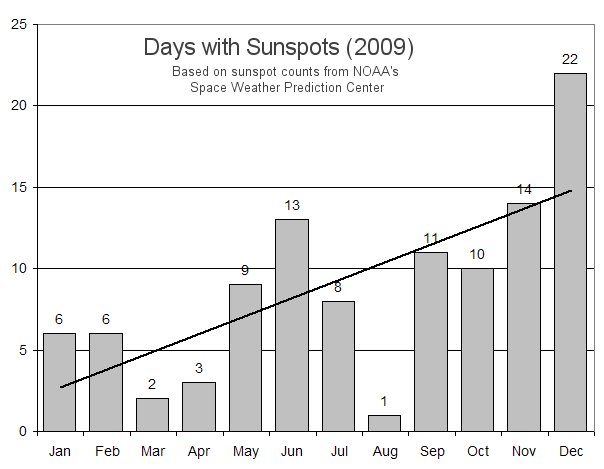
The dark line is a linear least-squares fit to the data. If the trend continues exactly as shown (prediction: it won’t), sunspots will become a non-stop daily occurance no later than February 2011. Blank suns would cease and solar minimum would be over.
If the past two years have taught us anything, however, it is that the sun can be tricky and unpredictable.
Leif Svalgaard (09:53:50) :
Gauss used simple high-school algebra and trigonometry, and no philosophical nonsense.
No Newtonian nonsense either. 😉
Leif Svalgaard (09:56:54) :
tallbloke (09:38:22) :
>i>”Newtonian physics describe planetary orbits to a much, much higher precision than 0.3%.”
Thank you, I know that.
You give a convincing imitation of someone who does not 🙂
Nice smiley Leif.
My good lady is taking me gently by the ear to remove me from your very-eccentric nonsense.
TTFN HNY
sunspots are not the cause of the solar cycle but rather one measure of its strength
The Sun-Earth interaction is complex, and we haven’t yet discovered all the consequences for the Earth’s environment of the unusual solar winds this cycle,” Kozyra says. “The intensity of magnetic activity at Earth in this extremely quiet solar minimum surprised us all. The new observations from last year are changing our understanding of how solar quiet intervals affect the Earth and how and why this might change from cycle to cycle.
http://www.ucar.edu/news/releases/2009/solarminimum.jsp
Using the cause and effect argument, have you tried to compare your solar fluctuations with long-term indicators of fluctuations like lake levels, flood frequencies, changes in glacier size, etc.? Closed basin lakes would be best (depend on long term changes in precipitation/evaporation) such as Great Salt Lake or Lake Baikal. (Aral Sea is a different reason). Lakes with smaller outlets like Lake Superior and Lake Victoria, especially since they have a 100 years of lake level records compared to piecemeal glacial size measurements for a 100 to 300 years.
While waiting for Leif, please allow me to correct a typographical error in
Quote: Oliver K. Manuel (08:37:40) :
“Is there reason to doubt that elements like Hydrogen (1-2 amu) and Uranium (235-238 amu) are immune to solar mass fractionation?”
Should be “Is there reason to believe that elements like Hydrogen (1-2 amu) and Uranium (235-238 amu) are immune to solar mass fractionation?”
Happy New Year!
Oliver K. Manuel
Quote: Sask Resident (15:01:36) :
“Using the cause and effect argument, have you tried to compare your solar fluctuations with long-term indicators of fluctuations like lake levels, flood frequencies, changes in glacier size, etc.? . . . ”
See: W. J. R Alexander, F. Bailey, D. B. Bredenkamp, A. vander Merwe, and N. Willemse, “Linkages between solar activity, climate predictability and water resource
development,” J. South African Institut. Civil Engineering 49 (2007) 32-44.
Oliver K. Manuel (20:06:27) :
Hi Oliver, and Happy New year to you.
Do we know the mass of the gas giant planets well enough to be able to calculate the total mass of the sun from the size of the wobble it counteracts their mass with as they orbit? I know this technique is used by astronomers to estimate the size and orbital periodicity of extrasolar planets orbiting other stars.
Would that provide independent confirmation or disproof of your theories of a superdense solar core?
Thanks
Robuk (13:10:20) :
Kozyra says. “The intensity of magnetic activity at Earth in this extremely quiet solar minimum surprised us all. The new observations from last year are changing our understanding of how solar quiet intervals affect the Earth and how and why this might change from cycle to cycle.
She says this because she does not know history. Such high-speed streams at minimum happen regularly. This minimum is not special in that regard. Our understanding is not changing, although she personally may have to learn something.
Oliver K. Manuel (20:06:27) :
While waiting for Leif
I’m overwhelmed by the clarity of the arguments by one of the greatest scientists of our time fighting consensus and sense, so I give up.
Quote: tallbloke (06:46:21) :
“Hi Oliver, and Happy New year to you.
Do we know the mass of the gas giant planets well enough to be able to calculate the total mass of the sun from the size of the wobble it counteracts their mass with as they orbit? . . . Would that provide independent confirmation or disproof of your theories of a superdense solar core?
Thanks”
No, the total mass of the Sun is not the issue. The distribution of mass inside the Sun is.
Those who understand (neutron-repulsion, neutron-emission and neutron-decay to produce the Hydrogen that the Sun continuously discards) know that the minimum mass of a neutron star is 1 amu, not 1.3 solar mass!
There is other strong circumstantial evidence for a dense solar core among the many “mysteries” for the Standard Solar Model of a Hydrogen-filled Sun:
Solar cycles of deep-seated magnetic fields protrude through the solar surface in a pattern that follows shifts in solar angular momentum.
That observation provides circumstantial evidence for a compact, energetic and highly magnetic solar core!
Do you or others have any questions about my comment to Leif: “The visible universe is filled with Hydrogen, but compact, energetic cores of stars and galaxies are mostly Neutrons because
V( H) ≈ 1,000,000,000,000,000 x V(N)”?
Apparently unaware of huge volume differences between H and N, scientists mistakenly assumed that H must be the most abundant species in the cosmos because it occupies the most space!
Again, thanks for the question, tallbloke.
Best wishes you and yours for 2010!
Oliver K. Manuel
Leif Svalgaard (13:30:45) :
“Oliver K. Manuel (20:06:27) :
While waiting for Leif
I’m overwhelmed by the clarity of the arguments by one of the greatest scientists of our time fighting consensus and sense, so I give up.”
Really, really, really bad manners, Leif.
Qupte: Leif Svalgaard (13:30:45) :
“I’m overwhelmed by the clarity of the arguments by one of the greatest scientists of our time fighting consensus and sense, so I give up.”
I am certainly not a great scientist but I was trained by one of the very best:
In 1960 I was an unusually naive 23 year-old graduate student at the University of Arkansas when I became part of a research project to decipher the origin of the solar system, directed by a very sophisticated and talented nuclear geochemist that the US military had relocated from the University of Tokyo after WWII – Professor Paul Kazuo Kuroda.
Although Kuroda’s skills as a nuclear geochemist had been used by the Japanese government during Second World War, Kuroda himself was very humanistic and idealistic – teaching by example to always follow the basic principles of science.
His autobiography describes Kuroda’s work at the University of Tokyo:
http://www.omatumr.com/abstracts2005/PKKAutobiography.pdf
This obituary is a short summary of his life:
http://www.omatumr.com/abstracts2005/KurodaWriteupMeteoritic.pdf
Oliver K. Manuel (13:36:54) :
There is other strong circumstantial evidence for a dense solar core among the many “mysteries” for the Standard Solar Model of a Hydrogen-filled Sun:
Solar cycles of deep-seated magnetic fields protrude through the solar surface in a pattern that follows shifts in solar angular momentum.
We’re not encouraged to discuss that here, but if you’d like to put up a guest post on my blog about this aspect of your theory please visit my site and submit a post.
http://tallbloke.wordpress.com
I don’t know enough about nuclear physics to comment on the rest unfortunately.
Cheers
Glenn (14:06:39) :
“Really, really, really bad manners, Leif.”
This has been noted before and is unfortunate. Resorting to Ad Hominem seems to be acceptable policy when confronted with an opposing view.
Quote: Leif Svalgaard (13:30:45) :
“I’m overwhelmed by the clarity of the arguments by one of the greatest scientists of our time fighting consensus and sense, so I give up.”
Again, I am not a great scientist but I also had the good fortune to do postdoctoral research under the late Professor John H. Reynolds in the Physics Department at UC-Berkeley and to do part of my graduate research work there.
John was a member of the Geophysics Division of the National Academy of Sciences:
http://www.nap.edu/openbook.php?record_id=11172&page=248
Clive E Burkland (17:14:32) :
Glenn (14:06:39) :
“Really, really, really bad manners, Leif.”
This has been noted before and is unfortunate. Resorting to Ad Hominem seems to be acceptable policy when confronted with an opposing view.
No need to be so hard on Glenn.
No need to be hard on anyone.
It’s New Year, turn over a new Leaf. 😉
It’s a shame that solar related threads almost always end up in acrimony.
Ad hominem arguments (against the person) are usually one of the last resorts of someone trying to defend an untenable belief, and have no place in a scientific debate.
These sort of tactics are being used by the IPCC Climategate cabal and add no value to our understanding. This is a sure sign that the CAGW hypothesis has hit the rocks and it is time for new ideas to be considered even if they rock the boat of main-stream scientific thinking.
Any theory which fails to accurately predict future events or requires liberal doses of ‘pixie-dust’ to account for new observations is in need of a re-think, no matter how useful that theory has been to the progress of science in the past.
Tenuc (04:30:31) :
Any theory which fails to accurately predict future events or requires liberal doses of ‘pixie-dust’ to account for new observations is in need of a re-think, no matter how useful that theory has been to the progress of science in the past.
~
Yes, I think so toooooo.
WAPL 105.7 All request New Year weekend.
Quote: “Although Kuroda’s skills as a nuclear geochemist had been used by the Japanese government during Second World War . . .”
I have more respect for scientists who use their skill for the government that pays their salary than I do for NAS members who ignored experimental data for the past 35 years and pretended that the Sun is a ball of Hydrogen and that injections from a nearby supernova explain short-lived radionuclides and linked chemical and isotopic variations in the material that formed the solar system.
With kind regards,
Oliver K. Manuel
Tenuc (04:30:31) :
“Any theory which fails to accurately predict future events or….”
It is can not be called theory, and it could not have been theory anyway, it was just a hypothesis that has failed…
Happy 20-10 to all.
OT, but there is an interesting detail in the LASCO 3 image on the SOHO web site. Look at the image at this link.
http://sohowww.nascom.nasa.gov/data/realtime/c3/512/
Is that a comet in the middle of the lower left quadrant of the image?
JT
1994,
John Butler and his colleagues at Armagh Observatory report that data gathered there as far back as 1795 show that the average air temperature varies with the length of the sunspot cycle. The Armagh astronomers found that the highest temperatures correspond to years in which the cycle has a shorter-than-normal duration.
Our data support the contention that solar variability has been the principle cause of temperature changes over the past 2 centuries,” says Butler.
Throughout the 20th century the Sun was unusually active, peaking in the 1950s and the late 1980s. Dean Pensell of NASA, says that, “since the Space Age began in the 1950s, solar activity has been generally high. Five of the ten most intense solar cycles on record have occurred in the last 50 years.” The Sun became increasingly active at the same time that the Earth warmed. But according to the scientific consensus, the Sun has had only a minor recent effect on climate change.
What this means is that the climate scientists are fully aware of the almost perfect correlation with sunspot numbers and the earths temperature but have NO idea how this link works. The link is obvious and undisputable and unlike co2 and temperture it can only be one way round.
JT (14:31:02) :
Is that a comet in the middle of the lower left quadrant of the image?
Very likely, as SOHO has ‘discovered’ nearly two thousand of them:
http://sohowww.nascom.nasa.gov/hotshots/2008_06_23/
Robuk (14:40:59) :
John Butler and his colleagues at Armagh Observatory report that data gathered there as far back as 1795 show that the average air temperature varies with the length of the sunspot cycle.
People keep saying this, but there is little support for this. If you simply take the trouble to look for yourself [e.g. here: http://www.leif.org/research/Cycle%20Length%20Temperature%20Correlation.pdf ] you see either no correlation or a very weak opposite correlation].
Throughout the 20th century the Sun was unusually active, peaking in the 1950s and the late 1980s. Dean Pensell of NASA, says that, “since the Space Age began in the 1950s, solar activity has been generally high. Five of the ten most intense solar cycles on record have occurred in the last 50 years.”
And if you took the trouble to check on Pesnell [takes five minutes] you’ll find that the statement is false.