The sun has seen a resurgence of activity in December, with a number of cycle 24 sunspots being seen. The latest is group 1039 seen below:

2009 is ending with a flurry of sunspots. Indeed, if sunspot 1039 holds together just one more day (prediction: it will), the month of December will accumulate a total of 22 spotted days and the final tally for the year will look like this: From Spaceweather.com
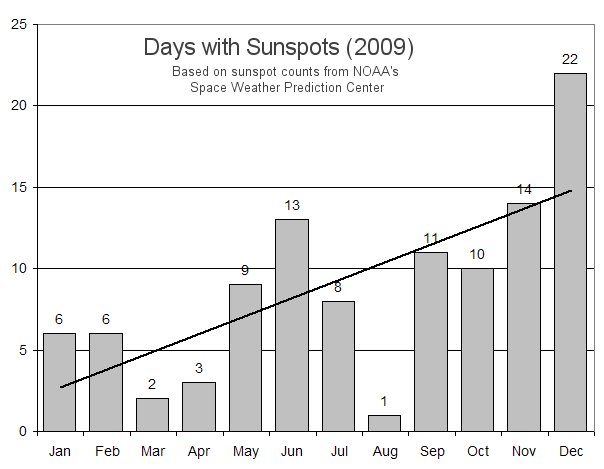
The dark line is a linear least-squares fit to the data. If the trend continues exactly as shown (prediction: it won’t), sunspots will become a non-stop daily occurance no later than February 2011. Blank suns would cease and solar minimum would be over.
If the past two years have taught us anything, however, it is that the sun can be tricky and unpredictable.
Quote: Leif Svalgaard (19:24:31) :
“Perhaps you could understand it and try to explain it to me and the folks?”
I understand. My conclusions will naturally seem alien and outlandish to those who have not followed my 50-year path of continuous changes in direction (zig-zags) with each surprising discovery since 1960:
a.) Iron meteorites are as old as “primitive” meteorites.
b.) Decay products of I-129 and Pu-244 are still not homogenized inside the Earth – after 4-5 billion years of geochemical processing.
c.) Meteorites formed before the products of r-, p- and s-nucleosynthesis reactions (B2FH, 1957) mixed.
d.) Lightweight isotopes of elements are enriched in the solar wind.
e.) Some mysterious mass fractionation process produced values of
(Ne-20/Ne-22) = 1, 2, 3, 4, . . . , 11, 12, 13, 14 in meteorites
f.) Diamonds (carbon) in carbonaceous meteorites contain “strange” xenon, enriched in r- and p-products of nucleosynthesis, and all of the He and Ne.
g.) Other parts of carbonaceous meteorites contain “normal” xenon, but no He or Ne.
h.) Heavy elements and heavy isotopes of elements are enriched in solar flares.
i.) The Sun consists mostly of iron (Fe), but solar luminosity was a mystery until neutron repulsion was discovered because Fe is the stable end product of nuclear reactions.
Since you are a solar scientist, please review the experimental data and conclusions in the paper, “Composition of the solar interior: Information from isotope ratios,”
http://arxiv.org/pdf/astro-ph/0410717v1
Presented at the 2002 SOHO/GONG Conference on Helio-seismology and published by the European Space Agency (ESA SP-517, editor: Huguette Lacoste, 2003) pp. 345-348, ISBN: 92-9092-827-1
I will be happy to respond to questions.
With kind regards,
Oliver K. Manuel
Oliver K. Manuel (20:35:34) :
i.) The Sun consists mostly of iron (Fe), but solar luminosity was a mystery until neutron repulsion was discovered because Fe is the stable end product of nuclear reactions.
I will be happy to respond to questions.
So far you have not responded satisfactorily to a single question.
All of your points have nothing to do with the Hydrogen content of the Universe and the Sun. and solar luminosity is not a mystery [after about 1938] and is fully understood and confirmed by neutrino measurements. [I do not need a diatribe on neutrinos now]. The main issue is that you NOWHERE show that the Sun is not 91% Hydrogen. You CLAIM it all over the place. but that does not work for me.
If you ever saw the movie “Jesus Christ, Superstar”, you will understand why I say with Herod: “Prove to me that you’re no fool: walk across my swimming pool”.
I.e. explain, so I and Herod can understand it why the Sun is not mostly Hydrogen as all other main sequence stars.
Quote: Leif Svalgaard (19:49:25) :
“Speaking of attacks, I would take the above [since much of my work has been funded by NASA, etc, and I’m on a NASA panel] as a serious attack on me.”
Thanks, Leif, for the information.
Please convey to NASA officials the seriousness of the present situation.
If you have access to the Obama’s Science Advisor or the Secretary of DOE, you might also advise them to stop ignoring published (peer-reviewed) reports that neutron repulsion:
a.) Is a greater source of nuclear energy than fission or fusion, and
b.) Powers the Sun and produces solar luminosity, solar neutrinos, and solar wind hydrogen in the proportions observed.
These public officials have the funds and a responsibility to either confirm or deny the above findings.
With kind regards,
Oliver K. Manuel
Oliver K. Manuel (21:05:02) :
These public officials have the funds and a responsibility to either confirm or deny the above findings.
The acceptance of these claims are not up to these officials, but to thousands of hard-working scientists [the majority not even American] who have long ago rendered their verdict on this.
“Speaking of attacks, I would take the above [since much of my work has been funded by NASA, etc, and I’m on a NASA panel] as a serious attack on me.”
Thanks, Leif, for the information.
And is this flippant remark how you shrug off the serious attack on me?
Now, “walk across my swimming pool”.
Leif,
1. You see only the surface of stars, yet
2. Proudly display the certainty of one who is convinced that the interior of apples must be red because the surfaces are red!
3. You know the Sun throws away 50,000 billion metric ton of Hydrogen each year, yet
4. Pretend that this “smoke” from the solar furnace is its “fuel.”
5. You address none of the experimental data, yet
6. Claim “they nothing to do with the Hydrogen content of the Universe and the Sun.”
7. You confuse Hydrogen volume in the Universe with Hydrogen abundance, ignoring
8. My earlier note: The visible universe is filled with Hydrogen (H) , but compact, energetic cores of stars and galaxies are mostly Neutrons (N) because
V( H) ≈ 1,000,000,000,000,000 x V(N) = 10^15 x V(N)
Unless you are simply trying to obfuscate Watts Up With That, Leif, please address the experimental data in the paper, “Composition of the solar interior: Information from isotope ratios,”
http://arxiv.org/pdf/astro-ph/0410717v1
With kind regards,
Oliver K. Manuel
Quote: Leif Svalgaard (21:53:31) :
quotes: Oliver K. Manuel (21:05:02) : ‘These public officials have the funds and a responsibility to either confirm or deny the above findings.’
“The acceptance of these claims are not up to these officials, but to thousands of hard-working scientists [the majority not even American] who have long ago rendered their verdict on this.”
“Speaking of attacks, I would take the above [since much of my work has been funded by NASA, etc, and I’m on a NASA panel] as a serious attack on me.”
‘Thanks, Leif, for the information.’
“And is this flippant remark how you shrug off the serious attack on me?”
Now, “walk across my swimming pool”.
Again, Leif, thanks. Your comments are indeed revealing.
Normally, I would quickly sink but thanks to “global warming”, I may be able to walk across a swimming pool. It is now 12 F or -11C here.
With kind regards,
Oliver K. Manuel
Oliver K. Manuel (21:57:16) :
Again, Leif, thanks. Your comments are indeed revealing.
And, again, I yield to the superior logic of the greatest scientist of all times, being completely stumped by the impenetrable arguments that seem to have fooled even their author.
Oliver K. Manuel (21:57:16) :
please address the experimental data in the paper, “Composition of the solar interior: Information from isotope ratios,”
I can accept all the experimental data as presented. I have no problem with any of them. Only with the extrapolation you make into non-measured areas. So, now it is your turn. “Walk across my swimming pool”.
Oliver K. Manuel (21:57:16) :
8. My earlier note: The visible universe is filled with Hydrogen (H) ,
So a star that is forming now out of the interstellar medium would consist of hydrogen, right?
Leif Svalgaard (19:24:31) :
Leif Svalgaard (18:35:01) :
tallbloke (17:39:54) :
How about addressing the peer reviewed science linked by Oliver?
“I cannot address the links as they make no sense.”
for example, the first link was purporting to prove that H is not abundant in the Sun. The only place I see any hint of discussion of this is this passage “Fractionation that enriches lighter nuclei at the solar surface can accommodate these conclusions and the occurrence of high abundances of H, He …”
This is no demonstration at all. If the Sun was 91% H to begin with [as all other stars are, being formed from interstellar gas of that composition], you could still have fractionation of all the rest without impacting the 91%.
OK, how about addressing this statement. What other interpretations are possible?
http://www.lpi.usra.edu/meetings/metsoc98/pdf/5011.pdf
High energy events, such as flares, disrupt intrasolar
diffusion [6]. Hence, solar energetic particles
are less enriched in light isotopes than are elements
in the quiet solar wind [6]. Since the average weight
of particles in the sun is closer to 56 than to 1 amu,
the average temperature must be higher to explain
the Sun’s overall density. Thus, fusion reactions may
not be limited to the Sun’s inner core. The inverse
correlation between the solar neutrino flux and sun
spot number [7] suggests that solar flares also disrupt
nuclear fusion reactions outside the Sun’s core.
tallbloke (00:11:46) :
OK, how about addressing this statement. What other interpretations are possible?
“Since the average weight of particles in the sun is closer to 56 than to 1 amu, […] Thus, fusion reactions may not be limited to the Sun’s inner core.”
It has the unsubstantiated claim that the average ‘molecular weight’ is 56 amu rather than 1 amu [measurements of the sound speed in the interior suggests otherwise]. And so what if fusion might occur in small amounts elsewhere [e.g. in strong solar flares]? How does that show that there is no Hydrogen in the interior? this is the typical mixture of fact and fiction that characterizes pseudo-science. But, perhaps the greatest scientist of all times has a good explanation. I just haven’t seen it, or saw it and didn’t know what it was.
Leif Svalgaard (00:36:01) : Your comment is awaiting moderation
tallbloke (00:11:46) :
OK, how about addressing this statement. What other interpretations are possible?
“Since the average weight of particles in the sun is closer to 56 than to 1 amu, […] Thus, fusion reactions may not be limited to the Sun’s inner core.”
It has the unsubstantiated claim that the average ‘molecular weight’ is 56 amu rather than 1 amu [measurements of the sound speed in the interior suggests otherwise]. And so what if fusion might occur in small amounts elsewhere [e.g. in strong solar flares]? How does that show that there is no Hydrogen in the interior? this is the typical mixture of fact and fiction that characterizes pseudo-science. But, perhaps the greatest scientist of all times has a good explanation. I just haven’t seen it, or saw it and didn’t know what it was.
If you have managed to make sense of it, then I would like to be educated.
@Leif Svalgaard (00:37:00):
“If you have managed to make sense of it, then I would like to be educated.”
Hey Leif, when it comes to facts, you’re like a rock. Only a hammer and chisel can break your conviction. Go figure, your name is Leif but the character of a rock.
I LIKE IT !
Leif Svalgaard (00:37:00) :
If you have managed to make sense of it, then I would like to be educated.
The paper presented at the SOHO/GONG conference in 2002 by Oliver seems to be a good place to start. What are your main objections to what he and other scientists have found and described here?
http://arxiv.org/ftp/astro-ph/papers/0410/0410717.pdf
Quote: Leif Svalgaard (22:50:30) :
“And, again, I yield to the superior logic of the greatest scientist of all times, . . .”
I am neither:
(a.) a fool, nor
(b.) unusually talented.
Such simplistic binary thinking is not productive. As I pointed out earlier [Oliver K. Manuel (20:35:34)]
“My conclusions will naturally seem alien and outlandish to those who have not followed my 50-year path of continuous changes in direction (zig-zags) with each surprising discovery since 1960”
I will try to explain this journey in an autobiography, in progress:
“MY JOURNEY TO THE CORE OF THE SUN: A Summary of 50 Joyful Years of Continuous Discovery”
I do not envy those who sat on the sidelines.
Again, Leif, please review the experimental data and conclusions in the paper, “Composition of the solar interior: Information from isotope ratios,”
http://arxiv.org/pdf/astro-ph/0410717v1
That was was reviewed by other solar scientists after presentation at the 2002 SOHO/GONG Conference on Helio-seismology and published by the European Space Agency (ESA SP-517, editor: Huguette Lacoste, 2003) pp. 345-348, ISBN: 92-9092-827-1
With kind regards,
OLlver K. Manuel
Oliver K. Manuel (06:23:18) :
I will try to explain this journey in an autobiography, in progress
I’m not interested in your journey, but in the Sun.
Again, Leif, please review the experimental data and conclusions in the paper,
Again, I have already done that:
“I can accept all the experimental data as presented. I have no problem with any of them. Only with the extrapolation you make into non-measured areas. So, now it is your turn.”
tallbloke (06:13:36) :
What are your main objections to what he and other scientists have found and described here?
That the internal abundance of Hydrogen and Helium do not follow from the data presented. As the interstellar material consists of 91% H, stars forming out of that will too, regardless of how much the tiny amounts of Fe, Xe, etc are fractionated.
tallbloke (06:13:36) :
What are your main objections to what he and other scientists have found and described here?
It should not be hard for the authors to reproduce HERE the statement that shows that the Sun is not a ‘ball of Hydrogen’, so I expect that to happen [and have asked for it many times]. So far, Oliver [and you] have adroitly avoided that and instead asked me to ferret that out. I’m sorry, but it ain’t there, that I can see, so help me out.
Quote: Leif Svalgaard (23:25:16) :
“So a star that is forming now out of the interstellar medium would consist of hydrogen, right?”
No, Leif, stars do not form “out of the interstellar medium.”
That is just another one of NASA’s unfounded myths:
Oscillating solar neutrinos.
The SSM of a Hydrogen-filled Sun, etc.
Helioseismology determination of chemical composition.
Please study the paper, “Composition of the solar interior: Information from isotope ratios:”
http://arxiv.org/pdf/astro-ph/0410717v1
To understand the Sun will require 50 years of catching up on experimental data that was ignored by NASA and its army of consensus scientists.
Best wishes to all for 2010,
Oliver K. Manuel
Leif Svalgaard (06:41:29) :
So far, Oliver [and you] have adroitly avoided
Leif, please. I haven’t entered much into the nuclear physics discussion as it’s not my main area of interest or expertise. I have not tried to avoid anything. I’m just trying to get a handle on the strengths and weaknesses of competing theories.
As I understand it, there are some quite big issues with the gas cloud theory of star formation around gravitational collapse, angular momentum exchange, and turbulence. Oliver’s idea that lot’s of hydrogen andother light elements gather round a supernova remnant seems a good way to avoid these difficulties.
So given the difficulties mainstream star formation theory has, I think it’s well worth giving alternative ideas a fair hearing. Especially when they deal with several other difficulties and explain real observations as well. Now, like you, I’d like to hear more from Oliver about how it all fits together, but unlike you, I’m not going to demand his theory is capable of disproving something which has never been proved in the first place and is inadequately theorised anyway.
Quote: Leif Svalgaard (06:37:11) :
“As the interstellar material consists of 91% H, stars forming out of that will too, regardless of how much the tiny amounts of Fe, Xe, etc are fractionated.”
Stars do not form out of the interstellar medium, Leif.
That is a NASA myth that was directly falsified several years ago by space age measurements on the only star close enough for detailed study.
Abundance measurement of:
a.) Isotopes in the solar wind
b.) S-products in the photosphere
c.) Elements in solar flares
d.) Isotopes in solar flares
All show that the Sun is a plasma diffuser that selectively moves lightweight elements like H and He to its surface.
To protect the myth of a Hydrogen-filled Sun, NASA even violated public trust and hid experimental data from the Galileo Mission to Jupiter.
That’s no way to do science, Leif!
By their own actions, NASA has admitted that it knows the SSM of a Hydrogen-filled Sun is wrong.
Best wishes,
Oliver K. Manuel
tallbloke (09:11:13) :
As I understand it, there are some quite big issues with the gas cloud theory of star formation around gravitational collapse, angular momentum exchange, and turbulence.
I don’t know where you have those ideas from. The theory of star formation is on very firm footing. Sure, people are debating the details; that is BTW only possible once you have a firm theory to begin with.
Now, like you, I’d like to hear more from Oliver about how it all fits together
And that is where he fails us.
Quote: David Alan (02:25:32) :
“Hey Leif, when it comes to facts, you’re like a rock. Only a hammer and chisel can break your conviction. Go figure, your name is Leif but the character of a rock.”
Leif is not dense, he is very clever.
As noted earlier, here could be serious consequences for acts – like manipulating and/or hiding data obtained with public funds.
That’s my opinion,
Oliver K. Manuel
tallbloke (09:11:13) :
As I understand it, there are some quite big issues with the gas cloud theory of star formation around gravitational collapse, angular momentum exchange, and turbulence.
A primer on star formation:
http://www.chara.gsu.edu/~wiita/a1020starformation8a.ppt
tallbloke (09:11:13) :
but unlike you, I’m not going to demand his theory is capable of disproving something which has never been proved in the first place
I’m not demanding anything of the kind. Only two things:
1) that the theory is explained [strike one, it is not]
2) that it makes sense [strike two, so far as we know from what meager info he has provided – one would expect more from the self-proclaimed greatest scientist alive]