The sun has seen a resurgence of activity in December, with a number of cycle 24 sunspots being seen. The latest is group 1039 seen below:

2009 is ending with a flurry of sunspots. Indeed, if sunspot 1039 holds together just one more day (prediction: it will), the month of December will accumulate a total of 22 spotted days and the final tally for the year will look like this: From Spaceweather.com
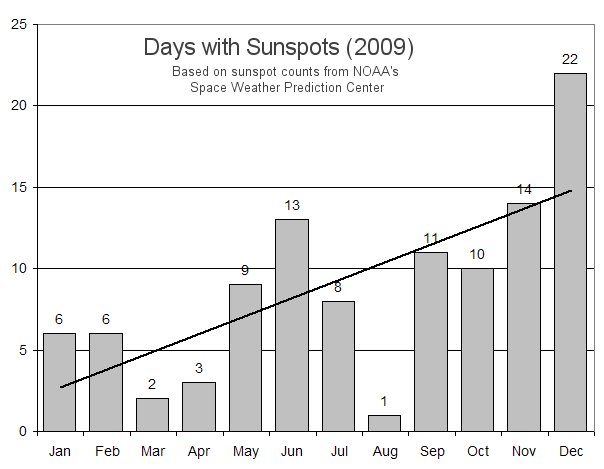
The dark line is a linear least-squares fit to the data. If the trend continues exactly as shown (prediction: it won’t), sunspots will become a non-stop daily occurance no later than February 2011. Blank suns would cease and solar minimum would be over.
If the past two years have taught us anything, however, it is that the sun can be tricky and unpredictable.
Invariant (07:52:05) :
Did he write anything about the reasons for global warming between 1700 and 1950?
His book is about the Sun and its influence and he is – understandably – vague on what else might have caused this. AGW is a possibility that he does not discount. He was chair of a NASA task force studying this a few years back, and his book basically reflects the view of that study: http://lwstrt.gsfc.nasa.gov/TRT_SunClimate.pdf
M. Simon (05:23:31) :
but more and more unlikely as the number increases, just as the likelihood of keep getting heads in coin tossing goes does down with increasing number of tosses
I know you know better. But for those who don’t.
It is unlike Leif to make a simple mistake like this, so I anticipate an explanation.
It may go like this. With each coin toss, the probability of heads and tails is 1/2. But what is the probability of three heads in a row, versus, say two in a row? The probabilities are combinatorial, so that the probability of three heads in a row is 1/2×1/2×1/2, or 1 in 8, where is the probability of two heads in a row is 1/2×1/2, or 1 in 4.
anna v (06:34:01) :
I would appreciate a link to this claim.
It is true that the solar system is a many body problem even though the equations controlling it are known, but chaotic? The equations have been programmed both in analogue ( planetaria) and in computers so I think the claim far fetched but am open to convincing.
Nevertheless each individual planet is a clock and certainly their combined motion will be a clock too. Clock: a method of counting time.
You don’t need to go any further than the most accurate ephemeris available on the net at JPL. They calculate their data from equations which they then modify with various ‘epicycles’ which are it total pretty thorough, but don’t reduce to some nice Newtonian complete formula for a neat clockwork cosmos.
As for each individual planet being a clock, the quasi-chaotic variations in length of day measurements should tell you that these ‘clocks’ are affected by the ‘many body problem’ in several ways. It is the correlation I discovered between changes in Earth’s length of day and the changes in the z-axis solar equatorial – solar system barycentre relative distance caused mainly by the motion of the gas giant planets which has spurred my research, because those motions also correlate with solar surface behaviour. I appreciate that correlation is not causation, but the probabilities that these things are coincidence is vanishingly small, so they hint that there is an underlying principle.
So you can think of the solar system as a clock if you like, but I contend that it’s a far more complex and inter-related clock than you suppose.
One thing I want to leave you with is this; you said that all things to be considered a valid part of scientific debate have to fit in with Newtonian conceptions such as angular momentum, energy, mass etc. But at the end of the C17th Newtonian physics was at a loss to determine the orbit of planetoid Ceres accurately.
The problem was solved by Gauss, and he didn’t use any of the ‘fundamental quantities of physics’ to do it. He used Keplerian concepts of proportion, resonance, and harmonious motion. I highly recommend this article to you:
http://wlym.com/~animations/ceres/index.html – click on ‘the Kepler problem’, have a read, then come and discuss it if you like. You are welcome.
http://tallbloke.wordpress.com
“There are more things in heaven and earth, Horatio, Than are dreamt of in your philosophy.”
– Shakespeare-
Please could a mod fix my italic tags and delete this. – Thanks.
REPLY: Fixed – Anthony
Leif Svalgaard (08:18:03) :
his book basically reflects the view of that study
I forgot to mention one thing that has changed [also in Eddy’s mind], namely the large variation of TSI shown by the red curve in Figure 3. Modern reconstructions of TSI do not show this large change: the reconstructions seem to converge on the blue curve which shows negligible long-term trend.
Thanks Anthony.
I was quoting Anna as far as “Clock: a method of counting time.”
But not to worry.
REPLY: Fixed again – there wasn’t enough context in your initial request for me to know what you expected quoted. the closing tag was after Shakespeare so it seemed the logical choice. -A
tallbloke (08:19:20) :
I appreciate that correlation is not causation, but the probabilities that these things are coincidence is vanishingly small, so they hint that there is an underlying principle.
You confuse a priori and a posteriori probability. The chance that I will get a given hand in Bridge is extremely small – 1 in 635013559600 – [a priori], but once I have gotten a hand [a posteriori] the probability is one. In other words, if you spot a correlation [having looked around a lot – some people call that ‘research’] you are closer to the a posteriori case. If you make a prediction [without knowing in advance what the data looks like] and it is borne out you have an a priori case.
1. Quote: Leif Svalgaard (23:11:52) :
“Other processes creates the other heavy elements, but Hydrogen, Helium, and Deuterium are primordial.”
No. Deuterium (H-2) is made primarily by spallation reactions in the outer part of a star. Deuterium, Li, Be and B are produced by a process that B2FH called the x-process.
Deuterium (H-2), Li, Be and B have very low nuclear stability, i.e., their nucleons are very loosely bound. Inside a star, they would be quickly consumed by fusion. Readers be aware that Deuterium (H-2) and Li are therefore used in the production of thermonuclear weapons (H-bombs).
Fowler, Greenstein and Hoyle were keenly aware of the low nuclear stability of these nuclei when they suggested local synthesis of D, Li, Be and B in 1961 [“Deuteronomy. Synthesis of deuterons and light nuclei during the early history of the Solar System”, American Journal of Physics 29 (1961) 393-403].
Later Dr. D. D. Sabu and I proposed that other elements were also made by local element synthesis [“Elemental and isotopic inhomogeneities in noble gases: The case for local synthesis of the chemical elements”, Trans. Missouri Acad. Sci. 9 (1975) 104-122; “Strange xenon, extinct superheavy elements and the solar neutrino puzzle”, Science 195 (1977) 208-209].
2. Quote: Leif Svalgaard (23:16:40) :
“As the Figures show, they apply [if we assume for a moment that they make sense] to amu greater than 3 and therefore not to Hydrogen. Explain HERE why Hydrogen [and Deuterium] become deficient.”
You are right. We did not report mass fractionation across H-1 (1 amu) and H-2 (2 amu) because spallation and/or fusion reactions readily increase and/or decrease the abundance of H-2 (Deuterium) in the solar wind. We could not separate out and identify mass fractionation changes in the D/H ratio.
Hydrogen (the lightest of all elements, H-1) did not become deficient inside the Sun. It is continuously being produced there by neutron-decay near the solar core. Upward migration of H+ ions, carried by deep-seated magnetic fields, is the flow that maintains mass separation in the Sun. When these deep-seated fields reach the solar surface, they carry H+ away in the solar wind. Each year the solar wind carries away 50,000 billion metric ton of Hydrogen with isotopes of other elements carefully sorted by mass and selectively enriched in the lightweight ones.
Geiss thought that fusion reactions that in the Sun converted H-2 into He-3 [“Primordial abundance of hydrogen and helium isotopes”, in Origin and Evolution of the Elements (eds., Prantos, N., Vangioni-Flam, E. and Cassè, M., Cambridge University Press, Cambridge, 1993) pp. 89-106]. His proposal would explain excess He-3 without solar mass fractionation.
Isotope data on H and He from the 1996 Galileo Probe into the atmosphere of Jupiter do not support Geiss’ idea that excess He-3 was produced in the sun by deuterium burning [“Abundances of Hydrogen and Helium Isotopes in Jupiter”, in The Origins of the Elements in the Solar System: Implications of Post 1957 Observations (O. K. Manuel, editor, Kluwer Academic/Plenum Publishers, New York, NY, 2000) 589-643].
Solar mass fractionation has been quantitatively identified:
a.) Across isotopes in the solar wind over the range of 3-136 amu.
b.) Across s-products in the photosphere for 27-207 amu.
Is there reason to doubt that elements like Hydrogen (1-2 amu) and Uranium (235-238 amu) are immune to solar mass fractionation?
With kind regards and best wishes for 2010!
Oliver K. Manuel
Looking at Stereo, it appears that there will probably be a few blank days after 1039 disappears around the Western limb in a few days.
Leif Svalgaard (07:34:53) :
tallbloke (03:37:12) :
The solar systems orbiting bodies (including the sun) follow quasi cyclic but ultimately indeterminate courses.
The ultimate course doesn’t matter. On time scales that we are talking about [even millions of years], the planets are good clocks.
Hi Leif. I agree that from a utilitarian or operational POV they are good clocks. My point is that you can’t extrapolate from that to a conceptually ideal Newtonian cosmos. The difference may seem like hair splitting, but it is important when we are talking about 0.01% variations having measurable effects, or potential feedback mechanisms which derive sufficient energies from relatively tiny differences etc. Lets jut remember that all this discussion is about a 0.3% variation in planetary surface temperature over 300 years.
0.1% per century.
tallbloke (08:19:20) :
If you do not know in your scientific bones that energy, momentum,angular momentum conservation are very very basic outcomes in the langrangian formalisms of any physical theory, I give up.
Oliver K. Manuel (08:37:40) :
“Other processes creates the other heavy elements, but Hydrogen, Helium, and Deuterium are primordial.”
No. Deuterium (H-2) is made primarily by spallation reactions in the outer part of a star.
Deuterium is destroyed in convective stars like the Sun. The Deuterium in interstellar space is primordial. The precise prediction of its abundance is one of the triumphs of the Big Bang theory.
Is there reason to doubt that elements like Hydrogen (1-2 amu) […] are immune to solar mass fractionation?
Yes, many [e.g. that OBSERVATIONS show that most of the baryonic matter of the Universe is H]. But that is not the issue. The question should be: “Is there reason to believe that elements like Hydrogen …”. So far, your ‘explanation’ seems to be that you don’t see any reason to doubt what you claim.
Interesting NASA paper there, Leif; thanks.
Here’s a brief note about atmospheric tides. http://www.scientificamerican.com/article.cfm?id=does-the-moon-have-a-tida
tallbloke (08:55:36) :
My point is that you can’t extrapolate from that to a conceptually ideal Newtonian cosmos.
Nobody is doing that. The actual cosmos we have is a good clock on time scales that matter. No need to set up the strawman of ‘ideal Newtonian’
Let’s just remember that all this discussion is about a 0.3% variation in planetary surface temperature over 300 years.
No, it is about solar variability, unless you believe that the planets regulate our temperature [‘Jupiter shine’], which you may actually do. Newtonian physics describe planetary orbits to a much, much higher precision than 0.3%.
Leif Svalgaard (08:18:03) : His book is about the Sun and its influence and he is – understandably – vague on what else might have caused this. AGW is a possibility that he does not discount. He was chair of a NASA task force studying this a few years back, and his book basically reflects the view of that study: http://lwstrt.gsfc.nasa.gov/TRT_SunClimate.pdf
Thanks Dr. Svalgaard.
Now it is time for the New Year Turkey dinner with my parents, wife and two sons (2 and 6 yr). In my mind I cannot see why the natural global heating from 1700 to 1950 should not continue after 1950…
Happy New Year to all of you!
Invariant
anna v (08:56:52) :
tallbloke (08:19:20) :
If you do not know in your scientific bones that energy, momentum,angular momentum conservation are very very basic outcomes in the langrangian formalisms of any physical theory, I give up.
Read the Gauss article I linked for you.
Newtonian mechanics is something I understand well, being an engineer. But what I also know, as a graduate philosopher of science, is that conceptual tools can restrict the ‘thinking out of the box’ we find fun and occasionally enlightening.
Pry bars are useful tools, but they can also be used turn a window of opportunity into a prison. Once Gauss had finished using Kepler’s outmoded concepts to get closer to determining the orbit of Ceres than Newtonian mechanics had been able to, he could then use Newtonian mechanics to confirm the validity of his formula. And vise versa I would add.
SO instead of insisting that we limit ourselves to one particular box of tools at the outset, lets allow some freedom to experiment with other conceptual devices, and then see if the result turns out to be consistent with more ‘accepted practices’ anyway.
Happy New Year to you.
Leif Svalgaard (09:04:41) :
tallbloke (08:55:36) :
Let’s just remember that all this discussion is about a 0.3% variation in planetary surface temperature over 300 years.
No, it is about solar variability, unless you believe that the planets regulate our temperature [‘Jupiter shine’], which you may actually do.
What I believe is that the solar system is a system in the full sense of the word, not simply a chain of causes and effects radiating from the centre of the sun outwards.
Newtonian physics describe planetary orbits to a much, much higher precision than 0.3%.
Thank you, I know that. I’m just trying to give some context and proportion to the scale of changes under discussion. And I wasn’t just referring to this thread when I said “remember all this discussion…”, but to the climate debate in general. I’ll leave it there for now and give others some airspace.
Happy New Year to you Leif.
Quote: Leif Svalgaard (08:58:00) :
quotes: Oliver K. Manuel (08:37:40) :
a.) ‘Deuterium (H-2) is made primarily by spallation reactions in the outer part of a star.’
“Deuterium is destroyed in convective stars like the Sun. The Deuterium in interstellar space is primordial. The precise prediction of its abundance is one of the triumphs of the Big Bang theory.”
The Big Bang is desperately in need of triumphs, but Deuterium is not one of them.
b.) ‘Is there reason to doubt that elements like Hydrogen (1-2 amu) and Uranium (235-238 amu) are immune to solar mass fractionation?’
“Yes, many [e.g. that OBSERVATIONS show that most of the baryonic matter of the Universe is H].”
Yes, interstellar space has a weak gravitational field and is filled with H and some D that is carried away with the H by stellar winds of stars.
Perhaps a return to basics will help you understand the difference between the composition of material in weak and strong gravitational fields. Look at the RED DOTS representing the two basic constituents of all nuclei in the Cradle of the Nuclides:
http://www.omatumr.com/Data/2000Data.htm
The neutron with Z/A = 0, and
The hydrogen atom with Z/A =1.
The neutron spontaneously decays to a hydrogen atom in the Earth’s weak gravitational field. This natural process (half-life ~ 10 minutes) is accompanied by a hugh volume expansion:
Charge separation:
Neutron ==> Hydrogen
V(final) /V(initial) ~ 1,000,000,000,000,000
The opposite reaction occurs naturally with a hugh volume contraction in the strong gravitational field at the center of stars and galaxies.
Charge collapse:
Hydrogen ==> Neutron
V(final) /V(initial) ~ 0.000,000,000,000,001
The visible universe is filled with Hydrogen, but compact, energetic cores of stars and galaxies are mostly Neutrons because
V( H) ≈ 1,000,000,000,000,000 x V(N)
Again, best wishes for 2010!
Oliver K. Manuel
tallbloke (09:21:21) :
Read the Gauss article I linked for you.
That article is quasi-philosophical nonsense in the full sense of that word. Gauss was simply solving a mathematical problem: how to determine an elliptic orbit from three observations. BTW, Gauss used simple high-school algebra and trigonometry, and no philosophical nonsense.
tallbloke (09:38:22) :
>i>”Newtonian physics describe planetary orbits to a much, much higher precision than 0.3%.”
Thank you, I know that.
You give a convincing imitation of someone who does not 🙂
Happy New Year to all and cold enough to throw a sokein the cart of fools’ wheels of AGW, but not too cold for the rest of us 🙂
http://arthistory.suite101.com/article.cfm/search_engine_optimization
“The Haywain” by Hieronymus Bosch is overcrowded with objects and figures surrounding a cart laden disproportionately high with hay and with a bush somehow growing from the top. In front of the bush, three people are making music. Standing beside them are an angel and a devil.
To the left, behind the wagon, ride an emperor, a king, and a pope, incongruously providing an escort for a wagonload of dried grass. To the right, the wagon is being pulled by an assortment of strange demonic creatures from the underworld. One of these creatures is a combination of a man and a fish; another is part bird, and a third is a hooded man with branches growing out of his back. Nearby, people can be seen streaming out of a wooden doorway in a mound of earth. The haywain itself is accompanied by men and woman trying to grab handfuls of hay; they fight and fall beneath the wheels.
The cart moves inexorably forward. The foreground of the painting is chaotic, while a clear and beautiful landscape can be seen in the distance. The haywain and its crowd of followers seem to be heading away from pristine innocence toward a place of punishment. The crowd is moving toward their ultimate destination: the day of reckoning.
Artist Hieronymus Bosch (1450-1516) is well known for paintings that mock equally the hypocrisy of the clergy, the extravagance of nobility, and the immorality of everyday people. His use of Christian symbolism and his extraordinary level of detail come from the traditions of manuscript illustrations of the Middle Ages. In this example, the hay wagon is his symbol for human greed, and his painting depicts the unworthiness of humans and their approaching doom.
Just read a post that made me think about the “descreening” of an astrosphere.
Not that I think that this is possible in this new “dark age.”
Not that I think that this is possible in this new “dark age.”
But was wondering (again) about the different possibilities, levels or effects of descreening when I came across this article.
M Star Astrosphere Size Fluctuations and
Habitable Planet Descreening∗
Smith & Scalo
Department of Astronomy, The University of Texas at Austin, Austin, TX 78712
June 9, 2009
http://arxiv.org/PS_cache/arxiv/pdf/0906/0906.1274v1.pdf
Leif, got this article under your belt?
REPLY: Fixed again – there wasn’t enough context in your initial request for me to know what you expected quoted. the closing tag was after Shakespeare so it seemed the logical choice. -A
You sir, are a gentleman. Happy New Year to you and the team.
Leaving the last word to Shakespeare is always a good logical choice:
“O, how this spring of love resembleth
The uncertain glory of an April day;
Which now shows all the beauty of the sun,
And by and by a cloud takes all away.”
The Two Gentlemen of Verona (I, iii, 84-87)
Happy New Year to all and cold enough to throw a spoke in the cart-of-fools’ wheels of AGW, but not too cold for the rest of us 🙂
http://arthistory.suite101.com/article.cfm/search_engine_optimization
“The Haywain” by Hieronymus Bosch is overcrowded with objects and figures surrounding a cart laden disproportionately high with hay and with a bush somehow growing from the top. In front of the bush, three people are making music. Standing beside them are an angel and a devil.
To the left, behind the wagon, ride an emperor, a king, and a pope, incongruously providing an escort for a wagonload of dried grass. To the right, the wagon is being pulled by an assortment of strange demonic creatures from the underworld. One of these creatures is a combination of a man and a fish; another is part bird, and a third is a hooded man with branches growing out of his back. Nearby, people can be seen streaming out of a wooden doorway in a mound of earth. The haywain itself is accompanied by men and woman trying to grab handfuls of hay; they fight and fall beneath the wheels.
The cart moves inexorably forward. The foreground of the painting is chaotic, while a clear and beautiful landscape can be seen in the distance. The haywain and its crowd of followers seem to be heading away from pristine innocence toward a place of punishment. The crowd is moving toward their ultimate destination: the day of reckoning.
Artist Hieronymus Bosch (1450-1516) is well known for paintings that mock equally the hypocrisy of the clergy, the extravagance of nobility, and the immorality of everyday people. His use of Christian symbolism and his extraordinary level of detail come from the traditions of manuscript illustrations of the Middle Ages. In this example, the hay wagon is his symbol for human greed, and his painting depicts the unworthiness of humans and their approaching doom.
Carla (10:11:09) :
Leif, got this article under your belt?
Basically states the obvious: that smaller stars are even better protected than the Sun by their stellar winds.