The sun has seen a resurgence of activity in December, with a number of cycle 24 sunspots being seen. The latest is group 1039 seen below:

2009 is ending with a flurry of sunspots. Indeed, if sunspot 1039 holds together just one more day (prediction: it will), the month of December will accumulate a total of 22 spotted days and the final tally for the year will look like this: From Spaceweather.com
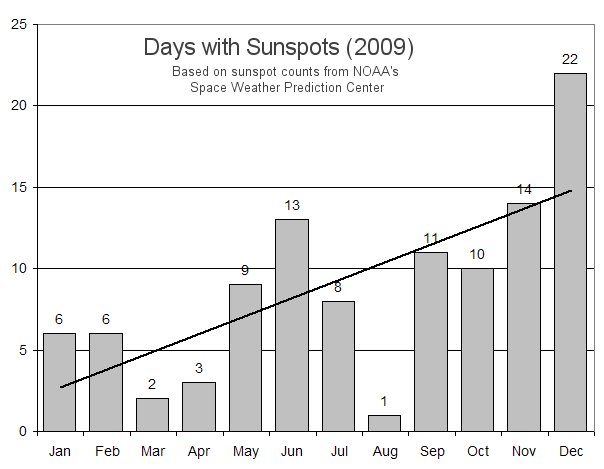
The dark line is a linear least-squares fit to the data. If the trend continues exactly as shown (prediction: it won’t), sunspots will become a non-stop daily occurance no later than February 2011. Blank suns would cease and solar minimum would be over.
If the past two years have taught us anything, however, it is that the sun can be tricky and unpredictable.
Its surely not the case of their being a really cold winter. Yahoo!
Its understanding the real reason as to what causes whatever happens.
Clearly a cold winter is at odds with climate hysteria (ie ever onward and upward temperatures) – but understanding and proving why is important.
Personally I think the most important thing now is claiming independence and accessibility to the raw data and confirming its veracity (no matter what it might say). Then let anybody deal with it as they will.
Robuk (09:50:31) :
You have to ask why they don`t run the old equipment alongside the modern, might it be they are trying to hide the decline.
But they do, and it does not make any difference. Here is the telescope Wolf used: http://www.leif.org/research/Wolf-Telescope.png and it is still being used by [amateurs] Friedli and Keller:
The sunspot-activity in the years 1976 – 1995.
Keller, H. U.; Friedli, T. K.
Mitt. Rudolf Wolf Ges., Jahrg. 3, Nr. 7, p. 1 – 46 (1996)
Abstract
The paper contains the last twenty years of sunspot relative and group numbers as observed by the standard observers M. Waldmeier, A. Zelenka and H. U. Keller in Zurich. Starting with January 1996 a new series of sunspot countings called Swiss Wolf Numbers RS will be initiated using standard observations made by T. K. Friedli at the original Fraunhofer Refractor used by Wolf and an international network of professional and amateur astronomers.
The Medieval Spotted Period is a myth!
Robert Jones (07:30:43) Here is the Dec 8, 2009 sunspot graph with the red prediction line from the NOAA:
http://www.sec.noaa.gov/SolarCycle/sunspot.gif
John M Reynolds
Personally, I’d love to see the sunspot number go up, it’s highly annoying when band (HF radio) conditions just go completely to pot when the sun sets…
Given the fairly long period of inactivity, it would be interesting to see just how much the spots go towards influencing the effects on the atmosphere.
I’m not at all sure that humans should try to influence the climate, given normal laws, the Earth will seek it’s own balance. Why should the AGW crowd want to maintain a status quo pegged at some predetermined preindustrial date?
Ref – Leif Svalgaard (10:06:34) :
“Robuk (09:50:31) :
You have to ask why they don`t run the old equipment alongside the modern, might it be they are trying to hide the decline.”
“But they do, and it does not make any difference. Here is the telescope Wolf used: ..”
__________________________
Outstanding! Surprised they don’t have in enclosed.
Galen Haugh (08:10:25) :
Jerry, I’m trying to find a paper put out recently by an insurance actuarialist who, having some time on his hands, applied his mathematical expertise to sunspot cycles and weather/temperature patterns and he found several things:
1) He was amazed with the correlation he saw (having worked just with health/life demographics for insurance estimates, typically his results are rather imprecise), and
2) He did indeed see a definite lag of about 2-3 years. So I’m expecting really cold weather to set in 2-3 years after the deep solar minimum which we may be in now, or it may not have happened quite yet.
There are many possible mechanisms for a lag:
1) The solar flux takes time to propagate out to the edges of the heliosphere. So, the deflection of cosmic rays lags behind “today’s” solar flux. Thus, the clouds look more like a moving average of a month or two of the solar flux.
2) The impact of the clouds on climate is, at best, on the first derivative of temperature. So, absolute temperature (being driven by the integral of clouds) lags.
3) However, there’s a complicating factor that could lead to huge lags. Clouds also have a warming effect. It’s a clear, cloudless night that gets the coldest. The effect of clouds on the poles is to slow both the summer melt and the winter freeze. Notice the deviations from the mean here:
http://ocean.dmi.dk/arctic/meant80n.uk.php
Check previous years by clicking on the year on the left. Notice how recent years show the temperature not falling as quickly in the fall and not rising as quickly in the spring. This would, eventually lead to more ice forming than melting — the exact pattern during this solar minimum (which began just a bit too late to help the 2007 ice).
http://www.ijis.iarc.uaf.edu/en/home/seaice_extent.htm
Notice 2008 & 2009 in April & May. That’s really slow melt, which could be caused by all the clouds blocking the sun.
This mechanism could lead to very long term cumulative effects — yielding delays much larger than a couple of years. Increased clouds due to reduced solar flux could lead to a long-term buildup of Arctic ice which would only significantly impact global climate after many years of accumulation. This could explain why the coldest part of the Maunder minimum was near the end.
The high peaks are during times, when the Sun approaches the solar-system barycenter. At these times, the
Sun moves in the contrary (retrograde or highly inclined) direction for a short while, and has got a negative
angular momentum (with respect to the invariant plane), so it should actually subtract in a vector sum of the
system, but here it is added in the scalar sum (there is no negative scalar (absolute value or vector length)
“Simon Filiatrault (07:00:09) : angular momentum)…
The first derivation of angular momentum sum (fig. 78) only little matches the sun-spot cycle, but the highpeak
arround 1990 could be correlated with a drop of solar-flare activity at the middle of preceeding Sunspot
cycle 22, both peaks arround 1800 and 1990 having a damping effect on the Solar activity, possibly due to
effects of exchange between Sun orbital angular momentum and spin angular momentum.
The “wave” of approximate period of 854 years, which could also probably be anti-correlated with Sun spin”
I would really like to know what inside the sun could cause this. What I mean are there physics involved? If so what type of physics or even the physical mechanism that can explain this statement. Thanks.
Congratulation to Mr. & Mrs. North & South Solar Hemispheres. You have now reached a level of activity where the highest point is equal to the lowest point reached in 1996 (SC22-23). Adjusting for sunpore counting inflation, of course.
So, to all those remaing wary of the Sun’s activity bustin’ loose, there is the SC5 fiasco where it started to rise in 1798/99, then fell flat on it’s collective face for the next year.
Then there’s the solar cycle that started to rise, then disappeared entirely into the depths of the Maunder Minimum.
Ah, trends, you can’t live with ’em, and you can’t live without ’em.
Ref – wmsc (10:25:36) :
“Why should the AGW crowd want to maintain a status quo pegged at some predetermined preindustrial date?”
___________________
Once read: ‘Humans evolved during and are the product of the Ice Age.’ If the paleologists, climatologists, etc. are right then we sure need to get used to warmer temps, no ice, and higher sea levels. Ice Ages don’t last long during the solar system’s trek around the MilkyWay. It’s kinda: Short Winter, Long Summer, Short Winter, Long Summer, or so I seem to recall. No real Autumn or Spring to speak of (unless one counts the rise and decent periods). I guess the AGW crowd will want to spend a lot of money to even out the Sun’s orbit and make everything nice and cool.
@AdderW (08:31:14) :
“We urgently need a tax on sun spots now, to keep the numbers down.
Sun spot trading anyone?”
Drats! You beat me to it.
“This is depressing. These sunspots are going to warm the earth giving fuel to the warmers.”
Even so, it will be weaker than late 20th century activity. The next minimum will likely be as big; as the one we just went through. Also consider; this lower solar activity is happening along with negative PDO. So the overall trend will be cooling of the climate, at least for 2-3 decades.
Remember, late 20th century warming coincided with higher solar activity and positive PDO. Now the opposite is unfolding.
Let’s not forget, back in 2007 NASA was expecting solar cycle 24 to be a gigantic one. That’s when Al Gore came out with his movie and the infrastructure was set up ready to introduce Carbon trading schemes, soon as cycle 24 was to get kicking. Oh the irony!
Don’t forget the Watts Effect!, it’s coming!, This post will surely provoke at least 6 months of a quiet sun.
Dr. Svalgaard, I believe you correctly called the low point of the minimum long before anyone else that I know of did. If I recall correctly, you made the determination based on your F10.7 chart. I remember at the time not being sure that the turn you were seeing wasn’t just a random variation, but your interpretation was correct.Congratulations!
(and of course those scientists such as Hathaway who predicted the minimum was here each month until they got lucky and it happened hardly deserve notice)
The very long solar cycle 23 which is ended/ending, will cause a very weak solar cycle 24. The dye is cast, we will have 20 years of colder temperatures, no matter what happens in the short term.
2007, 2008, and 2009 are three of the top 20 years with the most days without sunspots since 1849, and with 2008 and 2009 being in the top five. solar activity in 2009 was over 85% less than expected in terms of sunspot production.
David Archibald’s and Joe D’Aleo’s work is impressive.
No electric power, no email, no Internet 30 Dec 09 – Here’s a great graph showing two different solar cycle 24 predictions (guesstimates) from NASA, the latest of which shows a less active sun … and ultimately, no electric power, no email, and no Internet.
See
http://www.iceagenow.com/No_electric_power_no_email_no_Internet.htm
Is this possible? Should it be taken seriously?
Frederick Michael (10:31:31) :
This mechanism could lead to very long term cumulative effects — yielding delays much larger than a couple of years. Increased clouds due to reduced solar flux could lead to a long-term buildup of Arctic ice which would only significantly impact global climate after many years of accumulation. This could explain why the coldest part of the Maunder minimum was near the end.
I thought it was colder before the Maunder Minimum than during it.
Jim Arndt (10:35:37) :
I would really like to know what inside the sun could cause this. What I mean are there physics involved? If so what type of physics or even the physical mechanism that can explain this statement.
There is no known mechanism for this, and the various proposals [spin-orbit coupling, tides, electric, magnetic, aliens, …] have no physical basis. The paper is marred by calculating the meaningless scalar sum of angular momenta.
wws (11:04:54) :
Dr. Svalgaard, I believe you correctly called the low point of the minimum long before anyone else that I know of did.
The NASA-NOAA panel [of which I’m a member] also called December 2008 as the minimum.
So what you guys are saying is;
-Svensmark & Co are on an upswing.
-The AGW flock will run into hiding until spring.
Then they will return, trying to put tax on soot and
methane?
Kind of when the berlin wall fell, all the socialists went
into temporary hiding…
What do you think?
Leif Svalgaard (11:19:58) :
wws (11:04:54) :
Dr. Svalgaard, I believe you correctly called the low point of the minimum long before anyone else that I know of did.
The NASA-NOAA panel [of which I’m a member] also called December 2008 as the minimum.
Simon Filiatrault (07:00:09)
When looking at the path of the sun about the solar systems barycenter, I know you think the sun must be somehow be affected by this malformed Spiro graph path it takes over the centuries. However, don’t you realize the sun is merely following the geodesic gravitational gradient and “feels” basically nothing? The core path of the sun is around the Sun-Jupiter barycenter and the non-aligned accelerations from the other eight planets are incredibly tiny and tend to cancel out to boot. Why would you follow this path thinking the sun’s relation about the solar system’s barycenter would somehow affect sunspots?
This may be the beginning of the end? Hope so!
Maybe this new CO2-AGW litigation will go to SCOTUS and we can then prove that AGW is a fallacy.
And the lawyers really are not so smart after all, heck the TEAM is not that smart if they need to fake everything as they have.
http://online.wsj.com/article/SB10001424052748703478704574612150621257422.html#articleTabs%3Darticle
Now I am really impressed.
This could all be a bit confusing but I’ll try and sort it all out.
Our staring point is:
Anthropogenic CO2 causes global warming.
The IPCC claims a consensus and Al Gore says so and who am I to question them.
There is even an accepted and established mechanism for this, the “greenhouse effect”.
Now its no good people pointing out any correlations between sunspot activity and climate, aurora activity and Nile floods, solar flares etc without showing a causal relationship.
Until some mechanism is found that links them all together, we cannot draw any conclusions.
But I’m really impressed, the correlations are very strong and if we follow through with the data it suggests that the current cooling is only temporary.
So, to borrow from the declaration that followed the acceptance of the global chilling data, this cooling is actually masking the full effect of global warming.
But, since we know that CO2 causes global warming and since CO2 is man made, and hence since global warming is unequivocally caused by mankind, it necessarily follows that if there is a causal link between these various activities that it must be that they are all also caused by CO2 and hence man is responsible for destabilising solar activity and planetary motions.
No other conclusion is possible.
I mean, we may suppose that there is a link between planetary motions and sun spot activity (which ought to make choosing the start and end of sun spot cycles much easier since you would define them from the planetary resonances and not but some arbitrary “pick a day” method, and then we could re-compute all solar activity cycles based on historical resonance data rather than arbitrary cycle start and end points just to see what it throws out).
We may also suppose there is some mechanism that links the earth’s climate to solar activity and hence to planetary motions.
But, since we already know that climate change is caused by CO2 then the only possible conclusion is that CO2 must also cause solar activity changes and planetary resonances which means we should now invest heavily in finding out how CO2 causes the planets to move as they do and how they can affect solar activity. I’m pretty sure that if President Obama and Gordon Brown throw enough taxpayers money into research, the physicists will find that just such a mechanism exists.
But damn, that’s gonna cause a hell of an increase in taxes.
(to be honest, I suspect that about the one and only thing definitively caused by anthropogenic CO2 is taxation).
Leif Svalgaard (11:17:29)
There is no known mechanism for this, and the various proposals [spin-orbit coupling, tides, electric, magnetic, aliens, …] have no physical basis. The paper is marred by calculating the meaningless scalar sum of angular momenta.”
Leif that is why I asked the question because I knew it could not be answered a meaningful way to explain it.
I look at it as there are 9 planets and one of them is bound to correlate to something. Add the moon and we have cheese (with wine). Has anyone asked if the planets are controlled by to sun? Maybe that’s why there is the glimmer of a correlation, just as accurate to say the sun controls the planets as to the planets control the sun. LOL