Note this a mirrored posting of Steve McIntyre’s Climate Audit post. The Climate Audit Server is getting heavy traffic and is slow to load – here is the article exactly as he wrote it yesterday. -Anthony
Yamal: A “Divergence” Problem
The second image below is, in my opinion, one of the most disquieting images ever presented at Climate Audit.
Two posts ago, I observed that the number of cores used in the most recent portion of the Yamal archive at CRU was implausibly low. There were only 10 cores in 1990 versus 65 cores in 1990 in the Polar Urals archive and 110 cores in the Avam-Taymir archive. These cores were picked from a larger population – measurements from the larger population remain unavailable.
One post ago, I observed that Briffa had supplemented the Taymir data set (which had a pronounced 20th century divergence problem) not just with the Sidorova et al 2007 data from Avam referenced in Briffa et al 2008, but with a Schweingruber data set from Balschaya Kamenka (russ124w), also located over 400 km from Taymir.
Given this precedent, I examined the ITRDB data set for potential measurement data from Yamal that could be used to supplement the obviously deficient recent portion of the CRU archive (along the lines of Brifffa’s supplementing the Taymir data set.) Hantemirov and Shiyatov 2002 describe the Yamal location as follows:
The systematic collection of subfossil wood samples was begun, in 1982, in the basins of the Khadytayakha, Yadayakhodyyakha and Tanlovayakha rivers in southern Yamal in the region located between 67°00 and 67°50 N and 68°30 and 71°00 E (Figure 1). These rivers flow from the north to the south; hence, no driftwood can be brought from the adjacent southern territories At the present time, the upper reaches of these rivers are devoid of trees; larch and spruce-birch-larch thin forests are located mainly in valley bottoms in the middle and lower reaches.
Sure enough, there was a Schweingruber series that fell squarely within the Yamal area – indeed on the first named Khadyta River – russ035w located at 67 12N 69 50Eurl . This data set had 34 cores, nearly 3 times more than the 12 cores selected into the CRU archive. Regardless of the principles for the selection of the 12 CRU cores, one would certainly hope to obtain a similar-looking RCS chronology using the Schweingruber population for living trees in lieu of the selection by CRU (or whoever).
As a sensitivity test, I constructed a variation on the CRU data set, removing the 12 selected cores and replacing them with the 34 cores from the Schweingruber Yamal sample. As shown below, this resulted in a substantial expansion of the data set in the 19th and 20th centuries and a modest decline in the 18th century. (Hantemirov and Shiyatov 2002 had reported a selection of long cores of 200-400 years; while the CRU archive does not appear to be the precisely the same as the unavailable Hantemirov and Shiyatov 2002 archive, it does appear to be related. This pattern of change indicates that the age of the CRU cores is systematically higher than the age of the Schweingruber cores.)

Figure 1. Comparison of core count. Black – variation with Schweingruber instead of CRU; red- archived version with 12 picked cores.
The next graphic compares the RCS chronologies from the two slightly different data sets: red – the RCS chronology calculated from the CRU archive (with the 12 picked cores); black – the RCS chronology calculated using the Schweingruber Yamal sample of living trees instead of the 12 picked trees used in the CRU archive. The difference is breathtaking.

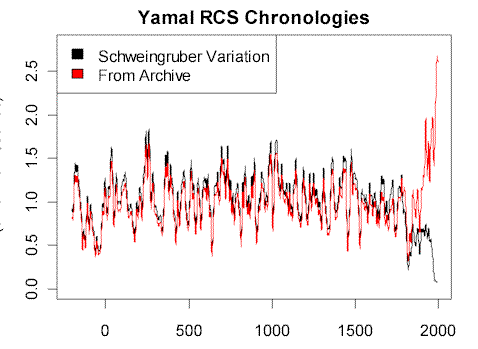
Figure 2. A comparison of Yamal RCS chronologies. red – as archived with 12 picked cores; black – including Schweingruber’s Khadyta River, Yamal (russ035w) archive and excluding 12 picked cores. Both smoothed with 21-year gaussian smooth. y-axis is in dimensionless chronology units centered on 1 (as are subsequent graphs (but represent age-adjusted ring width).
Finally, here is another graphic showing the same two RCS chronologies, but adding in an RCS chronology on the merged data set obtained by appending the Schweingruber population to the CRU archive – this time retaining the 12 cores. Unsurprisingly this is in between the other two versions, but most importantly it has no HS.

Figure 3. Also showing merged version up to 1990. (After 1990, there is only the few CRU cores and it tracks the CRU version.)
I hardly know where to begin in terms of commentary on this difference.
The Yamal chronology has always been an exception to the large-scale “Divergence Problem” that characterizes northern forests. However, using the Schweingruber population instead of the 12 picked cores, this chronology also has a “divergence problem” – not just between ring widths and temperature, but between the two versions.
Perhaps there’s some reason why Schweingruber’s Khadyta River, Yamal larch sample should not be included with the Yamal subfossil data. But given the use of a similar Schweingruber data set in combination with the Taymir data (in a case where it’s much further away), it’s very hard to think up a valid reason for excluding Khadyta River, while including the Taymir supplement.
Perhaps the difference between the two versions is related to different aging patterns in the Schweingruber population as compared to the CRU population. The CRU population consists, on average, of older trees than the Schweingruber population. It is highly possible and even probable that the CRU selection is derived from a prior selection of old trees described in Hantemirov and Shiyatov 2002 as follows:
In one approach to constructing a mean chronology, 224 individual series of subfossil larches were selected. These were the longest and most sensitive series, where sensitivity is measured by the magnitude of interannual variability. These data were supplemented by the addition of 17 ring-width series, from 200–400 year old living larches.
The subfossil collection does not have the same bias towards older trees. Perhaps the biased selection of older trees an unintentional bias, when combined with the RCS method. This bias would not have similarly affected the “corridor method” used by Hantemirov and Shiyatov themselves, since this method which did not preserve centennial-scale variability and Hantemirov and Shiyatov would not have been concerned about potential bias introduced by how their cores were selected on a RCS chronology method that they themselves were not using.
Briffa’s own caveats on RCS methodology warn against inhomogeneities, but, notwithstanding these warnings, his initial use of this subset in Briffa 2000 may well have been done without fully thinking through the very limited size and potential unrepresentativeness of the 12 cores. Briffa 2000 presented this chronology in passing and it was never properly published in any journal article. However, as CA readers know, the resulting Yamal chronology with its enormous HS blade was like crack cocaine for paleoclimatologists and got used in virtually every subsequent study, including, most recently, Kaufman et al 2009.
As CA readers also know, until recently, CRU staunchly refused to provide the measurement data used in Briffa’s Yamal reconstruction. Science(mag) acquiesced in this refusal in connection with Osborn and Briffa 2006. While the Yamal chronology was used in a Science article, it originated with Briffa 2000 and Science(mag) took the position that the previous journal (which had a different data policy) had jurisdiction. Briffa used the chronology Briffa et al (Phil Trans B, 2008) and the Phil Trans editors finally seized the nettle, requiring Briffa to archive the data. As noted before, Briffa asked for an extension and, when I checked earlier this year, the Yamal measurement data remained unarchived. A few days ago, I noticed that the Yamal data was finally placed online. With the information finally available, this analysis has only taken a few days.
If the non-robustness observed here prove out (and I’ve provided a generating script), this will have an important impact on many multiproxy studies that have relied on this study.
Tom, I really don’t see what’s so hard to understand about that….
Tree Ring widths
– has anyone done a study into how tree-ring widths vary over time
– I imagine that tree-rings will gradually shrink due to natural aging over time
– probably with an exponential-decay-like characteristic the older the tree ring is…
… a bit like a hockey-stick ;o)
Google search for Trends in recent temperature and radial tree growth spanning 2000 years across northwest Eurasia brought up The Royal Society website and the whole paper (as far as I can tell). Certainly appears to be complete. (Search from Melbourne, Australia.)
Joanne Nova is a good communicator and has a good summary of the current issue at her http://joannenova.com.au/2009/09/breaking-news-cherry-picking-of-historic-proportions/
She does note “The details are on the last three days of Steve McIntyre’s site Climate Audit, and summed up beautifully on Watts Up,” but I think her post is a good one to pass on to the general public. Those interested will be here soon enough.
I guess someone will have to double-check the summer temperature numbers in Yamal.
From the links above, it appears Briffa used this profile of temperature change throughout the year.
http://rstb.royalsocietypublishing.org/content/363/1501/2269/F6.large.jpg
But there are other temperature profiles in the links which don’t show anything particularly special is happening – summer or annual.
http://rstb.royalsocietypublishing.org/content/363/1501/2283/F10.large.jpg
http://rstb.royalsocietypublishing.org/content/363/1501/2269/F1.large.jpg
http://rstb.royalsocietypublishing.org/content/363/1501/2283/F8.large.jpg
And then there is this profile of the number of trees and the resulting temperature index from three different datasets.
One can see which dataset was chosen – hint, the one in the middle with the hockey stick.
http://rstb.royalsocietypublishing.org/content/363/1501/2269/F3.large.jpg
ralph (02:17:13) :
>>>Every single one of my comments from yesterday at
>>>the Guardian were deleted.
And mine were not even put up on the board in the first place!
The UK has very strange defamation laws. If you are accused of defamation you are guilty until you prove your innocence in a court of law= ££££££s. To initiate the case costs a mere £1700
All blogs message boards etc. have to be aware of this else vast sums of money can change hands – from the author, and if the blog/newspaper publisher does not remove the offending text completely, from the publisher mainly to the hands of barristers/lawyers etc.
Using a psuedonym is no safeguard as your ip address is recorded and can be extracted from the publisher and your name and address from your ip provider at no cost using something called a “norwich pharmacal”.
If your messages implied/stated falsification, incompetance, or otherwise denigrated the authors then the publisher would be forced to act to protect itself. There is a really good case to look at – smith v advfn for an example.
http://www.bailii.org/form/search_multidatabase.html and search advfn.
Take care!
steven mosher (23:24:02) The standard defense ( esper) in such a selection is that the 12 cores are well correlated with temperature, while the 34 are not. This is known as cherry picking.
There is a temperature record for a few hundred years. If it is assumed to be representative of the actual growing temperature during the growing season then picking trees that exhibit growth patterns that mimic the temperature is not cherry picking. You are picking trees that grow in tune to the facts and rejecting others that have grown otherwise (water, minerals, depth of soil, tree age, have changed the growth pattern and they do not match the temp record. In the extreme should you also include trees that have died early = zero growth?!)
I may well be mistaken here but I assume that the trees on record are not growing for the complete period of 2000 years? If each tree is just a short record then would you suggest that the matching of ring growths on progressively older/preserved trees is cherry picking. I have always assumed that the record can only be extended back in time by matching growth patterns in different samples from similar area. I assume that trees that have badly matched patterns are not used – I’m sure you would agree that this is a valid action?. Isn’t this the similar to only using trees that match known temperatures and discarding the rest.
Tom P
Except that thermometers behave in a predictable way – the same cannot be said of tree rings. How can anyone be even vaguely sure that a tree behaved in the same way hundreds of years ago, when conditions may have been very different, to the way it behaves today with respect to temperature?
If you can’t use most of the proxy data then you shouldn’t use any of it.
>>>All blogs message boards etc. have to be aware of this
>>>else vast sums of money can change hands – from the author
No expletives or imputations used – simply arguing the data, and yet the posts are still deleted or not even posted.
.
I took a screenshot of my posting at RC (before and after), so I am going to try and post them here. I first tried direct links to climateaudit and JeffId’s webpage. When that didn’t work, I took Anthony’s advice and tried it with tinyurl. That didn’t work either.
[IMG]http://i939.photobucket.com/albums/ad234/Patriot_Vet/RealClimate/RealClimateScreenshot.jpg[/IMG]
http://i939.photobucket.com/albums/ad234/Patriot_Vet/RealClimate/RealClimateScreenshot.jpg
[IMG]http://i939.photobucket.com/albums/ad234/Patriot_Vet/RealClimate/RealClimateScreenshot-AfterModer-1.jpg[/IMG]
http://i939.photobucket.com/albums/ad234/Patriot_Vet/RealClimate/RealClimateScreenshot-AfterModer-1.jpg
[IMG]http://i939.photobucket.com/albums/ad234/Patriot_Vet/RealClimate/RealClimateScreenshot-AwaitingModer.jpg[/IMG]
http://i939.photobucket.com/albums/ad234/Patriot_Vet/RealClimate/RealClimateScreenshot-AwaitingModer.jpg
[IMG]http://i939.photobucket.com/albums/ad234/Patriot_Vet/RealClimate/RealClimateScreenshot-AfterModerati.jpg[/IMG]
http://i939.photobucket.com/albums/ad234/Patriot_Vet/RealClimate/RealClimateScreenshot-AfterModerati.jpg
I am supplying the direct link, as well as trying to post the pictures directly.
Tom P:
Agriculture has had the concept of Leibig’s barrel (Law of the mMinimum) for almost two centuries: http://en.wikipedia.org/wiki/Liebig%27s_barrel
Simply, this concept says that the rate of growth of plants will be dictated by the minimum resource available to it at that time. It appears that Mann et al have made the assumption that temperature will have been the minimum resource for the entire span of the life of the trees that they selected.
If you have a total sample population where it does not appear that temperature is the minimum resource for most of those plants over the past century, then it is clear that there must be at least two potential resources that could control growth rates over the life of a plant. In reality, there are probably many more than two, including precipitation, temperature, nutrients, light, wind etc.
If they elect not to use the entire population, then they have to do some heavy duty number crunching to show statistically that these twelve trees should be expected to always have had temperature as the controlling minimum factor. Personally, I don’t really see how they could isolate out enough factors to conclusively show that for a millenium.
It appears that Mann et al have been victims of the same recency bias that has cause so many problems in the finacial sector where they have assumed that recent data during a period where there was surface temperature data available is both predictive of the future and is more important than older information.
Hello!
New here and first post.
I am man, 24 years old from France
I hope to enjoy here.
Thanks for the info
This is a very cool site. I am bookmarking it right now
Glückwunsch zum neuen Blog!
You might want to drop the Schweingruber Yamal sample. It shows a drop in temperatures in the 20th century.