Note this a mirrored posting of Steve McIntyre’s Climate Audit post. The Climate Audit Server is getting heavy traffic and is slow to load – here is the article exactly as he wrote it yesterday. -Anthony
Yamal: A “Divergence” Problem
The second image below is, in my opinion, one of the most disquieting images ever presented at Climate Audit.
Two posts ago, I observed that the number of cores used in the most recent portion of the Yamal archive at CRU was implausibly low. There were only 10 cores in 1990 versus 65 cores in 1990 in the Polar Urals archive and 110 cores in the Avam-Taymir archive. These cores were picked from a larger population – measurements from the larger population remain unavailable.
One post ago, I observed that Briffa had supplemented the Taymir data set (which had a pronounced 20th century divergence problem) not just with the Sidorova et al 2007 data from Avam referenced in Briffa et al 2008, but with a Schweingruber data set from Balschaya Kamenka (russ124w), also located over 400 km from Taymir.
Given this precedent, I examined the ITRDB data set for potential measurement data from Yamal that could be used to supplement the obviously deficient recent portion of the CRU archive (along the lines of Brifffa’s supplementing the Taymir data set.) Hantemirov and Shiyatov 2002 describe the Yamal location as follows:
The systematic collection of subfossil wood samples was begun, in 1982, in the basins of the Khadytayakha, Yadayakhodyyakha and Tanlovayakha rivers in southern Yamal in the region located between 67°00 and 67°50 N and 68°30 and 71°00 E (Figure 1). These rivers flow from the north to the south; hence, no driftwood can be brought from the adjacent southern territories At the present time, the upper reaches of these rivers are devoid of trees; larch and spruce-birch-larch thin forests are located mainly in valley bottoms in the middle and lower reaches.
Sure enough, there was a Schweingruber series that fell squarely within the Yamal area – indeed on the first named Khadyta River – russ035w located at 67 12N 69 50Eurl . This data set had 34 cores, nearly 3 times more than the 12 cores selected into the CRU archive. Regardless of the principles for the selection of the 12 CRU cores, one would certainly hope to obtain a similar-looking RCS chronology using the Schweingruber population for living trees in lieu of the selection by CRU (or whoever).
As a sensitivity test, I constructed a variation on the CRU data set, removing the 12 selected cores and replacing them with the 34 cores from the Schweingruber Yamal sample. As shown below, this resulted in a substantial expansion of the data set in the 19th and 20th centuries and a modest decline in the 18th century. (Hantemirov and Shiyatov 2002 had reported a selection of long cores of 200-400 years; while the CRU archive does not appear to be the precisely the same as the unavailable Hantemirov and Shiyatov 2002 archive, it does appear to be related. This pattern of change indicates that the age of the CRU cores is systematically higher than the age of the Schweingruber cores.)

Figure 1. Comparison of core count. Black – variation with Schweingruber instead of CRU; red- archived version with 12 picked cores.
The next graphic compares the RCS chronologies from the two slightly different data sets: red – the RCS chronology calculated from the CRU archive (with the 12 picked cores); black – the RCS chronology calculated using the Schweingruber Yamal sample of living trees instead of the 12 picked trees used in the CRU archive. The difference is breathtaking.

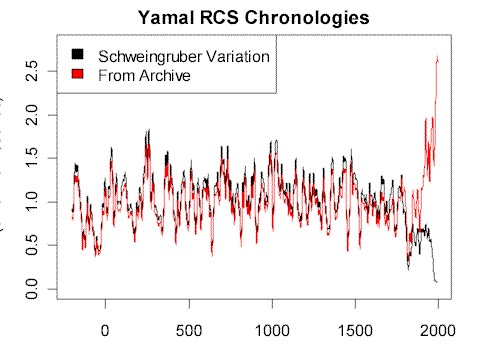
Figure 2. A comparison of Yamal RCS chronologies. red – as archived with 12 picked cores; black – including Schweingruber’s Khadyta River, Yamal (russ035w) archive and excluding 12 picked cores. Both smoothed with 21-year gaussian smooth. y-axis is in dimensionless chronology units centered on 1 (as are subsequent graphs (but represent age-adjusted ring width).
Finally, here is another graphic showing the same two RCS chronologies, but adding in an RCS chronology on the merged data set obtained by appending the Schweingruber population to the CRU archive – this time retaining the 12 cores. Unsurprisingly this is in between the other two versions, but most importantly it has no HS.

Figure 3. Also showing merged version up to 1990. (After 1990, there is only the few CRU cores and it tracks the CRU version.)
I hardly know where to begin in terms of commentary on this difference.
The Yamal chronology has always been an exception to the large-scale “Divergence Problem” that characterizes northern forests. However, using the Schweingruber population instead of the 12 picked cores, this chronology also has a “divergence problem” – not just between ring widths and temperature, but between the two versions.
Perhaps there’s some reason why Schweingruber’s Khadyta River, Yamal larch sample should not be included with the Yamal subfossil data. But given the use of a similar Schweingruber data set in combination with the Taymir data (in a case where it’s much further away), it’s very hard to think up a valid reason for excluding Khadyta River, while including the Taymir supplement.
Perhaps the difference between the two versions is related to different aging patterns in the Schweingruber population as compared to the CRU population. The CRU population consists, on average, of older trees than the Schweingruber population. It is highly possible and even probable that the CRU selection is derived from a prior selection of old trees described in Hantemirov and Shiyatov 2002 as follows:
In one approach to constructing a mean chronology, 224 individual series of subfossil larches were selected. These were the longest and most sensitive series, where sensitivity is measured by the magnitude of interannual variability. These data were supplemented by the addition of 17 ring-width series, from 200–400 year old living larches.
The subfossil collection does not have the same bias towards older trees. Perhaps the biased selection of older trees an unintentional bias, when combined with the RCS method. This bias would not have similarly affected the “corridor method” used by Hantemirov and Shiyatov themselves, since this method which did not preserve centennial-scale variability and Hantemirov and Shiyatov would not have been concerned about potential bias introduced by how their cores were selected on a RCS chronology method that they themselves were not using.
Briffa’s own caveats on RCS methodology warn against inhomogeneities, but, notwithstanding these warnings, his initial use of this subset in Briffa 2000 may well have been done without fully thinking through the very limited size and potential unrepresentativeness of the 12 cores. Briffa 2000 presented this chronology in passing and it was never properly published in any journal article. However, as CA readers know, the resulting Yamal chronology with its enormous HS blade was like crack cocaine for paleoclimatologists and got used in virtually every subsequent study, including, most recently, Kaufman et al 2009.
As CA readers also know, until recently, CRU staunchly refused to provide the measurement data used in Briffa’s Yamal reconstruction. Science(mag) acquiesced in this refusal in connection with Osborn and Briffa 2006. While the Yamal chronology was used in a Science article, it originated with Briffa 2000 and Science(mag) took the position that the previous journal (which had a different data policy) had jurisdiction. Briffa used the chronology Briffa et al (Phil Trans B, 2008) and the Phil Trans editors finally seized the nettle, requiring Briffa to archive the data. As noted before, Briffa asked for an extension and, when I checked earlier this year, the Yamal measurement data remained unarchived. A few days ago, I noticed that the Yamal data was finally placed online. With the information finally available, this analysis has only taken a few days.
If the non-robustness observed here prove out (and I’ve provided a generating script), this will have an important impact on many multiproxy studies that have relied on this study.
Questions:
Just how important is this tree ring study?
How much other research is dependent upon it?
Does this really change the debate or just leave egg on some researchers faces?
I find it disturbing, conceptually, but is this a game changer?
Philip Bratby wrote, “Science as a whole may be damaged by these revelations – how can you trust government-funded scientists in the future?”
I am a scientist in my mid-50’s and in an earlier part of my career, I did a lot of government contract supported research, mostly small projects. It was frustrating to watch a topic become “hot” and all of a sudden, all the funds would move there. The only way to maintain continuity in funding was to be able to describe the field you worked in as a subset of the hot field. This often led you in directions that were dead ends.
Climate science and global warming is definitely a hot field with $79 Billion spent over the last 20 years and now the threat of realigning the develop worlds economy around low carbon energy. They have done a better job of keeping the topic in the press than Brittany Spears has of keeping her name in the tabloids. This science publishing by press release has resulted in a politization of the science of global warming with fortunes to be made or lost based on how elected officials vote on a bill. So you end up with science being used to support political concensus rather than finding the truth. It is inevitable that this will turn out badly for all involved.
From my perspective, if the public stops automatically trusting governmeht funded scientists that is not in itself a bad thing. After all, skepticism is at the heart of all new scientific discoveries. Perhaps what we really need is a way for scientists to fund the work they do that does not involve government funding or government review for every new project that needs to get done.
So, in nutshell, removing the tinsel and baubles, the epicenter of the AGW Armageddon is – 12 trees from remote Russia.
These revelations show that AGW is second only to Global Banking as the biggest [snip] ever perpetuated on HumanKind.
I see dead scientists in Copenhagen. Not dead really, just missing in action. How great would it be if very few scientists showed up in Copenhagen in December? Lets stare a movement.
Myrddin–
I wouldn’t go that far. Proving that natural variation *could* have caused the 20th century warming is not the same thing as proving it *did*.
But, possibly, perhaps, maybe. . . if Steve’s analysis stands up. . . we’ll hear a bit less about “the science is settled”. That would certainly be a welcome step in the right direction. I’ve never said the AGWers are wrong –what annoys me is the way they throw everyone else who is unconvinced under the bus in the most insulting terms.
“REPLY: suggestion- keep screencaps of the comment page while it is awaiting moderation. -A”
It wasn’t my post. Reading the previous comment by the poster strongly suggests it was indeed this topics reference….
Philip Bratby wrote, “Science as a whole may be damaged by these revelations – how can you trust government-funded scientists in the future?”
In his farewell speech President Eisenhower warned of two threats to US democracy. Neither was external; the US was very strong militarily. Both were internal and he coined a term for each:
-Military-Industrial Complex
-Scientific-Technological Elite
The fear was government would become the dominate funding source for scientific research (it has) and fund “science” that provided results they wanted. Dr. Happer was reportedly fired from this position (directing all funding for weapons and energy research … including GW research in the Clinton admin) by Al Gore for refusing to change his views on AGW.
A government interested in expansion (i.e. Cap-and-Trade) likes the idea of AGW and resists funding projects that may disprove AGW.
Dr. Lindzen, Professor of Atmospheric Science at MIT, asserts the federal government turned climate research science into a political game by awarding grants to researchers willing to produce requested results and withholding funds from researchers asking politically incorrect questions or returning with politically incorrect results. Dr. Lindzen, a former IPCC author, is in a position to say things less renowned scientists fear to speak out.
Robert E. Phelan (12:03:09) :
Interesting to note that at Oct 14, 2007 the temp. was very close to what is being shown as the current arctic temp. Somebody’s got their data link crossed up.
Anthony – you indeed have the patience of Jobe and the wisdom of Solomon. Rather than await the rebuttal, however, count on ad hominem attacks and baseless allegations of a corrupt scientific agenda based on (to my understanding non-existent) payments from ‘big-oil’. This is no longer about science. This is big-time politics. Guys like Gore, Hansen, and their like don’t give a wit about integrity or science. It’s about their ability to make money and garner power.
Good candidate for future Quote of the Week:
“However, as CA readers know, the resulting Yamal chronology with its enormous HS blade was like crack cocaine for paleoclimatologists…”
I suppose the Team will forever be known as ” Michael Mann and The Cherry Pickers “.
I suppose too that other scientists will be very careful not to be too closely associated with the activities of MM&TCPs.
How long before The Swiss National Science Foundation who fund ADVANCE-10k group dendrochronological activities in Russia will wait before taking action against CRU to safeguard the foundation’s reputation.
I am rather at a loss to see what all of the fuss is about. A tree-ring series that demonstrably does not reflect recorded temperatures has not been included in one of Briffa’s temperature reconstructions of Siberia.
I’d understand the disquiet if a recently well-performing tree-ring proxy that diverged for earlier reconstructed temperatures had been excluded with no valid justification. But that is not what is being claimed by MacIntyre.
There’s a further reason have confidence that Briffa and coworkers have done a reasonable job – all three reconstructions give a Medieval warm period about a thousand years ago, in two of the cases actually spiking higher than today! However the temperatures of the last one-hundred years do have the highest sustained values for the last two-thousand years, at least in Northern Siberia.
REPLY: Tom P you’ve just fallen for the Texas Sharpshooter Fallacy, (I’d link to the CA post but the server is overwhelmed, find it later) but you already knew that since you posted the exact same comment over at CA. So since you didn’t get the response you were looking for over there, you decide to shop it around here?
The fact that you don’t get it suggests your ability to see outside that scientific cocoon you live in might be clouded. But hey, if you want to defend this train wreck right on top of Hadley UK “losing” key climate data, be my guest. It is after all your UK Met Office scientific credibility at stake here. -A
I think that I shall never see
A worse thermometer than a tree
A tree upon a hill so high
Might as well go read tea leaves, chicken entrails, your own naval, ANYTHING!
geo (13:36:58) :
But, possibly, perhaps, maybe. . . if Steve’s analysis stands up. . . we’ll hear a bit less about “the science is settled”. That would certainly be a welcome step in the right direction.
I’ve resigned myself to the fact that the media will never host the debate on this no matter what. They are so politically vested in AGW being true that they will never give an inch. Ever. To expect that at this juncture is incredibly naive.
So the debate will continue on the internet, and hopefully people like Anthony & Steve will continue to entice more & more people into the realm of reason — and take a piece out of the media’s ratings one person at a time until their current business strategy of scaring rather than informing people completely collapses.
They’d rather go down kicking & screaming rather than publish any evidence to the contrary.
Anthony,
No sharpshooter fallacy at all. To summarise what I posted on CA for the benefit of your readers:
It is certainly valid to select the series that act as the “best” thermometers over the known record using your justified reconstruction of choice, and then see what profile is reconstructed for prior times. This might give a warmer medieval period than today, or it might be cooler.
The process above is doing no more conceptually than calibrating a series of thermometers at the end of an experiment and then using only the records from those thermometers in calibration as a valid reflection of the thermal history of the experiment. That is not cherry picking or confirmation bias, just careful experimental science.
Looking at other graphs too the only thing to me that resembles a hockey stick is CO2 levels.
And that’s the one hockeystick you should be elated to see, the extra CO2 could allow plants to better withstand a Solar/SST induced cold period, heck I wonder if there’s certain thesholds where you start to see a clear difference in certain plants.
I ask that because currently CO2 levels are rising as part of the year-long cycle when Northern Hemisphere plants start shedding bio-material as Winter comes, my mother planted ground cover plants that act like a green carpet covering the soil while being able to walk on it, I noticed just recently an explosion of new growth in the existing areas that’s a little bigger and a brighter green. Heck for the past year or so I noticed brighter green areas on some trees that it seems is not there because the leaves are getting ready to fall off because they later deteriorate and fall off as the nights get colder, these brighter green leaves are at times bigger than the ones that grew in the spring (size differences is most pronounced in the popular river birches). On the ‘green carpet’ as I call them, sunlight is not the sole reason as the cottonwoods still have plenty of leaves to shed.
My grandmother also has a vine that’s about to cover her bird hotel again, she cut the whole thing back last year. (it hasn’t grown like that many years ago as I recall despite her good fertile garden soil)
Tom P, if 90% of the proxy data disagrees with the temperature record, then one or the other (or both) must be either wrong or irrelevant.
Meanwhile, over on the BBC:
“Four degrees of warming ‘likely’
In a dramatic acceleration of forecasts for global warming, UK scientists say the global average temperature could rise by 4C (7.2F) as early as 2060.
The Met Office study used projections of fossil fuel use that reflect the trend seen over the last 20 years.
Their computer models also factored in new findings on how carbon dioxide is absorbed by the oceans and forests…”
http://news.bbc.co.uk/1/hi/sci/tech/8279654.stm
The Met Office forecast a warm dry Winter and a hot dry Summer here in the UK. I don’t need to say how those forecasts turned out but maybe they will have a better chance with a 50 year forecast!
Bob Kutz (13:46:41) : “This is no longer about science. This is big-time politics. Guys like Gore, Hansen, and their like don’t give a wit about integrity or science. It’s about their ability to make money and garner power.”
You mean something like this:
http://online.wsj.com/article/SB125383160812639013.html
Meanwhile – The Guardian moderators have spent the day frantically deleting all references to Steve McIntyre’s latest post from its ‘Comment Is Free’ (SIC) section.
From the Hockey Rules
Broken Stick A player without a stick may participate in the game. A player whose stick is broken may continue to participate in the game if he drops the broken portion of his stick. A minor penalty shall be imposed for an infraction of this rule. A broken stick is one that, in the opinion of the official, is unfit for normal play. A goalkeeper may continue to play with a broken stick until stoppage of play or until he has been legally provided with a new stick. A player whose stick is broken may not receive a stick thrown onto the ice from any part of the rink, but must obtain a stick at his players’ bench or be handed one from a teammate. A goalkeeper whose stick is broken may not receive a stick thrown onto the ice from any part of the rink but may receive a stick from a teammate without proceeding to his players’ bench.
Rip that Nobel Prize off Al Gore and the IPCC and give it to Steve for uncovering the biggest scientific [snip] of the century.
***********************************
Tom P (14:41:34) :
“The process above is doing no more conceptually than calibrating a series of thermometers at the end of an experiment and then using only the records from those thermometers in calibration as a valid reflection of the thermal history of the experiment. That is not cherry picking or confirmation bias, just careful experimental science.”
***********************************
Tom – you don’t have any real thermometers against which to calibrate. You only have tree rings, lake sediments, etc. How do you know any given series is valid? Because it shows the MWP? What about other parts of the record? You only assume it’s valid elsewhere in time, but you don’t know it. What’s really happening is that you are selecting “thermometers” that look the way you expect.
http://en.wikipedia.org/wiki/Texas_sharpshooter_fallacy
What I am about to ask is from my own experience and from what I read from another post. When a tree is cut into sections the rings are not uniform, they will very in thickness from one side of the tree to the other side. Tree ring thickness will also vary over the length of the tree. A core sample from one side of a tree could have thicker rings than the opposite side. How can tree rings be used as a rate of growth indicator?
Hopfully, WUWT won’t mind me linking to my much stronger post on this news.
http://strata-sphere.com/blog/index.php/archives/10811
I think the evidence has grown to the point it is impossible for these slanted results to be the result of accident or incompetence.
And if science is to survive to the next century, or turn into a cult of rumor, then it is time to be more blunt. This news pretty much wipes out any and all evidence of any unnatural warming. If there was not trillion$ of dollar$ being demanded and millions of jobs on the line to reverse this mythical phenomena I think we could dismiss the errors.
But with so much human suffering as the potential result, is there any reason not to investigate the activities and motives of these people?
AJStrata
“Rip that Nobel Prize off Al Gore and the IPCC and give it to Steve for uncovering the biggest scientific fraud of the century.”
I agree that this would be wonderful. However, how likely is it that “science” will give a damn about this latest finding of fraud? I do not see any “science” in science anymore. It is mere crony-ism pretending to be science.