Of course with H1N1 influenza concerns now reaching another peak in the media, this is bound to add fuel to the fire now that NOAA has announced we’ll likely see our present weak El Niño strengthen and continue into this winter.
Of course it is all based on a model. On the plus side, he argues against greenhouse gases making stronger El Niño events. – Anthony
From a Texas A&M News release
Texas A&M researcher shows possible link between 1918 El Niño and flu pandemic
Research conducted at Texas A&M University casts doubts on the notion that El Niño has been getting stronger because of global warming and raises interesting questions about the relationship between El Niño and a severe flu pandemic 91 years ago. The findings are based on analysis of the 1918 El Niño, which the new research shows to be one of the strongest of the 20th century.
El Niño occurs when unusually warm surface waters form over vast stretches of the eastern Pacific Ocean and can affect weather systems worldwide. Using advanced computer models, Benjamin Giese, a professor of oceanography who specializes in ocean modeling, and his co-authors conducted a simulation of the global oceans for the first half of the 20th century and they find that, in contrast with prior descriptions, the 1918-19 El Niño was one of the strongest of the century.
Giese says there were few measurements of the tropical Pacific Ocean in 1918, the last year of World War I, and the few observations that are available from 1918 are mostly along the coast of South America. “But the model results show that the El Niño of 1918 was stronger in the central Pacific, with a weaker signature near the coast,” Giese explains. “Thus the limited measurements likely missed detecting the 1918 El Niño.”
Giese adds, “The most commonly used indicator of El Niño is the ocean temperature anomaly in the central Pacific Ocean. By that standard, the 1918-19 El Niño is as strong as the events in 1982-83 and 1997-98, considered to be two of the strongest events on record, causing some researchers to conclude that El Niño has been getting stronger because of global warming. Since the 1918-19 El Niño occurred before significant warming from greenhouse gasses, it makes it difficult to argue that El Niño s have been getting stronger.”
The El Niño of 1918 coincided with one of the worst droughts in India, he adds. “It is well known that there is a connection between El Niño and the failure of the Indian monsoon, just as there is a well-established connection between El Niño and Atlantic hurricane intensity,” Giese says. In addition to drought in India and Australia, 1918 was also a year in which there were few Atlantic hurricanes.
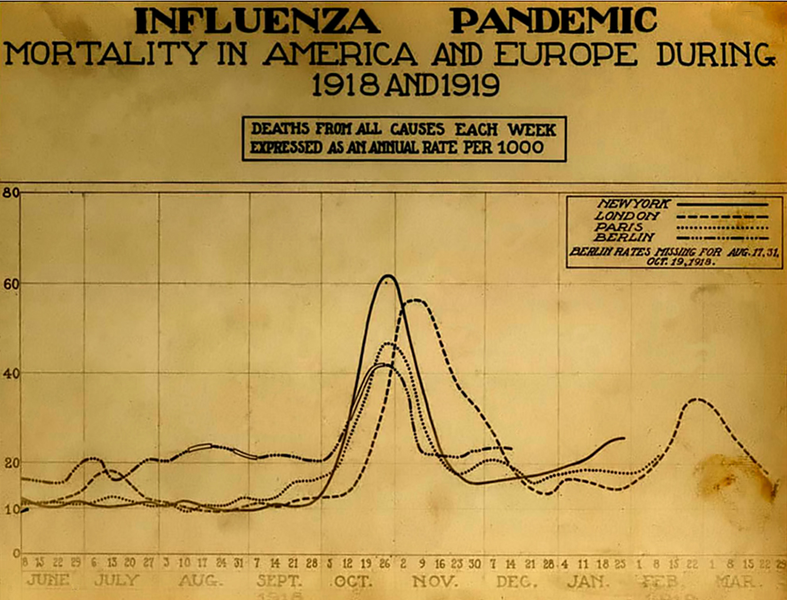
The research also raises questions about El Niño and mortality from the influenza pandemic of 1918. By mid-1918, a flu outbreak – which we now know was the H1N1 strain that is of great concern today – was sweeping the world, and the resulting fatalities were catastrophic: At least 25 million people died worldwide, with some estimates as high as 100 million deaths. India was particularly hard hit by the influenza.
“We know that there is a connection between El Niño and drought in India,” Giese notes.
“It seems probable that mortality from influenza was high in India because of famine associated with drought, so it is likely that El Niño contributed to the high mortality from influenza in India.”
The flu epidemic of 1918, commonly called the “Spanish Flu,” is believed to be the greatest medical holocaust in history. It lasted from March of 1918 to June of 1920, and about 500 million people worldwide became infected, with the disease killing between 25 million to 100 million, most of them young adults. An estimated 17 million died in India, between 500,000 to 675,000 died in the U.S. and another 400,000 died in Japan.
Could the events of 1918 be a harbinger of what might occur in 2009?
Giese says there are some interesting parallels. The winter and spring in 1918 were unusually cold throughout North America, just at the time influenza started to spread in the central U.S. That was followed by a strengthening El Niño and subsequent drought in India. As the El Niño matured in the fall of 1918, the influenza became a pandemic.
With a moderate to strong El Niño now forming in the Pacific and the H1N1 flu strain apparently making a vigorous comeback, the concerns today are obvious, Giese adds.
Giese’s work will be published in the current “Bulletin of the American Meteorological Society,” and the research project was funded by NOAA (National Oceanic and Atmospheric Administration) and the National Science Foundation.
Contact: Benjamin Giese at (979) 845-2306 or b-giese@tamu.edu or Keith Randall at (979) 845-4644 or keith-randall@tamu.edu
About research at Texas A&M University: As one of the world’s leading research institutions, Texas A&M is in the vanguard in making significant contributions to the storehouse of knowledge, including that of science and technology. Research conducted at Texas A&M represents an annual investment of more than $582 million, which ranks third nationally for universities without a medical school, and underwrites approximately 3,500 sponsored projects. That research creates new knowledge that provides basic, fundamental and applied contributions resulting in many cases in economic benefits to the state, nation and world.
Tim(13:12:10)
The black death was a specific outbreak of plague in Europe during the 1340s. The entire population of Europe at that time was about 100 Million, about 20 Million died, over several years. Wiki has a figure of 200 Million as the total number of people who may have died from Bubonic/pnuemonic/septicemic plague thoughout history. That figure is a pretty high estimate, and requires the assumption that most epidemics over a period of 400 years were plague, which is unlikely.
Holocaust is a word, “The Holocaust” occured during WWII.
The 1918 Spanish Flu is considered the worse disaster in human history because it killed 50-100 million people in a one year time period. No natural disaster, famine, war or pandemic has anyway near that body count.
I imagine few here (aside from Canadians) realize what a farce Canadian politics has degenerated into — here’s a good example with an H1N1 theme:
“It’s like sending body bags to Afghanistan for our soldiers. We’ve been asking for proper health institutions, proper health equipment. Instead, what do we get? Body bags. That’s totally unacceptable.”
“If this is preparedness, they’re sending the wrong message to our communities. Who would do such a thing?”
“This is an absolute disgrace. This is morally appalling. Instead of flu-kits, instead of preparing and planning to get the vaccine on time – instead of planning to save lives – they spent their time planning on how to deal with the deaths.”
“Health Canada refused to send hand sanitizer […] but is now sending body bags.”
“Chiefs furious after body bags sent to reserves”
http://www.ctv.ca/servlet/ArticleNews/story/CTVNews/20090916/flu_bodybags_090916/20090916?hub=TopStories
This isn’t the Canada I grew up in years ago …but I only have one vote…
Maybe my previous thoughts had legs and this is possibly another example of me thinking outside the box. What am I talking about?
I told a couple of Energy MET’s earlier this year via PM , as well as a science writer at a newspaper, about this possible connection. But my theory had a slightly different twist. The pandemics seem to have formed after the El Nino’s followed a two year La Nina event…….. Maybe this somehow causes it to mutate differently do to changing climate factors. Don’t know.
Here’s a comment I made over at eastern in their swine flu thread about “something else to consider, but it was speculative.” But you also have to be a member to read their poltical forum.
I also mentioned somewhere else in this long thread that this would go pandemic before it was declared June.
And this possible relationship would allow one to forecast pandemics well out in advance in my opinion. Or at least the chances of it happening.
Post # 2119
http://www.easternuswx.com/bb/index.php?showtopic=196339&st=2100&p=3801962&#entry3801962
Jim Hughes (05:40:54) :
I told a couple of Energy MET’s earlier this year via PM , as well as a science writer at a newspaper, about this possible connection. But my theory had a slightly different twist. The pandemics seem to have formed after the El Nino’s followed a two year La Nina event…….. Maybe this somehow causes it to mutate differently do to changing climate factors. Don’t know.
Dear Jim… Viruses are not living beings which go there mutating under environmental pressures. Viruses mutate into the host cells, when their RNA recombines and incorporates strands of the host cell’s RNA. This virus was created in pigs farms or in a lab in New Jersey in 1976.
Regards,
Nasif Nahle
But if we remember that without a spring the clock is gradually slowed down by friction, we find that this process can only be understood as a statistical phenomenon. ,
In addition, cutting edge research has shown how our environment and our behaviors can affect gene expression. ,