Of course with H1N1 influenza concerns now reaching another peak in the media, this is bound to add fuel to the fire now that NOAA has announced we’ll likely see our present weak El Niño strengthen and continue into this winter.
Of course it is all based on a model. On the plus side, he argues against greenhouse gases making stronger El Niño events. – Anthony
From a Texas A&M News release
Texas A&M researcher shows possible link between 1918 El Niño and flu pandemic
Research conducted at Texas A&M University casts doubts on the notion that El Niño has been getting stronger because of global warming and raises interesting questions about the relationship between El Niño and a severe flu pandemic 91 years ago. The findings are based on analysis of the 1918 El Niño, which the new research shows to be one of the strongest of the 20th century.
El Niño occurs when unusually warm surface waters form over vast stretches of the eastern Pacific Ocean and can affect weather systems worldwide. Using advanced computer models, Benjamin Giese, a professor of oceanography who specializes in ocean modeling, and his co-authors conducted a simulation of the global oceans for the first half of the 20th century and they find that, in contrast with prior descriptions, the 1918-19 El Niño was one of the strongest of the century.
Giese says there were few measurements of the tropical Pacific Ocean in 1918, the last year of World War I, and the few observations that are available from 1918 are mostly along the coast of South America. “But the model results show that the El Niño of 1918 was stronger in the central Pacific, with a weaker signature near the coast,” Giese explains. “Thus the limited measurements likely missed detecting the 1918 El Niño.”
Giese adds, “The most commonly used indicator of El Niño is the ocean temperature anomaly in the central Pacific Ocean. By that standard, the 1918-19 El Niño is as strong as the events in 1982-83 and 1997-98, considered to be two of the strongest events on record, causing some researchers to conclude that El Niño has been getting stronger because of global warming. Since the 1918-19 El Niño occurred before significant warming from greenhouse gasses, it makes it difficult to argue that El Niño s have been getting stronger.”
The El Niño of 1918 coincided with one of the worst droughts in India, he adds. “It is well known that there is a connection between El Niño and the failure of the Indian monsoon, just as there is a well-established connection between El Niño and Atlantic hurricane intensity,” Giese says. In addition to drought in India and Australia, 1918 was also a year in which there were few Atlantic hurricanes.
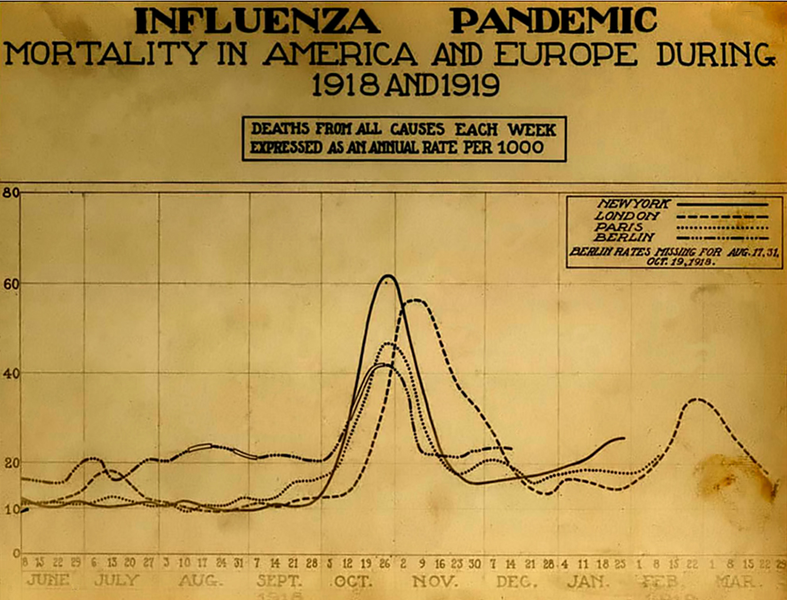
The research also raises questions about El Niño and mortality from the influenza pandemic of 1918. By mid-1918, a flu outbreak – which we now know was the H1N1 strain that is of great concern today – was sweeping the world, and the resulting fatalities were catastrophic: At least 25 million people died worldwide, with some estimates as high as 100 million deaths. India was particularly hard hit by the influenza.
“We know that there is a connection between El Niño and drought in India,” Giese notes.
“It seems probable that mortality from influenza was high in India because of famine associated with drought, so it is likely that El Niño contributed to the high mortality from influenza in India.”
The flu epidemic of 1918, commonly called the “Spanish Flu,” is believed to be the greatest medical holocaust in history. It lasted from March of 1918 to June of 1920, and about 500 million people worldwide became infected, with the disease killing between 25 million to 100 million, most of them young adults. An estimated 17 million died in India, between 500,000 to 675,000 died in the U.S. and another 400,000 died in Japan.
Could the events of 1918 be a harbinger of what might occur in 2009?
Giese says there are some interesting parallels. The winter and spring in 1918 were unusually cold throughout North America, just at the time influenza started to spread in the central U.S. That was followed by a strengthening El Niño and subsequent drought in India. As the El Niño matured in the fall of 1918, the influenza became a pandemic.
With a moderate to strong El Niño now forming in the Pacific and the H1N1 flu strain apparently making a vigorous comeback, the concerns today are obvious, Giese adds.
Giese’s work will be published in the current “Bulletin of the American Meteorological Society,” and the research project was funded by NOAA (National Oceanic and Atmospheric Administration) and the National Science Foundation.
Contact: Benjamin Giese at (979) 845-2306 or b-giese@tamu.edu or Keith Randall at (979) 845-4644 or keith-randall@tamu.edu
About research at Texas A&M University: As one of the world’s leading research institutions, Texas A&M is in the vanguard in making significant contributions to the storehouse of knowledge, including that of science and technology. Research conducted at Texas A&M represents an annual investment of more than $582 million, which ranks third nationally for universities without a medical school, and underwrites approximately 3,500 sponsored projects. That research creates new knowledge that provides basic, fundamental and applied contributions resulting in many cases in economic benefits to the state, nation and world.
The major cause of death during the 1918 influenza epidemic was “secondary” bacterial pneumonia. There were no antibiotics available to treat bacterial pneumonia in 1918.
Viral diseases spread far more effectively during the cold months because of increased availability of virus particles within aerosols originating from sneezing and coughing; the formation of such aerosols is enhanced during cold weather but is extremely limited during hot weather (reference the following citation).
Anice C. Lowen,1 John Steel,1 Samira Mubareka,1 and Peter Palese. 2008. High
Temperature (30°C) Blocks Aerosol but Not Contact Transmission of Influenza
Virus. Journal of Virology Vol 82:5650-5652.
Far more deaths occur within the United States during the 4 coldest months of the year (December, January, February, March) than occur during the 4 warmest months of the year (June, July, August, September) per CDC mortality statistics. The average over the period of 2003 through 2007 is 26,400 more deaths occurring during a cold month than during a warm month.
My grandmother died in the 1918 flu epidemic.
To see an interesting 1918 spike (tall & wide) contrast NAO (North Atlantic Oscillation) with SOI (Southern Oscillation Index) [i.e. NAO – SOI]. A sum [NAO + SOI] also produces an ‘anomalous’ spike at 1918. Note the coincidence with the “big warming” at Spitsbergen, the crash in LOD, and the crash in the Chandler wobble period. At the exact same time, precipitation started decreasing dramatically (on a decadal timescale) in mid-latitude west-coast North America (a region of normally-plentiful rainfall). This was a time of interesting pressure variations in Earth’s shells and it occurred during an episode of anomalous phase-difference between polar motion & solar system-wide oscillations. Barkin is onto something important – a missing link in our understanding.
commonsense (13:37:03) Take 3 seeds of star anise boil them in half a liter of water, and drink it three times a day, and just don’t worry, it will help you also with any stomach gases you could have.
Well,after explained how dangerous the present pandemic can be IF ONE DO NOT TAKE THE APPROPIATE MEASURES AT TIME ,preventing infection and call for emergency care at the firt symptoms (I hope the post may save some reader’s life, and so was morally mandatory to explain that), I see the report.
El Niño is not a cause of concern, outside of India.
For South Americans like me ,and also Alaskans and Canadians, the El Niño-related hot weather is exactly what is needed to stop the spread of the flu.
commonsense (13:37:03) …and last but not least…try a bit, also, of “commonsense”
Paul Vaughan (13:47:28) We’re down the road in LOD:
http://www.giurfa.com/fao_temps.jpg
El Niño is not a cause of concern, outside of India
In any case many la ninas will keep on provoking Argentinian pampas’ droughts.
See: http://www.giurfa.com/salinas.pdf
Commonsense(13:37:03)
Your figures and info aren’t accurate, while there was initially a great deal of concern in Mexico City, this flu hasn’t been the killer that the 1918 virus was.
The very best info currently coming from the CDC is that this flu is tracking very close to typical seasonal flu in terms of the infection rate and fatality rate. Early on there was great concern about the fatality rate, but of course the only cases they knew about where those that had become serious. Now that they can see the big picture, they realise that a great many more people have had the virus – and a normal mild course of illness. The fatality rate is normal for seasonal flu. Contrary to the info you have, there have been no fatalites in the US, except among the normal higher risk groups (elderly, young, sick or pregnaut). There have been NO cases of Cytokine storm.
Both my wife and I are currently recovering from the flu right now, just as our local media starts covering all the cases of H1N1 popping up in local schools. They really don’t know just how many people have really been infected.
My concern is that this virus, like the 1918 H1N1 virus, is making a pandemic wave through the population outside the normal flu season. The current flu isn’t that serious, but neither was the 1918 bug during the initial non-seasonal emergence.
I have heard all the concern in the media about the H5N1 Avian (bird) flu mutating so that it can be passed from person to person. Not very likely IMHO. I am much more concerned about H1N1 undergoing a very slight mutation that would allow it to make another pass through populations whose immune systems are primed against it.
There is a whole lot that is unknown about the 1918 pandemic, but what is known is that the 2nd and 3rd waves caused all the fatalities, the people who died are the ones who should have been best able to fight it off and the evidence seems to indicate that the cause of death was a serious overreaction of the immune system. It is entirely possible that the 1918 virus was not all that dangerous, the first time you are exposed. If it comes back again in a slightly different form, a healthy immune system was no advantage.
I am certainly not the type to get all bent out of shape by every sky is falling concern that we hear about. However I would be far less skeptical about Al Gore’s warnings if I knew that 100 million people had died of global warning 90 years ago!
If deaths from the Spanish Lady were rapid – hour to 48 hours, I have to wonder if it might have been due to cytokine storms rather than bacterial pneumonia.
If the Mexican Flu kills via cytokine storms, could it actually be a bad idea to take the vaccine? Normally I believe in the due diligence of vaccines, but if an immune system over-response is the problem. . . Maybe we should stop taking our vitamin D3 and vitamin C? If it turns into something like what reportedly Argentina experienced (and could we please have independent corroboration on that one, and not from the people still afraid of cow pox?)
Actually the black death, which swept through Europe in 1340s, did kill between 1/4 to 1/2 of the population of Europe, however that is only a few 10s of millions. There were a lot less people then, (and even fewer afterward). The black death is believed to have been Bubonic/pneumonic plague, but that isn’t certain.
Some researchers think the Black Death was a flu epidemic and not bubonic plague. One reason is that it spread throughout Iceland before rats (rat fleas are the bubonic plague vector) reached the country.
Philip_B (15:22:10)
“Some researchers think the Black Death was a flu epidemic and not bubonic plague. One reason is that it spread throughout Iceland before rats (rat fleas are the bubonic plague vector) reached the country.”
I had heard something similar, but for different reasons. One of the accounts I read of the 1918 pandemic discussed that in some areas, the 1918 virus was referred to as the “black death”. In other areas it was termed the “blue death”. In either case, victims that were progressing on a fatal path became cyanotic(?sp). Their lips and other mucus membranes became blue from lack of oxygen, soon their skin started to change shade. Doctors used this sign to tell which patients needed treatment, and which would die anyway, developing the blue color was always fatal.
The origin of the term “black death” is lost in history, it is assumed that due to the timing of the black death arriving in Europe, and the rate of spread, that the primary cause was Bubonic Plague, spread by rats, carrying fleas, which were infected by the yersinia pestis bacteria. Victims who were bitten by the fleas developed a blood born infection which caused the lymph nodes to swell to enormous sizes. The swollen nodes were referred to as buboes, hince the name “bubonic” plague. As bad as this was, much worse was when the blood born disease managed to infect the lungs of any particular victim. The transmission route could then become readily spread airborn particles, rather than fleas bites, resulting in Pnuemonic Plague, which was easily spread, and quite deadly. It is thought that the name “black plague” is a result of the fact that the area of the swollen buboes would be badly bruised and sometimes necrotic, resulting in black tissue, but that’s just a theory.
It would be possible for plague to find it’s way to Iceland without flea infected rats, if it were in the pneumonic form. That said, any sailing vessel, departing Europe in the 14th century, carrying pneumonic plague would likely never arrive at port.
I have a couple of books that are about epidemics throughout history. It’s very interesting, there are many points in history were the future would have been different, except for some disease occurring. Conditions associated with warfare are very likely to result in infections that are “game changers”.
Roddy Baird (22:50:30) : & DGallagher (19:37:21) :
Yea, i thought it was always a given that the “great war” was where the 1918 flu came from, i know it came to nz with the returning soldiers. Im sure thats how it spread so quickly.
It is clear that the researchers have fallen into the same ole IPCC-style trap. They have forgotten to account for all the other confounding factors that would influence influenza … clearly they need to allow for volcanic activity, sunspots, cosmic radiation and, of course, CO2 emmissions.
1/10 for shoddy research.
No. It is sometimes argued that the Black Death could not have been Bubonic because it spread in Iceland where there were no rats. Oddly enough that is a good reason to suppose that it was Bubonicus spread by rats/fleas.
You see Bubonicus doesn’t just kill the humans and the fleas it kills the rats too, and there are many contemporary records of the rats dying. But its real danger is its long incubation period, an infected numan might be infectious but not show symptoms for weeks, same for ratty.
But the fleas are always busy: and breed and die fast.
So perhaps the infected rats that reached Iceland died: but not before they had brought the disease. And Iceland was and is a nation of coastal settlements so ratty could travel by ship.
I think it is generally accepted that the Black Death was Bubonicus but that there might also been contemporary outbreaks of pneumonic disease or possibly Anthrax, or as likely all three since diagnosis of the time could not have distinguished them.
Moreover when such a pestilential disease strikes a population with no natural immunity it not only runs rife like wildfire but can take strange forms. And from the sheer morbidity there was no natural immunity to it.
The great famines in Europe, due to weather, were a generation earlier and so unlikely to have contributed to the violent outbreak.
And again what argues for Bubonicus was that it stayed, breaking out every few years, ever more weakly, for over three hundred years, and was known as the Plague, and then mysteriously disappeared. Well viruses mutate very quickly but Bubonicus doesn’t so generations of humans and rats slowly become immune.
But certainly the Black Death represents one of the the greatest, if not the greatest pandemic of all time with an initial morbidity of somewhere around 50% at first contact.
True there have been other great killers, smallpox, now extinct, influenza certainly, syphilis, and the like. And they may have killed in their time more humans in total than the Black Death. But none did so so violently, so suddenly, and in terms of the proportion of the population that died from the initial outbreak, so devastatingly.
It took nearly four hundred years for populations in Western Europe to recover to what they had been before the Black Death.
So who is afraid of the great big AGW monster now?
As I understand it the current thinking over the Spanish flu is that it was a human strain of about 1915 which mutated by jumping from humans into pigs and chickens and back again at a specific British Army rear support base [depot] in France in 1917. Well so the researchers say. And the movement of troops, repatriation at the end of the war and the resumption of travel and trade simply spread it. As wars always tend to do.
Could we see another pandemic like it? especially given far greater and above all faster movement of people today? possibly but I doubt it.
The circumstances of 1917 were unique in their scale, numbers of troops , chickens and pigs in one place, AND in the numbers of people moving in and out of the infectious zone.
Could we see another unexpected pandemic like the Black Death. Again I doubt it. Our medical armoury is simply too good.
Whih is not to say disease is not always with us, but count your blessings. You live in an age where, whilst not perfect, modern science has banished famine, except as a political tool of murder, has vanquished many of the great killers of mankind, and will conquer more, and offers you and your children a much better future than even you enjoy.
But the Luddites I am afraid are always with us, and love to make our flesh creep with tales of hobgoblins and the End Of Days unless we reform our wicked ways.
But then it has always been so.
Kindest Regards
wsbriggs (08:46:51) : “…If you get the flu, go to bed, do not do the rest of us any favors by “working through it.” If you have a variety that can attack the heart, you may save your life.”
My mother (a nurse) was born in 1898 and survived that period, though I don’t remember whether she got the flu or not. I do remember her saying that the people who died were the ones who wanted to show how strong they were and refused to go to bed.
WSB: “Be aware that the symptomatic difference between viral pneumonia and congestive heart failure is very small – misdiagnosis occurs. That can be fatal.”
Thanks. Good post.
Dr. Geise may be right about the size of the 1918 El Nino, but the entire concept of the paper smacks of “association, therefore causation.” I think Amir Hawk agrees.
Supercritical (00:43:50) : “During the 4 years of that war [WWI], the most stupendous ‘blip’ in CO2 emissions must have ocurred. Does this show up on the graphs?”
Probably not that big a blip of CO2, since many other things constantly cause CO2 evolution, including the oceans, etc. Also, much of the war was static, once the sides dug into trenches. Chlorine, however, is another matter. I suspect more chlorine was deliberately dumped into the atmosphere during WWI than before or since, when it was used as a WMD in the trenches. Did it affect the planet? I’m not sure. It did affect my uncle–he almost died from chlorine gas.
Gene Nemetz (20:36:49) : There has not been that many deaths from H1N1. There are deaths all the time from diseases. H1N1 deaths are not unusually high.
H1N1 deaths were initially unusually high in Mexico. There is a plausible reason why this might be. Flu kills via a cytokine storm.
http://en.wikipedia.org/wiki/Cytokine_storm
This can be disrupted via high levels of antioxidants: Vit C, E, etc.
To the extent that the world is a more prosperous place and eats better, there will be fewer deaths. To the extent folks are surviving on beans and corn with low antioxidant levels, they would be more likely to die.
So make sure your antioxidant levels are high.
Also, there appears to be increased immunity among folks like me who lived through the ’56 ’57 flu (it may have been a related variant). I can tell you that flu was really icky. But to the extent the “old and vulnerable” are really “resistant”, the population virulence will be dampened.
To the extent we have an older population, and that resistance is true, there will be a lower percentage of deaths.
FWIW, the cytokine storm is most harmful to healthy young folks, since it turns the immune system against yourself. Those with the “best” immune systems are the ones most likely to die…
But antivirals work against it, cytokine disruptors work, and simple antioxidants are very helpful.
It is interesting that there could be a connection to El Nino’s.
This popped up on another thread too. What I said there was:
Most flu variations get “brewed up” in Asia where pigs are raised over water that birds (i.e. farmed ducks) live in; all in close proximity to humans. The multiple strains of flu get to swap bits around with each other until something virulent gets put together. Then it hops onto visiting wild birds and migrates with them to the rest of the world.
It is an easy “surmise” that the migration patterns and timing of birds might be modified by El Nino and that might change their tendency to either pick up the new strains or deliver it to vulnerable populations in sync with the environmental factors that would make them susceptible.
It is also worth noting that malnutrition would tend to depend on weather cycles (crop yields) in pre-modern times that also depend on ocean current cycles. It would not take much to have a synchrony between poor crop yields, migration bringing a lot of sick birds to the local pond, and flu outbreaks.
bateman (21:59:33) :
John F. Hultquist (21:27:24) :
They say the lucky ones get it early on in this bout of H1N1.
California is ground zero in the US.
Both my spouse and her sibling got a flu this summer. It was moderately strong and is believed to have been H1N1 (we are in California, it has been found in the schools with a couple near here closed from it, and they are both teachers…). No antigen tests were done, but the context (and her doctor) point at H1N1 as probable.
Why this matters: They both got secondary pneumonia.
This argues for some mild lung damage that gave the bacteria a free field.
So, if you get “flu like symptoms”; don’t push it. Take bed rest. Pay attention to your lungs. Keep your antioxidant levels high. Ask your doctor about tamiflu and related antivirals. IF you start having lung “issues” ask your doctor about cytokine disruptors and about checking for pneumonia.
FWIW, I had a ‘sniffles scratchy throat for a day or two’ and gone. This also argues for H1N1 as I had the ’57 flu that supposedly gives some immunity.
This flu is NOT a light weight nothing. There are factors that can mitigate it’s impact, but if the population has poor medical access, low antioxidant levels, is young and overcrowded: it can be very bad.
We will likely come through this ‘about like a normal flu season’, but only if we use reasonable care to take care of ourselves and avail ourselves of modern medical care and good diets rich in antioxidants. So eat your fruits and vegetables. (And your chocolate 😉
And don’t ignore a persistent cough that lingers after the flu is gone. It took 2 different antibiotics and 2 months to finally cure the pneumonia, and she had a ‘very early stage’ pneumonia when first noticed …
bateman (21:59:33) :
John F. Hultquist (21:27:24) :
They say the lucky ones get it early on in this bout of H1N1.
California is ground zero in the US.
Let’s try that again with proper italics…
Both my spouse and her sibling got a flu this summer. It was moderately strong and is believed to have been H1N1 (we are in California, it has been found in the schools with a couple near here closed from it, and they are both teachers…). No antigen tests were done, but the context (and her doctor) point at H1N1 as probable.
Why this matters: They both got secondary pneumonia.
This argues for some mild lung damage that gave the bacteria a free field.
So, if you get “flu like symptoms”; don’t push it. Take bed rest. Pay attention to your lungs. Keep your antioxidant levels high. Ask your doctor about tamiflu and related antivirals. IF you start having lung “issues” ask your doctor about cytokine disruptors and about checking for pneumonia.
FWIW, I had a ‘sniffles scratchy throat for a day or two’ and gone. This also argues for H1N1 as I had the ’57 flu that supposedly gives some immunity.
This flu is NOT a light weight nothing. There are factors that can mitigate it’s impact, but if the population has poor medical access, low antioxidant levels, is young and overcrowded: it can be very bad.
We will likely come through this ‘about like a normal flu season’, but only if we use reasonable care to take care of ourselves and avail ourselves of modern medical care and good diets rich in antioxidants. So eat your fruits and vegetables. (And your chocolate 😉
And don’t ignore a persistent cough that lingers after the flu is gone. It took 2 different antibiotics and 2 months to finally cure the pneumonia, and she had a ‘very early stage’ pneumonia when first noticed …
Maybe it is the cool and wet summers that bring on the flu pandemics.
a jones – congratulations on your comments about the diminished role of viruses and other pathogens to our health … I’ve nominated you for a Darwin award.
E.M.Smith (01:33:05)
There is some disinfomation in your posting – I can readily believe that the flu your wife suffered from was H1N1, it is the primary flu in circulation right now, and is not at all rare – it’s all 50 states right now. However the ’57 Asian flu was H2N2, there is no cross immunity between the two.
The initial reports from Mexico City were quite alarmist, there were reports that flu was just starting to spread and yet there were already a high number of fatalites, most of which were not in the normal high risk groups. When it was determined that the virus was a H1N1 variety, as was the 1918 virus, public health officials became very concerned.
After several weeks, better information became available. There were a lot more people with the flu then had been originally thought, the fatality rate was completely normal for seasonal flus. Many of those thought to have been victims had actually died from other causes. Those that had died from the flu were in the normal higher risk groups, nothing remarkable. At the end of the day, the concern about the “swine” flu boils down to the fact that it is the same serotype (H1N1) as the 1918 virus, and it has emerged outside the normal flu season, as did the 1918 virus.
It is not factually known whether any flu kills by cytokine storm, however it is believed that the 1918 virus did. It is also likely that the H5N1 avian flu produces a cytokine storm. During any normal flu infection, there will be a large amount of cytokines in the blood stream, it is normal and necessary part of the immune response, and isn’t at all the same as cytokine storm, which is an uncontrolled feedback loop.
Tamiflu (and other anti-virals) are not recommended for those who are not in the higher risk groups, however it is recommended for pregnaut women at the first sign of infection. For some reason, the 2009 H1N1 virus seems to be affect pregnaut women more severely than the general population.
DGallagher (09:49:32) :
The initial reports from Mexico City were quite alarmist, there were reports that flu was just starting to spread and yet there were already a high number of fatalites, most of which were not in the normal high risk groups. When it was determined that the virus was a H1N1 variety, as was the 1918 virus, public health officials became very concerned.
Have you ever heard about the “Country of the Tomorrows”? Well, I live in that country, Mexico, and I can assure you that from the initial 1350 infected people living in La Gloria Veracruz, no one died by A-H1N1. Oaxaca was the first state where a person died by SWINE influenza. Almost all fatalities were due to negligence, so from the Mexican Health authorities (they thought it was seasonal influenza) as from the patients.
Talking about lab-borne viruses is like talking about religion or politics… Everyone thinks he is correct. 😉
Wiki says Black Plague killed 200 million. Wouldn’t this be a greater “medical holocaust,”? And wouldn’t any “holocaust” have to occur after the “Holocaust,” or was this a term before ww2???