Of course with H1N1 influenza concerns now reaching another peak in the media, this is bound to add fuel to the fire now that NOAA has announced we’ll likely see our present weak El Niño strengthen and continue into this winter.
Of course it is all based on a model. On the plus side, he argues against greenhouse gases making stronger El Niño events. – Anthony
From a Texas A&M News release
Texas A&M researcher shows possible link between 1918 El Niño and flu pandemic
Research conducted at Texas A&M University casts doubts on the notion that El Niño has been getting stronger because of global warming and raises interesting questions about the relationship between El Niño and a severe flu pandemic 91 years ago. The findings are based on analysis of the 1918 El Niño, which the new research shows to be one of the strongest of the 20th century.
El Niño occurs when unusually warm surface waters form over vast stretches of the eastern Pacific Ocean and can affect weather systems worldwide. Using advanced computer models, Benjamin Giese, a professor of oceanography who specializes in ocean modeling, and his co-authors conducted a simulation of the global oceans for the first half of the 20th century and they find that, in contrast with prior descriptions, the 1918-19 El Niño was one of the strongest of the century.
Giese says there were few measurements of the tropical Pacific Ocean in 1918, the last year of World War I, and the few observations that are available from 1918 are mostly along the coast of South America. “But the model results show that the El Niño of 1918 was stronger in the central Pacific, with a weaker signature near the coast,” Giese explains. “Thus the limited measurements likely missed detecting the 1918 El Niño.”
Giese adds, “The most commonly used indicator of El Niño is the ocean temperature anomaly in the central Pacific Ocean. By that standard, the 1918-19 El Niño is as strong as the events in 1982-83 and 1997-98, considered to be two of the strongest events on record, causing some researchers to conclude that El Niño has been getting stronger because of global warming. Since the 1918-19 El Niño occurred before significant warming from greenhouse gasses, it makes it difficult to argue that El Niño s have been getting stronger.”
The El Niño of 1918 coincided with one of the worst droughts in India, he adds. “It is well known that there is a connection between El Niño and the failure of the Indian monsoon, just as there is a well-established connection between El Niño and Atlantic hurricane intensity,” Giese says. In addition to drought in India and Australia, 1918 was also a year in which there were few Atlantic hurricanes.
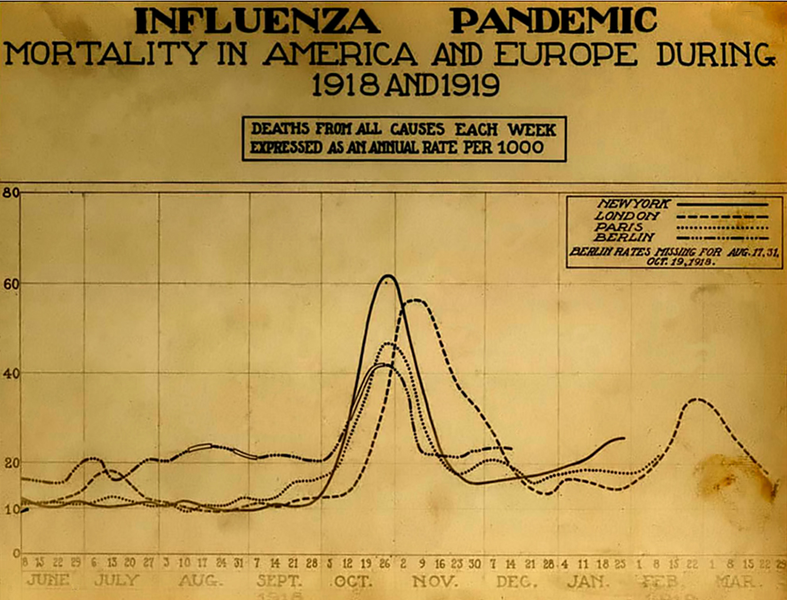
The research also raises questions about El Niño and mortality from the influenza pandemic of 1918. By mid-1918, a flu outbreak – which we now know was the H1N1 strain that is of great concern today – was sweeping the world, and the resulting fatalities were catastrophic: At least 25 million people died worldwide, with some estimates as high as 100 million deaths. India was particularly hard hit by the influenza.
“We know that there is a connection between El Niño and drought in India,” Giese notes.
“It seems probable that mortality from influenza was high in India because of famine associated with drought, so it is likely that El Niño contributed to the high mortality from influenza in India.”
The flu epidemic of 1918, commonly called the “Spanish Flu,” is believed to be the greatest medical holocaust in history. It lasted from March of 1918 to June of 1920, and about 500 million people worldwide became infected, with the disease killing between 25 million to 100 million, most of them young adults. An estimated 17 million died in India, between 500,000 to 675,000 died in the U.S. and another 400,000 died in Japan.
Could the events of 1918 be a harbinger of what might occur in 2009?
Giese says there are some interesting parallels. The winter and spring in 1918 were unusually cold throughout North America, just at the time influenza started to spread in the central U.S. That was followed by a strengthening El Niño and subsequent drought in India. As the El Niño matured in the fall of 1918, the influenza became a pandemic.
With a moderate to strong El Niño now forming in the Pacific and the H1N1 flu strain apparently making a vigorous comeback, the concerns today are obvious, Giese adds.
Giese’s work will be published in the current “Bulletin of the American Meteorological Society,” and the research project was funded by NOAA (National Oceanic and Atmospheric Administration) and the National Science Foundation.
Contact: Benjamin Giese at (979) 845-2306 or b-giese@tamu.edu or Keith Randall at (979) 845-4644 or keith-randall@tamu.edu
About research at Texas A&M University: As one of the world’s leading research institutions, Texas A&M is in the vanguard in making significant contributions to the storehouse of knowledge, including that of science and technology. Research conducted at Texas A&M represents an annual investment of more than $582 million, which ranks third nationally for universities without a medical school, and underwrites approximately 3,500 sponsored projects. That research creates new knowledge that provides basic, fundamental and applied contributions resulting in many cases in economic benefits to the state, nation and world.
WWS – from the link provided by RBateman: “The first wave was relatively mild – symptoms sufficient to incapacitate a person but with low mortality. It is referred to in some accounts as the Three Day Flu” … “The epidemic seemed to subside over the summer months. It was not until late August when the Second wave appeared- but this time with a difference -a lethal difference”.
wws (05:11:42) :
this particular flu seemed especially effective at provoking massive immune system overreactions….
This is the key observation that directly points the finger at the global vacination program… and everyone believes vacinations are “settled science” just like AGW… start digging and you will be amazed at what you find…
http://www.vaccinationdebate.com/web2.html
In the UK between 1970 and 1990, over 200,000 cases of whooping cough occurred in fully vaccinated children.
In 1977, Dr Jonas Salk who developed the first polio vaccine, testified along with other scientists, that mass inoculation against polio was the cause of most polio cases throughout the USA since 1961.
In 1979, Sweden abandoned the whooping cough vaccine due to its ineffectiveness. Out of 5,140 cases in 1978, it was found that 84% had been vaccinated three times!
In the New England Journal of Medicine July 1994 issue a study found that over 80% of children under 5 years of age who had contracted whooping cough had been fully vaccinated.
Linking the Spanish Flu to an El Nino event creates the impression that the current
Mexican Flu epidemic develops under similar circumstances.
This and some other remarks, make me conclude that this too is nothing more but an alarmist statement. Nothing more nothing less.
Except for the fact that I see this report as a clever promotion of Mr. Giese and A&M University to make themselves a name since the Mexican Flu “Pandamic” is big news today.
There always will be ideal circumstances for whatever pandemic somewhere in the world.
The biggest epidemics: smallpox, bubonic plague, cholera, aids, malaria and influenza.
The biggest killer still has to be determined but I am sure it’s not influenza that ranks the list.
He does not deny the link CO2-Global Warming.
I regard that as a missed opportunity.
He simply serves another agenda but the climate agenda.
But alarmist it is.
Wake up US people: As you are about to begin autumm it is the right time for the FLU PROPAGANDA, just ask your friends in the southern hemisphere, where we are about to begin springtime, if there was any flu whatsoever. They will all tell you that there was flu…but just in the media.
This is a case similar to Global Warming scare.
Following this post reasoning: There is no real el Nino apart from dubious data and charts and there won´t be any el nino, at leasr a big one or even moderate, it will be in any case a very feeble one, an almost emacieted and starving kid, so there won’t be any flue whatsoever. (though you will read and hear a lot of it)
Interestingly, the winter of 1997 – 98 was a really bad one for influenza here in CA. I got hit myself. Somehow, warm and wet seems to help viruses survive outside (not rocket science, considering substrate conditions, hygroscopic mechanisms, etc).
H.R. (02:24:30) :how confident can we be about the accuracy of their assertion of the strength of the 1918 El Nino?
El Nino intensities:
1917 Degree:Intense Source:Lavalle:García (1917) Murphy (1923)
1918-1919 Degree:Moderate Source:Muphy (1923) Portocarrero (1926)
http://www.cipca.org.pe/cipca/nino/nino/feni%F1o.htm
For the sake of truthfullness: THEY ARE WRONG, here, again, el nino intensities:
El Nino intensities:
1917 Degree:Intense Source:Lavalle:García (1917) Murphy (1923)
1918-1919 Degree:MODERATE Source:Muphy (1923) Portocarrero (1926)
Link:
http://www.cipca.org.pe/cipca/nino/nino/feni%F1o.htm
My only comments on the flu are these, within the pantheon of flu bugs, there are at least 3 which, if not properly treated (bed rest, fluids, etc.), will evolve and attack the heart. It’s called viral cardiomyopathy and I’ve been a victim.
If you get the flu, go to bed, do not do the rest of us any favors by “working through it.” If you have a variety that can attack the heart, you may save your life.
Be aware that the symptomatic difference between viral pneumonia and congestive heart failure is very small – misdiagnosis occurs. That can be fatal.
It doesn’t take H1N1 to ruin your day.
This is a LIE which originates in the same source, as the global warming/climate change scam: The UN. We should call it the WHO (World health organization) VIRUS.
You can try to correlate anything to anything else – why not El Nino and flu? Of course the 1918 flu had certain properties that made it deadly that could not have been related to weather.
WWS(5:11)
“One of the hallmarks of the 1918 flu was that the stronger and healthier a person was, the more likely they were to die quickly from it, which meant that it hit healthy adults in their 20’s and 30’s harder than any other segment – a uniquely perverse hallmark of that particular epidemic. Barry does a very good job of explaining why this happened from a medical perspective; this particular flu seemed especially effective at provoking massive immune system overreactions, which were the worst in the people with the healthiest immune systems. Their lungs would clot and swell completely shut within 48 hours, it was horrific.”
The overreaction of the immune system (to the 1918 flu) is believed to be a “cytokine storm” (not a weather event). The immune system has a mechanism that moderates it’s reactions, so that the immune response doesn’t damage healthy tissue. In a cytokine storm, the immune system reacts strongly and fails to moderate, in effect there is a feedback loop. The effects can be similar to hemorragic fevers (bleeding from mucus membranes, fluid collecting in the lungs, etc.). It is believed that cytokine storms are responsible for the deaths in Hong Hong due to SARS (2003) and that the human deaths from the H5N1 avian flu are due to cytokine storm.
Last week the CDC announced that the new vaccine was much more effective than they had hoped. The expectation was that two doses would be required, and that it would take several weeks for meaningful immunity to develop. Testing of the new (H1N1) vaccine shows that a single dose results in strong immunity within just a few days. The CDC thinks that this is wonderful news, but I’m not so sure. To date, none of the deaths due to the current H1N1 virus have shown any signs of cytokine storm.
BTW : Don’t get any shots of distilled water for a lot of bucks!. Save syringes and Save the planet!
Gallagher has explained it very clear [DGallagher (09:03:46)]. I would add only that the lymphocytes overreact by cytokines stimulus and kill healthy cells of lung tissue. The virus attack the tissue cells, then the macrophages are produced for disable the virus. However, as the macrophages enter the damaged tissue, the viruses attack them and the macrophages throw a chemical SOS. Then the cell killers are produced and enter the organs affected to kill every infected cell. Nonetheless, the cell killers destroy also healthy cells due to the excess of cytokines in tissues.
I do not agree with many things issued by the WHO. One is that the virus is seasonal. This is not real because the cases of A-H1N1 have not decreased during this summer. Something else which I disagree with is about mass vaccination. I think the vaccine is useless, the virus was intentionally spread and not only tamiflu cures the disease.
By the way, the swine influenza did not start in Mexico. The first cases of the current strain of A-H1N1 appeared in Fort Dix, NJ, in 1976.
Re: MalagaView (23:25:56)
There was no consensus on what caused the disease until about a decade after the pandemic ended IIRC. The doctors at the time – and many had never even attended medical school nor was there any active medical accreditation yet – mostly assumed it was caused by a bacterium. Any vaccination efforts would have been directed to the wrong target. There were places in the US where the common assumption was that the flu was spread by dogs and every dog in the community was killed. The custom of covering the mouth when coughing may have originated during the pandemic or been greatly strengthened socially. Spitting on the sidewalk was made a jailable offense in some towns as well. The Great Influenza by Barry offers a good history.
@Nogw (08:11:51) :
“H.R. (02:24:30) :how confident can we be about the accuracy of their assertion of the strength of the 1918 El Nino?
El Nino intensities:
1917 Degree:Intense Source:Lavalle:García (1917) Murphy (1923)
1918-1919 Degree:Moderate Source:Muphy (1923) Portocarrero (1926)
http://www.cipca.org.pe/cipca/nino/nino/feni%F1o.htm“
Thanks, Nogw. Much appreciated.
So then… why did they need a model to reconstruct the El Nino when someone has already been there and done that?
I’m underwhelmed by the article. Seems to be a “groceries and rent” study to me.
Ron de Haan (07:56:47)
“There always will be ideal circumstances for whatever pandemic somewhere in the world.
The biggest epidemics: smallpox, bubonic plague, cholera, aids, malaria and influenza.
The biggest killer still has to be determined but I am sure it’s not influenza that ranks the list.”
Yes and no – There are diseases that have killed a lot of people over a long period, but these are all lumped together over time, rather than being divided into specfic outbreaks as is the case with flu. Annually, influenza infects about 3-5 million people, with up to 500,000 deaths. In just the US, there are about 200,000 hospitalizations for flu each year and an average of 36,000 deaths.
Smallpox killed over 300 million people worldwide in the 20th century.
Plague/Black death killed about 100 million in Europe, Asia and Africa between 1300 -1800 AD.
Measles, about 200 million worldwide over the last 150 years.
Malaria, 80 – 250 Million, worldwide 1900 – present
TB, 40 – 100 Million, worldwide 1900 – present
HIV/ AIDS – about 25 million infected, worldwide 1981 – present
In contrast:
SARS – 775, mostly Asia 2002-2003
West NIle Virus – 677, North America 1999-2004
Avian H5N1 flu – 256, Mainly Asia 2003 – present
Flu
Hong Hong flu H3N2 – 750,000, worldwide 1968
Asia Flu H2N2 – 4,000,000, worldwide 1957
Spanish Flu H1N1- 50-100 million worldwide 1918-1919
As far as the greatest human killer of all time, Influenza is right up there. Smallpox, measles and Plague aren’t big killers any more, but flu goes right on, killing about 1/2 million people a year, it doesn’t take too long to rack up a big body count at that rate.
Look through the literature on the 1918 Flu you’ll find that there were apparent outbreaks as early as 1916 (anecdotal cases and outbreaks reported from Europe in 1916 and 1917 (8) and the United States in early 1918 (9-11) were caused by a virus related to the pandemic virus remains speculative.)
http://www.pnas.org/content/102/31/11059.full
I don’t know how any 1918 El Nino links to this? But it appears there was an El Nino in 1915
http://www.science-house.org/nesdis/elnino/background.html
Now for the scary bit
http://www.hmforces.co.uk/news/articles/688-hell-on-earth-half-the-worlds-population-were-victims-of-spanish-flu-pandemic
———-It was unusual for flu to strike in the summer months, but the first significant civilian outbreak was in Glasgow in May 1918. The initial wave was not especially virulent and there were few fatalities.————-
Next they’ll be saying the MWP caused the black plague.
Isn’t speculation fun?
The 1918 pandemic came in 3 or 4 waves. The big killers were the 2nd and 3rd waves. We know little about the 1st wave, but it probably wasn’t that much different from the last 6 months of the swine flu epidemic.
There are a number of contemporary records that say those infected in the first wave were more likely to die in the second or third wave. The reason may well be the difference between dengue fever and dengue hemorhagic fever, and the reason there is no dengue vaccine.
And on the El Nino link, I don’t think it is beyond the realm of possibility that the flu virus’s epidemic/pandemic lifecycle is synchronized with the Earth’s climate cycles.
The flu virus has clearly evolved over long periods to spread by means of species jumping epidemics and some weather conditions would be more conducive to its spread.
Well a “possible link” is NOT a “probable cause”; so nothing here to see; return to your seats.
George
The point is that viruses are not living beings, they are not cells and don’t achieve a proton motive force which all living beings need for obtaining energy. Viruses don’t have any thermoregulatory system and they don’t reproduce without cell hosts and have not part into the biomes; hence, I don’t see how an abiotic particle could be affected by climate. It is the same as saying that the salt grains would be affected by El Niño.
I remember in my first statistics classes being invited to correlate all manner of events in cities (births, deaths, marriages, murders, burglaries you can name it) to the number of ministers in cities. We thought we had discovered a great conspiracy until he lead us to the realisation that maybe the causality was a function of population size. How do these things get published when there is not a single attempt to falsify the hypothesis?
Lars Kamél (01:02:08) :
“The greatest medical holocaust in history surely must be “the black death” in medieval Europe and Asia. It killed about one third of the population in Europe. I don’t know what was the death poll in Asia, but probably it was similar. The Spanish flu is nowhere near those numbers.”
Actually the black death, which swept through Europe in 1340s, did kill between 1/4 to 1/2 of the population of Europe, however that is only a few 10s of millions. There were a lot less people then, (and even fewer afterward). The black death is believed to have been Bubonic/pneumonic plague, but that isn’t certain. It is believed that the total number of deaths from all outbreaks of bubonic plague, wordwide, throughout history (including the black death, the Plague of Justinian,The Great Plague of London and the Third pandemic) may total as high as 200 million. However, most of the epidemics between 1300 and the mid 1800s were referred to as “plague”, and certainly many were not actually due to Bubonic Plague.
A reasonable estimate of the number of people killed by Plague throughout history is about 100 Million, which is the same as the high side estimate for the number of people that died in a single outbreak of flu in 1918.
There is pretty much universal agreement that the worst pandemic of human history was the 1918-19 spanish flu (total number of deaths not % of population). Naturally there were factors involved, greater population, more mobility, WW I, etc. However the flu took a heavy toll in isolated parts of the world that weren’t effected by those factors.
I have read many horrific stories about the effects of that pandemic – mass graves, whole villages wiped out, women getting on the subway in NYC feeling a little sick and dying during the ride, and so on. But something that really struck me, i’m not sure why, were stories about people getting attacked by packs of starving, abandoned dogs. Things are pretty bad at that point.
Of course, the widespread displacement of people due to coastal flooding as a result of the collapse of the icesheets, the global famine that will follow the prolonged drought, the proliferation of natural disasters and increased incidence of kidney stones all brought about by global warming will make a lethal pandemic seem pretty mild by comparsion.
SOI it is again in the positive,…la nina back?
http://eldersweather.com.au/climimage.jsp?i=soi
Nasif Nahle (11:38:30) :
The point is that viruses are not living beings
Do you see any resemblance in them with some GWRs?
The 1918-1920 A/H1N1 Pandemic (yes , it was H1N1 and began in April 1918) KILLED MORE PEOPLE THAN WWI AND WWII COMBINED: 100 MILLION.
What was the mortality rate? 4% , yes JUST FOUR %.
Compare the mortality rates this year (read clearly Argentina):
Worldwide: 0,6%
Mexico: 1,5%
ARGENTINA: 5% (This is 2009, not 1918)
source: ECDC
Seasonal influenza: 0,05% (estimate based on deaths and an infection rate of 1/3 human population)
Ratio between seasonal and 2009/AH1N1 mortality:
Worldwide: 10 times more deadly
Mexico: 150 times more deadly
ARGENTINA: 500 times more deadly (This is 2009, not 1918)
Every year seasonal flu kills 500 000 people worldwide, mainly among weakened people (source: WHO)
For 2009: MINIMUM 5 MILLION DEATHS, mainly among healtly and young people. (source: elementary arithmetics)
Proportion of already ill people killed by the virus: just 30% (source: PAHO)
Killer mechanism: auto-immunitary cytokine storm ( stronger the immune system, stronger the illness).
So, this is not a joke!
Avoid massive gatherings, never touch your face without washing your hands and call the emergency attention at the firt symthoms:
sore troat,
fever over 38ºC,
generalized pain,
diarrea,
cough
If you do`’t geyt the antivirals, there is a 10% chance of cytokine reaction when the virus spread to the lungs (specially among young ,healthy adults ,over 10 and under 30 years old), so you can have:
Bronchiolar necrosis
lungs filled with dead immune cells and fluids ( viral pneumonia)
multi-organ failure
Then you drown in your own fluids and blood, and die.
THE MEDIA DON’TEXAGGERATE, THEY IGNORE AND COVER THE EMEERGENCY!
Look for first hand information: WHO, PAHO, ECDC, CDC, articles in Nature, Science, The New England Journal of Medicine.
Read the info and save your lifes!