Leif Svalgaard has been saying for sometime now that Solar Cycle 24 seems to be getting underway. Seeing sunspot group 1024 today, I’m tending to agree.

The magnetic polarity (seen on the SOHO magnetogram) of the spot group combined with the middle latitude indicates it is a cycle 24 spot.
From Spaceweather.com
The most active sunspot of the year so far is emerging in the sun’s southern hemisphere: movie. Sunspot 1024 has at least a dozen individual dark cores and it is crackling with B-class solar flares. This morning, amateur astronomer David Tyler caught one of the flares in action from his backyard solar observatory in England:

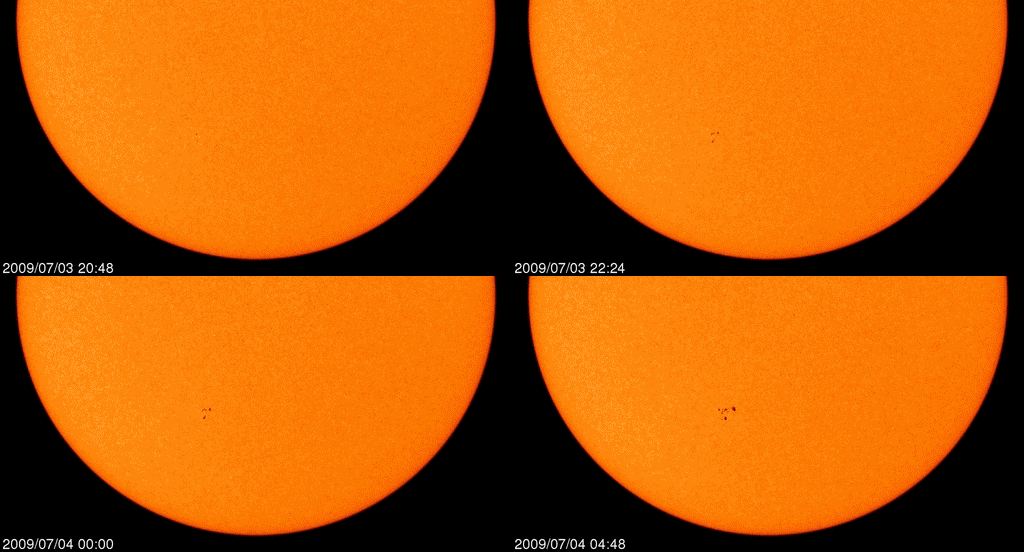
The magnetic polarity of sunspot 1024 identifies it as a member of new Solar Cycle 24. Its rapid emergence on July 3rd and 4th continues the recent (few-month) trend of intensifying new-cycle activity. This sunspot is the best offering yet from the young solar cycle.
I agree. This one looks like a “normal” sunspot. The question now is: how long will it last? Many promising cycle 24 sunspots have fizzed just as quickly as they arrived. Cycle 24 has not yet shown any indications of spot stamina.
In other news, the SOHO satellite has developed a problem with its pointing motor for the high gain antenna.
This is a serious concern, and data outages are already happening due to limited pointing ability. There is a backup spacecraft for SOHO in the pipeline, the Solar Dynamics Observatory, set for a November 2009 launch date. It has recently been shipped to Cape Canaveral. Lets hope the didn’t use the US postal service or DHL.
In other solar satellite news…
Goodbye Ulysses (July 3, 2009)

Hi-res TIF image (4.6M)
Upon receipt of the last command from Earth, the transmitter on Ulysses switched off on June 30, 2009, bringing one of the most successful and longest missions in spaceflight and solar study history to an end. After 18.6 years in space and defying several earlier expectations of its demise, the joint ESA/NASA solar orbiter Ulysses achieved ‘end of mission’. The craft is nearly out of hydrazine fuel for its stabilizing thrusters, and there’s not enough money to continue the mission for another year. A final communication pass with a ground station enabled the final command to be issued to switch the satellite’s radio communications into ‘monitor only’ mode. No further contact with Ulysses is planned.
Ulysses is the first spacecraft to survey the environment in space over the poles of the Sun in the four dimensions of space and time. Among many other ground-breaking results, the hugely successful mission showed that the Sun’s magnetic field is carried into the solar system in a more complicated manner than previously believed. Particles expelled by the Sun from low latitudes can climb up to high latitudes and vice versa, even unexpectedly finding their way down to planets. Regions of the Sun not previously considered as possible sources of hazardous particles for astronauts and satellites must now be carefully monitored. “Ulysses has taught us far more than we ever expected about the Sun and the way it interacts with the space surrounding it,” said Richard Marsden, ESA’s Ulysses Project Scientist and Mission Manager.
So farewell, and congratulations on a job exceedingly well done.
Don’t you see certain beauty in the Hathaway’s magnetic butterfly diagram?
http://solarscience.msfc.nasa.gov/images/magbfly.jpg
Science and art have gone arm in arm trough the centauries.
Remember renaissance.
vukcevic (09:27:34) :
I think it is Von Newman, http://en.wikipedia.org/wiki/Von_Neuman , who is credited with the saying: give me four parameters and I can fit any functional form, with a fifth I can fit an elephant.
I counted five parameters in your formula.
It is the same problem in simplified form, with the General Circulation Models that are so bad in predictions though they back fit. The modelers are also enamored with the beauty of their models, but it has not much to do with the future, in my opinion.
Tenuc (10:04:12) :
The correlation to-date looks very good, if not a little worrying.
But science it ain’t. It completely fails in the past, as it predicts a solar cycle with constant length: 10.81 years for all cycles, except a cycle every 120 or so years [~1782, 1903, 2023], where the predicted length is between 0.5 and 5 years. It is also not based on sound physics and is pure numerology.
anna v (11:01:21) :
It is the same problem in simplified form, with the General Circulation Models that are so bad in predictions though they back fit.
And Vuk’s formula doesn’t even ‘back fit’.
anna v (11:01:21) :
I think it is Von Newman, ….give me four parameters and I can fit any functional form, with a fifth I can fit an elephant.
Maybe poor man saw only a two dimensional line drawing of an elephant.
anna v (11:01:21) :
…….. The modelers are also enamored with the beauty of their models, but it has not much to do with the future, in my opinion.
To quote one of my compatriots (whose name, as it happens, is the unit of measure for the intensity of magnetic polar field that I have plotted)
“The present belongs to them; the future I am creating for.”
(loose translation)
Drs Leif Svalgaard & Frank Hll
perhaps you could comment on the observed phenomena: one half of the present SS group racing forward (just in a space of one day) as shown here:
http://www.vukcevic.talktalk.net/2009-07-04.gif
which I think it cannot be attributed to differential rotation over such small difference in latitude.
Hi all,
Today’s estimated ISN is 17. The last time it was this high was March 2008. Maybe it is finally starting to pick up. I personally am really favoring Leif’s forecast of a low but still definitely visible cycle. As for the next one, we’ll just have to see. I’d also be interested in hearing the basis of Dr. Archibald’s prediction that things would ramp up in June, which seems to have more or less verified.
Regards to all,
Paul
vukcevic (12:02:00) :
one half of the present SS group racing forward (just in a space of one day) […] which I think it cannot be attributed to differential rotation over such small difference in latitude.
It is quite usual that sunspot groups show considerable ‘eigen’-movements, like pulling apart, rotating, etc. In fact, such movements [caused by the roiling solar plasma with its frozen-in magnetic field being dragged along by the plasma] tend to increase the energy stored in the magnetic field, thus increasing the chance and severity of flaring. Nothing unusual here.
As ever, the proof of the pudding will be in the eating. I have a copy of the graph for future comparison against reality.
As past history shows, causality can be a curious thing.
Paul Stanko (12:05:44) :
the basis of Dr. Archibald’s prediction that things would ramp up in June, which seems to have more or less verified.
If memory serves that would be June 2010, but in any case it would be of interest to see what the basis is.
Leif Svalgaard (12:11:33) :
It is quite usual that sunspot groups show considerable ‘eigen’-movements, like pulling apart, rotating, etc.
I can comment a bit further on this. The ‘canonical’ picture of a sunspot group attributes it to a strong ‘flux rope’ or bundle of flux strands that have reaches to surface at on point of their extent. The plasma ‘beta’ that determines whether the field moves the plasma or the plasma moves the field changes from greater than one [plasma moves field] to less than one [field moves plasma] in the lower corona to greater than one again [plasma moves field] in the solar wind, so just above the surface the flux rope can be considered ‘cut’. As a magnetic flux rope is under strong tension [along the rope], one could imagine that the tension in the subsurface rope would pull apart the two bipoles of a sunspot group. This is kind of the ‘traditional’ view [that may not be correct]. Helioseismolgy seems to indicate that the flux ropes are actually cut somewhere below the photosphere [and thus not extending to any great depth, sunspots thus being shallow phenomena, lacking deep ‘roots’], scuttling this simple-minded ‘explanation’. But perhaps Frank could educate us more about this.
Tenuc (12:12:33) :
As past history shows, causality can be a curious thing.
What purports to predict the future must also explain the past.
Tenuc (10:04:12) :
The correlation to-date looks very good, if not a little worrying.
Leif Svalgaard (11:33:39) :
But science it ain’t. It completely fails in the past, as it predicts a solar cycle with constant length: 10.81 years for all cycles, except a cycle every 120 or so years [~1782, 1903, 2023], where the predicted length is between 0.5 and 5 years. It is also not based on sound physics and is pure numerology.
Dr. Svalgaard
You are attributing to my formula power of recreating the past that we do not know. It cannot be said with any degree of certainty what was the intensity of PF even as recently as 1964, since there were no means of measurement (excluding some Russian dubious estimates in 1965).
To go back as far as 1782 is stretching scientific credulity.
Polar field formula
http://www.geocities.com/vukcevicu/PolarField1Cr.gif
is a version of SS formula advanced by some 3 years (intentionally factor is left as t-1940-3).
What we know is a SS record with a reasonable accuracy. Formula can retrace that relatively successfully.
If you wish TO RETRACE SUNSPOT RECORD WHICH WE DO KNOW, AND NOT POLAR FIELDS WHICH WE DO NOT KNOW
than you or anyone else should use
http://www.geocities.com/vukcevicu/Solar_cycles.gif
which I have brought to your attention before.
You can read estimated peak value of the past solar maxima from the middle graph or calculate it from its equation. Use anomaly graph at bottom to reduce value by 25-30% whenever it indicates low cycle.
Alternatively, you can use the two equations at the top graph (Y1 equation gives you a point in time of a maximum, which you then use to calculate the amplitude of that max by using Y2 equation ), again in conjunction with the anomaly graph, reduceing value by 25-30% whenever it indicates low cycle.
If you whish to imbue the polar field formula with powers of retracing the past PF (not recomended, since they are not known, it would be just a speculation) than you should also use it IN CONJUNCTION WITH THE ANOMALY GRAPH.
I would be grateful if you perhaps take a note of the above and not misrepresent my case.
Thank you.
Leif Svalgaard (12:11:33) :
I can comment a bit further on this. … The plasma ‘beta’ that determines whether the field moves the plasma or the plasma moves the field changes from greater than one [plasma moves field] to less than one [field moves plasma]………
It is a surprisingly large velocity of plasma across the solar surface: I estimate the distance of ‘stretching’ to be about 8% of the solar radius or 55,700km during 24 h ( 2,320 km/h =1.9 Mach), nearly twice the speed of sound, which one might classify as an explosion rather than a movement or flow of plasma.
I wonder if Dr. Frank Hll, being an expert on the plasma flow would comment.
For the above comment please refer to:
http://www.vukcevic.talktalk.net/2009-07-04.gif
That there was solar charged particle interaction with the Earth’s magnetosphere which resulted in geomagnetic storms has been known for 30 years, but the exact dynamics and morphology have only recently been determined by NASA in situ satellite probes (THEMIS).
And this Sun/Earth electromagnetic relationship turned out to be much more dynamic than NASA or most anybody else thought possible.
“We knew it all along”, is the refrain of somebody who wants to downplay the relationship and continue thinking the same old thoughts.
No, this dynamic is remarkable and significant.
And opposed to some that want to downplay this physical relationship because it contradicts their professional opinion, there is a need to fully understand the phenomenon.
We are not there yet.
Jim Hughes (05:16:44) :
And the penumbra on the big spot was clearly visible in a 4″ projection..
No squinting required.
anna v (11:01:21) :
…….. The modelers are also enamored with the beauty of their models, but it has not much to do with the future, in my opinion.
I’ve always wondered why the modellers don’t build a model to predict the future winners of the Aintree Grand National or the Kentucky Derby, for example. They can use all the historical data to build their model and then model the future! There have to be less variables involved than trying to predict the future climate! They’d make a fortune on the horses!!
Hmm. Maybe they are making more money modelling the climate…
That was true but you need to view it in context of the time and the base of experience of the folks on the trail west. It was totally unsuitable for the type of farming and crops that they were accustomed to based on their experience in the Mississippi valley and central eastern plains states.
The Average annual precipitation in the High plains (Colorado, Wyoming etc.) classifies them as semi-arid regions (they are borderline deserts in periods of drought)
For example the Annual average precipitation in Colorado is about 15.31 inches of water. Yet this June we had the second wettest month in recorded history at 4.86 inches of precipitation in just one month, compared to the all time record (since 1872) of 4.96 inches. The dryest June on record was 1888 when only a trace was recorded for the month of June.
We have very high variability in precipitation.
Annual Precipitation (INCHES) Colorado
RECORD
MAXIMUM 23.31 1967
MINIMUM 7.48 2002
Our snow season this year ended with 38.1 inches of snow compared to an average of 67.1, our June average temperature was 3.2 deg F below average in 2009.
The Pioneers went from moist low altitude plains states with broad leaf forests and long grass prairies to the high plains which are near desert conditions in a matter of a few hundred miles and a month or so on the trail. Once the climbed out of the Missouri and Mississippi river drainage and started to enter the short grass prairies the climate dried out very rapidly. Since they began their travel in the spring the effect was aggravated by the changing weather as they moved into the heat of the summer, and left the cool wet spring weather behind as well.
High planes states: (short grass prairie )
Montana 11.37
North Dakota 15.36
South Dakota 17.47
Wyoming 13.31
Colorado 15.31
New Mexico 8.91
Eastern Plains (long grass prairie broad leaf forests)
Kansas 28.61
Missouri 33.91
Minnesota 26.36
Nebraska 30.34
Now compare annual rainfall numbers for the states many of the pioneers were coming from :
Illinois 33.34
Indiana 39.12
Iowa 34.71
Ohio 37.77
Pennsylvania 40.26
Kentucky 43.56
There was a period of unusually wet weather during the time around the gold rush and after in the late 19th century that led to the theory that “The rain follows the plow”. Settlers thought that by turning the earth as they settled the prairie, that they had “modified the climate” through human intervention, increasing rain fall. Unknown to them they were simply experiencing a wet cycle of natural variability.
They were proven wrong during the dust bowl when Mother Nature showed they were assigning anthropomorphic causes to natural variation. As a result their attempts to turn and plant every piece of available ground thinking they could manipulate climate and get unlimited farm production, was actually the worst possible thing they could do.
When natural climate variation shifted to the dry cycle their “sod busting” unleashed the dust bowl and decades of desertification due to the blowing dust and stripped top soil.
Perhaps there is a lesson there for the current AGW supporters ?
Naw they could not be wrong again!
Larry
vukcevic (14:05:45) :
You are attributing to my formula power of recreating the past that we do not know.
No, you are claiming that you can predict the future from planetary movements, therefore you can also tell the past. The solar cycles have different lengths, but your formula for polar field reversals show them all to have the same length [apart from the few times where the formula fails], so you are in effect claiming that polar field reversals are not synchronized with the solar cycles. Well, a test of this awaits us, as your formula predicts a reversal in 2011 [being already a year off and assuming that it stays a year off]. Now, why is all this important? Because, in our time, pseudo-science is on the upswing and must be countered. Granted that there are too many charlatans for this countering to have much effect, it must still be attempted.
vukcevic (14:36:11) :
( 2,320 km/h =1.9 Mach), nearly twice the speed of sound, which one might classify as an explosion rather than a movement or flow of plasma.
Speed of sound where? Solar movements are typically of the order of 1 km/sec.
James F. Evans (15:08:50) :
We are not there yet.
You are not there yet. The THEMIS results just confirm what we thought all along, which is, of course, important. NASA press releases always label everything a ‘breakthrough’ and everything as ‘never seen before’. From their press release:
“These observations confirm for the first time that magnetic reconnection triggers the onset of substorms. The discovery supports the reconnection model of substorms [which is 30 years old], which asserts a substorm starting to occur follows a particular pattern.”
Can someone wipe clean my screen, it must be dirty… what else?
Leif Svalgaard (21:10:45) :
Speed of sound… does that apply in space?
Anecdotal:
Though our June was average to warm, we are having a rare July in Greece. It is more like September with temperatures five to ten degrees less than what happens at this time, humidity and rains inland. I regret not keeping a diary. There was a July like this in the middle of the 1990’s but I cannot remember the date really to be able to say it was during the previous SSP minimum. I call our summer air conditioned if the temperatures do not go much over 30C and nights are cool enough to cool the houses.
Of course I am talking of the seaside where I have my holiday cottage ; the urban temperatures are three to four degrees higher, as per usual summer and winter.
Since meteorologists are predicting this I suspect fronts have been moving higher or lower than average, as the case may be.