Leif Svalgaard has been saying for sometime now that Solar Cycle 24 seems to be getting underway. Seeing sunspot group 1024 today, I’m tending to agree.

The magnetic polarity (seen on the SOHO magnetogram) of the spot group combined with the middle latitude indicates it is a cycle 24 spot.
From Spaceweather.com
The most active sunspot of the year so far is emerging in the sun’s southern hemisphere: movie. Sunspot 1024 has at least a dozen individual dark cores and it is crackling with B-class solar flares. This morning, amateur astronomer David Tyler caught one of the flares in action from his backyard solar observatory in England:

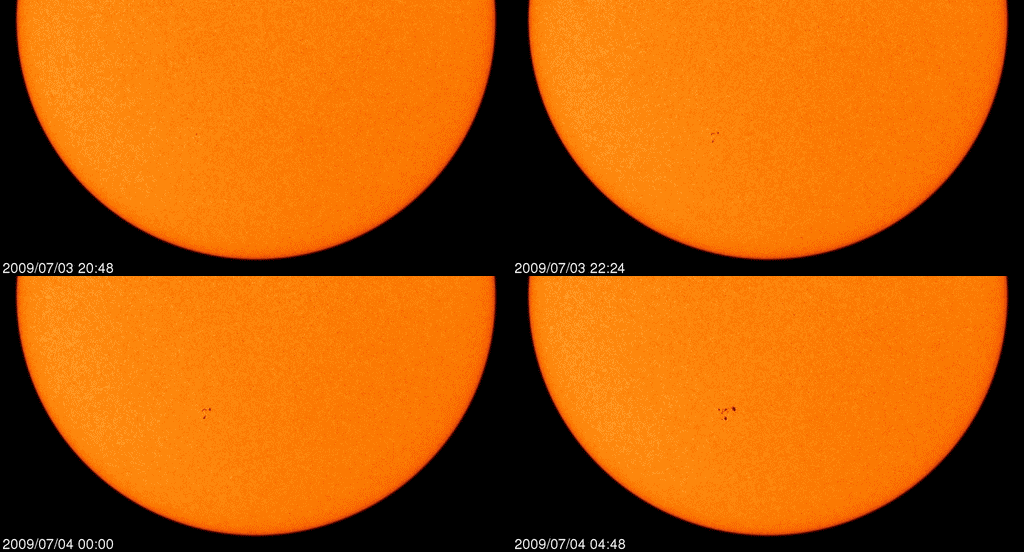
The magnetic polarity of sunspot 1024 identifies it as a member of new Solar Cycle 24. Its rapid emergence on July 3rd and 4th continues the recent (few-month) trend of intensifying new-cycle activity. This sunspot is the best offering yet from the young solar cycle.
I agree. This one looks like a “normal” sunspot. The question now is: how long will it last? Many promising cycle 24 sunspots have fizzed just as quickly as they arrived. Cycle 24 has not yet shown any indications of spot stamina.
In other news, the SOHO satellite has developed a problem with its pointing motor for the high gain antenna.
This is a serious concern, and data outages are already happening due to limited pointing ability. There is a backup spacecraft for SOHO in the pipeline, the Solar Dynamics Observatory, set for a November 2009 launch date. It has recently been shipped to Cape Canaveral. Lets hope the didn’t use the US postal service or DHL.
In other solar satellite news…
Goodbye Ulysses (July 3, 2009)

Hi-res TIF image (4.6M)
Upon receipt of the last command from Earth, the transmitter on Ulysses switched off on June 30, 2009, bringing one of the most successful and longest missions in spaceflight and solar study history to an end. After 18.6 years in space and defying several earlier expectations of its demise, the joint ESA/NASA solar orbiter Ulysses achieved ‘end of mission’. The craft is nearly out of hydrazine fuel for its stabilizing thrusters, and there’s not enough money to continue the mission for another year. A final communication pass with a ground station enabled the final command to be issued to switch the satellite’s radio communications into ‘monitor only’ mode. No further contact with Ulysses is planned.
Ulysses is the first spacecraft to survey the environment in space over the poles of the Sun in the four dimensions of space and time. Among many other ground-breaking results, the hugely successful mission showed that the Sun’s magnetic field is carried into the solar system in a more complicated manner than previously believed. Particles expelled by the Sun from low latitudes can climb up to high latitudes and vice versa, even unexpectedly finding their way down to planets. Regions of the Sun not previously considered as possible sources of hazardous particles for astronauts and satellites must now be carefully monitored. “Ulysses has taught us far more than we ever expected about the Sun and the way it interacts with the space surrounding it,” said Richard Marsden, ESA’s Ulysses Project Scientist and Mission Manager.
So farewell, and congratulations on a job exceedingly well done.
vukcevic (01:57:34) :
field itself has to be variable (time or space).
Which it is. And the heliosphere is not a vacuum, and the spin of the particles has nothing to do with the magnetic field on the Sun or in space. Vuk, this whole discussion has become surreal, and points either to completely failure of our educational system or to the blindness caused by a pet idea, or both.
Gene Parker, the ‘father’ of the solar wind, put the matter best:
“The theoretical structure of electric and magnetic fields is presented in the standard textbooks, and one may ask why further conversation on the subject is useful or interesting. What is new that has not already been said many times before? The reply is that the emphasis in the usual formulation of electromagnetism is directed toward static electric and magnetic fields and then to electromagnetic radiation, whereas we are interested here in the electromagnetism of the cosmos — the large-scale magnetic fields that are transported bodily in the swirling ionized gases (plasmas) of planetary magnetospheres, stars, and galaxies, and, indeed, hroughout intergalactic space. The plasma and the magnetic fields appear to be everywhere throughout the universe. The essential feature is that no significant electric field can arise in the frame of reference of the moving plasma. Hence, the large-scale dynamics of the magnetic field is tied to the hydrodynamics (HD) of the swirling plasma in the manner described by theoretical magnetohydrodynamics (MHD). So we shall have a fresh look at the theoretical foundations of both HD and MHD. The conventional derivations of the basic equations of HD and MHD are correct, of course, but the derivations ignore some fundamental questions, allowing a variety of misconceptions to flourish in the scientific community. We work out a minimal physical derivation, laying
bare the simplicity of the necessary and sufficient conditions for the validity of HD and MHD to describe the large-scale bulk motion of plasmas and their magnetic fields. The essential condition for HD is that there be enough particles to give a statistically precise definition of the local plasma density; the essential condition for MHD is that there be enough free electrons and ions that the plasma cannot support any significant electric field in its own moving frame of reference. Both of these requirements are satisfied almost everywhere throughout the cosmos, with the result that HD and MHD accurately describe the large-scale bulk dynamics of the plasmas and fields. The magnetic field is transported bodily with the bulk motion of the plasma, and the dynamics is basically the mechanical interaction between the stresses in the magnetic field B and the pressure p and bulk momentum density NMv of the plasma velocity v. The associated electric current j and the electric field E in the laboratory frame of reference play no direct role in the dynamics. They are created and driven by the varying B and v. If needed for some purpose, they are readily computed once the dynamics has provided B and v. […]
The essential point is that we live in a magnetohydrodynamic universe in which the magnetic field B is responsible for the remarkable behavior of the gas velocity v, and vice versa. Then we must recognize that the large-scale magnetic stresses in the interlaced field line topologies created by the plasma motions have the peculiar property of causing the field gradients to increase without bound. The resulting thin layers of intense field shear and high current density “eat up” the magnetic fields at prodigious rates. The effect is commonly called rapid reconnection of the magnetic field because the field lines are cut and rejoined across the intense shear layer, and it is a universal consequence of the large-scale field line topology. Rapid reconnection is evidently responsible for such phenomena as the solar flare, the million degree temperature of the solar X-ray corona, and the terrestrial aurora. ”
Eugene N. Parker:
Conversations on Electric and Magnetic Fields in the Cosmos, Princeton University Press 2007
http://books.google.com/books/princeton?hl=en&q=&vid=ISBN9780691128412&btnG.x=12&btnG.y=11&btnG=Search+This+Book
then click on ‘Preview this bok’ for more.
Parker engages readers in a series of “conversations” that are at times anecdotal and even entertaining without ever sacrificing theoretical rigor. The dynamics he describes represents the Maxwell stresses of the magnetic field working against the pressure and inertia of the bulk motion of ionized gases, characterized in terms of the magnetic field and gas velocity. Parker shows how this dynamic interaction cannot be fully expressed in terms of the electric current and electric field.
Buy or read the book http://press.princeton.edu/titles/8454.html on-line.
Jim Hughes (04:55:08) :
Like what your Cycle 23 forecast was.
I did not make a cycle 23 forecast [was busy with other things]. Ken Schatten did.
And I’m not going to go down the road of all my prior interactions with some in the scientific community
Not all, just ONE, a single ONE.
It shows their own insecurities.
So, the whole world is insecure. Better come to and pay mister-know-it-all, eh?
Dr. Svalgard
Thanks for exhaustive review, I have red stuff from Parker available on http://books.google.com/books/, not that I could follow large part of it. His logic is impeccable, but then in chapter 3.1 he leads reader flawlessly astray.
I do understand beta 1 but I am still curious about =1, since I cannot imagine static plasma, unless is at 0K which plasma is not.
Just to make a short observation: electric charges (on subatomic scale) are fundamental properties of the matter (not easily destroyed or created, if at all), while magnetic fields are transitory effects (inc. permanent magnets which can be affected by electrical or mechanical stress). Electromagnetic waves (of all kinds) are result of oscillations of electrical charges from an LC circuit, down to the charged particles effects at quantum level. Electric charge readily creates magnetic field, why the other way around is not so.
It goes against the grain to give a primacy to an effect over a property of the matter at its most fundamental level, or perhaps we totally misunderstand each other, right from the start.
I shall not raise subject again voluntarily.
that should be:
I do understand beta more or less then 1
The appropriate signs disappeared.
vukcevic (08:37:37) :
perhaps we totally misunderstand each other, right from the start. I shall not raise subject again voluntarily.
Perhaps not. The issue was [and still is] whether large-scale electric currents can occur in the heliosphere except the ones generated by the magnetic field and the moving plasma.
but then in chapter 3.1 he leads reader flawlessly astray
Explain why and where you were derailed. Parker’s description is correct and is the way Nature works. If you still have difficulties understanding this [although his exposition is crystal clear and only requires elementary math and physics – well within reach of the average electrical engineer] I’ll be glad to help you over the hump.
He very clearly states in 3.1 [as he has shown] that ‘it follows that the [magnetic] field is the continuing cause of the [electric] current and not vice versa’.
This is the fundamental message you have to absorb. [And it is not hard].
vukcevic (08:37:37) :
perhaps we totally misunderstand each other, right from the start. I shall not raise subject again voluntarily.
Another good source to help you dispel your misconceptions is Vasyliunas’ paper: http://www.leif.org/EOS/2001GL013014.pdf
Leif Svalgaard (09:47:31) :
Another good source to help you dispel your misconceptions is Vasyliunas’ paper: http://www.leif.org/EOS/2001GL013014.pdf
Red Vasyliunas’ letter. I think the main problem there is the assumption of motion controlled by inertia of plasma’s mass as an initial condition. I think the starting point should be thermal chaotic gas motion, brought into order through Lorentz forces generated by initial chaotic movement of both types of charged particles. My maths is not up to the level required to set out an alternative set of equations, which could lead to a different conclusion.
vukcevic (11:54:23) :
the assumption of motion controlled by inertia of plasma’s mass as an initial condition
There is no such assumption, only an assumption of a spatially homogeneous initial plasma. There is no other alternative solution. Both Parker and Vasyliunas are quite correct. What they describe is the way cosmic plasmas behave. Not only is the theory impeccable, but detailed observations (e.g. THEMIS) show agreement. Since Parker’s treatment is more accessible it might be best to stick to that. The way to do this is for you to buy the book. Read it carefully, then for each section [e.g. 3.1] acknowledge that you have read it and understood it and agree with it. And if not, why not, then we tackle that specific problem until you have understood it and we can move on to the next.
@ur momisugly Leif Svalgaard (17:23:38) :
Admittedly, these points are ancillary to the larger discussion, but it goes to the underlying basis for the conclusions given about Sun/Earth energy budget determinations, principally the significance of solar maximum and solar minimum variations.
Dr. Svalgaard wrote: “The magnetic field and the moving plasma create the current, not the other way around.”
You’re getting warmer, but you aren’t there, yet.
The moving plasma creates the electric current because “moving plasma” as seperated charges, constitutes electrons having ordered movement (the charged particles are flowing linerally away from the Sun). In addition, charged particles when in motion have electric potential. Flows of charged particles are electric currents.
Also, Science knows the charged particles (electrons and ions) in the “solar wind” accelerate away from the Sun, and even continue accelerating past the Earth. Electric fields accelerate charged particles across interplanetary space.
There can be an electric field without a magnetic field, but there can’t be magnetic field without an electric field.
There simply is no way to avoid it: The “solar wind” is a diffused radial electric current.
I know NASA subscribes to “magnetic reconnection” (you can’t get ’em all right).
But here is a quote from the original developer of MHD Hannes Alfven, 1970 Nobel Prize winner in physics, from his book Cosmic Plasma:
“Again, it should be mentioned that there is no possibility of accounting for the energy of the particles as a result of ‘magnetic merging’ or of ‘magnetic field-line reconnection’, or any other mechanism which implies changing magnetic fields in the region of acceleration. In the region of the double layer, the magnetic field during the explosive transient phase is almost constant and cannot supply the required energy (of course, the secondary effects of the explosion also cause changes in the magnetic field).” Page 33, Chapter 2
So-called “magnetic reconnection” is really ‘electrical current re-configuration’. There are no ‘open magnetic field lines’, all magnetic fields exist in a circuit.
Hannes Alfven considered “magnetic reconnection” as pseudo-science.
In 1970, Hannes Alfvén, the ‘father of plasma physics,’ warned that cosmology was headed into crisis. He was referring to the treatment of plasma—which makes up about 99.9% of the visible universe—as a magnetizable gas. Alfvén was responsible for the theory, known as ‘magnetohydrodynamics’ or MHD. But he publicly repudiated its use for space plasma in his 1970 Nobel Prize acceptance speech:
“The cosmical plasma physics of today is far less advanced than the thermonuclear research physics. It is to some extent the playground of theoreticians who have never seen a plasma in a laboratory. Many of them still believe in formulae which we know from laboratory experiments to be wrong. The astrophysical correspondence to the thermonuclear crisis has not yet come.” —H. Alfvén, Plasma physics, space research and the origin of the solar system, Nobel Lecture, December 11, 1970
Too many astrophysicists are pure mathematicans and fail to appreciate that plasma and electromagnetism does not behave as the mathematical equations would have it in Nature because it is non-linear.
Nature does not conform to Man’s beliefs, in other words, even if every person subscribes to a belief — it can be wrong.
Dr. Svalgaard presented my [Anaconda’s] statement: “It would seem that what you presented [descriptions of electric currents and electric fields] in 1973 was forgotten by many in the interim possibly.”
Dr. Svalgaard responds: “No, this has not been forgotten, it is part of mainstream science.”
In general (yes, lip service is given), but when getting down to the details of physical relationships of many astrophysical objects and processes, astronomers and astrophysicists alike are most reluctant to acknowledge electromagnetic dynamics.
The crisis is here, today, in astronomy.
James F. Evans (15:27:07) :
In addition, charged particles when in motion have electric potential. Flows of charged particles are electric currents.
I think you too could benefit from reading Parker and Vasyliunas. The bottom line is that the is no currents in the rest frame of the plasma. And no electrical forces on the plasma.
astronomers and astrophysicists alike are most reluctant to acknowledge electromagnetic dynamics.
Because they know better.
The crisis is here, today, in astronomy.
I think there crisis is in you. It is getting a little tiresome to keep saying it, but you claimed that NASA ‘explicitly’ said that the currents were coming from the Sun. Where is that explicit quote?
Alfven was cautioning against misuse of the concept the created, not against proper use. What the recent NASA releases you referred to were about was confirmation of the picture we basically had correctly since the 1970s, as my 1973 paper so clearly illustrates.
Nature does not conform to Man’s beliefs
and most certainly not to yours. What we believe today has been wrung out of a reluctant Mother Nature. Hundreds of scientists have been involved in this great undertaking.
James F. Evans (15:27:07) :
In addition, charged particles when in motion have electric potential. Flows of charged particles are electric currents.
Here is an exposition you’ll like [it is on your level of ignorance]:
http://www.electric-sun.info/main.html#other
Be specific, run with the above. and find NASA releases that confirm each point made. Who would you rather believe: NASA or this guy?
Leif Svalgaard (15:01:13) :
There is no such assumption, only an assumption of a spatially homogeneous initial plasma.
Electric Field and Plasma Flow: What Drives What? byVytenis M. Vasylifinas
“As long as the inertia of the plasma is dominated by the rest mass of the plasma particles and not by the relativistic energy-equivalent mass of the magnetic field, flows produce electric fields, but electric fields do not produce flows, …..”
vukcevic (03:18:55) :
“As long as the inertia of the plasma is dominated by the rest mass of the plasma particles and not by the relativistic energy-equivalent mass of the magnetic field, flows produce electric fields, but electric fields do not produce flows, …..”
He is saying that his results holds as long as the Alfven speed is small compared to the speed of light. In the solar wind, the Alfven speed is of the order of 30 km/s, or 10,000 times smaller than the speed of light.
“The assumption of vanishing parallel electric fields was
challenged by Alfvén4 who proposed that such fields exist
above the ionosphere and cause downward acceleration of
auroral primary electrons, but his suggestion was generally
disregarded. The first indication in support of Alfvén’s idea
was McIlwains6 observation of auroral primary electrons.
Since then, an extensive body of evidence from space measurements
has been accumulated, and the existence and importance
of magnetic-field aligned electric fields in space
plasmas is now generally accepted.”
To highlight:
“Since then, an extensive body of evidence from space measurements
has been accumulated, and the existence and importance of magnetic-field aligned electric fields in space plasmas is now generally accepted.” — Carl-Gunne Fälthammar, Division of Plasma Physics, Alfvén Laboratory, Royal Institute of Technology, S-100 44 Stockholm, Sweden
From the PDF file paper linked below:
http://www.hep.princeton.edu/~mcdonald/examples/EM/falthammar_ajp_74_454_06.pdf