Leif Svalgaard has been saying for sometime now that Solar Cycle 24 seems to be getting underway. Seeing sunspot group 1024 today, I’m tending to agree.

The magnetic polarity (seen on the SOHO magnetogram) of the spot group combined with the middle latitude indicates it is a cycle 24 spot.
From Spaceweather.com
The most active sunspot of the year so far is emerging in the sun’s southern hemisphere: movie. Sunspot 1024 has at least a dozen individual dark cores and it is crackling with B-class solar flares. This morning, amateur astronomer David Tyler caught one of the flares in action from his backyard solar observatory in England:

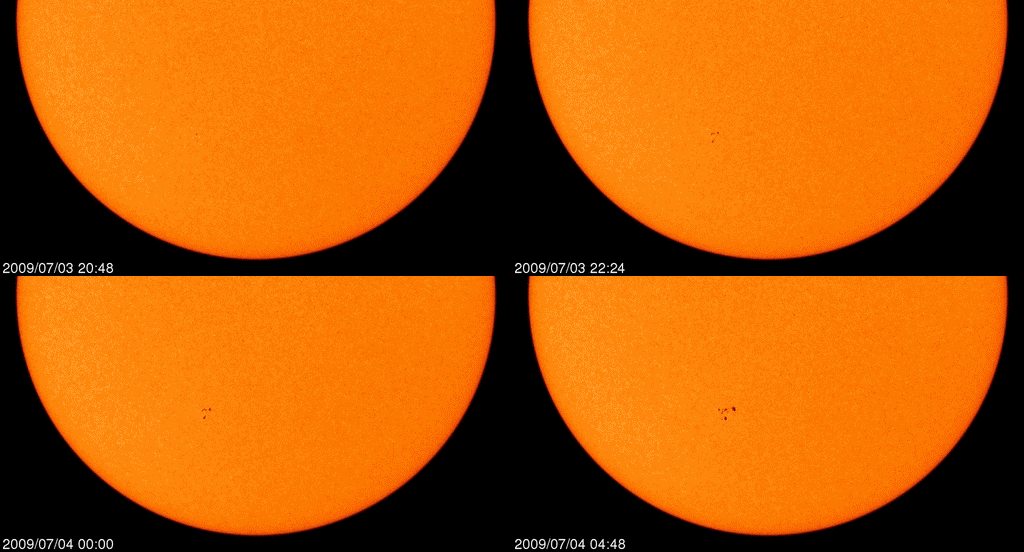
The magnetic polarity of sunspot 1024 identifies it as a member of new Solar Cycle 24. Its rapid emergence on July 3rd and 4th continues the recent (few-month) trend of intensifying new-cycle activity. This sunspot is the best offering yet from the young solar cycle.
I agree. This one looks like a “normal” sunspot. The question now is: how long will it last? Many promising cycle 24 sunspots have fizzed just as quickly as they arrived. Cycle 24 has not yet shown any indications of spot stamina.
In other news, the SOHO satellite has developed a problem with its pointing motor for the high gain antenna.
This is a serious concern, and data outages are already happening due to limited pointing ability. There is a backup spacecraft for SOHO in the pipeline, the Solar Dynamics Observatory, set for a November 2009 launch date. It has recently been shipped to Cape Canaveral. Lets hope the didn’t use the US postal service or DHL.
In other solar satellite news…
Goodbye Ulysses (July 3, 2009)

Hi-res TIF image (4.6M)
Upon receipt of the last command from Earth, the transmitter on Ulysses switched off on June 30, 2009, bringing one of the most successful and longest missions in spaceflight and solar study history to an end. After 18.6 years in space and defying several earlier expectations of its demise, the joint ESA/NASA solar orbiter Ulysses achieved ‘end of mission’. The craft is nearly out of hydrazine fuel for its stabilizing thrusters, and there’s not enough money to continue the mission for another year. A final communication pass with a ground station enabled the final command to be issued to switch the satellite’s radio communications into ‘monitor only’ mode. No further contact with Ulysses is planned.
Ulysses is the first spacecraft to survey the environment in space over the poles of the Sun in the four dimensions of space and time. Among many other ground-breaking results, the hugely successful mission showed that the Sun’s magnetic field is carried into the solar system in a more complicated manner than previously believed. Particles expelled by the Sun from low latitudes can climb up to high latitudes and vice versa, even unexpectedly finding their way down to planets. Regions of the Sun not previously considered as possible sources of hazardous particles for astronauts and satellites must now be carefully monitored. “Ulysses has taught us far more than we ever expected about the Sun and the way it interacts with the space surrounding it,” said Richard Marsden, ESA’s Ulysses Project Scientist and Mission Manager.
So farewell, and congratulations on a job exceedingly well done.
Both of those SOHO articles appear to be from 2003.
It took 5 days to get going.
evolution magnetogram:
http://www.vukcevic.talktalk.net/2009-07-04.gif
ima, Ian, squidly,
As a farmer, my comment is, ” what is optimal in terms of climate boils down to what is optimal for the grain producing regions of the globe.”
The EPA has informally extended its comment period, saying:
” Late comments may still be submitted on the proposed rule; however, the Clean Air Act does not require that the Environmental Protection Agency consider comments submitted past the end of the official comment period June 23, 2009, when developing the final rule. Nonetheless, we will continue to consider comments received after the close of the comment period, to the extent practicable.”
http://epa.gov/climatechange/endangerment.html
I think this EPA thing hinges on uncertainty, if not now then in some future court case. The Scalia side of the Supreme Court in Mass. v EPA seemed to be casting about for reasons to deny the EPA authority but according to what I read there were no affidavits or amicus curiae briefs or comments in the record they were presented that expressed much in the way of skepticism …. and of course skepticism and uncertainty go hand in hand. Hence I say, it hinges on uncertainty (provided, of course, you feel skeptical about the issue).
Frank Hll (09:56:36) :
Leif Svalgaard 6/17/ 09 (21:18:13) :
“This press release is just NASA PR-machine hype”
The ‘hype’ bit was the title of the release:
“Mystery of the Missing Sunspots, Solved?”
We have just seen too many ‘breakthrough’ announcements. The mystery has not seen solved, just moved. The mystery is why the Oscillation is progressing slower towards the equator. It is not clear [nor has it been showed – unless I missed something] that and why 22 degree latitude is the ‘magic’ number that controls the solar cycle. Perhaps Frank could educate us on that?
iamapopulist and Kirls:
You are wishing for a sufficiently extreme solar cycle to force more research on solar effects on climate. Keep in mind that we don’t have to have a complete washout of solar cycle 24 a la a Maunder Minimum event to demonstrate convincing current solar effects on climate.
The length of solar cycles, and the last one appears to have been decidedly longer than average, has a negative relationship with temperature for several years after the end of the cycle (longer cycles = lower temperatures). See:
http://www.sciencemag.org/cgi/content/abstract/254/5032/698
If you believe that solar effects are predominant, and CO2 levels have a negligible effect, then a cooler climate seems to be “baked into the cake” for the next several years at least.
Sadly, the AGW crowd seems impervious to reason. If they could respond to it they would have already responded to the over-abundance of evidence that the AGW due to CO2 hypothesis is foolish.
Hi Leif —
Frank Hll (09:56:36) :
Leif Svalgaard 6/17/ 09 (21:18:13) :
“This press release is just NASA PR-machine hype”
The ‘hype’ bit was the title of the release:
“Mystery of the Missing Sunspots, Solved?”
We have just seen too many ‘breakthrough’ announcements. The mystery has not seen solved, just moved. The mystery is why the Oscillation is progressing slower towards the equator. It is not clear [nor has it been showed – unless I missed something] that and why 22 degree latitude is the ‘magic’ number that controls the solar cycle. Perhaps Frank could educate us on that?
Notice the question mark in the title of the press release.
Like all other existing predictions of the solar cycle properties to date, it is simply an empirical observation, albeit a brand new one. Dynamo theory is clearly still not capable of completely explaining the activity cycle. Thankfully the sun and the climate are smarter than everyone on earth and nature ignores us as we attempt to understand.
I thought I was going to hear it had been sunspotting. This last week, the Sun (but only when out and felt direct) felt distinctly warmer to me. Even at 6 pm. Very different from last year. People may say the increased solar output is not enough to cause the increased warming sensation, but I’m wondering if there’s a subtle factor X multiplying things somehow. And that’s in addition to the Svensmark effect. There are subtle factors at work in the Universe beyond what orthodox Science recognizes. Like, people often know when one is looking at them, even when their backs are turned. Like, there are true stories of rainmakers. So why not a Sun sense?
But that’s just a hypothesis and not a proven fact.
Update on SSN11024 visibility:
http://www.robertb.darkhorizons.org/DeepSolarMin5.htm
Seeing is believing. This is the best spot of SC24, hands down.
SOHO MDI Cont. Image 2009/07/04_16:00
Total spot area is 356 x 10E-6
Umbral ( which must be calculated for each individual spot) is approx.
60 x 10E-6.
Does anyone concur?
REPLY: Can you describe the equipment setup for the projection images? Maybe even an apparatus photo? – Anthony
REPLY: Can you describe the equipment setup for the projection images? Maybe even an apparatus photo? – Anthony
For my own spot checking, it is a simple 0rion 70mm F/10 w/ 26mm Super Plossl, and I project a spot 4″ onto a piece of paper. It’s a look-out-the-window verify type of thing. No camera stuff. My ST7XME would be fried long before I got an image.
The images I calculate/present on belong to SOHO. I do it in such a way so than anyone can duplicate what I am doing. If you can’t see the spots on the 512×512 Luminence cutouts, it’s because I can’t see them either.
You need only SOHO images downloaded, a suitable image processing (like AstroArt 3 or 4, AIP4Win v 2.x, Photoshop, IRIS (kludgy) or similar that can operate and measure at the pixel level.
Geoff Sharp also uses an image processing program.
About factor X people may say SST’s (particulary ENSO) is the factor X, or an alarmist will say CO2.
We’re supposedly supposed to have an El Nino, but apparently the signs are perhaps still mixed. Here the SOI stalled out at -10 at the lowest since the last La Nina and in the past week has bolted back up to 0 which seems to not be very El-Nino like.
http://www.bom.gov.au/climate/enso/
I for one will make the most of this glorious cycle 24 yet to be. With the onslaught of 50,000 years of global cooling close at hand … we should all soak in the life-giving rays while we can. Humanity will not only survive this next ice cycle – we shall thrive!
Remember: any argument about so-called “carrying capacity” of humans on earth must include two elements:
• suppressed technology
• animal equality
Remember: any argument about so-called “carrying capacity” of humans on earth must include two elements:
• suppressed technology
• animal equality
Yes, It is a part of their “grand design”. they are determined to destroy our civilization.
Here is to America for celebrating our July 4th Independence from British tryanny! But I think that we are fighting Part II right now, because UK seems far ahead of us and leading the way in the green movement.
Continuing the discussion of growing grain in Canada, etc…..
In my last posting I wrote (or intended to): “The problem is that, while we can adapt, can our food supply? ”
I read years ago (1960s, IIRC) that the US midwest was considered semi-desert by the travellers west on the Oregon trail. The land was unsuited for growing crops, and nobody stopped. Then, as I read at the time, “the climate changed” some time in the mid 1800s (or later? I am recalling from 40+ years ago), bringing enough rainfall to permit growing crops. What I have learned in recent times is that the mid-1800s were a time of gradual warming. I would presume that this warming is what brought the moisture to the midwest. Now, by extension, I presume that a cooling climate might bring about a reversal, so that rainfall might be reduced, returning the great plains / prairies back to the dry semi-desert conditions of the early 1800s.
What I would like is confirmation of my impressions (or refutation, which would be better for all of us!!) from someone more expert than I on the climate of the North American breadbasket.
imapopulist wrote: “We do not farm nearly as intensively in North American as is done in Europe.” It seems to me that if the amount of rainfall decreased, it wouldn’t matter if the land were farmed intensively or not. Crops just would not grow without water.
I am not arguing with imapopulist. I would just like to formulate in my mind what the objective prospects for food growing in that area are. (BTW, doesn’t “intensive farming” imply high mechanization and, thus, high fuel inputs?)
I hope that I am not too late posting on this thread to pick the brains of everybody.
IanM
My guess is that sunspot 1024 will quickly fizzle out, as had the previous spots identified as Cycle 24 spots. Though all indications are that Cycle 24 is underway, the spots do not (yet) hang around long enough to contribute to the monthly count. Could it be that the sunspot amplitude of Cycle 24 has been grossly overestimated?
On the 0428 view, I count 10 discrete spots.
BTW This isn’t a mid-latitude occurance as, I believe, if I’m not mistaken, that the South Solar Pole is 8 degreees visible to us, so this group is 8 degrees further South than appears.
Good news that the sun seems to be firing up again,
It will be interesting to see what happens to TSI over the next few months as solar activity increases.
Does anyone know if an answer has been found to what causes the ~ -0.35 % difference between the ACRIM3 and VIRGO results and the even lower SORCE/TIM results?
I think the problem with a Sunsense is that throughout the day and throughout the year, the sun’s output at ground level is varying due to earth’s rotation and the coming and going of clouds. To have a sense that an energy source’s output has varied would require the energy source to remain constant almost all the time in order to build up a sense of what the right output is. As to AGW people being unaware of adaptation. They are almost all city sissies from birth. They are used to an environment that adapts to them. Such things as heaters and A/C, and artificial light.
The question everybody wants answered, but nobody can answer with certainty: Does this sunspot “fizz out” or “ramp up”?
Only time will tell and that in a nutshell is the extent of our understanding of ‘causation’.
From this page:
ftp://ftp.ngdc.noaa.gov/STP/SOLAR_DATA/SUNSPOT_REGIONS/USAF_MWL/SunspotAreaMetadata.txt
My numbers need to be dived by 2 for total Solar Area (not just the visible area) so they should read like this:
SOHO MDI Cont. Image 2009/07/04_16:00
Total spot area is 178 x 10E-6 (not corrected for foreshortening..I’ll pick that up later on)
Umbral ( which must be calculated for each individual spot) is approx.
30 x 10E-6.
My apologies.
James F. Evans (17:58:16) :
I’ll take a whack at that one.
It will have the highest probability of doing exactly what it has been doing the last 2.5 years, namely being lethargical in rate of change.
All those who watched the steady parade of big cycle projections knows that they were routinely undercut at angle of 60 degrees, more or less.
Roughly, the sun wants to ramp at several times the rate at which it ran it’s final deramp.
Hairpin curves at high speed in a Formula 1 car, ok.
A G2V star…not so fast.
Frank Hll (12:30:09) :
Thankfully the sun and the climate are smarter than everyone on earth and nature ignores us as we attempt to understand.
Apart from the astrologers in the know, I don’t think you’ll find many that disagree with you.
But, where does the 22 degrees come from? and if you look back at minima in 1976 [albeit very noisy] and 1987, do you [or rather MWO see the same 22 degree determinator?
Tenuc (15:58:40) :
Does anyone know if an answer has been found to what causes the ~ -0.35 % difference between the ACRIM3 and VIRGO results and the even lower SORCE/TIM results?
The ACRIM3 is still a mystery, but the SORCE/TIM is likely correct [IMHO]. That PMOD has been trending lower that TIM is probably due to calibratition/degradation problems. A few months ago I made a plot of the difference between PMOD and SORCE/TIM here and pointed out to Claus Froehlich that the difference was growing by 0.0177 W/m2 per year. He replied:
“Yes, you may have noticed that the VIRGO data are now Version 6.002 and I changed an internal correction – I did this already in SF. A few years ago I found a linear trend between the corrected PMO6V and DIARAD time series and allocated it to DIARAD. At SF I realized that this was probably wrong and remembered also that the re-analysis I started 2 years ago and never completed showed that the corrections of PMO6V-B the less exposed backup was with the early increase as determined for PMO6V-A too much changing – so I attributed the trend to PMO6V and obviously got a smaller change relative to TIM”.
But even with his corrected data series, there is still a changing difference [albeit a lot smaller]: http://www.leif.org/research/Diff-PMOD-SORCE.png
I pointed this out to him and also that although a detailed comparison of SORCE and PMOD composite, shows good agreement until 2008.6, the PMOD becomes much more erratic after that data, not keeping with the dead quiet the Sun has been the past nine months:
http://www.leif.org/research/Comparison%20SORCE%20PMOD%20since%202008.png
His reply ]14 April, 2009] was: “From that time on we have a problem with DIARAD I have not yet solved, but need to look into in much more detail – for the moment I used a simple correction, which may not be correct.”
So it seems safe to say that for the moment the PMOD composite should be viewed with some suspicion.
Leif Svalgaard (20:15:51) :
Hi Leif, we have talked in the past. I was wondering if you knew anything about the FTEs I posted a link to earlier. I figured that if I could ask anyone, you would be most likely to know more than Google. Does their behavior change during the sunspot maximums?
Ian L. McQueen (15:44:26) : “ . . .the US midwest. . .”
Your semi-desert comment makes me wonder what the very large number of Bison were eating? Or maybe the US midwest of the comment is not the same midwest of my mind.