Leif Svalgaard has been saying for sometime now that Solar Cycle 24 seems to be getting underway. Seeing sunspot group 1024 today, I’m tending to agree.

The magnetic polarity (seen on the SOHO magnetogram) of the spot group combined with the middle latitude indicates it is a cycle 24 spot.
From Spaceweather.com
The most active sunspot of the year so far is emerging in the sun’s southern hemisphere: movie. Sunspot 1024 has at least a dozen individual dark cores and it is crackling with B-class solar flares. This morning, amateur astronomer David Tyler caught one of the flares in action from his backyard solar observatory in England:

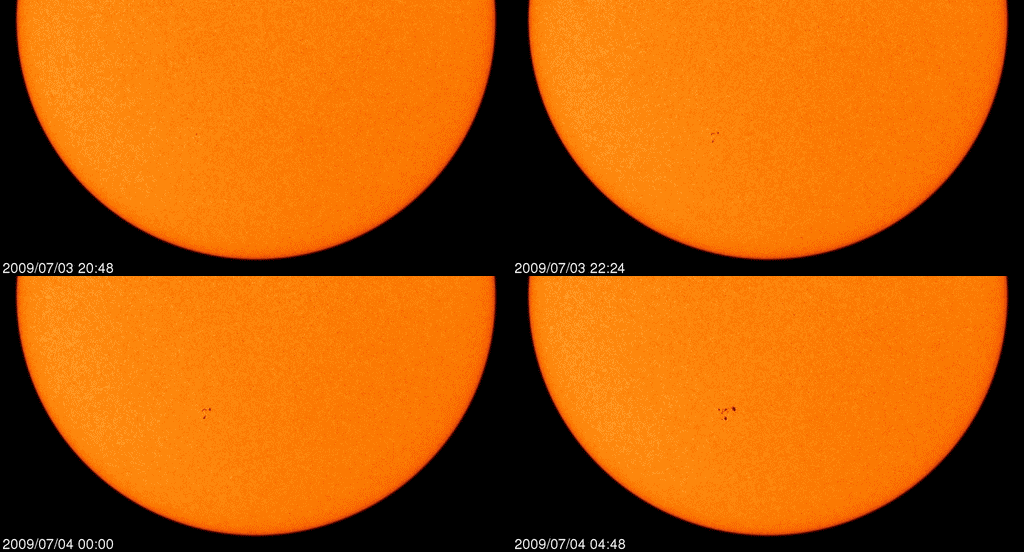
The magnetic polarity of sunspot 1024 identifies it as a member of new Solar Cycle 24. Its rapid emergence on July 3rd and 4th continues the recent (few-month) trend of intensifying new-cycle activity. This sunspot is the best offering yet from the young solar cycle.
I agree. This one looks like a “normal” sunspot. The question now is: how long will it last? Many promising cycle 24 sunspots have fizzed just as quickly as they arrived. Cycle 24 has not yet shown any indications of spot stamina.
In other news, the SOHO satellite has developed a problem with its pointing motor for the high gain antenna.
This is a serious concern, and data outages are already happening due to limited pointing ability. There is a backup spacecraft for SOHO in the pipeline, the Solar Dynamics Observatory, set for a November 2009 launch date. It has recently been shipped to Cape Canaveral. Lets hope the didn’t use the US postal service or DHL.
In other solar satellite news…
Goodbye Ulysses (July 3, 2009)

Hi-res TIF image (4.6M)
Upon receipt of the last command from Earth, the transmitter on Ulysses switched off on June 30, 2009, bringing one of the most successful and longest missions in spaceflight and solar study history to an end. After 18.6 years in space and defying several earlier expectations of its demise, the joint ESA/NASA solar orbiter Ulysses achieved ‘end of mission’. The craft is nearly out of hydrazine fuel for its stabilizing thrusters, and there’s not enough money to continue the mission for another year. A final communication pass with a ground station enabled the final command to be issued to switch the satellite’s radio communications into ‘monitor only’ mode. No further contact with Ulysses is planned.
Ulysses is the first spacecraft to survey the environment in space over the poles of the Sun in the four dimensions of space and time. Among many other ground-breaking results, the hugely successful mission showed that the Sun’s magnetic field is carried into the solar system in a more complicated manner than previously believed. Particles expelled by the Sun from low latitudes can climb up to high latitudes and vice versa, even unexpectedly finding their way down to planets. Regions of the Sun not previously considered as possible sources of hazardous particles for astronauts and satellites must now be carefully monitored. “Ulysses has taught us far more than we ever expected about the Sun and the way it interacts with the space surrounding it,” said Richard Marsden, ESA’s Ulysses Project Scientist and Mission Manager.
So farewell, and congratulations on a job exceedingly well done.
From my rusty memory of my physics course, I remember the following:
Magnetic fields cannot break, merge or recombine and if this could happen it would violate Maxwell’s equations. (This would have a major impact on our understanding of plasma physics and EM theory in general)
I also though that ‘freezing’ a magnet field in plasma was only possible if the plasma was ideal?
All dynamic magnetic fields are caused by electrical currents or time varying E-fields.
I’m trying to find some good experimental proof regarding the new paradigm, but I’m not yet convinced the evidence is there.
Tenuc (02:48:21) :
How much time was spent trying to figure out the equations for the magnetic fields to hold the plasma for the fusion reaction?
The solution is only 30 years away.
vukcevic (00:51:52) :
My explanation is simple
The problem with amateurism is that the amateur succumbs to ‘simple’ but wrong ideas [transformer sunspots, electric universe, planetary influences, anthropogenic climate change, vitamin C and cancer, the examples are legion] . The pseudo-scientific attitude that results is a danger to society at a time where we need the public’s appreciation of correct science [even with more uncertainty than for people ‘in the know’] the most.
Leif Svalgaard (08:03:29) :
vukcevic (00:51:52) :… is a danger to society at a time where we need the public’s appreciation of correct science …………
To accept your ideas without a question, for a budding young science student, is highly recommended. If I do that I may learn a bit more about current thinking, but I would gain very little and science even less.
However, there is that small probability that you and some of your colleagues are wrong, and possibly even smaller one, that I am correct, in which unlikely case I do get something out of it.
Although it is to a great satisfaction if one can ‘outdo’ top man of authority, I can assure I am no more danger to the science, than our lazy cat is to the rat population of SW London. Despite that, you posts are red with respect, and so is the advice, but that in no way mean that it will be taken.
vukcevic (08:22:33) :
If I do that I may learn a bit more about current thinking, but I would gain very little
You would gain a lot by embracing sound science.
Leif Svalgaard (08:35:11) :
You would gain a lot by embracing sound science.
I attempted to work out field for the current SS (Geoff’s Layman’s Sunspot Count on SC24), I do not know if that makes any sense or is it total waste of time. Perhaps you can take a look.
vukcevic (09:19:53) :
I attempted to work out field for the current SS
What field? Magnetic field? or magnetic flux? be specific.
Leif Svalgaard (09:23:42) : Your comment is awaiting moderation
vukcevic (09:19:53) :
“I attempted to work out field for the current SS”
What field? Magnetic field? or magnetic flux? be specific.
Just saw it.
400 microTesla is 4 Gauss….
But WSO measures the magnetic flux over the 3′ aperture of the instrument, not the field as L&P does.
@ur momisugly Leif Svalgaard:
I have to commend you for your willingness to answer comments and go “toe to toe” with various people, including myself.
So, while I don’t agree with your basic premise: The Sun’s irradiance is all that matters, and irradiance has varied very little, 0.1% over several solar cycles, and, therefore, the Sun’s fluctuations have little or nothing to do with climate change.
I can only salute your willingness to engage interlocutors.
As I wrote above (15:08:50): “And this Sun/Earth electromagnetic relationship turned out to be much more dynamic than NASA or most anybody else thought possible.”
NASA is confirming electric current into the Earth’s atmosphere 24/7. Don’t believe me? Review the following NASA press release:
http://science.nasa.gov/headlines/y2008/06mar_polar.htm
“Our own planet has auroras 24 hours a day,” says Jim Spann of the Marshall Space Flight Center, “and we can see them even in broad daylight.” The trick, he explains, is picking the right wavelength. “If we look at Earth from space using an ultraviolet (UV) filter, we see there are auroras underway at all times. It is a beautiful sight.”
Is NASA engaged in pseudo-science?
Leif Svalgaard (08:38:57) : “Pseudo-science should be beaten down whenever it rears its ugly head.”
Or does NASA just engage in overhyped puffery?
Leif Svalgaard (21:00:24) : “FTEs are another NASA overhyped release.”
The NASA press release goes on: “we were amazed to see Northern and Southern Lights active non-stop,” says Spann, one of the scientists who led development of the satellite’s UV instrumentation.”
And:
“A good substorm can unleash a hundred thousand billion (10^14) Joules of energy, as much as a magnitude 5 earthquake. Although auroras, generally speaking, are understood (they are caused by solar activity), the sudden power of substorms is one of the biggest mysteries of space science.”
Dr. Svalgaard and others maintain this electrical energy is “small potatoes” and can be safely ignored.
It seems to me, if you add up enough “magnitude 5 earthquakes” of equivalent energy, no matter how much it is dwarfed by the supposed amount of irradiant energy the Earth receives from the Sun, in a closely balanced system, it will have an impact.
“…the sudden power of substorms is one of the biggest mysteries of space science.”
Yes, just a lot of NASA hype.
Now, if one considers the Earth as a closely balanced “mechanism” where additional amounts of energy of whatever source is likely to have an impact on climate and other processes, just as additional weight will impact a finely balanced teeter-totter, any additional energy will impact the Earth’s climate.
But Dr. Svalgaard and others prefer to ignore this energy and hold onto opinions that ignore scientific evidence.
They are willfully blind prisoners of their own assumptions — assumptions they have clinged to since the 1970’s.
Want to see a movie of these 24/7 ultraviolet auroras:
http://science.nasa.gov/headlines/y2008/images/polar/20070621_3_geo_2meg.gif
If electric current from the Sun to the Earth is continuous or 24/7, shouldn’t science get an accurate measurement of this electrical energy as opposed to flippantly responding that it can be safely ignored?
Willful ignorance or investigation: What is the proper attitude of scientists?
Electric current is coming from the Sun to the Earth 24/7, and when it “ramps up” it causes visible light auoras (and substorms), yet ultraviolet auroras continue unabated 24/7, reflecting an underlying continuous electric current flow from the Sun to the Earth.
So-called “solar wind” is better explained as solar electric current. Charged particles, electrons and ions, flow away from the Sun. Charged particles in motion is considered electric current by definition.
Shouldn’t Science label processes in a way that most aptly explains them, as opposed to labels that lead to false impressions?
Does science understand the Sun/Earth electromagnetic physical relationship?
We aren’t there yet.
Leif Svalgaard (09:30:46) :
400 microTesla is 4 Gauss, not 4000 Gauss as you had it….
But WSO measures the magnetic flux over the 3′ aperture of the instrument, not the field as L&P does.
The WSO values probably have to be multiplied by 1.85 to compensate for magnetograph saturation of the flux , see: http://www.leif.org/research/The%20Strength%20of%20the%20Sun's%20Polar%20Fields.pdf (section 4)
Leif Svalgaard (10:45:40) :
see here (section 4)
Leif Svalgaard (11:19:00) : Your comment is awaiting moderation
Leif Svalgaard (10:45:40) : trying again:
see here (section 4)
Leif Svalgaard (10:45:40) :
see here (section 4)
Thanks for the link: I have flittingly red most of the article, but I will do it again.
What I was trying to do is to estimate relative the intensity of magnetic field (or whatever possible) for the current SS
http://wso.stanford.edu/daily/current/scan.9727.gif
or magnified:
http://www.vukcevic.talktalk.net/SSMF.gif
by using one from April 28, 2007 (magnified)
http://www.vukcevic.talktalk.net/SSMF.gif
as a reference, which I think features in the L-P chart
http://wattsupwiththat.files.wordpress.com/2009/06/livingston-penn-chesire_fig4.png
with the strength about 3000 Gauss.
The idea was to have an idea of rough estimated of strength (if scale is 20, 50, 100, 200 ?, 400 ?), by comparing to a known.
Obviously not very accurate, but better something then nothing.
Possible ?
vukcevic (12:07:53)
Sorry:that should be
by using one from April 28, 2007 (magnified)
http://www.vukcevic.talktalk.net/SSMF1.gif
James F. Evans (10:42:04) :
NASA is confirming electric current into the Earth’s atmosphere 24/7.
This has been known for decades
“we were amazed to see Northern and Southern Lights active non-stop,”
Again, this has been know for decades. The scientists are amazed that they can now actually see the aurora non-stop, but it has been known for a century that they were continuous. All it takes for that is to observe in the polar winter where it is dark 24/7.
“A good substorm can unleash a hundred thousand billion (10^14) Joules of energy, as much as a magnitude 5 earthquake.
Dr. Svalgaard and others maintain this electrical energy is “small potatoes” and can be safely ignored.
A good substorm lasts an hour or two, during that hour the Earth intercepts 1360 W/m2 * pi * 6371000^2 * 3600 sec = 1.7×10^17 Watt of sunlight or a thousand times as much [adjusting for the albedo, etc] does not change the order of magnitude. since substorms do not happen all the time, the proportion is more like 10,000 [solar max]-100,000 [solar min] to one, so is indeed small potatoes.
It seems to me, if you add up enough “magnitude 5 earthquakes” of equivalent energy, it will have an impact.
Of course, it will, but a very, very small impact.
“…the sudden power of substorms is one of the biggest mysteries of space science.”
Yes, just a lot of NASA hype.
Yes, indeed. The microphysics [magnetic reconnection] is a universal process and is taking place. The exact mechanism by which the resistivity that allows the process is still not well understood, but it is hardly a mystery.
any additional energy will impact the Earth’s climate.
Of course, it will, so only so slightly. And the climate system is not tottering on a tipping point. It is surprisingly robust, having weathered [nice pun here] all kinds of catastrophies [ice ages, super volcanoes, asteroid impacts, orbit changes, etc] in the past.
If electric current from the Sun to the Earth is continuous or 24/7, shouldn’t science get an accurate measurement of this electrical energy as opposed to flippantly responding that it can be safely ignored?
The solar wind in electrically neutral and there is no current coming from the Sun. The interaction between the solar wind and the Earth’s magnetic field does create electric currents. These have been measured accurately for decades and are [as the calculation above shows] small potatoes.
Charged particles in motion is considered electric current by definition.
No, only if there is an excess of one charge over the other.
Does science understand the Sun/Earth electromagnetic physical relationship?
To a very large extend, YES.
We aren’t there yet.
You are not there. We are, although ‘there’ keeps being pushed further and further out, of course, as we learn more and more, enabling us to ask ever more pointed questions. In a sense, we’ll never be ‘there’, but we are close enough to have a basic understanding of the solar wind and its impact.
I gave a talk 35 years ago at a NASA conference. I’m scanning the text in now and will put it on my website. Please look for it and compare what we knew already then with the recent NASA press releases.
vukcevic (12:07:53) :
The idea was to have an idea of rough estimated of strength (if scale is 20, 50, 100, 200 ?, 400 ?), by comparing to a known.
Obviously not very accurate, but better something then nothing.
Possible ?
No, not possible, as WSO and MWO and KNO all measure the magnetic flux over their respective apertures, not the magnetic field. To convert flux to field, you need to know the ‘filling factor’, that is, how much of the photosphere is actually filled with the magnetic field. The filling factor is unknown but is believed to be of the order of 0.01, i.e. 99% of the photosphere is not magnetic at all [or rather, not pervaded by large-scale magnetic fields].
Leif Svalgaard (12:31:06) :
No, not possible, as WSO and MWO and KNO all measure the magnetic flux over their respective apertures, not the magnetic field.
Thanks for that. It will save me waisting time on yet one more pointless exercise.
Dr. Svalgaard:
You are in the contradicting yourself. NASA has confirmed by THEMIS in situ satellite probes that indeed electric current is coming from the Sun to the Earth.
NASA has explicitly stated such.
Do you disagree with NASA?
We’ve been over this before, but I’ll link all the NASA statements that confirm electric currents in the space between the Sun and the Earth if necessary, and I’ll track down your statements acknowledging electric currents in the near-space around the Earth.
Apparently, Dr. Svalgaard, you feel free to set up your own definitions:
My comment: “Charged particles in motion [are] considered electric current by definition.”
Dr. Svalgaard responds: “No, only if there is an excess of one charge over the other.”
False, not when there is a quasi-neutrality.
I’m surprised that you would contradict NASA in situ observations & measurements and even contradict yourself.
Such is the determination to justify one’s own opinions that even NASA findings are to be kicked aside if they contradict one’s own scientific opinion.
Sometimes, it’s better to simply acknowledge the scientific evidence than have somebody else lay out all the evidence so that indepedent judgments can be made about the quality of the opinions offered.
Svalgaard versus NASA?
Sorry, I’ll take NASA.
NASA has the in situ satellite probes to make observations & measurements, Svalgaard does not.
James F. Evans (13:32:18) :
NASA has confirmed by THEMIS in situ satellite probes that indeed electric current is coming from the Sun to the Earth.
NASA has explicitly stated such.
Do you disagree with NASA?
show us just this one.
James F. Evans (13:32:18) :
> My comment: “Charged particles in motion [are] considered electric current by definition.”
I haven’t been following the discussion here too closely, but an electrical
engineer view (and electronics toy view) concurs with Leif’s “No, only if
there is an excess of one charge over the other.”
Take a salt (NaCl will do fine) solution and stir. By your definition
there is a current, the EE will puzzle for a moment, realize that
there are no amps to measure and say there is no current even though equal
numbers of Na+ and Cl- ions are swirling around (and H+ and OH- too).
Take a stream of Na+ ions and send them from Io to Saturn (millions of
amps – now _that’s_ a current) or take a stream of protons and entrain
them in the Earth’s magnetic field – that’s a current too.
Water flowing down a river, well, that’s a current, but it’s not an
electric current and no amps involved.
Leif Svalgaard (13:44:33) :
James F. Evans (13:32:18) :
“NASA has confirmed by THEMIS in situ satellite probes that indeed electric current is coming from the Sun to the Earth.
NASA has explicitly stated such.
Do you disagree with NASA?
NASA has just been confirming and fine-polishing the understanding we had 35 years ago. In this paper http://www.leif.org/research/Geomagnetic-Response-to-Solar-Wind.pdf from 1973 I outlined what we knew back then, and what NASA [and other research] have just been confirming, in spite of their hype about breakthroughs. Our basic understanding has held firm over the last 35 years. We have since only filled in some of the blanks and crossed a few t’s and dotted a few more i’s.
Ric Werme (17:44:31) :
James F. Evans (13:32:18) :
“Charged particles in motion [are] considered electric current by definition.”
Here is a view of an electronic engineer:
If the interplanetary space, permeated by a magnetic field and the presence of particles of both polarities originating from the same source (i.e. moving in same direction) is considered then:
Charged particles will spiral along imaginary field lines in a helical motion, result is double helix with left and right (clockwise and anticlockwise) orientation as a consequence of the particles polarity.
Hence, there are two ‘electric currents’ in opposite direction, total sum being zero.
However, things are not as simple as that.
If at the end of a spiral there is an asymmetric load, i.e. reacting to one charge but not the other (interaction of protons and athoms nuclei, but no equal interaction with the electron stream), then this will load one helix not the other, resulting in an imbalance. Therefore, may not be a resultant current along the path but there is an effect of an electric current flow as far as the end load is concerned; here is an ambiguity since electric currents have to close the circuit.
There is a further complication as discovered by Ulysses probe.
Interactions between fast and slow solar wind cause certain degree of ‘bunching’ of either positive or negative particles along the path. This causes potential difference along the path of solar wind, which gets reversed further along, and so on. Clusters of the excessive polarity at a particular area affect speed of propagation of both types of particles, resulting in an electric current flow, between two clusters, but that may be reversed during next stage.
Two currents trough a particular section S are I1= n1Sv1Q1 , I2= n2Sv2Q2,
Where n1 = n2 = n number of particles, Q1= -Q2 = Q charge, v1 and v2 are velocities, then resultant current is : I=I1+I2 = nS Q(v1-v2).
Put a load at a cluster (e.g. Earth atmosphere), result is localised electric current.
Dr.S will no doubt dispute all of the above.
Ric Werme (17:44:31) :
…….
Take a salt (NaCl will do fine) solution and stir. By your definition
there is a current, the EE will puzzle for a moment, realize that
there are no amps to measure and say there is no current even though equal
numbers of Na+ and Cl- ions are swirling around (and H+ and OH- too).
It all depends on a load in the path of particles movement (as mentioned in my previous post). If probes (i.e. electrodes) introduced into the solution are copper and zinc, connected by a conductor, then current will flow. To exist electric currents require electric potential difference and closing of the circuit.
vukcevic (01:51:49) :
Dr.S will no doubt dispute all of the above.
Indeed, as there are no asymmetric loads.
Leif Svalgaard (04:03:25) :
Indeed, as there are no asymmetric loads.
Of course there are unsymmetrical loads: ENA is one of many examples one can think of :
http://ibex.swri.edu/researchers/observations.shtml
http://adsabs.harvard.edu/abs/2008AGUFMSH14A..05W
http://ibex.swri.edu/multimedia/img/ena_research.jpg
I did mention one example- interaction of protons and atoms nuclei, but no equal interaction with the electron stream, which takes out kinetic energy out of protons, i.e. loads proton stream, but not the electron, on the other hand electrons elsewhere recombine with positive ions, but protons do not.
Typical of Dr. Svalgaard, good old doc again indulges in his favourite sport of trying to shoot down anything in his sights he may dislike, be it correct or wrong. In my post, I presented comprehensive overview of ways electric currents are invoked in the interplanetary space. Come on, give us proper scientific explanation of your objections, as you often do when you are on solid ground, but here, it appears you are not so certain of strength of your argument.