Leif Svalgaard has been saying for sometime now that Solar Cycle 24 seems to be getting underway. Seeing sunspot group 1024 today, I’m tending to agree.

The magnetic polarity (seen on the SOHO magnetogram) of the spot group combined with the middle latitude indicates it is a cycle 24 spot.
From Spaceweather.com
The most active sunspot of the year so far is emerging in the sun’s southern hemisphere: movie. Sunspot 1024 has at least a dozen individual dark cores and it is crackling with B-class solar flares. This morning, amateur astronomer David Tyler caught one of the flares in action from his backyard solar observatory in England:

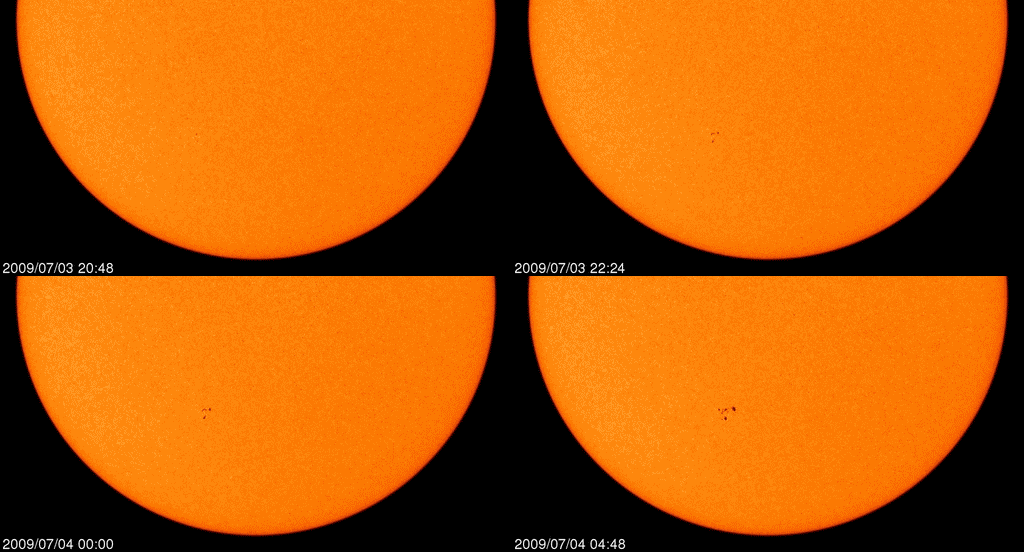
The magnetic polarity of sunspot 1024 identifies it as a member of new Solar Cycle 24. Its rapid emergence on July 3rd and 4th continues the recent (few-month) trend of intensifying new-cycle activity. This sunspot is the best offering yet from the young solar cycle.
I agree. This one looks like a “normal” sunspot. The question now is: how long will it last? Many promising cycle 24 sunspots have fizzed just as quickly as they arrived. Cycle 24 has not yet shown any indications of spot stamina.
In other news, the SOHO satellite has developed a problem with its pointing motor for the high gain antenna.
This is a serious concern, and data outages are already happening due to limited pointing ability. There is a backup spacecraft for SOHO in the pipeline, the Solar Dynamics Observatory, set for a November 2009 launch date. It has recently been shipped to Cape Canaveral. Lets hope the didn’t use the US postal service or DHL.
In other solar satellite news…
Goodbye Ulysses (July 3, 2009)

Hi-res TIF image (4.6M)
Upon receipt of the last command from Earth, the transmitter on Ulysses switched off on June 30, 2009, bringing one of the most successful and longest missions in spaceflight and solar study history to an end. After 18.6 years in space and defying several earlier expectations of its demise, the joint ESA/NASA solar orbiter Ulysses achieved ‘end of mission’. The craft is nearly out of hydrazine fuel for its stabilizing thrusters, and there’s not enough money to continue the mission for another year. A final communication pass with a ground station enabled the final command to be issued to switch the satellite’s radio communications into ‘monitor only’ mode. No further contact with Ulysses is planned.
Ulysses is the first spacecraft to survey the environment in space over the poles of the Sun in the four dimensions of space and time. Among many other ground-breaking results, the hugely successful mission showed that the Sun’s magnetic field is carried into the solar system in a more complicated manner than previously believed. Particles expelled by the Sun from low latitudes can climb up to high latitudes and vice versa, even unexpectedly finding their way down to planets. Regions of the Sun not previously considered as possible sources of hazardous particles for astronauts and satellites must now be carefully monitored. “Ulysses has taught us far more than we ever expected about the Sun and the way it interacts with the space surrounding it,” said Richard Marsden, ESA’s Ulysses Project Scientist and Mission Manager.
So farewell, and congratulations on a job exceedingly well done.
Leif Svalgaard (21:51:58) :
What is the importance, theoretical or not, of these connections? I know, easy question.
ohioholic (22:21:12) :
What is the importance, theoretical or not, of these connections? I know, easy question.
That the reconnection model is correct has great importance as we may be able to model the details and predict the outcome if we can figure out what conditions trigger the process. Reconnection is a ‘universal’ process, so progress on one front can be used everywhere. On the other hand, everything that relies on ‘explosive’ release of energy may be harder to predict.
Jimmy Haigh (20:34:12) :
…I’ve always wondered why the modellers don’t build a model to predict the future winners of the Aintree Grand National or the Kentucky Derby, for example….They’d make a fortune on the horses!!
That would be the day. Have you seen any of the recent Dr. Hathaway’s predictions. His method is unique:
“We don’t know why this works, the underlying physics is a mystery to us, but it does work”.
http://science.nasa.gov/headlines/y2006/21dec_cycle24.htm
With science like that, more likely to loose his shirt than make a fortune.
From my point of view, the prediction method I strongly favour is one described here:
Geophysical research letters, vol. 32, l01104, doi:10.1029/2004gl021664, 2005
Sunspot cycle 24: Smallest cycle in 100 years?
by
Leif Svalgaard,1 Edward W. Cliver,2 and Yohsuke Kamide1
I am biased in favour of it (purely selfish attitude, rather than the detailed understanding of the method), since it is based on the intensity of polar fields, which of course gives an additional edge to the polar field formula
http://www.geocities.com/vukcevicu/PolarField1Cr.gif
No surprise in desperate but futile attempts to discredit it.
hotrod (21:01:10) concluded: “Naw they could not be wrong again!”
Thank you for some nice history and pertinent conclusions relevant to our times, Larry.
You generated images of Steinbeck in my mind alongside Piltdown Man. Now there’s a good fair spread…
You are also more generous in your historical perspective than I believe the future will be of we off a generation of carbon infamy.
Ray (22:15:28) :
Leif Svalgaard (21:10:45) :
Speed of sound… does that apply in space?
On the Sun, certainly
Leif Svalgaard (05:38:11) :
Ray (22:15:28) :
Leif Svalgaard (21:10:45) :
Speed of sound… does that apply in space?
On the Sun, certainly
I mentioned speed of sound only as a reference point, since most of us know its value here on Earth, with atmosphere at pressure of 1At, 20C and humidity of 50%. Since it varies with medium than in predominantly Hydrogen atmosphere, and not forgetting Helium (as any Donald Duck impersonator would know) and god knows what pressure and temperature I should have left it to 2000+km/h. Apologies to purist, but I am certain everyone understood what was meant.
Polarity mixing? = Cycle 23?
http://sohowww.nascom.nasa.gov/data/realtime/mdi_mag/1024/latest.jpg
a bit far fetched maybe….
VG (08:06:01) :
Polarity mixing? = Cycle 23?
http://sohowww.nascom.nasa.gov/data/realtime/mdi_mag/1024/latest.jpg
a bit far fetched maybe….
Anything is possible. “Sun is a messy place”
http://www.vukcevic.talktalk.net/2009-07-04.gif
vukcevic (07:45:34) :
I mentioned speed of sound only as a reference point, since most of us know its value here on Earth
No, it was meant to make something implausible. The speed of sound in the photosphere is much higher [twenty times] than in air on the Earth, typically 10 km/s.
VG (08:06:01) :
Polarity mixing? = Cycle 23?
Such weak ‘mixing’ is not unusual.
vukcevic (08:34:30) :
“Polarity mixing? = Cycle 23?”
Anything is possible. “Sun is a messy place”
No, that messy. You seem to subscribe to Al Gore’s view ‘If one doesn’t know anything, anything is possible’.
I make 10 km/s divided by about 330 m/s around thirty times.
Sorry I am such a pedant.
Kindest Regards
Hank (08:05:10) :
In answer to your musings on the midwestern desert. I would start off saying a greater or just as great a threat in the nations cornbelt would be to have a frost such as happened on June 4/5, 1859.
Now there’s an interesting solar connection! It was almost exactly three months after that freeze that the great solar storm of 1859 occurred. Of the two, either losing large chunks of cropland, or a repeat of that solar event, I would have to guess that the latter would be capable of causing far more damage to our current civilization.
a jones (09:42:47) :
I make 10 km/s divided by about 330 m/s around thirty times.
Sorry I am such a pedant.
Welcome to the club. The speed of sound varies a lot with height in the solar atmosphere [because density and temperature] vary a lot]. At a certain height the ratio is precisely twenty. The 10 km/s was just to give an order of magnitude. For the non-pedants, the important point was that the movement observed is much slower than the speed of sound, contrary to the [orange and apple] Mach 1.9 quoted.
vukcevic (07:45:34) :
I mentioned speed of sound only as a reference point, since most of us know its value here on Earth
Leif Svalgaard (09:22:31) :
No, it was meant to make something implausible.
Not if you think of it as analogous to a current transformer. http://www.geocities.com/vukcevicu/ElctCurrent-Plasma.jpg
If current Io is increased, more plasma would be sucked into loop. In turn the loop’s current I will also increase, Lorentz forces will force loop expansion outwards. Consequence of this is that the resting feet of the loop will spread apart. Front foot will move at an apparent speed higher than rotation, while the back foot relative to rotation may lag behind.
http://www.vukcevic.talktalk.net/2009-07-04.gif
vukcevic (10:23:23) :
The last sentence should be:
Front foot will move at an apparent speed higher than rotation, while the back foot relative to rotation may lag behind, expanding the footprint area at the same time.
vukcevic (10:23:23) :
“No, it was meant to make something implausible.”
Not if you think of it as analogous to a current transformer.
But it is not. Good advice for you to follow: “when in a hole, stop digging”. The plasma beta is larger than one, so the plasma movements control the magnetic field.
Leif Svalgaard (11:09:06) :
But it is not. Good advice for you to follow: “when in a hole, stop digging”. The plasma beta is larger than one, so the plasma movements control the magnetic field.
I am sorry to say, your explanation of magnetic ropes and beta factor I did not find convincing (what happens when beta =1, presumably on the Sun everything stops for a tea break). I was hopeful that Dr. Hill might have a good explanation. As an engineer I prefer problem solutions that work, to some mathematical exoteric theorising, that no one can test.
Currents on the Sun cannot be directly measured or even identified. Currents and their strength can only be observed by observing and measuring the resulting magnetic fields. All indications from the optical and magnetic observations are absolutely in line what could be expected if currents are present. If an electric current analogy can explain a particular phenomena in simplest of terms, according to the basic laws of electro-magnetism, and there is no forthcoming satisfactory alternative explanation (even from top man of solar science), then choice is self-evident. However I am prepared to consider an alternative providing is as convincing.
FYI, Ian, read up on “Vertical Farming” or “Indoor Farming”.
Some think it could lead to urban renewal, but I see urban problems as stemming from corrupt and incompetent government (urban and up), so I’m very skeptical of that.
But if water becomes short, then setting up massive greenhouses to recover water lost to evaporation (plus benefits of warming the crop and soil, etc) may make sense.
Wheat is a grass, so the mid-continent climate is suitable, but corn (maze) takes a lot of water (it originated in the tropics, after all).
vukcevic (12:26:17) :
All indications from the optical and magnetic observations are absolutely in line what could be expected if currents are present.
No, they are not in the sense you advocate. That may be your interpretation, but the plasma is electrically neutral and there is no emf driving any currents, except when the magnetic field changes rapidly. This whole subject we have gone over so many times, but perhaps one last time: the plasma is electrically neutral, the magnetic field is frozen into the plasma and moves with it, there is no electric field in the rest frame of the plasma, brief electric currents are caused by changing magnetic fields driven by movements of the plasma. Your various analogies are not a picture of how this this works, but are in a sense backwards.
Dr. Svalgaard
Question was:
What happens when beta =1 ?
I see no answer !
Recommended :
Dr. Paul M. Bellan, Professor of Applied Physics
scientist from CALTECH, California Institute of Technology
From: American Institute of Physics publication:
WHY CURRENT-CARRYING MAGNETIC FLUX TUBES GOBBLE UP PLASMA AND BECOME THIN AS A RESULT
http://authors.library.caltech.edu/1892/1/BELpop03.pdf
Note comments with his illustration:
http://www.geocities.com/vukcevicu/belen.gif
vukcevic (13:53:06) :
What happens when beta =1 ?
I see no answer !
You probably would not either understand or accept the answer anyway, but I can try: beta > 1 in the photosphere and below, and < 1 in the chromosphere and above [until we are are out in the solar wind where beta again is > 1]. Thus there are two thin ‘layers’ where beta = 1. Both of these are important because they mark the boundaries of the part of the corona that can be shaped by magnetic fields. Nothing ‘happens’ at these boundaries.
WHY CURRENT-CARRYING MAGNETIC FLUX TUBES GOBBLE UP PLASMA AND BECOME THIN AS A RESULT
That you cite this paper is a typical example of the confusion you are operating under. A central aspect if the paper is twisting of the magnetic field [requires frozen-in field] and generation of the current by a dynamo [i.e. from movements of the magnetic field]. The twisting and the currents are consequences of the magnetic field and movements of the plasma, as I have been trying to tell you for many months.
I am not concerned with the ‘chicken and egg’ puzzle here. Main thing is that THERE ARE ELECTRIC CURRENTS.
My model of a ‘current transformer’ gives a simple explanation which is in agreement with the basic laws of physics.
vukcevic (15:22:21) :
I am not concerned with the ‘chicken and egg’ puzzle here. Main thing is that THERE ARE ELECTRIC CURRENTS.
My model of a ‘current transformer’ gives a simple explanation which is in agreement with the basic laws of physics.
I have been telling you for months that there are currents generated by movements of the plasma and the magnetic field, e.g. the HCS. The chicken-and-egg business is only a puzzle if you do not understand how nature works in this case, and your ‘model’ is simply incorrect. With an incorrect model one can explain anything. You keep invoking the ‘basic laws of physics’, but this is only relevant for the application of them. So the transformer is a valid application, but since the Sun doesn’t work like that, this is hardly relevant.
“So the transformer is a valid application, but since the Sun doesn’t work like that, this is hardly relevant.”
Since in many cases solar science is not definitive, than perhaps valid applications are more appropriate and relevant.
Ballan states:
“The current I (in my illustration Io) is assumed to be generated by some subsurface dynamo and so its time-dependence is a prescribed quantity. This time dependence is assumed to be such that I increases smoothly from zero to some finite value….”
“We further conclude that, given sufficient time and assuming there are no losses, current-carrying flux tubes will always tend to become axially uniform.”
Elsewhere (Solarcycle24.com) you offered your interpretation Fred Ward’s theory (hardly a theory, barely hypothesis): “is thought to be due to the effect of the latitudinal variation of the Coriolis parameter and an assumed vortical circulation around the spots. The more rapid longitudinal motion of extended spot groups is suggested to be the result of the preferential occurrence and development of such groups in regions of above-average horizontal wind and wind shear.”
“is thought to be due” author is speculating. Coriolis force is function of angular velocity (13 degrees/day, which is low for the effect to take a place within day or two); “effect of the latitudinal variation” is minimal and often there is no perceptible difference in latitude.
Abandoning your previous speculation:
“As a magnetic flux rope is under strong tension [along the rope], one could imagine that the tension in the subsurface rope would pull apart the two bipoles of a sunspot group. This is kind of the ‘traditional’ view [that may not be correct]. Helioseismolgy seems to indicate that the flux ropes are actually cut somewhere below the photosphere [and thus not extending to any great depth, sunspots thus being shallow phenomena, lacking deep ‘roots’], scuttling this simple-minded ‘explanation’. But perhaps Frank could educate us more about this.”
My explanation is simple, supported by theoretical work and equivalent to well known electro-magnetic effects. You have failed to prove otherwise with an assemblage of speculations. As far as I am concerned ‘case closed’ for time being.