Leif Svalgaard has been saying for sometime now that Solar Cycle 24 seems to be getting underway. Seeing sunspot group 1024 today, I’m tending to agree.

The magnetic polarity (seen on the SOHO magnetogram) of the spot group combined with the middle latitude indicates it is a cycle 24 spot.
From Spaceweather.com
The most active sunspot of the year so far is emerging in the sun’s southern hemisphere: movie. Sunspot 1024 has at least a dozen individual dark cores and it is crackling with B-class solar flares. This morning, amateur astronomer David Tyler caught one of the flares in action from his backyard solar observatory in England:

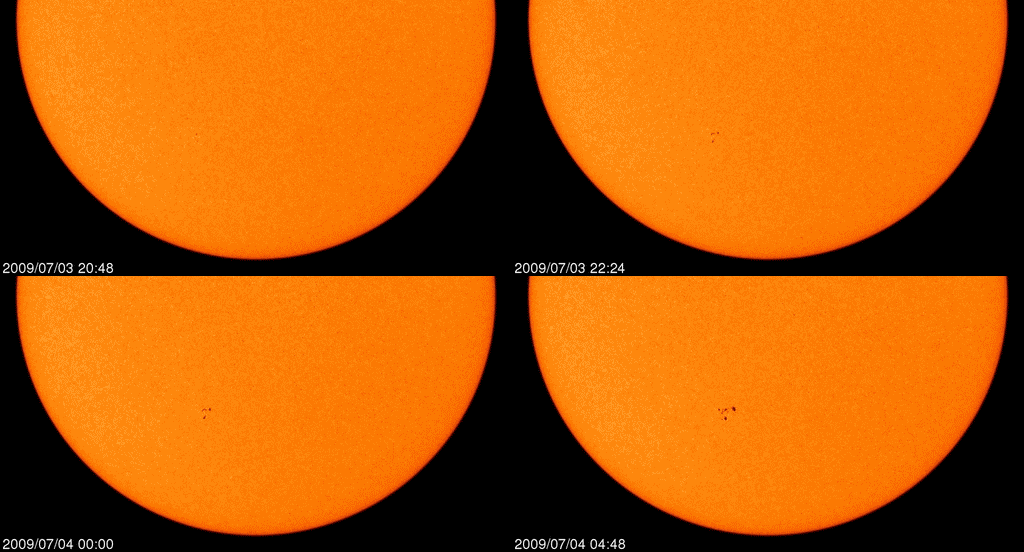
The magnetic polarity of sunspot 1024 identifies it as a member of new Solar Cycle 24. Its rapid emergence on July 3rd and 4th continues the recent (few-month) trend of intensifying new-cycle activity. This sunspot is the best offering yet from the young solar cycle.
I agree. This one looks like a “normal” sunspot. The question now is: how long will it last? Many promising cycle 24 sunspots have fizzed just as quickly as they arrived. Cycle 24 has not yet shown any indications of spot stamina.
In other news, the SOHO satellite has developed a problem with its pointing motor for the high gain antenna.
This is a serious concern, and data outages are already happening due to limited pointing ability. There is a backup spacecraft for SOHO in the pipeline, the Solar Dynamics Observatory, set for a November 2009 launch date. It has recently been shipped to Cape Canaveral. Lets hope the didn’t use the US postal service or DHL.
In other solar satellite news…
Goodbye Ulysses (July 3, 2009)

Hi-res TIF image (4.6M)
Upon receipt of the last command from Earth, the transmitter on Ulysses switched off on June 30, 2009, bringing one of the most successful and longest missions in spaceflight and solar study history to an end. After 18.6 years in space and defying several earlier expectations of its demise, the joint ESA/NASA solar orbiter Ulysses achieved ‘end of mission’. The craft is nearly out of hydrazine fuel for its stabilizing thrusters, and there’s not enough money to continue the mission for another year. A final communication pass with a ground station enabled the final command to be issued to switch the satellite’s radio communications into ‘monitor only’ mode. No further contact with Ulysses is planned.
Ulysses is the first spacecraft to survey the environment in space over the poles of the Sun in the four dimensions of space and time. Among many other ground-breaking results, the hugely successful mission showed that the Sun’s magnetic field is carried into the solar system in a more complicated manner than previously believed. Particles expelled by the Sun from low latitudes can climb up to high latitudes and vice versa, even unexpectedly finding their way down to planets. Regions of the Sun not previously considered as possible sources of hazardous particles for astronauts and satellites must now be carefully monitored. “Ulysses has taught us far more than we ever expected about the Sun and the way it interacts with the space surrounding it,” said Richard Marsden, ESA’s Ulysses Project Scientist and Mission Manager.
So farewell, and congratulations on a job exceedingly well done.
ohioholic (20:25:25) :
if you knew anything about the FTEs I posted a link to earlier. […] Does their behavior change during the sunspot maximums?
FTEs are another NASA overhyped release. We have known about them for more than 30 years. They happen every time when and place where the interplanetary magnetic field [IMF] is pointing southward as it hits the Earth’s magnetic field. This happens all the time and everywhere every few minutes. If enough of them happen in rapid succession we get a geomagnetic storm. Since the IMF is flapping around a lot it can point south at any time and usually flaps north-south many times each day. This does not depend on the solar cycle, although the magnitude of the flux does, being on average twice as large at solar maximum.
The red curve here http://www.swpc.noaa.gov/ace/MAG_SWEPAM_24h.html shows this ‘north-south’ part of the field. If negative, the field is South and we have good FTEs.
It is interesting that this group of spots is not embedded in a plage area.
This should mean that there is a cooling rather than a heating coming out, since the spots are of lower temperature and there is no compensating high temperature ( plage) visible in these frames.
I don’t get it. The first big sunspot flare up of Solar Cycle 24 and some people here are commenting like a strong cycle is inevitable now, and lamenting the lack of cooling we will see from a stronger cycle 24, and actually going as far as to discuss the ramifications on crops and whatnot. Remember, folks, it’s only one flare up.
Perspective.
OK, Dr. Lief is gonna pull on his fish net stockings and leathers before administering the whipping I deserve for mentioning that DMI chart shows a sudden spike in Arctic temperature just as the sun decides to give us the best spot and flare show for all of cycle 24 to date.
groweg (12:11:17) :
The length of solar cycles, and the last one appears to have been decidedly longer than average, has a negative relationship with temperature for several years after the end of the cycle (longer cycles = lower temperatures).
The evidence suggests otherwise. In http://www.leif.org/research/Cycle%20Length%20Temperature%20Correlation.pdf I show first [the blue curve] the length of each solar cycle [two points are shown: from min to min, and from max to max]. The pink curves show the temperature anomalies [again two points as above]. The next figure shows the lack of correlation [pink circles]. Since there is a significant trend, one can try to de-trend the temperature curve [green curve in 1st figure] and do the correlation again [green dots, 2nd figure]. There is still no significant correlation, and the little there is is positive: longer cycle => warmer.
Jesse (21:56:25) :
Perspective
That should hold both ways. In being mesmerized by the behavior of the sun ( I suppose it is atavistic, sun Gods are in all our prehistory) we should not lose sight of the fact that the current problem is not whether warming or cooling is in the cards ( or stars if you prefer).
The problem is that some misguided politicians have swallowed whole the half baked proposition that CO2 is doing the warming ( and now the cooling too, if we consider the morphing to the “climate change” mantra) and are basing policy decisions on this. Maybe they have found a convenient flag to hide their taxing plans behind but the effect is the same. Our efforts should be to show that the emperor has no clothes to hide behind, and not to rally around irrelevant talking points, like the sun’s effect on cooling or warming.
1024 has certainly evolved into decent group….at last count (07/05/09 1:23 SOHO time) it covers 249 pixels using the Layman’s Count. The closest previous group was 1007 in Nov last year with a comparable count of 110.
Does this group put doubt on L&P’s findings or is it just a flash in the pan?
Here is a blow up showing the detail.
http://i41.tinypic.com/2nis75d.jpg
anna v (21:45:56) :
You are quite right, anna. There is very little in the way of bright region surrounding these spots. Only a smidgeon on the two minor ones.
The bright areas can occur with or without sunspots. Normally only visible on the Continuum images when on the limb, you need a Ca II K-line narrowband image that shows these bright areas. I’ve done some hunting around for current images (like SOHO stays up to date) but so far not found any source. Leif would know.
As we have had global dimming since around 1945, according to the Stockholm graph
here:
http://wattsupwiththat.com/2009/06/27/new-paper-global-dimming-and-brightening-a-review/#more-8950
How can the sun possibly have had any bearing on rising global temperatures over the last 65 years?
dennis ward (23:17:51) :
It woks both ways. The atmosphere isn’t a diode, as AGW would lead one to believe.
When the dirurnal is large, more is getting in and out.
When the diurnal is small, less is getting in and out.
Now, add to that changes in everything else.
TSI, spectral shift, Ocean temps, ionosphere depth, humidity, aerosols, dust, volcanic gases, burning, etc.
What else could it be?
Everything, that’s what else if could be.
‘How can the sun possibly have had any bearing on rising global temperatures over the last 65 years?’
http://www.telegraph.co.uk/news/worldnews/northamerica/usa/3222476/Suns-protective-bubble-is-shrinking.html
The dimming sun has indeed had a significant effect on the earth over the last decade. As to whether the temperatures were ever rising faster (or at all) over the last 65 years, maybe the surfacestations project can answer that one for you. As for the last 10 years of cooling…
One thing is for sure, even with CO2 out of the picture, the science is certainly not settled but is just getting more interesting.
dennis ward (23:17:51) :
–rbateman (23:51:03) :
–Everything, that’s what else if could be.
Horatio:
O day and night, but this is wondrous strange!
Hamlet:
And therefore as a stranger give it welcome.
There are more things in heaven and earth, Horatio,
Than are dreamt of in your philosophy.
Lord Kelvin (died 17th of December 1907 but General Relativity developed by Einstein in the years 1907–1915.) was equally wrong, so I guess no one is above thinking it is all done and dusted, although after this example perhaps everyone should think twice before making a similar statement. He (Kelvin) said:-
“There is nothing new to be discovered in physics now, All that remains is more and more precise measurement.”
Sound familiar?
dennis ward (23:17:51) : “As we have had global dimming since around 1945, according to the Stockholm graph”
How do you make it global? It says AT Stockholm, so obviously it is local data, not global.
Does cloudines affect this data as variation is so large?
Isn’t this like the 4rth article about sc24 ramping up? (since last year)
And this spot appeared a couple of weeks ago and now re-appeared again (after 7-8 of zero sunspots)…
the official weather department in the Netherlands talks of a steady increase of sunlight reaching the soil during the last 80 years. They say they assume its due to diminished cloud cover.
(dutch)
http://www.knmi.nl/kenniscentrum/de_toestand_van_het_klimaat_in_Nederland_2008/hoofdstuk_4/index.html
the_Butcher (02:20:47) :
Isn’t this like the 4rth article about sc24 ramping up? (since last year)
Precisely. A broken clock syndrome. I’d prefer to wait until we actually see more evidence of a ramping before pronouncing such a ramping. One group does not a ramp make. I will say that I see SC24 on a slow rise, but this article is slightly on the hyberbole side of the line. Just my take.
rbateman (12:59:00)
Seeing is believing. This is the best spot of SC24, hands down.
SOHO MDI Cont. Image 2009/07/04_16:00
Total spot area is 356 x 10E-6
Umbral ( which must be calculated for each individual spot) is approx.
60 x 10E-6.
Does anyone concur?
I agree and this is the best activity level on a few fronts.
The interesting thing is that it’s only from 2006 we do have real scientific analysed the sunspots….. look at http://www.rymdportalen.com/?page=nyheter&id=74 Translated to English: “Next year the European Space Agency, ESA, and its American counterpart, NASA, studying the sun together via their own satellite. This will provide stereo images of the bucket’s example soleruptioner.
With the project, Solar Terrestrial Relations Observatory (STEREO), it should now become possible to study particles from Solstorm shares when they are on the way to Earth. In the current situation, it is only possible to study the particles when they pass Earth.
“We hope to learn more about how soleruptioner arises,” said Volker Bothmer at Happy’s University.
Solstorm shares can cause major disruptions in electricity, communication and navigation on Earth. Solutbrotten October 28, 2003 created great confusion in the earth.
One copper also through the new system to develop an early warning system can alert the astronauts carrying out space walks outside the space station or outside their spacecraft.”
Need one say more?
Ian L. McQueen (15:44:26) : Midwest farming
One big answer is irrigation. I fly over the corn/wheat belt frequently, and see huge numbers of circular irrigation plots. That will decline when the underlying aquifer dries out. As for all those bison, they covered a rather large area. Their numbers were limited only by what grew around them. And the guns of Buffalo Bill & Friends.
As for “warming”, when this sunspot popped out, our high temps dropped over 10 degrees (from last week to this week), so I think it is a sign of the apocalypse. (0.06 on the 1-10 scale of sarcasm)
Ian L. McQueen (15:44:26) :
In answer to your musings on the midwestern desert. I would start off saying a greater or just as great a threat in the nations cornbelt would be to have a frost such as happened on June 4/5, 1859. Here is a quote:
History of the United States from the Compromise of 1850 Volume 3 1860 – 1862, by James Ford Rhodes, – 1900 page 56
” In a large part of the country, however, the rising hopes, springing from the better outlook of affairs, were blasted by the June frost of 1859. In the early morning of June 5, the mercury went down to 32°: the frost killed the wheat, corn, potatoes, vegetables, and fruit of a considerable portion of New York, Pennsylvania, Ohio, Indiana, and Illinois. John Brown wrote from Akron, Ohio, that the frost had been very destructive in western New York and Ohio. ‘Farmers here,’ he said, ‘ are mowing the finest looking wheat I ever saw, for fodder only.”
http://books.google.com/books?id=DH98lunbPioC
I had heard similar stories about the prairie being passed over by early settlers (I live in Northern IL so this kind of stuff is interesting to me.) If you read this account though: http://books.google.com/books?id=ELoEAAAAYAAJ&pg=PA67 ; it could be that prairie soil was just to tough to break open with the standard horse drawn plow that an eastern farmer might possess.
Where I live another question/issue discussed is: why prairie, why not woods? For most the answer is that once fires start on the prairie they go on and on and destroy all saplings and seedlings. I am coming to think that it could be a combination of things. Prairie fires and devastating summer freezes of the little ice age. In old county histories I have read accounts of freezes that left the trees of a region all dead. I think one thing that is true is that prairie soils are good soils. This is because all the biological material is right at the surface whereas in a woodland soil the leaves are way up in the air and off the surface. Due to this prairie soils eroded away to a much lesser degree than woodland soils.
Lucy Skywalker (12:57:31) : “I thought I was going to hear it had been sunspotting. This last week, the Sun (but only when out and felt direct) felt distinctly warmer to me. Even at 6 pm. Very different from last year”
Hi Lucy, I always enjoy reading your comments but this is clearly smacks of algorean science.
That’s a nice one that looks even better today. However, all the other indexes and the Planetary Index are not different and don’t show signs of solar activity pickup. It’ll be interesting to see how things go in the months to come. I just hope the sun will not sombre in a renewed low after giving out such activity.
vukcevic (06:33:53) :
Since it appears that you have been giving more than passing attention to my formula
Leif Svalgaard (08:38:57) :
Pseudo-science should be beaten down whenever it rears its ugly head.
It is art (the science has to wait ! ), and beauty (or for that matter ugliness) is a in the eye of beholder, that is to say a property and an attribute of mind.
“When I say it is beautiful, I mean there is a property which justifies my exhilaration and it is such that if you could grasp what I grasp, you too would have the same exhilaration. But maybe you are not able to grasp it.”
http://www.geocities.com/vukcevicu/PolarField1Cr.gif
vukcevic (09:27:34) :
It is art (the science has to wait ! ),
Then post it to an art-blog.
REPLY: I was going to say something else type blog, but Leif’s comeback works well enough. – Anthony
vukcevic “When I say it is beautiful, I mean there is a property which justifies my exhilaration and it is such that if you could grasp what I grasp, you too would have the same exhilaration. But maybe you are not able to grasp it.”
I’ve saved a copy of your graph, and will see what happens as the solar cycle develops. The correlation to-date looks very good, if not a little worrying.