By Joseph D’Aleo, CCM, ICECAP
May has been frigid slowing the planting and emergence of the summer crops in Canada. Late freezes and even snows are still occurring regularly and can be expected the rest of the month.

See larger image here.
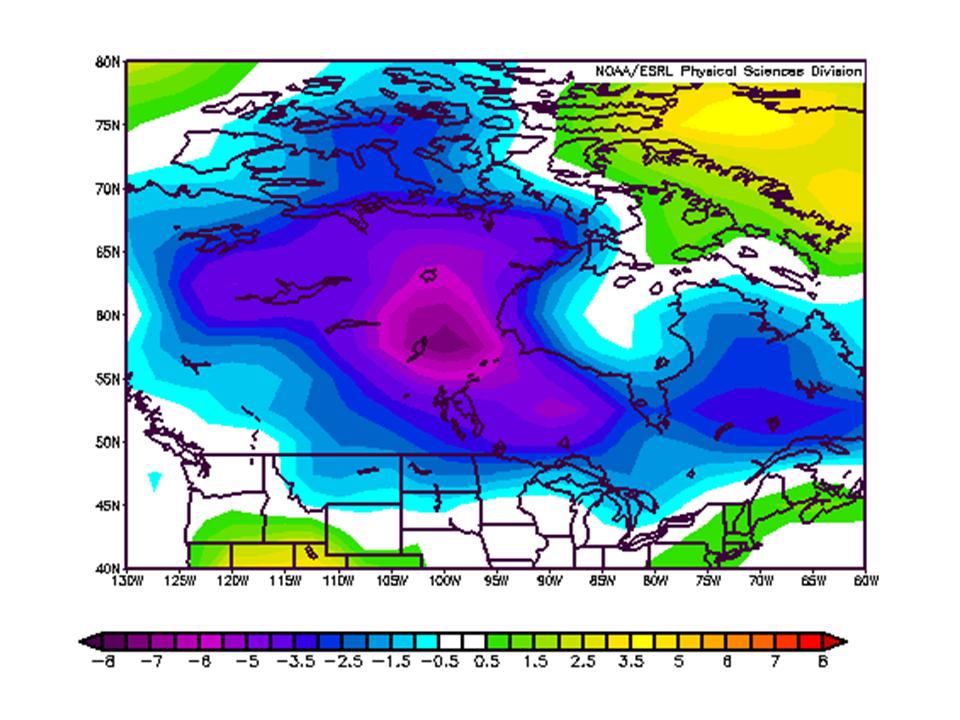
The chart above shows the May 2009 temperature anomaly through May 24th. Parts of central Canada (Churchill, Manitoba) are running 16 degrees F below normal for the month through the 26th (map ends 24th). Every day this month has seen lows below freezing in Churchill and only 6 out of the first 26 days days had highs edge above freezing. The forecast the rest of the month is for more cold with even some snow today in Churchill and again this weekend perhaps further south.
Hudson Bay remains mostly frozen though most of the seasonal melting occurs in June and July most years.
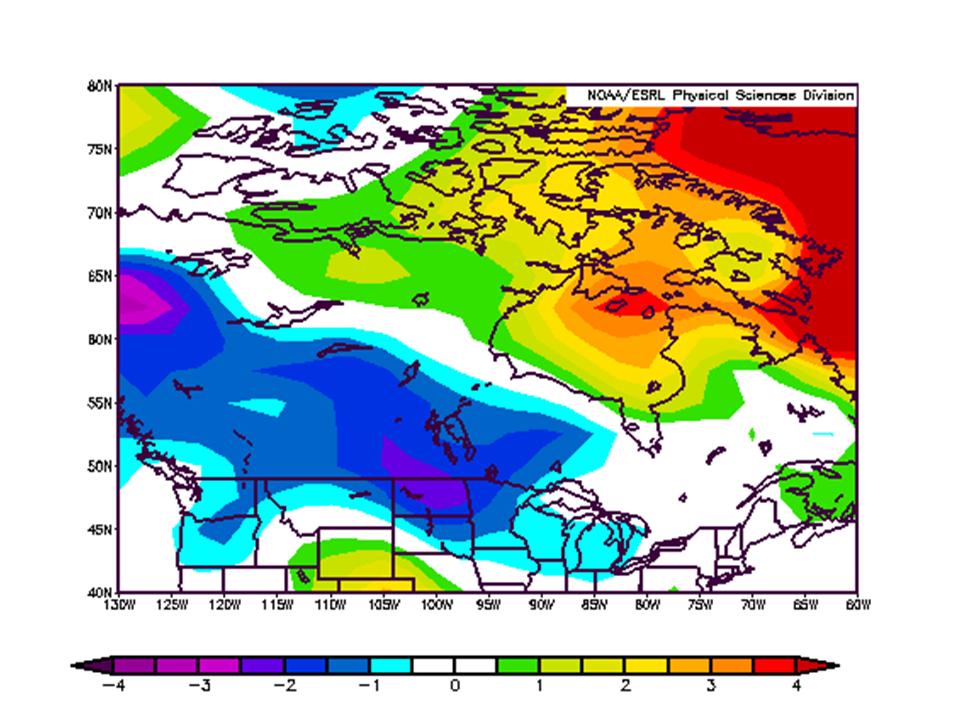
Parts of the south central region were also cold in April averaging 3-5 F below normal. The winter (December to March) was a cold one for southwest and central Canada but warmer in the far northeast.


See larger image here.
Meanwhile the arctic ice remains higher this data for any year this decade in a virtual tie with 2004.

See larger image here.
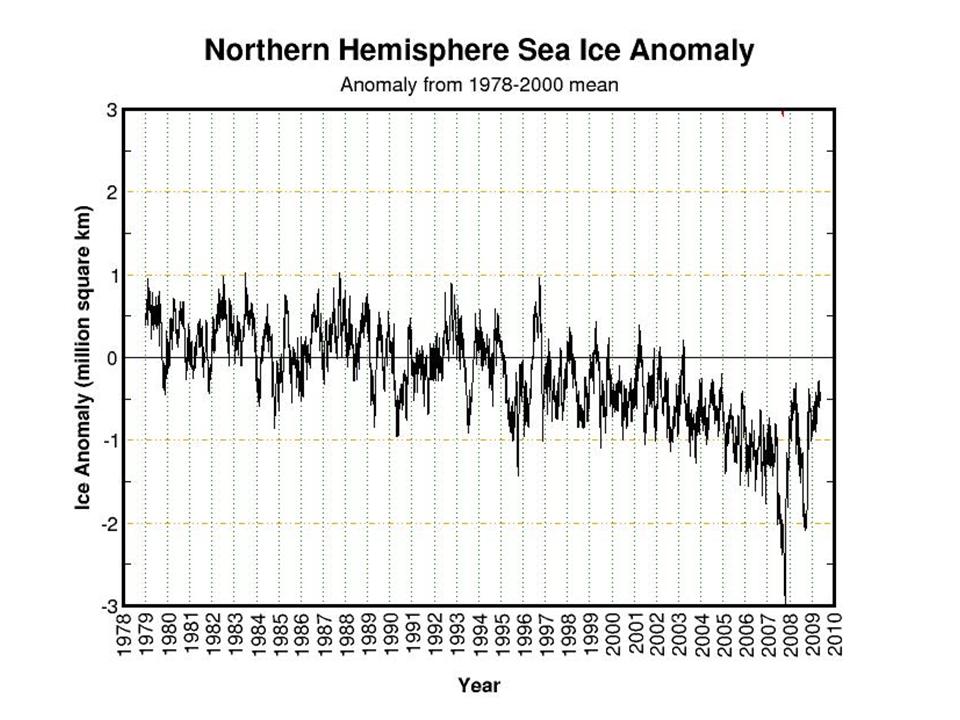
Given the polar stratospheric aerosols from Mt Redoubt, and a colder Atlantic and a continued cold Pacific, the recovery from the minimum of 2007 should continue this season.
The global data bases have large gaps in Canada, Africa, South America. So they will not reflect this in their global May anomalies as well as the satellites that see the entire surface – land and ocean excluding high latitude polar.
See pdf here.
May has been frigid slowing the planting and emergence of the summer crops in Canada. Late freezes and even snows are still occurring regularly and can be expected the rest of the month.

See larger image here.
The chart above shows the May 2009 temperature anomaly through May 24th. Parts of central Canada (Churchill, Manitoba) are running 16 degrees F below normal for the month through the 26th (map ends 24th). Every day this month has seen lows below freezing in Churchill and only 6 out of the first 26 days days had highs edge above freezing. The forecast the rest of the month is for more cold with even some snow today in Churchill and again this weekend perhaps further south.
Hudson Bay remains mostly frozen though most of the seasonal melting occurs in June and July most years.
Parts of the south central region were also cold in April averaging 3-5 F below normal. The winter (December to March) was a cold one for southwest and central Canada but warmer in the far northeast.

See larger image here.
Meanwhile the arctic ice remains higher this data for any year this decade in a virtual tie with 2004.

See larger image here.
Given the polar stratospheric aerosols from Mt Redoubt, and a colder Atlantic and a continued cold Pacific, the recovery from the minimum of 2007 should continue this season.
The global data bases have large gaps in Canada, Africa, South America. So they will not reflect this in their global May anomalies as well as the satellites that see the entire surface – land and ocean excluding high latitude polar.
See pdf here. H/T Climate Depot and Andy for the heads up
Canada Has a Frigid May after a Cold Winter By Joseph D’Aleo
May has been frigid slowing the planting and emergence of the summer crops in Canada. Late freezes and even snows are still occurring regularly and can be expected the rest of the month.
See larger image here.
The chart above shows the May 2009 temperature anomaly through May 24th. Parts of central Canada (Churchill, Manitoba) are running 16 degrees F below normal for the month through the 26th (map ends 24th). Every day this month has seen lows below freezing in Churchill and only 6 out of the first 26 days days had highs edge above freezing. The forecast the rest of the month is for more cold with even some snow today in Churchill and again this weekend perhaps further south.
Hudson Bay remains mostly frozen though most of the seasonal melting occurs in June and July most years.
Parts of the south central region were also cold in April averaging 3-5 F below normal. The winter (December to March) was a cold one for southwest and central Canada but warmer in the far northeast.
See larger image here.
Meanwhile the arctic ice remains higher this data for any year this decade in a virtual tie with 2004.
See larger image here.
Given the polar stratospheric aerosols from Mt Redoubt, and a colder Atlantic and a continued cold Pacific, the recovery from the minimum of 2007 should continue this season.
The global data bases have large gaps in Canada, Africa, South America. So they will not reflect this in their global May anomalies as well as the satellites that see the entire surface – land and ocean excluding high latitude polar.
See pdf here. H/T Climate Depot and Andy for the heads up.
.
This from the BoM of Australia, there’s an El Nino developing in the Pacific…
http://www.smh.com.au/environment/water-issues/warmer-than-normal-leave-your-winter-woolies-at-home-20090601-bsdh.html
It don’t feel warm. In fact the “weather” was one topic of conversation at a wedding on Sunday. No-one there was saying it was warmer than “average”.
How true is this, does anyone know sources of reliable information (Year I know, not easy in this day of instant misinformation)?
pat
According to this source , there is a possibiblity for an El Nino. There has been an El Nino event within about year after every solar minimum for most of the last 10 solar cycles [ i think about 8 out of the last 10 cycles]
http://www.bom.gov.au/climate/enso/
Pat
I double checked how soon after a solar minimum , do El Nino’s occur, if they occur at all. I found that it is not quite that positive. There is a pattern for the last 4 solar cycles but prior to that it was all over the place .
For the last 10 solar cycles
5 happened within about a year after the solar minimum[ 1913, 1964, 1976,1986, 1996]
3 happened within 2-3 years [1901,1923,1954]
2 had no such event [ 1933,1944]
It is June first and the temp reached the thirties F last night here in Vermont, and it snowed in the Adirondacks.
“Bottom line: The Sun is not the driver of the variation” – PG
In logical augmentation, this is known as asserting a negative. In other words, it is a statement made based on faith, or judgment, not rigorous proof, as it is nearly impossible to prove any negative on this scale. Especially with the climate as poorly understood as it is today, and the sun radiating on multiple wavelengths affecting various gases at various altitudes as well as modulating incoming radiation from deep space, like a transistor, through magnetism and the solar winds operating, of course, on a chaotic system where a butterfly’s wingbeat… well, you know the rest. Lief has his proof that the Sun can’t change the climate with small variations in irradiance, but it is so laden with assumptions, and dismissive of counter-evidence as random coincidence, that it is no proof at all. For instance, if you tell Lief that you found studies that show a correlation between solar cycles and temperature in arctic lakes, or flooding of the Nile, or wheat prices in 19th century England, he will tell they that they are all statistical flukes. If pressed, he will finally aver that one has to start somewhere to stay on solid ground, even if you have to assume the ground beneath you, to make progress. (my characterization of his position) That doesn’t get us anywhere close to “bottom line” finality.
The jury is out and the experiment may, or may not, be underway to get a better handle on the issue. We will see how the solar cycles progress.
Thanks for the info Matt V. S, basically, it could go either way. Here’s my prediction; It’ll be a cold winter with many low lows or even record lows in NSW, Australia.
Look people, I’m not doing your homework for you. If you want to know why it is snowing here, and drought”ing” there, you need to understand the basic water cycle as it comes off the ocean and travels across land. You also need to study the Jet Stream’s northern track and how its loops can cause both record heat and record cold within the span of a few days. It would also be worth your while to study record weather events. Try 1996 for starters. This study will help you understand what happens when a northern track and southern track follow each other in the same fall/winter/spring season (read La Nina/El Nino). It is a fabulous study in 5th grade water cycle application combined with Jet Stream data that will be a good starting point in understanding these powerful weather pattern variation drivers. Then work your way backwards, searching for information on what drives each driver. You will be lead to the Trade Winds and ENSO, then the Coriolis affect, and finally what drives that (which I am studying right now). In other words, do your own damn pencil work. I did, and am.
What is it with people these days? They don’t want to engage themselves in a course of study on their own? They want it spoon fed and with a bib? And then get extra pay for letting someone else do their homework for them? It is a lazy, not-really-interested-in-the-answers, I-want-my-course-in-online-video-format, person who requests that someone else push their pencil for them. As a teacher, your request disgusted me.
Homework. And it is brought to you in on-line video powerpoint format. Click on the ppt button to get to the presentation. Wanna bib with that?
http://www.cpc.ncep.noaa.gov/products/analysis_monitoring/enso_advisory/index.shtml
I live in Saskatchewan, Canada… The heart of Canada’s breadbasket. It has been one of the coldests Mays and Aprils on record…
We have had only a few warm days this year… Saturday, May 30, the temperature shot up to 30C/86F… For one day… 2 days previous to this, we had frost where I live… Tonight (June 1st), a hard frost is yet again predicted for this area (there has actually been frost almost every night somewhere in Southern Canada in May… unusual.. Hard frosts in Southern Ontario in late May where normally the frost free season begins in late April)
Many farmers in this area have seen their Barley crops freeze back twice now this year.. Luckily, barley is a very cold hardy cereal grain and can recover… Wheat is not… Much of the wheat is not even up yet… Same with Canola and other crops.
There are many, many trees in Saskatoon that are still in the process of just breaking bud… and it’s June! I have never, ever seen anything like this and I have been on this earth for almost 60 years.
People here are making snide remarks about “Global Warming” and “The 117th warmest May on record” (In 118 years of record keeping here).
It’s always Marcia Marcia (15:56:34) :
“”E.M.Smith (01:26:58) : What’s undeniable is crops. They are being planted late, not sprouting due to cold soils, and not setting fruit. Grain prices show it isn’t a local isolated thing.””
I have many friends in the Philippines. Life is already hard enought there. If food prices go higher I don’t know what they will do.
Well, I live in the Northern part of California near the coast. We’ve been colder than normal (part of the cool zone that stretches up into Oregon) so my comments were more about me, here, and Canada (from the article) along with a bit of Argentina from other news.
Well, the good news for your friends is that the Philippines are tropical. The poles are cooling, but the equator is staying warm (it will take a while to cool off all that ocean…). So a place like Canada has a colder growing season, but Brazil and the Philippines don’t notice much. They may pay more for beer made from Canadian barley or bread made from Argentine wheat, but local fruits, vegetables, and rice ought to be just about the same as now. At least for the next couple of years (IMHO, of course).
A good example of this was on The Weather Channel tonight. It showed a front moving down across the central US with cold air north of it and warm south. So folks in North Dakota may have a bit of a harder time getting grains to grow (or tomatoes to set fruit 😉 at near 50F) while folks in Texas and Florida are wondering what all the fuss is about since they are at normal summer temps of 85F to 90F+. Oh, and the Anomaly Admirers say nothing is happening since when you average it all together it disappears…
I’ve watched this for a year or so now. To me, it is like a giant “Lava Lamp” with blobs of warm air pushing north to cool off and blobs of cold air pushing south from the pole (in the Northern Hemisphere, of course it would be reversed in the Southern, but I don’t see the S. H. on the nightly weather report 😉 As the N. Pole has cooled we’ve moved from a flatter jet stream to a more ‘loopy” one with the lava lamp blobs trying to equalize the temperature difference. The corollary to this is that if you are far enough away from the pole that the polar air blob never reaches you, “nothing happens” from your point of view.
Barley, Wheat, Oats all tend to be cooler climate crops and widely grown in the northern latitude land of the northern hemisphere (and in Australia and Argentina). Soybeans and rice are warmer climate crops and grown more in places like Texas, California, and yes, Asia and the Philippines. All further from this cooling blobs of polar air effect. So global wheat prices are rising. But rice, not so much:
http://futures.tradingcharts.com/hist_RI.html
Shows rice having seasonal price movements, but nothing of a trend to speak of longer term. Generally flat sideways from 2008 to date with humps up and valleys down depending on news and season.
It’s also the case that the Philippines have started growing a lot more aquacultured food, like shrimp and Tilapia, that are fairly low cost to produce. So to the extent folks are eating traditional fish, shrimp, and rice dishes they ought to see nothing much. To the extent they want imported beer and French Bread, well, that’s going to cost a bit more… but that’s probably not the poor folks…
The other good news is that to the extent wheat is grown in a warm place, like Brazil or the Philippines, the higher prices will mean more revenue to the country from exports. The rural farmers will make a bit more money, and that’s generally a good thing.
So I wouldn’t worry too much about the Philippines. I’d worry a whole lot more about the Canadian wheat farmers and the price of Labatts Blue beer… Oh, and places like North Korea where it does get cold are likely to have a very cold hard winter next year. That does not bode well given their lack of investment in improved farming; having spent their money to play with nuclear weapons and rockets instead. That is something to worry about… but that is for a different topic elsewhere…
The only real worry I’d have is that Texas gets a bit more 1930’s style drought and folks keep trying to grow corn and soybeans when they ought to shift to drought tolerant things like millet and sorghum more. That would only be a one or two year effect, most likely. Farmers catch on pretty quick and some amount of sorghum is already grown in Texas. Doesn’t take long for one guy moaning about his corn failure and another crowing about his big sorghum crop, or his millet that produced with little rain, for the shift to happen. Yes, gossip is a major driver of crop decisions! And an effective coordinating tool for improving crop choices. Strange, but true…
BTW, you can put millet flour in any corn bread recipe instead of the corn and get a very nice loaf of “millet bread”. I’m very fond of it. While many folks disparage millet as “bird seed” it is a staple food in much of drought stricken Africa. It is also one of the traditional important grains of Asia used for a kind of couscous like dish. I would speculate it had that revered position in the past due to it’s drought tolerance and high yields under adverse conditions. Sorghum flour makes a nice pancake if used instead of wheat.
And finally, I do have to point out again that the big losers in any major food price hike / shortage are not people. It is cows and pigs. We reduce the herd size to save feed costs, that cuts demand for corn and soybeans. It takes 10 kilos of grain to make one kilo of beef (or 3:1 for pork) and that’s live weight on the hoof… So if food prices try to go up much, folks eat less beef and pork. That aquacultured fish has a 1:1 feed conversion ratio, so it stays cheaper. Instead of beef ribs, you have kung pao shrimp, and the grain needed drops by quite a bit: 9/10 less. (by 9 kilos if you drop 1 kilo of beef and substitute 1 kilo of shrimp or fish) That 9 kilos less demand makes up for a heck of a lot of reduced grain yield…
So your friends are well positioned to not notice much, especially if they are willing to eat less red meat and more traditional seafood / rice meals. And maybe rediscover a millet pilaf or sorghum hoe cakes…
Something very much like this happened in the Little Ice Age. England, Ireland, Germany, Russia all embraced the potato that grew well with cold and wet. France insisted on wheat and bread, disparaging the potato. One of the contributors to the French Revolution and the “Let them eat cake” reply to the peasants having no bread to eat… So a little food flexibility can go a very long way, and a brittle approach to food can topple empires…
Miles (14:21:24) :
E.M. – I’m eternally grateful that you didn’t mention rice and beer in the same sentence.
I’ll stifle my intense curiosity and only say “Don’t read my prior posting per the Philippines!!!” 😉
Pamela Gray (18:23:48) : No need to wash fry pan. Let cool slightly and then lick it clean.
Tho I’m thuposth tuh leth ith coorl frithst?
Thathst whath I didthnth doth.. 😉
BTW, I have a ‘crop’ of dandelions in my front yard. Regularly pick a few leaves just to munch or put into a regular salad. High in some needed minerals, nice herbal medicine and they are very rich in vitamins like C, A, K along with antioxidants and even protein. They have a bit of bitter flavor (so use them for the ‘bitters’ in your salad ) and I like them fresh with a home made olive oil mustard vinaigrette… even if the neighbors don’t understand that it isn’t a lawn full of weeds, it’s my salad garden…
BTW, bunnies just LOVE dandelions… bunnies have great instincts for what plants are good for you. The are also especially fond of cabbages and peas… Oh, and soft fruit wood (nobody’s perfect 😉
Reply: Tortoises love dandelions as well, both leaves and flowers. ~ charles the moderator
Michael H anderson (10:21:28) : The hysteria hasn’t abated though, nor should any of expect it to: it is far and away the greatest gravy train in human history, one our great-grandchildren can expect to be paying for as they curse our lack of courage and gullibility.
FWIW, I don’t expect “our children” to be paying for it, nor any of the other nonsense our governments are spending boatloads of cash to promote.
Why?
I expect that pretty quick they will figure out that they have to pay back the “debt” with pretty pieces of colored paper and that those are pretty darned easy to print up in large number with very large numbers on them… It’s the folks who are loaning the government the present value of money that are paying for it all – as their bonds are going to become worth very much less long before their maturity in 20 to 30 years…
Inflation is just wonderful for erasing debts…
BTW, China has realized that this is the game, and has been shortening the maturities they hold; pulling them in to the 2 year and 5 year range. The auction of 10 year bonds had to pay high rates (and our Treasury secretary is now in China trying to explain to intelligent people that they ought to do stupid things so that stupider people can do more incredibly stupid things with the Chinese money… I think they will give him some nice warm tea and smiles; and dump more 30, 20 and 10 year bonds for 2 year bonds.) They also dumped $10B or so on Petrobras to pay for drilling out the big oil field off the coast of Brazil for a piece of the oil. Expect to see more of that too: China handing long bonds to someone else in exchange for a resource ownership position. That’s what I’m doing with my dollars too.
So it isn’t your children nor your grand children who’s pocket will be picked. It’s the folks sitting on government bonds and large U.S. dollar deposits.
If you must hold U.S. dollar bonds, do it only with Treasure Inflation Protected Securities. They have an inflation adjustment built in. TIP is the ticker for a fund that holds them. Me? I’ve sent my money off to countries with growing economies… and exempt from Kyoto. I don’t need US bonds.
Yeah, I just posted about this in another thread. It is still very cool and well under so called seasonal normals. I strongly suspect that the change of El Nino – La Nina formation has altered jet stream, perhaps increasing northerly cloud cover, strengthening northerly flows, weakening warm gulf southerlies. The net result: we’re getting snow in S. Ontario at the end of May. Unheard of in my lifetime….
Fred Houpt
You must have been born after the 1950’s
Negative PDO levels [currently -1.65] bring cooler than normal temperatures to much of western Canada right up the Great Lakes and Ontario. The average annual PDO in 2008 was [-1.29]. This is the 4th lowest since 1900, only 1950, 1955, 1956 had average annual PDO‘s lower. Those years were coldest years [annual basis] in 61 years since 1948 for many parts of Canada like the west [Northwest, Prairies, Pacific coast.] So we seem to be returning to the weather of the 1950-1970’S which were generally cooler. This could last for several decades so we might as well get used the cooler weather generally. The 2009 pattern seems to follow 2008 so far.
Does anyone follow the Artic Sea Ice News and Analysis?
http://www.nsidc.org/arcticseaicenews/
An interesting thing happened this past month. They shut down the daily reporting for a while and “recalibrated” their sensors. Up to the end of April, the sea ice area was trending towards the 1979-2000 average. After the calibration it moved back towards the historical low of 2007. It may be real but it looks a bit like the data was adjusted to expectations perhaps purposely, coincidentally or accidentally. I don’t have the skills to interpret the information, but perhaps others on this site do.
Matt: 1955. Thanks for the info. I was just reading an interesting note about how the Sun’s magnetic interplanetary field is so low and might go lower. If I’m not mistaken, in the past when the earth warmed up during the early 2000’s it was observed that almost all the other planets in our s.s. also simultaneously warmed, all the way out to Pluto! I wonder now if the reverse will be observed and if yes will any mainstream scientist have any explanation?