Guest post by Steve Goddard
Yesterday, Dr. Walt Meier from NSIDC again graciously updated us about the NSIDC sensor problem, and also about his current thinking with respect to polar ice trends. The key concepts being that Arctic ice continues to decline, and that Arctic and Antarctic ice are separate entities – so the current near normal global sea ice area “has no meaning in terms of climate change.” This article examines both of those concepts.
NSIDC is still having sensor problems on their satellite, as seen below on 2/28/09. Note the speckled white areas, and the large dark gray sliver in the Sea of Okhotsk near the top.
http://nsidc.org/data/seaice_index/images/daily_images/N_daily_extent_hires.png
Fortunately there is another ice extent data source, AMSR-E which has not suffered sensor problems and their data is unaffected. NSIDC also explains on their web site that “AMSR-E has a lower absolute error” than the NSIDC sensors, even when functioning properly. AMSR-E (below) has been recording sea ice since 2002. The maximum ice extent for 2009 (red) and 2008 (orange) are both in the top three on the AMSR-E record, at more than 14M km2. The only year which had greater ice extent than the last two years was 2003. So clearly we are on a recent trend of higher Arctic ice maximums, which is a fact that is rarely if ever reported by the main stream media. Also note in the NSIDC map above, all of the ice basins are close to the 1979-2000 normal.
If there is a dramatic downwards trend in maximum Arctic extent, it certainly isn’t visible in either the map or the graph.
 http://www.ijis.iarc.uaf.edu/seaice/extent/AMSRE_Sea_Ice_Extent.png
The NSIDC graph below also shows Arctic ice extent nearly back to the 1979-2000 mean.

http://nsidc.org/data/seaice_index/images/daily_images/N_timeseries.png
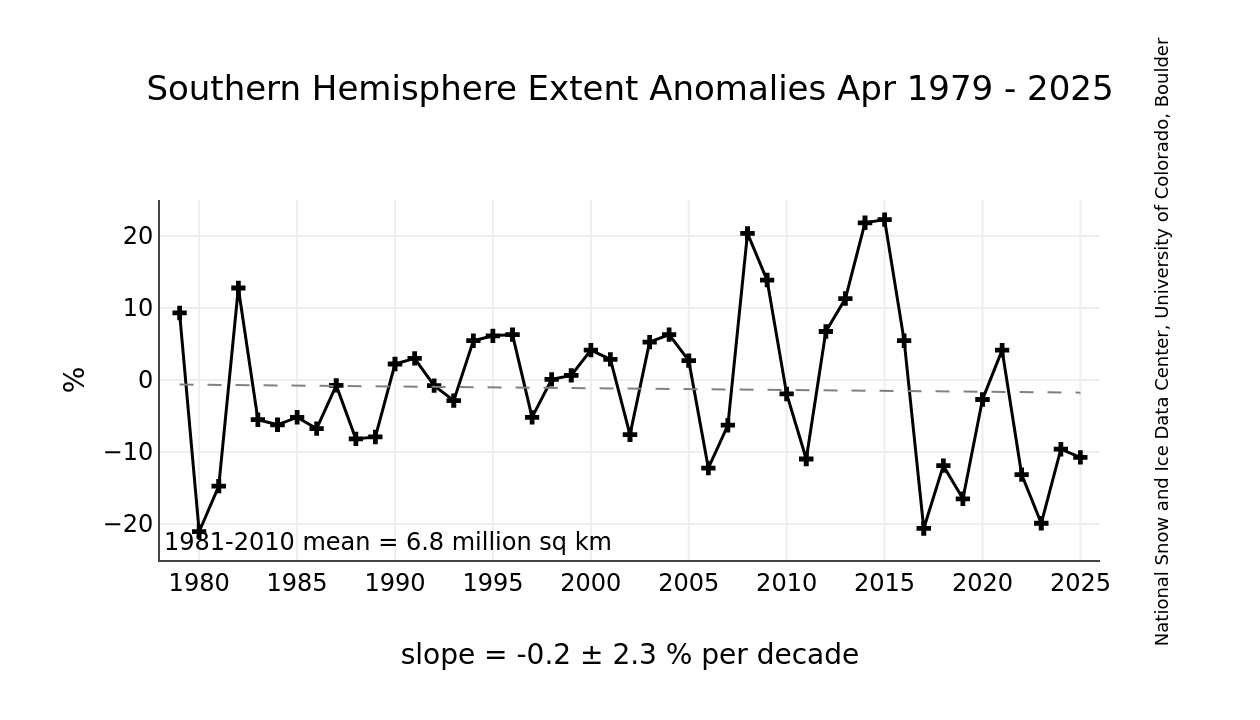
Turning our attention to Antarctica. Dr, Hansen predicted in 1980 that ice loss in Antarctica would be symmetrical to the Arctic. But the current thinking, as expressed by Dr. Meier, indicates that view is no longer valid. In fact, NSIDC data shows that Antarctic ice extent has actually increased substantially, as seen below.

http://www.epa.gov/climatechange/effects/downloads/Challenge_chapter2.pdf
It was reported last week that the IPY (International Polar Year) released a study claiming that both polar ice caps are melting “faster than expected.” Given that NSIDC shows Antarctica gaining ice at a rapid pace, I find myself surprised that IPY would release a study saying exactly the opposite. But then again, an IPY official reportedly forecast that last summer (2008) might have an “ice free Arctic.”
Columnist George Will reported that overall global sea ice area is normal, and was correct. Dr. Meier confirmed that on January 1 global sea ice levels were normal.
Walt Meier (16:04:59)
1. He (George Will) was factually incorrect on the date that he reported his “daily
global ice” number. However, he was merely out-of-date with his facts
(it was true on Jan 1, but wasn’t 6 weeks later).
The UIUC graph shows global ice levels well within one standard deviation of the 1979-2000 mean. Dr. Hansen was correct that according to global warming theory, both poles should be losing ice – though we know now it theoretically should be happening more slowly in the Antarctic. Yet 20 years later we actually see the Antarctic gaining ice, which is contrary to Dr. Hansen’s theory, contrary to IPY claims, and probably contrary to Steig’s questionable temperature analysis .
The main trend I see in polar ice is an increasing disconnect between hype and reality. Given that the AO (Arctic Oscillation) has been neutral this winter and polar drift has been less than last year, I forecast that the summer Arctic ice minimum in 2009 will show more ice than either of the last two years. What do you think?
Discover more from Watts Up With That?
Subscribe to get the latest posts sent to your email.
Ken Feldman,
Please tell me exactly where you think the missing ice is in the Arctic?
http://nsidc.org/data/seaice_index/images/daily_images/N_daily_extent_hires.png
You say that Antarctic melt now matches Greenland. Good thing Greenland isn’t melting.
Greenland’s Ice Armageddon on Hold
Richard Kerr of Science magazine reports on a presentation at the recent fall meeting of the American Geophysical Union in a News Focus article entitled: ‘Galloping Glaciers of Greenland Have Reined Themselves In’
Ice loss in Greenland has had some climatologists speculating that global warming might have brought on a scary new regime of wildly heightened ice loss and an ever-faster rise in sea level. But glaciologists reported at the American Geophysical Union meeting that Greenland ice’s Armageddon has come to an end.
http://climateresearchnews.com/2009/01/greenlands-ice-armageddon-on-hold/
Something seems a bit strange about this discussion. It is as if thinning Arctic ice or lesser extent of the ice is a bad thing. Yes, humans, animals, plants all would have to adjust — just like they always have adjusted in the past during climate change. Today we have ways to assist in that adjustment.
The bottom line is that warmer is better, healthier, and provides more living space on this earth. We sceptics can seem a bit defensive in responses to Dr. Meier’s conclusions that the ice is thinning (less multidecadal ice) or that there can be greater melting (fragility?) of one-year ice. Bring it on. This would be a good thing and it has happened before in the 1930s and 1940s and before that. Dr. Meier simply has not included an expectation of natual cycles in his projections — and I think he should. Thirty years does tell us anything important about climate changes.
Given the warm PDO and the warm AMO at the same time with Pacific warm water flowing through the Bering Straits and Atlantic warm water coursing through the Barents Sea (and under the ice to the Arctic coast off Siberia), if the Arctic ice is not thinner, then ice is not acting like ice. But the climate regime appears to have changed, at least the PDO. Will there be more cooling? Only time will tell.
I thank Dr. Meier for helping us understand the purposes and methods of the NSIDC and for generously giving of his time to WUWT. I hope he can include the natural cycles (and therefore expected changes) in the agencies reporting in the future. And we can keep CO2 in mind — but not cap-and-trade.
Lake Superior is completely frozen over as of today. Anyone here know when this last occurred? Maybe 2003? Just another by-product of our coal fired power plants, I’m sure.
Looking at the current graph of the last few days the steep increase in Arctic ice area must look suspicious to a true skeptics, is the instrument faulty? is it now reading too high? is anyone at WUWT looking into it?
Manfred
Just a guess, but the chart you posted showed Nortrhern Hemisphere ice. Mine was of the Arctic. Presumably ice extends out of the Arctic, particularly in winter, so this would be picked up as NH data.
Tonyb
@TonyB
and these are 3 month averages…
http://arctic.atmos.uiuc.edu/cryosphere/IMAGES/seasonal.extent.1900-2007.jpg
…
however, cryosphere looks pretty much like a fabrication out of the hockey stick laboratory. no increase when the global temperatures decreased till approx. 1980, almost no variation until approx. 1950 in contrast to reportrted history.
As an environmental scientist (landscape and salinity issues) and a keen observer of sustainability in particular climate change, where I must admit I have received government greenhouse mitigation funding for a research project. Despite the funding which furthered my salinity project and as a byproduct provided carbon sequestration benefits (although the sequestration was the main priority to receive the funding) I have always been sceptical of pro-warmist claims and selective use of data, however I am now starting to wonder whether my scepticism has lead me to selectively seek out information to support my beliefs. The information I read on this blog and many others seems overwhelming in refuting global warming or as it is now called climate change.
Why are we not getting more coverage in the MSM or why are not more recognised scientists debunking the myth.
I think that mankind has always tried to conquer nature and it is awfully big-headed of us as a species to think that we have had any impact on the climate and secondly that we can control it.
The reason why the maximum extent doesn’t get as much as attention is because it doesn’t deserve as much. The maximum is not expected to decline like the minimum and does not have the impacts on climate, people, and wildlife like summer sea ice.
Why does this remind me of media trumpeting any hot spot on the globe, like for instance a Southern Australia hotspot, and the media stiff arm treatment to record cold in the US, Canada, Scandinavia, China, Iraq, India, Vietnam, Russia, Israel, Saudia Arabia, ect. ?
re. Ken Feldman
Sea ice in the Antarctic reached a record high extent in
October 2007. The average winter temperature in the interior, by the way, is -60C, and in summer a balmy -17C. Not much reason to believe your data about melting land ice.
Paleoclimate studies from the Law Dome ice core and Ace Lake (Antarctic Cooperative Research Centre) have shown that the summer climate from these locations has been remarkably constant over the last 700 years.
Globally, sea-ice extent shows little trend in 30 years.
Over the same period land ice in Antarctica (90% of the world’s total) and in Greenland (5%) has been
accumulating (Doran et al., 2002; Johannesen et al., 2005)
Walt Meier,
Looking over the comments can you see how blogger-review is stricter than peer-review? No one gets any breaks from bloggers–no one. There is no inside track to publication. There is no favoritism.
This is good. This is as it should be.
I’m not sure stricter is the correct word.
“jeez (17:30:03) :
I’m not sure stricter is the correct word.”
What is a better word?
This is a repost: Dr. Meier, many have found the NSIDC explanation for not using the 30 years average record normally accepted in the climatology field, quite unconvincing at best. Considering government agencies computational means, how come the NSIDC is unwilling to do change its average from 1979-2000 to 1979-2008 and recalibrate the database? It is obvious that the 1979-2000 average maintains artificially a higher average than would the accepted 30 years baseline, although as one figure pointed out on the NSIDC site by not much. Still this goes to methodoly: what makes the NSIDC decide arctic sea ice measurements should compare to a 21 year average? What’s next? Another field will prefer 15 y average perhaps? Sure it doesn’t reverse the trend but it enhances it and perhaps one day it may mask the trend’s reversal.
Thank you for your answer.
OT
interesting article on Discovery website care of drudgereport
http://dsc.discovery.com/news/2009/03/02/global-warming-pause.html
@PeterT (16:36:14) :
is it now reading too high? is anyone at WUWT looking into it?
Did you read the entire article? Mr. Goddard pointed out that the new sensor is producing faulty data.
TonyB (15:38:24) :
Thank you for posting a link to the paper “An Analysis of Arctic Sea Ice Fluctuations 1953-1977 (http://ams.allenpress.com/archive/1520-0485/9/3/pdf/i1520-0485-9-3-580.pdf)
But the paper says that their data sources are listed in Table 1. Unfortunately Table 1 is not included in the paper, so evaluating their data is not possible. It seems like climate scientists have had problems revealing their data ever since 1978!
Just want truth… (17:34:07) : I think the phrase you are looking for is “more rigorous” instead of stricter.
>If there is a dramatic downwards trend in maximum Arctic extent, it certainly isn’t visible in either the map or the graph.
It seems you do not bother to read posts or chose to ignore them and recycle the same silly strawmen. Maximum sea ice extent is constrained by geography and is not anticipated to change much in the early stages of global warming. What matters is the minimum extent which is going down and fast.
Awhile ago, I had downloaded the NH sea ice extent data back to 1972.
I’ve put this into the (recently rediscovered) monthly NH sea ice extent data and it seems to match right up.
So here is the monthly NH sea ice extent back to 1972.
http://img99.imageshack.us/img99/9072/nhsaseaiceextent.png
Here is the anomaly by month compared to the average over the period.
http://img230.imageshack.us/img230/894/nhseanom72.png
An arctic sea ice researcher Martin W. Miles and, one of the weatherchannel and icecap founders, Joe D’Aleo have proposed that the Arctic sea ice is governed by the Atlantic Multidecadal Oscillation (AMO) so I have charted this up versus the NH sea ice anomaly. I have to say, the relationship is certainly suggestive. The AMO has recently gone negative again for the first time since, well, 1994 in terms of the actual trend.
http://img15.imageshack.us/img15/8510/nhse72anomamo.png
[Steve McIntyre actually produced the NH sea ice extent anomaly chart to 1978 a few years ago and still to this day, the NSIDC won’t provide it. It only took me a few hours to put this together and they apparently have dozens of dedicated sea ice researchers. Why wouldn’t they use the daily data which goes back to 1972? Any discontinuity between the 1972-on and the 1978-on data is too small to notice in my opinion, maybe 0.1M or 0.2M km^2. ]
DJ,
Sounds like you are voting for less ice this summer than 2007.
DJ writes:
“Maximum sea ice extent is constrained by geography”
Please clarify because it makes very little sense as is.
“You say that Antarctic melt now matches Greenland. Good thing Greenland isn’t melting”
Steve,
You need to look at actual data, not just repeat some misinterpreted quotes from suspect sources. Greenland is still melting away.
“Isolating the PGR signal in the GRACE data: impact on mass balance estimates in Antarctica and Greenland
Authors: Barletta, V. R.1; Sabadini, R.1; Bordoni, A.2
Source: Geophysical Journal International, Volume 172, Number 1, January 2008 , pp. 18-30(13)
Abstract:
SUMMARY
Redistribution of mass over the Earth and within the mantle changes the gravity field whose variations are monitored at high spatial resolution by the presently flying GRACE space gravity mission from NASA or, at longer wavelengths, by the Satellite Laser Ranging (SLR) constellation. In principle, GRACE data allow one to study the time evolution of various Earth phenomena through their gravitational effects. The correct identification of the gravitational spatial and temporal fingerprints of the individual hydrologic, atmospheric, oceanographic and solid Earth phenomena is thus extremely important, but also not trivial. In particular, it has been widely recognized that the gravitational estimates of present-day ice mass loss in Greenland and Antarctica, and the related effect on sea level changes, depend on an accurate determination of the Postglacial Rebound (PGR) after Pleistocene deglaciation, which in turn depends on the assumed solid Earth parameters and deglaciation model. Here we investigate the effect of the uncertainty of the solid Earth parameters (viscosity, litospheric thickness) and of different deglaciation processes on PGR in Greenland and Antarctica. We find that realistic constraints to the trend in ice mass loss derived from GRACE data determine a range of variation substantially wider than commonly stated, ranging from an important ice loss of −209 Gt yr−1 to an accumulation of +88 Gt yr−1 in Antarctica, and Greenland ablation at a rate between −122 and −50 Gt yr−1. However, if we adopt the set of most probable Earth parameters, we infer a substantial mass loss in both regions, −171 ± 39 and −101 ± 22 Gt yr−1 for Antarctica and Greenland, respectively. “
Walt Meier is no doubt a well intentioned scientist, and he is of course more than welcome to post his views and responses here.
However, I think that he might find a downside in coming here, and then just sort of ‘giving up’ responding to the many sincere and serious questions raised by interested persons here. If he does that, he will appear to have conceded the game, yielding the argument to the questioners, and further accelerating the loss of credibility of climate scientists.
It is looking to me that Walt will, if not careful, join the merry band of climate scientists – James Hansen, Michael Mann, Gavin Schmidt, and now it appears Eric Steig (see CA for comprehensive detail on the latter 3) – and their political colleague Al Gore – who are keen to make emotive pronouncements by press-release, but then refuse to engage in discussion on the substance. Unfortunately for them, it is not a good look if they make these press-releases, but then cannot substantiate their statements when the data finally is published – if it is. The Hockey Stick, Mann 08, Steig 09 are good examples.
No wonder the climate scientists are losing credibility. Sorry to say this Dr Meier. You seem to be a good bloke. However, I seriously suggest that you and your colleagues engage some independent PR advice on how to handle this dialogue.
Ken Feldman,
Perhaps you should look a little deeper before firing off. The quote was straight out of the AGU publication.
http://www.sciencemag.org/cgi/content/summary/323/5913/458a
FALL MEETING OF THE AMERICAN GEOPHYSICAL UNION:
Galloping Glaciers of Greenland Have Reined Themselves In
Richard A. Kerr
Ice loss in Greenland has had some climatologists speculating that global warming might have brought on a scary new regime of wildly heightened ice loss and an ever-faster rise in sea level. But glaciologists reported at the American Geophysical Union meeting that Greenland ice’s Armageddon has come to an end.
You realize of course that a gigaton of ice is not very much on a continent the size of Antarctica. One meter thickness of ice on 1km2 is a megaton. A gigaton would only be 1000km2 (30kmx30km.) It sounds very scary, but is less than the measurement error.
To: Ken Feldman (18:26:38) :
Please explain exactly how a 1/2 of one degree change in average temperature has “melted” that 100 G Tons of ice (+/- 100 G ton) your paper reference claims.
When the radar images show ice depths over most of both Antarctica and Greenland show depths increasing. And when ocean levels are NOT rising as AGW theory requires. (I grant the 3 mm/year change discovered so far.)
So what you are saying is that the ocean temperature correlates well with ice melt. Let me wrap my brain around this. Let’s see. Water heats up……..ice melts. Water cools down……ice melt not so much. Are you kidding????? These two things are related???? Whoda guessed.
If the Arctic and the Antarctic are “unique and separated environments that
respond differently”, then is there any climate change that can be accurately labeled as “global”
Or is all climate change, like politics, local?
If that is the case, then can the words “global warming” or “global climate change” have any meaning?
My role here is just to ask stupid questions.