Guest post by Steve Goddard
Yesterday, Dr. Walt Meier from NSIDC again graciously updated us about the NSIDC sensor problem, and also about his current thinking with respect to polar ice trends. The key concepts being that Arctic ice continues to decline, and that Arctic and Antarctic ice are separate entities – so the current near normal global sea ice area “has no meaning in terms of climate change.” This article examines both of those concepts.
NSIDC is still having sensor problems on their satellite, as seen below on 2/28/09. Note the speckled white areas, and the large dark gray sliver in the Sea of Okhotsk near the top.
http://nsidc.org/data/seaice_index/images/daily_images/N_daily_extent_hires.png
Fortunately there is another ice extent data source, AMSR-E which has not suffered sensor problems and their data is unaffected. NSIDC also explains on their web site that “AMSR-E has a lower absolute error” than the NSIDC sensors, even when functioning properly. AMSR-E (below) has been recording sea ice since 2002. The maximum ice extent for 2009 (red) and 2008 (orange) are both in the top three on the AMSR-E record, at more than 14M km2. The only year which had greater ice extent than the last two years was 2003. So clearly we are on a recent trend of higher Arctic ice maximums, which is a fact that is rarely if ever reported by the main stream media. Also note in the NSIDC map above, all of the ice basins are close to the 1979-2000 normal.
If there is a dramatic downwards trend in maximum Arctic extent, it certainly isn’t visible in either the map or the graph.
 http://www.ijis.iarc.uaf.edu/seaice/extent/AMSRE_Sea_Ice_Extent.png
The NSIDC graph below also shows Arctic ice extent nearly back to the 1979-2000 mean.

http://nsidc.org/data/seaice_index/images/daily_images/N_timeseries.png
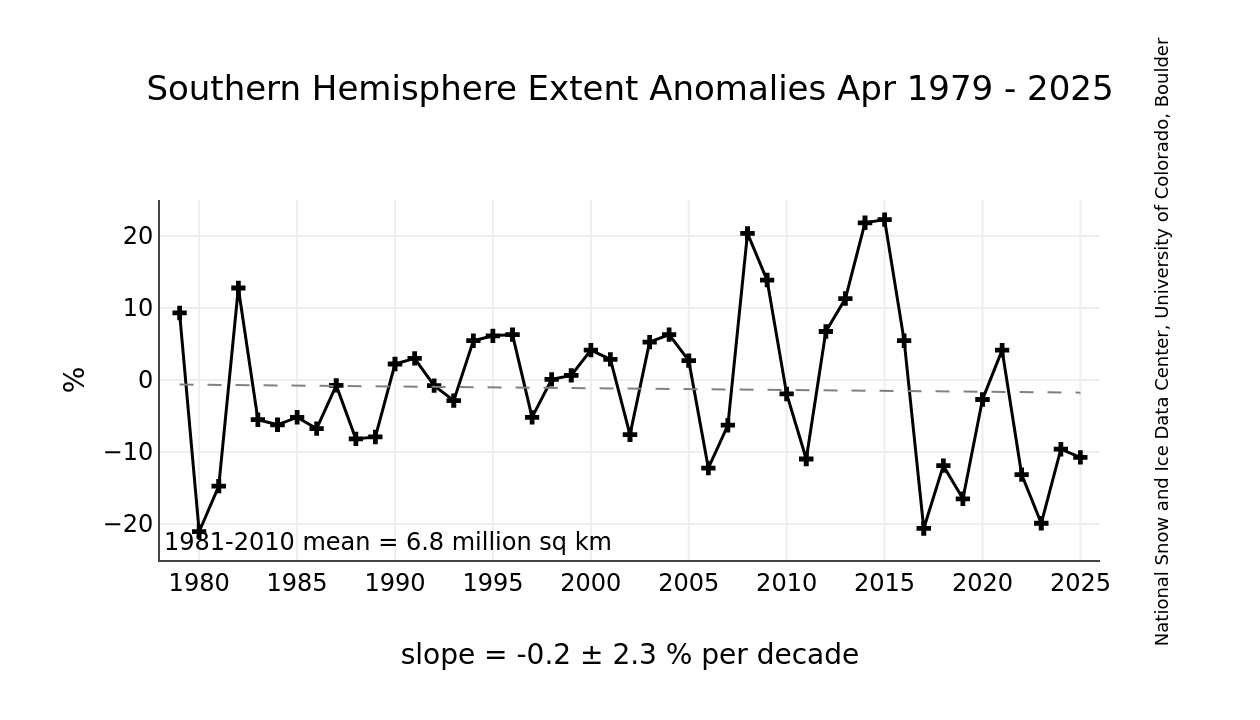
Turning our attention to Antarctica. Dr, Hansen predicted in 1980 that ice loss in Antarctica would be symmetrical to the Arctic. But the current thinking, as expressed by Dr. Meier, indicates that view is no longer valid. In fact, NSIDC data shows that Antarctic ice extent has actually increased substantially, as seen below.

http://www.epa.gov/climatechange/effects/downloads/Challenge_chapter2.pdf
It was reported last week that the IPY (International Polar Year) released a study claiming that both polar ice caps are melting “faster than expected.” Given that NSIDC shows Antarctica gaining ice at a rapid pace, I find myself surprised that IPY would release a study saying exactly the opposite. But then again, an IPY official reportedly forecast that last summer (2008) might have an “ice free Arctic.”
Columnist George Will reported that overall global sea ice area is normal, and was correct. Dr. Meier confirmed that on January 1 global sea ice levels were normal.
Walt Meier (16:04:59)
1. He (George Will) was factually incorrect on the date that he reported his “daily
global ice” number. However, he was merely out-of-date with his facts
(it was true on Jan 1, but wasn’t 6 weeks later).
The UIUC graph shows global ice levels well within one standard deviation of the 1979-2000 mean. Dr. Hansen was correct that according to global warming theory, both poles should be losing ice – though we know now it theoretically should be happening more slowly in the Antarctic. Yet 20 years later we actually see the Antarctic gaining ice, which is contrary to Dr. Hansen’s theory, contrary to IPY claims, and probably contrary to Steig’s questionable temperature analysis .
The main trend I see in polar ice is an increasing disconnect between hype and reality. Given that the AO (Arctic Oscillation) has been neutral this winter and polar drift has been less than last year, I forecast that the summer Arctic ice minimum in 2009 will show more ice than either of the last two years. What do you think?
OT, but I took a look at the ozone map again today. Same pattern of very high ozone at the N. pole while we get cold and wet down here (with low ozone over the tropics) and low ozone over the S. pole. Same “two eyes” that looks like an ETF hitting the N. Pole with a charge of particles (speculation, yes, rampant…)
For something that is supposed to be UV created, it sure doesn’t seem to be following the sunshine to the South Pole… so WUWT?
Make that EFT
I read somewhere a long time ago that an ice free Arctic ocean was the only likely source for all the water necessary to build the massive ice shields of the Big Ice Ages.
Just want truth… (17:34:07) :
“jeez (17:30:03) :
I’m not sure stricter is the correct word.”
What is a better word?
If you want something more pleasing to modern ears, you could use “more strict” yet:
OED, page 1120:
“1597 Hooker Excel. Pol. v. lviii 2. Definition, whether they be framed larger to augment, or stricter to abridge the number of sacraments, ”
And several others…
So “stricter” is a legitimate use, even if it sounds more English than American…
OH MY GOD!! Whoever would think one word could get so much attention from so many bloggers!.
But thanks for the “more strict”. I will be stricter on myself in the future.
The blogger-review process still works. Look out Dan Rathers of the world! You too James, Michael, Naomi, and Al!
Do I get the word published now? Which journal will it be in? 😉
Fat Man (18:59:34) : If that is the case, then can the words “global warming” or “global climate change” have any meaning?
My role here is just to ask stupid questions.
That actually is a very insightful question. There “are issues” with the concept of “global warming”. Can it be “fixed” if Antarctica gets 10C colder but nothing else changes? Can it get worse if the Antarctic MINIMUMS get 10C warmer (from -50C or so to -40C ) but nothing else changes?
Well, that’s what the concept of “global” average temperature says. (Though the exact digits I used are fabrications, the concept is correct).
If we do want to use the “global temperature”, who sets it? How? What if I want warmer? How will the temperature be adjusted? When? Using what thermometer?
I once had two employees sitting 2 cubes away from each other. They both complained: One too hot, the other too cold. Each demanded that I change the AC setting. I finally hung a recording thermometer (min / max) on the cube between them. It showed 72 +/- 1 F for days on end and the complaints stopped… Now we’re going to do the same thing on a global level, with broken thermometers? Riiiight…
BTW, since the thermometer readings are just averaged, you could “fix” global warming by putting a few extra thermometers in key cool places and do nothing else … The anomaly calculations are based on an 8000 cell map of the world. That’s about 250 km on a side if you use the whole globe. So just look 250 km in all directions. See any high spots or other cool places? If so, go put a thermometer on top. That will recored more cold and presto that box will be cooler. Do that enough and we can fix global warming for a few thousand bucks a station. Call it a couple of million, tops!
But wait, there’s more. Since GIStemp uses up to 1200 km for adjusting anomalies, you can go find a snow covered mountain top several hundred miles away and still have anomaly boxes drop their temps far removed from the mountain in all directions.
Think that’s absurd? Yup. But no more absurd than how we came up with the “global warming” number in the first place…
Anyone want to start funding AWS installations on mountain tops? I’ll manage the team that does the installations…
” DR (20:26:59) : “…a strong, negative, and currently unknown feedback is discovered somewhere in our climate system.”
Discovered, Lindzens’s Iris, like you said DR, clouds :
Why the IPCC models are wrong – Part 1
Why The IPCC models are wrong pt 2
“Andrew Dessler doesn’t mention it one time in his paper, yet his paper is allowed to pass “peer review” with the statement: “The only way that will not happen is if a strong, negative, and currently unknown feedback is discovered somewhere in our climate system.””
It gets past peer-review but not us.
>Sounds like you are voting for less ice this summer than 2007.
Steve there is about a 50% chance that this year will have more than last year. You can calculate the conditional probability very simply looking at the first differences.
What would it prove if this year has less ice than last year when the massive step down in 2007 was not sufficient to sway opinion here?
Fat Man (20:46:49) :
““The existence of a strong and positive water-vapor feedback”
If there is a positive water vapor feedback, why hasn’t it kicked in at some point in the last 3 billion years and turned the earth into a low rent Venus, and once that happened why would it ever cool off?”
I am having trouble with that question as well. Good luck.
At what point will NSIDC start to revise their ‘corporate beliefs’, how far does the polar ice sea ice levels have to increase both in summer and winter before the NSIDC will review their commitment to the idea of drastic melting and warming at the poles?
I wonder if the good Dr Meier will tell us what the ideal sea ice levels are both for winter and summer, I note that this information was lacking in his post but its essential for a greater understanding of the issues.
The question is simple and yet will have far reaching consequences I think, when(if) these parameters are reached does this mean that the global warming theory is wrong?
It seems that when sea ice extent reached near normal levels the goalposts were moved to include sea ice thickness, then summer minimums, then what next? If the experts at the NSIDC can be pinned down to give us a set series of figures for the ideal levels at the poles it should be easier to determine whether the AGW/MMCC theory is valid.
It’s rather amusing that George Wills badly misinterpreted NH ice levels between 1979 and now, but in the same vein I will equate SH levels :-
http://arctic.atmos.uiuc.edu/cryosphere/IMAGES/current.area.south.jpg
cherry picking my data points I can say that in the antarctic 2008/2009 actually does match 1979/1980 ! So in effect you can’t say SH sea ice has been increasing, at least compared to the data I pick :p Actually the cycles in that series is quite interesting, we seem to have hit one of the regular lows, wonder what causes that .. Dr Meier?
Taking Steve Goddards original points
“The maximum ice extent for 2009 (red) and 2008 (orange) are both in the top three on the AMSR-E record, at more than 14M km2. The only year which had greater ice extent than the last two years was 2003. So clearly we are on a recent trend of higher Arctic ice maximums, which is a fact that is rarely if ever reported by the main stream media.”
There’s only 7 years and 2008/9 is joint 3rd so it’s about average, I think you have applied spin here. As Walt Meiers says though it is summer that is important
http://arctic.atmos.uiuc.edu/cryosphere/IMAGES/seasonal.extent.1900-2007.jpg
sping and summer have bigger drops than autumn and winter and the trend is more pronounced.
As it looks likely that like we will start the melting season somewhere near 2008 start I am going to predict a summer minima just slightly higher than the amount reached in 2008. I seriously doubt it will be amongst the blues and purples on the JAXA graph.
It will be fun watching though.
Regards
Andy
Dr. Hansen’s 1980 paper shows symmetrical albedo changes at both poles. It certainly does not predict increasing ice in Antarctica.
Steve – you miss my point, the paper you refer to is a discussion of the predicted effects of 2xCO2, so far the increase is just over one third. Amongst other things, it predicts a 6C temperature increase in the Arctic – we haven’t seen that yet either.
The Antarctic sits in the middle of the largest heat sink on the planet; for that and other reasons it is unsurprising that its rate of warming lags the Arctic. The ultimate source of the sea ice is precipitation – snow falling over the continent, some warming, and associated changes in atmospheric moisture and wind patterns actually increases precipitation, which may counteract the effect on the sea ice of the Antarctic warming found by Steig et al. For these reasons and others global sea ice is not that useful an indicator, as noted by Dr Meier.
When we reach 560ppm, then we can evaluate whether the warming in the poles is symmetrical and of the order of 6C as projected by Hansen. At any point before then the statement that he predicted symmetrical warming at both poles is misleading.
Joel Shore
Glade to see that you are still trying to understand, but understanding is about reading and having a thorough technical acquaintance with the subject you propose, I suggest you read.
I wonder if anyone else has noticed that the Arctic Sea Ice extent http://arctic.atmos.uiuc.edu/cryosphere/IMAGES/current.365.jpg almost alway drops “significantly” when a Alberta Clipper comes South like at present?
Just an observation… When w strong heat buildup in the US Midwest occurs, the Sea Ice tends to recover.
To Jim Hebbard,
Watch this (well amazing) 1-year, every hour, cloud animation produced by NCAR and you can see how an Alberta Clipper can affect the whole arctic.
Basically it shows just how rapidly heat build-up at the equator (east to west weather) is transported pole-ward and how fast the jet stream moves the weather systems (now east to west).
(one or two months will give you a flavour, you don’t have watch the whole thing although the summer patterns are a little different than the winter).
You will have a different view of the climate after watching this.
https://www.ucar.edu/publications/nsf_review/animations/ccm3.512×256.mpg
Manfred says:
DR says:
These two posts illustrate my point: “However, there are also some dramatic downsides, one being that very little ever gets decided because a lot of folks don’t have the necessary background to agree on basic points of science.”
I don’t have to BELIEVE that Tamino is right. I can see that he is right. It’s just basic mathematics. But even before doing the calculation that Tamino has done, one can just look at Spencer’s result and say, “He gets the EXACT same slope to like 4 significant figures and the exact same R^2…What are the odds of that?” (The fact that Spencer didn’t ask himself that question when he did the calculation is a little bit scary.)
rcrejects says:
Well, I would agree with your first point only by tautology because I would not define anyone as being a “serious skeptic” if they didn’t accept that (modulo what I note below). However, by your standards, a not-insignificant fraction of those posting here (and those posting other things throughout the web) don’t qualify.
I also don’t know how you get 0.6 to 1 deg C as the “bare” (no feedbacks) result. I think the accepted range is about 1.0 to 1.2 deg C…maybe at the outside you can argue it down to 0.9 C.
AndyW,
Roger Pielke Sr. Did a study of melt season start/end dates in the Arctic, and found that they have not changed at all during the satellite record.
John Philip,
I am aware that Hansen’s study is for a doubling of CO2. My point is that the polarity of of the southern albedo trend is flipped from what he predicted. That can not be explained by buffering in the ocean.
Jim Hebard,
I’m not sure about your correlation with Arctic Clippers, but when cold air comes south from the Arctic, it has to be replaced by warmer air from the south.
Richard111 says:
It’s not that difficult to answer actually. The water vapor feedback is positive enough to magnify the warming. However, it is not of sufficient magnitude to create an instability. The distinction basically is the distinction between a diverging geometric series like 1 + (3/2) + (3/2)^2 + … and a converging one like 1 + (1/2) + (1/2)^2 + … (which converges to 2 and hence leads to a doubling of the original effect).
The more difficult question to answer is this: If our climate system is dominated by negative feedbacks, how can we explain the significant climate changes that we have seen in the past in response to forcings on the climate that we estimate to be rather modest? (See, for example, this paper: http://www.sciencemag.org/cgi/content/summary/sci;306/5697/821 )
2009 is just about to pass 2008, and move into the #2 spot.
http://www.ijis.iarc.uaf.edu/seaice/extent/AMSRE_Sea_Ice_Extent.png
Is the summer ice extent for the poll the “actual” summer ice extent or the “reported” summer ice extent from satellites with drifting sensors?
E M Smith
This may help you in your overall project
http://www.agu.org/pubs/crossref/2006/2005JD006494.shtml
It is a paid for article but abstact is interesting (just buy it and charge it to the vast budgets of Chiefio)
“We develop a continentality proxy (1600–1930) based on amplitudes of the annual signal in oxygen isotopes in an ice core. We show via modeling that by using 5 and 15 year average amplitudes the effects of diffusion and varying layer thickness can be minimized, such that amplitudes then reflect real seasonal changes in δ18O under the influence of melt. A model of chemical fractionation in ice based on differing elution rates for pairs of ions is developed as a proxy for summer melt (1130–1990). The best pairs are sodium with magnesium and potassium with chloride. The continentality and melt proxies are validated against twentieth-century instrumental records and longer historical climate proxies. In addition to summer temperature, the melt proxy also appears to reflect sea ice extent, likely as a result of sodium chloride fractionation in the oceanic sea ice margin source area that is dependent on winter temperatures. We show that the climate history they depict is consistent with what we see from isotopic paleothermometry. Continentality was greatest during the Little Ice Age but decreased around 1870, 20–30 years before the rise in temperatures indicated by the δ18O profile. The degree of summer melt was significantly larger during the period 1130–1300 than in the 1990s.”
By the way I posted Hadley CET 1660 for your attention earlier-did you see it??I am curious as to how well it correlates with the Upsalla temperatures
TonyB
Characterization and thickness of Arctic Ice
Recent posts on Arctic ice sent be back searching for things I had read earlier. Here are bits and pieces of information with some links, if others want to do their own searches.
Unlike glaciers and Antarctic ice sheets, the ice thickness in the Arctic (even “old” ice) averages about 2 to 3 m thick, with only a small fraction thicker than 6 m. These values are the ‘draft’ results, which means the ice thickness below the water line as would be measured by a submarine measuring up toward the floating ice. Draft ice is reported as 89% of the total ice thickness.
This reference summarizes submarine data going back to 1975, with a histogram showing thickness frequency observed for Spring and Autumn surveys.
New Arctic Sea Ice Draft Data From Submarines (January 2007)
http://psc.apl.washington.edu/pscweb2002/pubs/Wensnahan%20etal.(2007)EOS-SubData.pdf
Other references tell us that the ice is a complex mix of different forms, which means determining ice thickness requires analysis of the extent of each form to determine the overall average thickness. Which is why we probably won’t see a real-time ‘thickness’ plot any time soon.
Some terms:
Lead – open water (surrounded by ice)
First Year ice (FY): smooth texture, generally featureless
Multi Year ice (MY): rough surface which includes hummocks and depressions.
Apparently, the action of wind and waves pushes the ice around, which accounts for some of that Multi-Year ice complexity.
Raft – a slab of ice pushed up over another section of ice (presumably doubling the nominal thickness)
Ridges and Keels – ice pushed together in a way that some ice sticks up above water level (Ridges) and sticks down below (Keels). (my mental picture is ice slabs crushed together including some that get wedged sideways, sticking up above and down below the nominal surrounding thickness). Apparently the Ridges can extend for many kilometers. And as you might imagine, the Keels received the full attention of submarine crews navigating below them.
———————
Reading about the advances in instrumentation suggests some of the limitations in older techniques. For example, older submarine scans used a wide angle sonar that didn’t differentiate between thick ice versus a keel (it would see the tip of the keel, but not pick up spaces between keels). Narrow band sonar now exists which could look up through the keels to get a more defined picture, and there are now fixed point sea floor mounted sensors which can monitor both thickness and movement of the ice. Similarly, down looking measures (some types of satellite and air craft instrumentation) apparently have had difficulty differentiating between an open water Lead versus melt water on top of the ice.
The newer instruments and techniques seem to have been developed in the last 5 to 10 years. That suggests to me that there is not a lot of data yet using the newer tools, and that comparisons going back over 30 years may not yield an ‘apples to apples’ trend in the data.
Some links that I found interesting:
Top Down measurements
http://www.awi.de/en/research/research_divisions/climate_science/sea_ice_physics/subjects/ice_thickness_measurements/
Bottom up Ice Profiler
http://www.aslenv.com/reports/ice/IPS-OI-UK2002PosterPaper.pdf
Paper on sorting out sonar data to determine the Arctic ice types (First Year, Multi Year, Deformed, Ridges)
First Order Statistics Classification of Sidescan Sonar Images from the Arctic Sea Ice
http://ima.ac.uk/papers/Rueda2003.pdf
And last but not least, our friends at NSIDC (National Snow and Ice Data Center) have complied and analyzed the submarine data here
Submarine Upward Looking Sonar Ice Draft Profile Data and Statistics
http://nsidc.org/data/docs/noaa/g01360_upward_looking_sonar/index.html
Bill Illis,
The cloud animation is amazing. I’d like to see the computer animation within the GCMs. Oh yeah… they don’t have that available, or is it? I have an idea that the GCM animation would represent reality about as well as the “Steamboat Willie” animation does.
Too bad they don’t have layers representing ocean currents, sea ice, temperatures, humidity, cosmic rays, CO2, ozone, etc. Just choose your layers and run it. But I guess that would elucidate nothing since all the science is settled, right?
Mike