Guest post by Steve Goddard
Yesterday, Dr. Walt Meier from NSIDC again graciously updated us about the NSIDC sensor problem, and also about his current thinking with respect to polar ice trends. The key concepts being that Arctic ice continues to decline, and that Arctic and Antarctic ice are separate entities – so the current near normal global sea ice area “has no meaning in terms of climate change.” This article examines both of those concepts.
NSIDC is still having sensor problems on their satellite, as seen below on 2/28/09. Note the speckled white areas, and the large dark gray sliver in the Sea of Okhotsk near the top.
http://nsidc.org/data/seaice_index/images/daily_images/N_daily_extent_hires.png
Fortunately there is another ice extent data source, AMSR-E which has not suffered sensor problems and their data is unaffected. NSIDC also explains on their web site that “AMSR-E has a lower absolute error” than the NSIDC sensors, even when functioning properly. AMSR-E (below) has been recording sea ice since 2002. The maximum ice extent for 2009 (red) and 2008 (orange) are both in the top three on the AMSR-E record, at more than 14M km2. The only year which had greater ice extent than the last two years was 2003. So clearly we are on a recent trend of higher Arctic ice maximums, which is a fact that is rarely if ever reported by the main stream media. Also note in the NSIDC map above, all of the ice basins are close to the 1979-2000 normal.
If there is a dramatic downwards trend in maximum Arctic extent, it certainly isn’t visible in either the map or the graph.
 http://www.ijis.iarc.uaf.edu/seaice/extent/AMSRE_Sea_Ice_Extent.png
The NSIDC graph below also shows Arctic ice extent nearly back to the 1979-2000 mean.

http://nsidc.org/data/seaice_index/images/daily_images/N_timeseries.png
Turning our attention to Antarctica. Dr, Hansen predicted in 1980 that ice loss in Antarctica would be symmetrical to the Arctic. But the current thinking, as expressed by Dr. Meier, indicates that view is no longer valid. In fact, NSIDC data shows that Antarctic ice extent has actually increased substantially, as seen below.

http://www.epa.gov/climatechange/effects/downloads/Challenge_chapter2.pdf
It was reported last week that the IPY (International Polar Year) released a study claiming that both polar ice caps are melting “faster than expected.” Given that NSIDC shows Antarctica gaining ice at a rapid pace, I find myself surprised that IPY would release a study saying exactly the opposite. But then again, an IPY official reportedly forecast that last summer (2008) might have an “ice free Arctic.”
Columnist George Will reported that overall global sea ice area is normal, and was correct. Dr. Meier confirmed that on January 1 global sea ice levels were normal.
Walt Meier (16:04:59)
1. He (George Will) was factually incorrect on the date that he reported his “daily
global ice” number. However, he was merely out-of-date with his facts
(it was true on Jan 1, but wasn’t 6 weeks later).
The UIUC graph shows global ice levels well within one standard deviation of the 1979-2000 mean. Dr. Hansen was correct that according to global warming theory, both poles should be losing ice – though we know now it theoretically should be happening more slowly in the Antarctic. Yet 20 years later we actually see the Antarctic gaining ice, which is contrary to Dr. Hansen’s theory, contrary to IPY claims, and probably contrary to Steig’s questionable temperature analysis .
The main trend I see in polar ice is an increasing disconnect between hype and reality. Given that the AO (Arctic Oscillation) has been neutral this winter and polar drift has been less than last year, I forecast that the summer Arctic ice minimum in 2009 will show more ice than either of the last two years. What do you think?
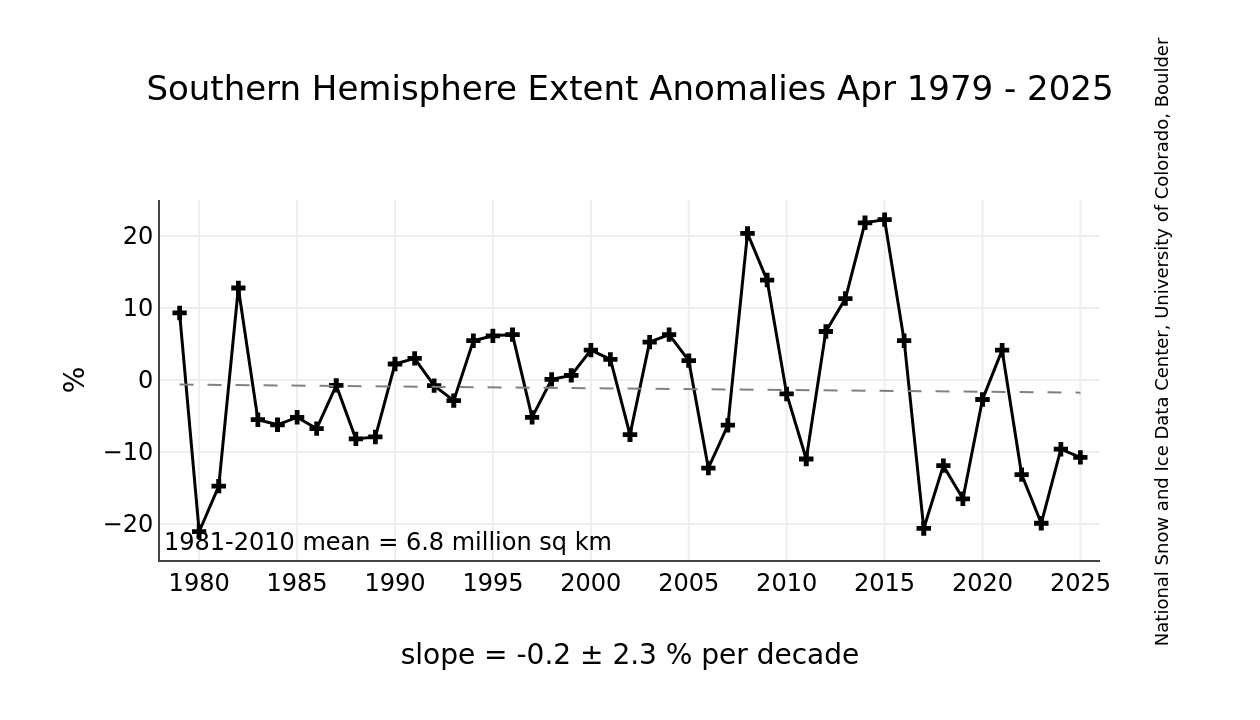
I downloaded the monthly sea ice extent and area data from the NSIDC.
I’ll have more to say about this later, but there is a decline in the Northern Hemisphere sea ice extent, (not unlike the sea ice “area” numbers from the Cryosphere today). The Southern Hemisphere is increasing.
Seasonally-adjusted NH sea ice extent.
http://img528.imageshack.us/img528/4817/nhseaiceextent.png
Anomaly from the 1978-2008 average.
http://img255.imageshack.us/img255/823/nhanomaly.png
It did not take very long for me to do this, so I have no idea why it is so hard for the NSDIC to provide the data.
Regarding maximum ice extent, let me preface what I’m about to say by admitting my level of ignorance of things Arctic compared to many in this thread.
Having said that, I must say that often when looking at Cryosphere Today comparitive ice maps, I’ve noticed that it appeared to me that much of the ice loss I’ve noticed in those comparisons seems to be concentrated around the shore lines of various land masses.
Has anyone considered whether some type of local developments might be having a marginal impact here? Sort of “UHI as applied to Arctic sea ice”? I understand much of the arctic is sparsely, if at all, habitated, but not all of it, and presumably such populations as do exist are using more energy and creating more heat output than they did 30 (or 50 or whatever) years ago. Could this be having an impact?
Anyone know what’s going on with extent and mass of NH continental ice? That’s the thing to track. Especially any trends toward positive mass balance year over year.
Walt Meier (09:59:52) said “What is of interest in winter is the ice thickness – how much is thick old ice vs. how much is thinner first-year ice. And that has been decreasing substantially in recent years.”
This seems to be moving the goalposts as facts change. I don’t know if Dr. Meier has always held this position or not, but the ice area has been one of the things that is always pointed too when discussing this issue. If Dr. Meier did not agree with that position did he ever dispute it?
So now that we are not talking about ice area or extant or any other surface measurement and instead talking about ice thickness (when we should be discussing total volume), where is the data for ice thickness (including instruments and methodologies used)?
Dr. Meier? Anybody?
maksimovich: Nice paper. Did I read it correctly that a warmer northern hemisphere translates into an increased Biomass and corresponding decrease in CO2?
Nice paper and I think it might be happening before our very eyes. i.e. warming in the NH and cooling in the SH.
I wonder if the geographic pole can wobble away from it’s current spot surrounded by ocean fast enough and cause it to move to a terrestrial one? Even more then continental drift? Anybody seen this in the literature? It seems plausible given the uneven mass of the continents in drift theory.
What Walt Meir is hypothesising that decreasing NH summer sea ice extent is a climate proxy for Global Warming, as defined by Climate Models.
His hypothesis is also that increasing SH sea ice extent is a Climate Proxy for Global Warming as shown by Steig et al 2008, and the Climate Models “counter intuitive” causal mechanism as referenced is stated here.
http://www.sciencedaily.com/releases/2005/06/050630064726.htm
So the Hypothesis, if correct, shows that even “good” recent measurable climate proxies are not reliable.
“When all you have is a hammer, everything looks like a nail”. To some degree, ice extent gets the popular attention because it is the hammer we have. Ice volume is pretty well unknowable and undeterminable on anything like a real/near-term basis, let alone in a continuously measurable and historically comparable manner.
Isn’t it?
Dr Meier
“The maximum is not expected to decline like the minimum and does not have the impacts on climate, people, and wildlife like summer sea ice.”
So The ice is melting, but not at the maximum only at the minimum? Strange effect if one can pull it off considering the arguments surrounding multi-year ice extent and thickness is a direct factor of maximums. If ice extent hits the land the only choice to increase mass is to grow thicker.
Please explain the second portion, quantify the effects for me. There is no accurate census of species degradation, there has been some range adjustments for migratory species such as Caribou, the Polar Bear argument is a canard when viewed over the entire habitat range and population.
I think there are many false starts in this debate over ice-loss effects, especially because there is no detailed data to support the assertions as not enough data exists. I understand anecdotal reports form indigenous populations, but consider that these populations have changed their society as well, they are not as nomadic, following food sources, as they were and much more reliant on technology that impacts inter-species interactions.
I think we can all agree this is something that should be examined but to start with a false premise, do not do the real legwork required and look at one short term indicator is simply a diversion.
Several people here have asked about the thickness of the Arctic ice
My relatively near neigbour Pen Hadow is walking to the North Pole on a rather dangerous expedition to determine that very question. He started yesterday and is dragging a device that will measure thickness.
http://www.catlinarcticsurvey.com/
Perhaps Anthony might like to do a post on his progress?
As far as I understand the thickness will be gauged over a line 700 miles or so long but in a relatively narrow band, so it will be by no means necessarily representative of the whole arctic. Also it demonstrates the thickness now but we can’t know the relative thickness of the ice in past years.
From my own research the period from around 1910 (the iceberg that sank the Titanic in 1912 was caused by unusual ice melt) through to the late thirties or perhaps later, was a time of very warm temperatures, limited ice extent and presumably limited thickness as well.
The Arctic Adventures of Bob Bartlett on board his ship the Morrisey was well documented on Pathe Newsreel in the 20’s and 30’s and it would appear that conditions were similar then to now.
TonyB
“The maximum is not expected to decline like the minimum and does not have the impacts on climate, people, and wildlife like summer sea ice.” (Walt Meier (09:59:52)
With all respect, I disagree. Who cares, how far is the summer ice extent behind Novaya Zemlya. But many will care if Baltic, Thames or northern Adriatic gets frozen during the winter, as happened during the mini-ice age.
I believe captain Edward J. Smith would also prefer less icebergs any day, especially on that April 14th, 1912.
Oh and by the way, I couldn´t resist and voted for the ice-free 2009 😉
The reality is that the ice levels increased for the past two years.
http://noconsensus.wordpress.com/2009/02/08/global-sea-ice-trend-from-gridded-data/
And it’s really way, way too small a change to be worried about.
For anyone interested in artic sea ice thickness, the book Unknown Waters has some nice first hand detail. The link has a review. It is perhaps of more interest to submariners.
http://www.nytimes.com/2008/03/18/science/18arctic.html
Speaking of the frozen north and polar regions, I think we have an answer to why 1880 is the cutoff for data in GIStemp:
http://chiefio.wordpress.com/2009/03/02/picking-cherries-in-sweden/
(with a h/t to tty for pointing me at it)
Shows a very long temperature record from Sweden… with 1880 being just about the dead bottom of the Little Ice Age impact on that particular station.
It would be very interesting to see a similar graph for arctic ice, if one can be made from the available data…
About 10% of the readers of any blog are red green colorblind like you and I are. The providers of charts like this should be aware that colors like red,brown,and orange, or dark green and dark brown are difficult for us to distinguish as are colors like yellow and light yellow-green, or pairs like blue and purple. They should provide secondary coding to the color traces such as broken lines dotted lines, line thickness etc. to allow the traces to be distinguished by all users including those that have atypical color vision.
There are tools that help the red/green colorblind with this dilemma but they are not always as helpful as they should be because of how the charts are constructed.
Two tools that I use are the colorzilla plugin for firefox that allows you to identify the actual color triplet of a graph trace. It how ever is problematic if the originator of the graph does not make sure the trace on the graph is exactly the same color as the key. This happens when they pick colors off of a color map rather than replicating the exact color triplet used in the key.
For example the 2007 trace on the JAXA ice extent graph key is color triplet R:210, G:254 B:0, but if you place the cursor on the trace on the graph, depending where it is placed, you get a slightly different color triplet of R:215, G:255 B:0, or R:228, G:255 B:77. There is usually enough similarity to allow the user to figure out which trace is which, but on some charts this can be a challenge if two traces use very similar color triplets they can actually be the same color in some places.
Another very helpful tool is “WhatColor”, its current download is wcol472e.exe, and I have used it and it appears to be a safe executable file. It is a share ware product by http://www.hikarun.com/e/
To the developers of blogs and web pages, please be colorblind friendly with your color picks. It is very frustrating to find a graph that is useless because several overlapping traces are indistinguishable from each other. Sometimes even with these tools they cannot be unambiguously resolved.
http://en.wikipedia.org/wiki/Color_blindness
Larry
I think the extent of the winter ice extent mattered during the LIA. 1695 ice surrounded iceland. Inuits in Kayaks spotted of the Orkney Islands.
http://geochemistry.usask.ca/bill/Courses/Climate/The%20Little%20Ice%20Age%20prt.pdf
See page 10 para 3. Ice flows in the north sea???????
Dr. Meier,
Is there a reason that in the visual of ice extent you use the 1979-2000 median as a comparison and in the graph you use the 1979-2000 average?
Sorry to get off topic.. just wondering if anyone has heard anything about the Hansen coal protest in Washington today?
Walt Meier (09:59:52) :
As we stated in our post last week, we are accounting for missing data when we produce our daily total extent plot. So it will be consistent with AMSR-E and more consistent with pre-2002 data than AMSR-E is.
The reason why the maximum extent doesn’t get as much as attention is because it doesn’t deserve as much. The maximum is not expected to decline like the minimum and does not have the impacts on climate, people, and wildlife like summer sea ice. Regardless, while 2008 is relatively high compared to recent years, it is still 500,000 to 1,000,000 square kilometers below the long-term average.
Wally, that is nonsense – and you know it as wellas I do.
“”” Stephen Wilde (11:17:07) :
Does open water at the North Pole in summer allow more energy to be lost to space than is reflected to space when the water is ice covered ?
Combine that with a negative PDO and a weak solar input to the oceans and the results should be both interesting and contrary to AGW theory.
I would be interested in Dr. Meier’s view on that specific point. “””
Stephen,
I tend to agree with you on your query about the open water condition; I think it connects to the albedo question as well.
Open water in the arctic tends to be warmer than the ice packs or the air over the ice packs; so I would expect to see accelerated evaporation in the arcic if there waslare areas of open water. This would result in a significant increase in the snow precipitation over the arctic lands.
Contrary to popular mythology there is actually more land in the Arctic (>60 N) than there is in the Antarctic (<-60S).
As for the albedo change due to polar ice; there’s a very good reason why all that ice is there in the first place; there isn’t very much solar energy arriving there anyway, because of the cosine effect. Albedo measures the global total solar spectrum reflectance of the entire planet, not the local reflection coefficient. If there was a lot of solar energy arriving at the poles tor eflect, well then there wouldn’t be so much ice there to reflect it, so I don’t think polar ice is a big contibutor to earth’s cooling processes; nowhere near as efficient at cooling as the tropical mid-day deserts are.
George
“Unfortunately, there are no incentives for being right, nor disincentives for being wrong in the climate game. The only positive incentives seem to involve research funding, ease of publication and academic collegiality which result only when forecasts are for gloom and doom.
“I wonder if the experts’ forecasts for melting Arctic ice would change if a ten million dollar prize was offered for the forecast that came closest to the actual result.”
What I suggested a couple of weeks ago was that someone formulate a set of mutually agreeable (to leading warmers) questions on easily adjudicated benchmarks for warming (e.g., Arctic & Antarctic ice extent, glaciers advancing/retreating, global temperatures (by one or more methods), sea level, etc.) and get them listed as betting items on the Intrade.com website. Here’s what I posted:
===============
I think it would be an excellent idea for the partisans of both sides to be able to bet against the other side. But arranging such bets on an ad hoc, one-to-one basis imposes a high overhead (making bets that are under $1000 (say) impractical), a high risk of non-payment, a great potential for foot-dragging “denial” in the event of a loss, a great potential for inter-personal nastiness during the negotiation and afterwards, etc.
What’s needed instead is a neutral venue where betting can be done impersonally, in small amounts, at a low overhead, with assurance of being paid (or at least getting ones money back in the event of a “draw” or “inconclusive”), etc.
Such a venue already exists. Bettors “bid” for bets at odds that sellers offer, in terms of any number of small-amount “contracts.” This has the effect of causing the odds offered to adjust quickly to reflect the money placed on each side of the bet. One of the additional advantages of this site’s method is that a person can cash-out or reduce his bet if he changes his mind, or has an emergency for which he temporarily needs money. (Of course, the “house” takes a cut as its commission when this occurs.)
The site already has a category for climate-related bets (click “Climate and Weather” in the menu on the left side of the screen). Its current bets relate only to whether laws regulating CO2 emissions will be passed in five countries. It also has bets relating to numbers-of-hurricanes and snowfall-levels in various cities, here:
http://www.intrade.net/market/listing/showEventGroup.faces?eg=508
It deals mostly with political and economic events, like the price of gold in the future, etc. That sort of question is easier to settle, because of its sharp Yes/No boundary, than questions like whether arctic sea ice has retreated, sea levels have risen, global temperature has risen, glaciers have retreated, etc. It would be very desirable if Intrade could be persuaded to add these fuzzier sorts of bets. It would do so only if the bet could be settled by reference to a data point from an agreed-upon “authority.” It wouldn’t want to have to serve as an arbitrator or interpreter of the fine points of the question.
There are downsides (and disagreements) to every authority, and downsides to every indicator of global warming (arctic ice, sea level, etc.), and to every data point regarding that indicator. But that problem can be easily finessed if Intrade were to provide a dozen (say) separate questions relating to the matter. That would allow bettors who don’t trust the indicator or an authority cited in certain questions to bet on the other questions where they believe those are more reliable. And it would allow the question of overall global warming to be distributed over several data points, reducing the risk that an anomalous reading in one indicator or data point would improperly answer the question. By employing a majority vote among indicators, a bettor could compensate for the weakness of each of them.
I therefore suggest that a new thread be set up here (or somewhere else on the Internet–or in many sites) where a preliminary set of betting-questions can be proposed and their wording thrashed out. Once these have been debugged sufficiently that lots of folks on both sides have said, “I’d bet on that question,” then Intrade could be approached by e-mail and asked to start taking bets on one or more of those questions. I think it would be a good idea to start small, with only a couple of questions, and to approach Intrade with a statement endorsed by leading names on both sides of the debate that they are prepared to abide by the settling of the bet in the manner described. One can suggest a contract to Intrade by e-mail here:
markets@intrade.com
Here’s another link, this one giving access to a pageful of contact information (by mail, fax, etc.):
http://www.intrade.net/faq/contactUs.faces
Intrade desires more respectability, visibility, and trading volume. By adding bets on the impact of the highly contentious matter of climate change, it would be performing a great social service. It would also thereby get lots of visibility, as its site would surely be regularly alluded to during online exchanges whenever a disputant is tempted to say, “Put your money where your mouth is.” Finally, once people register with the site, some will no doubt be tempted to place bets on the hundred or so other propositions on offer there. So Intrade will do well by doing good.
Intrade has been in business since 1999, and the predictions of the odds set by its markets in choosing winners of elections have been more accurate than those of pollsters. It’s been widely cited by political pundits as having a high accuracy rate.
Intrade is located in Dublin, Ireland and can’t accept payment from US credit cards. One has to set up an account online (there is a real-time online assistant to help step one through the process), then mail them a check, and then wait ten days for it to clear. In the interim, you should “learn the ropes” by making play-money bets in its training-wheels section, on its “Labs” tab.
Here are links to the sections of Intrade’s site where the details of participating are discussed.
About Intrade: https://www.intrade.com/jsp/intrade/help/general.html
Rules: https://www.intrade.com/jsp/intrade/help/index.jsp?page=rules.html
Safety & Security: https://www.intrade.com/jsp/intrade/home/safety_and_security.jsp
Help & FAQs: https://www.intrade.com/jsp/intrade/help/index.jsp?page=general.html
Rates & Fees: https://www.intrade.com/jsp/intrade/help/index.jsp?page=general.html%23fees
Forum (where bettors can argue for their positions: it’s pretty spicy): https://www.intrade.com/forum/
++++++++++
There’s a site where “play money” bets can be made on a variety of topics, including the environment. (I’ve turned $2,000 to $700,000 in a little over a year, mostly by betting heavily at long odds on the stock market crash.) See here for the home page, where you can register to participate:
http://www.hubdub.com/
Here’s the page on the environment topic, which has other bets relating to AGW. (I just bet $1000 (in play money), at 10-to-1 odds, that the Wilkins Ice Shelf will hang on until 2010.):
http://www.hubdub.com/science/environment
Here’s a bet that was proposed to Gore. Here’s a link to this bet:
http://www.hubdub.com/m30611/Who_will_win_the_Climate_Bet__Al_Gore_or_Wharton_Professor_Scott_Armstrong
Who will win the “Climate Bet” – Al Gore or Wharton Professor Scott Armstrong?
Current forecast: J. Scott Armstrong (68% chance)
Combining all predictions, the current most likely outcome is J. Scott Armstrong with a probability of 68% (up 7% in last 1 day)
In June 2007, Wharton Professor Scott Armstrong offered Al Gore a bet of $10,000 on who could best predict global mean temperature over the next ten years. Al Gore declined the bet, citing the reason that he does not bet money (the full story can be reviewed at http://theclimatebet.com).
Now, assume that Armstrong and Gore had made a gentleman’s bet (no money) and that the ten years of the bet started on January 1, 2008.
• Armstrong’s forecast was that there would be no change in global mean temperature over the next ten years.
• Gore did not specify a method or a forecast. Nor did searches of his book or on the Internet reveal any quantitative forecasts or any methodology he relies on. He did, however, imply that the global mean temperature would increase at a rapid rate – presumably at least as great as the IPCC’s 1992 projection of 0.03°C-per-year; thus. The IPCC’s 1992 projection is to be taken as Gore’s forecast.
Settlement details: The criterion will be the mean absolute errors of Armstrong’s and Gore’s annual forecasts for the ten year period, with the errors to be measured against the UAH global temperature record (http://vortex.nsstc.uah.edu). The win goes to the smallest mean absolute error.
PS: Individual Hubdubbers can post questions on the site themselves, without moderation. This could be a good way for both Warm-mongers and Cooler Heads to put forward their first versions of bets that could later be submitted to Intrade, for Real Money wagering.
I’ll put it to Dr. Meier that we’ve only been measuring the Arctic ice extent since 1979 and that is far too short a time period to draw any conclusions.
We just don’t know how much the ice cap varied during other warm periods. What happened during the Younger Dryas, the Roman Warm Period or the WMP? Do we even have any data to show what happened during the 1930’s?
We had a cooling trend in the middle of the 20th century that last until — 1979! We started measurement at the end of a cool climate. Is it not possible, even likely that the ice extent at that time was at the high end of normal variation?
CNN just aired a very very short piece on it and were very vague. I suspect that they did not get the turn out they had hoped (go figure), and it is also likely to be overshadowed by the 300 point nosedive of the DOW today. I suspect we won’t hear much about it for a couple of days, enough time for the MSM to spin up a good yarn about it, as it may take a bit of time to develop something sensational about an otherwise non-sensational event.
Mike Strong (11:23:48) : You asked:
“…why the NSIDC uses the 1979-2000 as the numerical average (mean) in their trend lines.”
I don’t know why they do this but the weather service always uses a 30 year time frame ending in “00” for normal temps and so on. Thus, when your local weather reporter claims the temp is X degrees higher than normal, “current normal” is the mean of a 30 year period from 1971 to 2000. I suppose this made sense when they started calculating means without modern computers. Seems less defensible today.
As the discussion of Arctic and Antarctic ice proceeds on this scientific forum, Dr. Tim Ball warns us of the consensus politics of cap and trade, which leads to government control over energy and the use of energy.
You can have all the liberty and freedom you want as long as you conform to government rules and regulations.
————————————————————-
Massive funding to promote ‘green energy’ ignores the science and demonstrates lack of understanding climate and renewable energy
Cap and Trade and Alternative energy: The real danger in Obama’s policies.
http://canadafreepress.com/printpage.php
Dishonesty is also evident because they have moved the goalposts again. First it was carbon credits, then it was carbon tax and now it is cap and trade. They are all the same idea falsely presented as methods of reducing CO2. In fact, they don’t reduce it at all but they do give government control and put more money in government hands. They are an environmental form of sin tax like those on tobacco and alcohol. The new name eliminates reference to CO2 (carbon) and taxes. A Cap, determined by the government, will limit the amount of CO2 you can produce. Details were expanded in Obama’s first budget proposal. He estimates a return of $625 billion from the cap and trade. It allows him to punish certain industries, as Obama indicated he would with the coal industry. The word Trade incorrectly implies some sort of business like approach. It is really an unnecessary transfer of wealth, just as carbon credits were in the Kyoto Protocol. As House Minority Leader John A. Boehner, Ohio Republican said. “We’ve got real concerns about his plan on cap and trade,” “Let’s just be honest and call it a carbon tax that will increase taxes on all Americans who drive a car, who have a job, who turn on a light switch, pure and simple.”