Guest post by Steve Goddard
Yesterday, Dr. Walt Meier from NSIDC again graciously updated us about the NSIDC sensor problem, and also about his current thinking with respect to polar ice trends. The key concepts being that Arctic ice continues to decline, and that Arctic and Antarctic ice are separate entities – so the current near normal global sea ice area “has no meaning in terms of climate change.” This article examines both of those concepts.
NSIDC is still having sensor problems on their satellite, as seen below on 2/28/09. Note the speckled white areas, and the large dark gray sliver in the Sea of Okhotsk near the top.
http://nsidc.org/data/seaice_index/images/daily_images/N_daily_extent_hires.png
Fortunately there is another ice extent data source, AMSR-E which has not suffered sensor problems and their data is unaffected. NSIDC also explains on their web site that “AMSR-E has a lower absolute error” than the NSIDC sensors, even when functioning properly. AMSR-E (below) has been recording sea ice since 2002. The maximum ice extent for 2009 (red) and 2008 (orange) are both in the top three on the AMSR-E record, at more than 14M km2. The only year which had greater ice extent than the last two years was 2003. So clearly we are on a recent trend of higher Arctic ice maximums, which is a fact that is rarely if ever reported by the main stream media. Also note in the NSIDC map above, all of the ice basins are close to the 1979-2000 normal.
If there is a dramatic downwards trend in maximum Arctic extent, it certainly isn’t visible in either the map or the graph.
 http://www.ijis.iarc.uaf.edu/seaice/extent/AMSRE_Sea_Ice_Extent.png
The NSIDC graph below also shows Arctic ice extent nearly back to the 1979-2000 mean.

http://nsidc.org/data/seaice_index/images/daily_images/N_timeseries.png
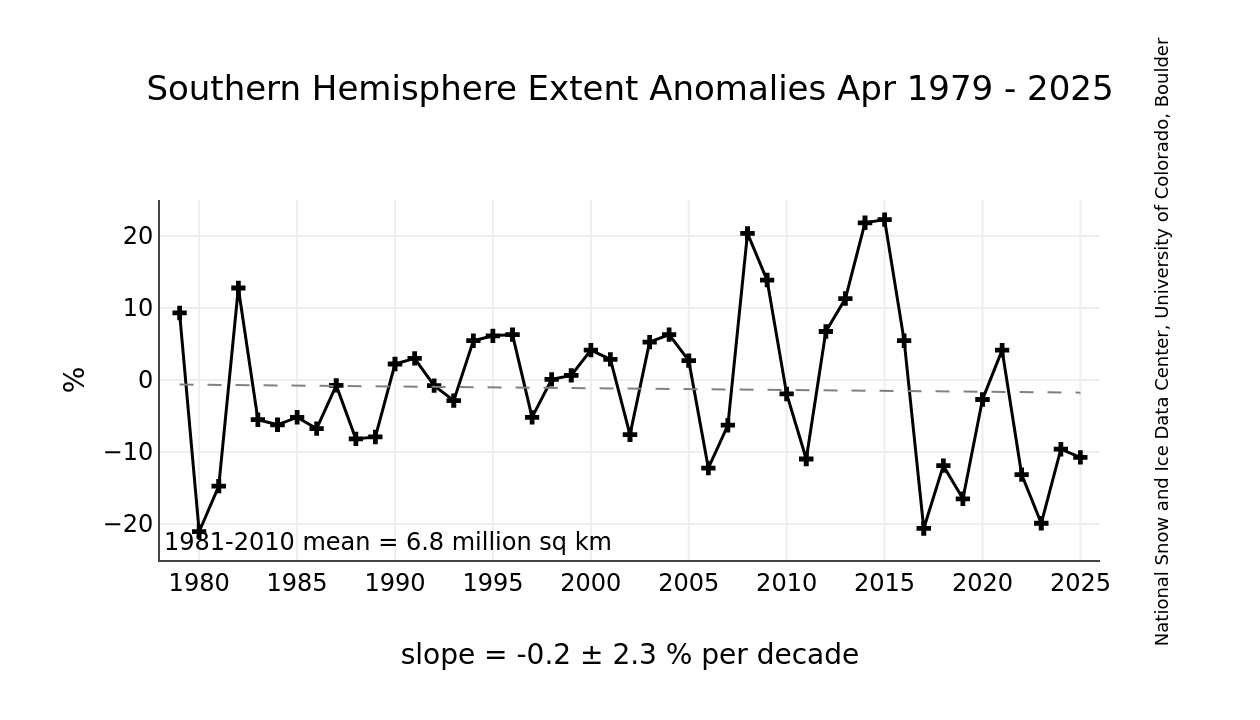
Turning our attention to Antarctica. Dr, Hansen predicted in 1980 that ice loss in Antarctica would be symmetrical to the Arctic. But the current thinking, as expressed by Dr. Meier, indicates that view is no longer valid. In fact, NSIDC data shows that Antarctic ice extent has actually increased substantially, as seen below.

http://www.epa.gov/climatechange/effects/downloads/Challenge_chapter2.pdf
It was reported last week that the IPY (International Polar Year) released a study claiming that both polar ice caps are melting “faster than expected.” Given that NSIDC shows Antarctica gaining ice at a rapid pace, I find myself surprised that IPY would release a study saying exactly the opposite. But then again, an IPY official reportedly forecast that last summer (2008) might have an “ice free Arctic.”
Columnist George Will reported that overall global sea ice area is normal, and was correct. Dr. Meier confirmed that on January 1 global sea ice levels were normal.
Walt Meier (16:04:59)
1. He (George Will) was factually incorrect on the date that he reported his “daily
global ice” number. However, he was merely out-of-date with his facts
(it was true on Jan 1, but wasn’t 6 weeks later).
The UIUC graph shows global ice levels well within one standard deviation of the 1979-2000 mean. Dr. Hansen was correct that according to global warming theory, both poles should be losing ice – though we know now it theoretically should be happening more slowly in the Antarctic. Yet 20 years later we actually see the Antarctic gaining ice, which is contrary to Dr. Hansen’s theory, contrary to IPY claims, and probably contrary to Steig’s questionable temperature analysis .
The main trend I see in polar ice is an increasing disconnect between hype and reality. Given that the AO (Arctic Oscillation) has been neutral this winter and polar drift has been less than last year, I forecast that the summer Arctic ice minimum in 2009 will show more ice than either of the last two years. What do you think?
Climate Heretic (12:47:03) :
While it is true that if the ice hits land the only option to increase mass is to grow thicker, that is no guarantee that it will happen. It’s going to depend on the temp above and below the ice, windspeed, under-ice ocean current speed, etc… You could theoretically get no/limited thickening even though you’ve reached the land mass edge, e.g. a large thin ice sheet. So, theoretically, once you reach that maximum thickness current conditions allow, no more ice volume growth, which is why at the high end, ice extent is a very poor proxy for measuring ice volume changes (the best measure of ice health?) On the other hand, at the low end, it will correlate much better. Thinner ice becomes open water more quickly under melt conditions as it cracks and breaks into chunks the melt accelerates due to more ice surface area exposed to air and water, the main heat transfer media. So minimum ice extent is a more reliable measure of “ice health” than maximum extent.
Barring a massive program to put sonar measurement units at fixed locations along the arctic sea bottom, I don’t see how we will have an accurate ongoing measurement of ice thickness, however, a medium term trend (3-5 years) of minimum extent can probably give us a good idea/proxy on the direction of the trend in ice thickness. Using this logic, minimum trend has been bouncing up and down the last few years with a clear trend towards lower, which matches up with sonar measurements from submarines. This could all change with another year or two or three of consecutive rebound, after all nothing is final until it is.
Cheers,
L. Bowser
Bobby Lane (10:45:48) : Either climate change, however one chooses to define it, is global in effect or it is not. It simply is not valid to argue ‘global warming’ is global in effect but sea ice is not. Which is it?
Ouch! You cut right to the center of it, don’t you? Nicely done!
Ryan C (13:49:24) :
Sorry to get off topic.. just wondering if anyone has heard anything about the Hansen coal protest in Washington today?
http://wattsupwiththat.com/2009/03/01/hansens-coal-and-global-warming-protest-may-get-snowed-out/
SSSailor (10:58:04)
Anthony
As I view …
——————————————
and reply from Anthony: I reported the very…
I agree, same to me. From someone with some expirience with control systems,
Anthony and SSSailor, you are right.
Edward (10:56:11) : If there is a concern about preserving Polar Bears why not just stop hunting them?
Perhaps because they are an apex predator that likes to hunt people? Unless, of course, you would like to eradicate all the people living in the arctic… Though your point is well taken.
(There was a very spooky film on Nat. Geo IIRC showing a gaggle of polar bears trying to get to the cameraman inside a steel cage. You could just see them thinking “Nice Snack… how do I get it out of this darned box?”. You will never find me in Polar Bear Country without some serious protection. To do otherwise it to be called “lunch meat”.)
Jack Green (12:35:40) :
maksimovich: Nice paper. Did I read it correctly that a warmer northern hemisphere translates into an increased Biomass and corresponding decrease in CO2?
Essentially yes.The “waxing and waning” of the interglacials and glaciials are associated with evolutionary acceleration and deacceleration across different Taxa. ie a biological arms race is a more colorful description.
eg Olsen, P. E. 1993 The terrestrial plant and herbivore arms race: a major control of Phanerozoic atmospheric CO2? Geol. Soc. Am. (Abstract) 25, 71.
The overall effect of life has been to cool our planet from long-term increase
in solar radiation (the faint sun paradox)
Schwartzmann, D. 1999 Life, temperature and the Earth.
However all strategies must include trade offs ( a limiting quality)
eg http://www.physorg.com/news155011574.html
Is there numeric data available from NSIDC for plotting their daily graphs? I’m thinking along the lines of what IARC/JAXA has at http://www.ijis.iarc.uaf.edu/seaice/extent/plot.csv I find the IARC/JAXA plot rather small. I prefer to take their data as a spreadsheet and plot a honking *BIG* graph that fills my 1920×1200 24 inch LCD monitor.
E M SMith 13 35 32
I think I have said this before, but I always treat the end of the LIA as being 1880 not 1850. You can see why on my Hadley CET graph.
http://cadenzapress.co.uk/download/mencken_hobgoblin.xls
Of major interest are the substantial periods of climate almost as warm as todays, back to 1660. That we are only fractionally anbove the temperatures experienced during the middle of the LIA should give the warmists food for thought as our recovery from that epoch is very weak indeed. However I would expect the very gentle recovery to continue. I guess most of this Chart is way outside the range of Gistemp (unfortunately)
tonyb
I admit that I read too many blogs and websites without a notepad in front of me (and maybe too many Mojitos floating in my brain), but I swear I saw somewhere that we have sea ice data going back to 1974. If so, why don’t we use all of the data?
Waht’s happening with the ice in de Beaufort Sea and Chuckchi Sea? It seems like the ice concentration there is getting lower each day, and it is melting last days?
Maybe ice will break there in the following days and open spaces will form?
Or has this something to do with the satellite problems?
Re: ice “volume”
I never heard of this metric until last summer when the ice extent and area failed to fall below the 2007 minimum. The AGWers fell back to a position of “well, the ive volume level is still falling and that’s what matters.”
Oh really? Then how come no one tracks it? Where’s the graph? Sea ice area is tracked. Sea ice extent is tracked. Where is this longterm plot of sea ice volume?? I really think that argument was simply made up last summer to salvage some sort of victory after the failure of the north pole ice to melt out.
If I’m wrong, please point me to the long-term data showing sea-ice volume…
By definition, multi-year ice is ice older than 1 year.
From NERSC data, ice area on 11 September 2008 was 5.0 * 10^6 km2; ice area on 28 February 2009 was 13.0 * 10^6 km2. Multi-year in the Arctic therefore currently measures 5.0 *10^6 km2 – 38% of the current ice area as defined by NERSC
geo (12:28:10) : I’ve noticed in those comparisons seems to be concentrated around the shore lines of various land masses.
Has anyone considered whether some type of local developments might be having a marginal impact here?
Or maybe all the intercoastal icebreakers ploughing back and forth to the inhabited / winter cruise area?
I have no doubt that there is a human made reduction in persistent ice in the Arctic… due to ice breakers. The only question is how much.
TonyB (12:48:41) : From my own research the period from around 1910 (the iceberg that sank the Titanic in 1912 was caused by unusual ice melt) through to the late thirties or perhaps later, was a time of very warm temperatures, limited ice extent and presumably limited thickness as well.
Hmmm… Shipping has tracked iceberg number and range for a very long time. Any charts of iceberg trends (as a proxy for arctic ice) over the very long haul? Like back to 1700? IF so it would likely highlight the ‘cherry pick‘ that is cutting of any data series before 1880.
While I respect Dr. Meier greatly, 30 years is not long term. We’re still discovering and trying to understand the relevant cycles involved in global weather, to come to any conclusions based on a split second in geological time is not smart.
Bob Illis:
Thanks! That’s exactly the data I was looking for. I also agree that the Center should have that up front as Dr. Meier keeps coming back to this as his primary argument.
Assuming the data is valid, I can understand Meier’s statement now. However, given the data I don’t know if I would characterize the decline as a major problem. First of all, we don’t really know what the pre-1979 data looks like, so it’s hard to get a big picture. Second, doing an eye-ball averaging, it seems to me the last few years MAY show a bottoming out of the downward trend. I’ll have to wait and see if I’m right about that.
This study refers to ice thickness since 1953. In essence it says that the ice was unusually thick in the run up to the first satellite records in 1979. Not surprising as it covered a long cool period.
http://ams.allenpress.com/archive/1520-0485/9/3/pdf/i1520-0485-9-3-580.pdf
Now we have the thinning again from a recent historic high. It is like EM Smiths gistemp-you choose a date that best suits your case
TonyB
“It will be less than 2007 1% (8 votes)”
How many people work at NSIDC?
Just wondering.
E M Smith
You want the Hudson Bay Trading Co records. This is a good study of the 1816 conditions which gives much details of sea ice back to 1750. The University of Manitoba holds the HBTC very extensive archives
http://pubs.aina.ucalgary.ca/arctic/Arctic38-2-121.pdf
Hope this helps
TonyB
My reading of the sea ice tea leaves is that wastage of arctic sea ice mass began or accelerated with the 1998 el nino and warming of the N Pacific surface water flowing in through Bering Straights. This has more to do with subduction rates of surface waters and SST. The cool PDO now in charge will reverse this trend – IMO.
I’m a little suspicious about the space toys breaking down at this time – when government officials / minsters have been shunted off to Antarctica to observe the annual sea ice minimum.
Snow forecast for Scotland tomorrow.
This article contains several errors that need to be corrected:
1. The graph clearly shows that arctic sea ice extent is well below the 1979 – 2000 average, yet the article states that it’s near the average.
2. Antarctica is losing more than 100 gigatonnes of ice each year, measured by gravity satellites (GRACE), satellite altimeters and GPS measurements on the ground. In fact, one of the critical glaciers (Pine Island Glacier) has accelerated by 40% since the 1990s and is now not in balance, the loss will continue. Antarctica is currently losing enough ice to raise sea levels by 0.5 mm/year. Yet the article claims: “It was reported last week that the IPY (International Polar Year) released a study claiming that both polar ice caps are melting “faster than expected.” Given that NSIDC shows Antarctica gaining ice at a rapid pace, I find myself surprised that IPY would release a study saying exactly the opposite.” It appears that the author of this article doesn’t understand the difference between sea ice and land ice.
3. The article also claims: “Dr. Hansen was correct that according to global warming theory, both poles should be losing ice – though we know now it theoretically should be happening more slowly in the Antarctic. Yet 20 years later we actually see the Antarctic gaining ice, which is contrary to Dr. Hansen’s theory, contrary to IPY claims” As explained above, Antarctica is losing ice. Greenland is also losing ice, at about the same rate:
http://earthobservatory.nasa.gov/Newsroom/view.php?old=2008012326052
“Antarctic Ice Loss Speeds Up, Nearly Matches Greenland Loss
January 23, 2008
Ice loss in Antarctica increased by 75 percent in the last 10 years due to a speed-up in the flow of its glaciers and is now nearly as great as that observed in Greenland, according to a new, comprehensive study by NASA and university scientists.
In a first-of-its-kind study, an international team led by Eric Rignot of NASA’s Jet Propulsion Laboratory, Pasadena, Calif., and the University of California, Irvine, estimated changes in Antarctica’s ice mass between 1996 and 2006 and mapped patterns of ice loss on a glacier-by-glacier basis. They detected a sharp jump in Antarctica’s ice loss, from enough ice to raise global sea level by 0.3 millimeters (.01 inches) a year in 1996, to 0.5 millimeters (.02 inches) a year in 2006.
Rignot said the losses, which were primarily concentrated in West Antarctica’s Pine Island Bay sector and the northern tip of the Antarctic Peninsula, are caused by ongoing and past acceleration of glaciers into the sea. This is mostly a result of warmer ocean waters, which bathe the buttressing floating sections of glaciers, causing them to thin or collapse. “Changes in Antarctic glacier flow are having a significant, if not dominant, impact on the mass balance of the Antarctic ice sheet,” he said.
To infer the ice sheet’s mass, the team measured ice flowing out of Antarctica’s drainage basins over 85 percent of its coastline. They used 15 years of satellite radar data from the European Earth Remote Sensing-1 and -2, Canada’s Radarsat-1 and Japan’s Advanced Land Observing satellites to reveal the pattern of ice sheet motion toward the sea. These results were compared with estimates of snowfall accumulation in Antarctica’s interior derived from a regional atmospheric climate model spanning the past quarter century.
The team found that the net loss of ice mass from Antarctica increased from 112 (plus or minus 91) gigatonnes a year in 1996 to 196 (plus or minus 92) gigatonnes a year in 2006. A gigatonne is one billion metric tons, or more than 2.2 trillion pounds. These new results are about 20 percent higher over a comparable time frame than those of a NASA study of Antarctic mass balance last March that used data from the NASA/German Aerospace Center Gravity Recovery and Climate Experiment. This is within the margin of error for both techniques, each of which has its strengths and limitations.
Rignot says the increased contribution of Antarctica to global sea level rise indicated by the study warrants closer monitoring.
“Our new results emphasize the vital importance of continuing to monitor Antarctica using a variety of remote sensing techniques to determine how this trend will continue and, in particular, of conducting more frequent and systematic surveys of changes in glacier flow using satellite radar interferometry,” Rignot said. “Large uncertainties remain in predicting Antarctica’s future contribution to sea level rise. Ice sheets are responding faster to climate warming than anticipated.”
Rignot said scientists are now observing these climate-driven changes over a significant fraction of the West Antarctic Ice Sheet, and the extent of the glacier ice losses is expected to keep rising in the years to come. “Even in East Antarctica, where we find ice mass to be in near balance, ice loss is detected in its potentially unstable marine sectors, warranting closer study,” he said.”
@TonyB (15:38:24) :
“This study refers to ice thickness since 1953. In essence it says that the ice was unusually thick in the run up to the first satellite records in 1979. Not surprising as it covered a long cool period. ”
http://ams.allenpress.com/archive/1520-0485/9/3/pdf/i1520-0485-9-3-580.pdf
very intersting.
however data from cryosphere is completely different. why ?
e.g. cryosphere has a decline in this period (what appears strange during this globalcooling period) and also completely different minimum values
http://arctic.atmos.uiuc.edu/cryosphere/IMAGES/seasonal.extent.1900-2007.jpg
Dr Meier,
1. Where is the data on ice thickness over time in the Arctic ?
2. You imply that there is no correlation between sea ice extent and ice thickness. That’s counterintuitive. What is your reference ?
I was at the Capitol Hill powerplant demonstration today, one of 20 or so counter demonstrators. There were perhaps 700 anti coal demonstrators who had pleanty of signs, were chanting, wearing green hardhats and were marching along peacefully around the plants perimeter. Some of their signs were pretty creative and also humourous, one had a large windmill attached with the words free energy. Hey, who isnt for free energy! Lots of press, and the counter demonstrators had many opportunities to talk to the press and have their photos taken. It was quite cold and snowy, and I did see James Hansen though perhaps he was there.
Sorry, I didnt see James Hansen.