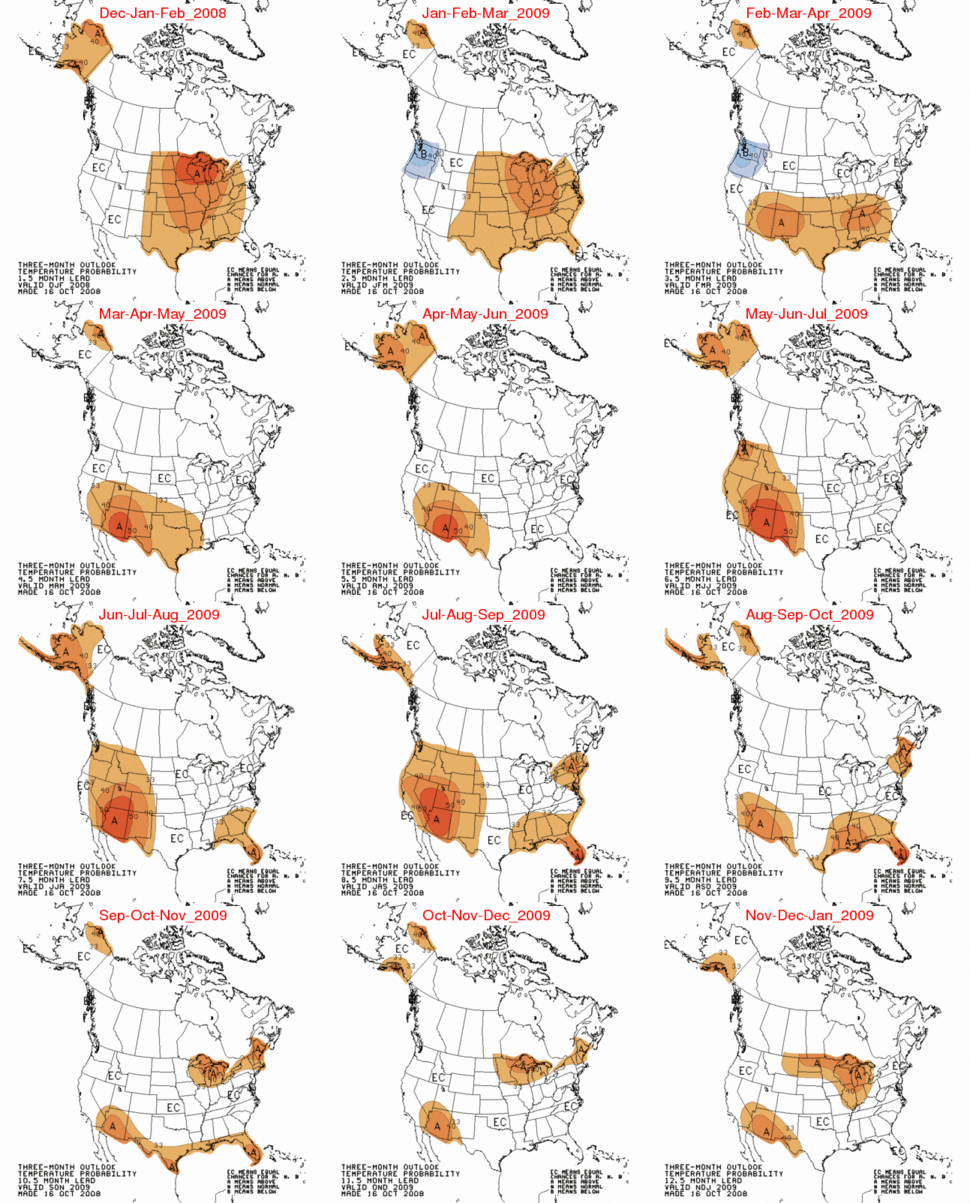
We are almost at the half way point for the meteorological winter (December through February) and it is a good time to evaluate how the NOAA CPC (Climate Prediction Center) and UK Met Office winter forecasts are doing so far. As seen below, CPC forecast the highest probability of warmth for Alaska and the upper midwest.


Trend of mild winters continues
25 September 2008
The Met Office forecast for the coming winter suggests it is, once again, likely to be milder than average.
Their scorecard is doing equally well, with the UK having it’s coldest winter in decades, as reported by the BBC.
last month proved to be the coldest December in more than 30 years, with the average temperature at 1.7C (35F), compared with the long-term average of 4.7C (40F) for the first part of the month.
On December 12, they issued this press release:
The Met Office seasonal forecast predicted the cold start to the winter season with milder conditions expected during January
Yet the Met Office appeared undaunted by yet another incorrect seasonal forecast, as reported by the always faithful Guardian earlier this week.
In the midst of a cold snap – a hot weather warning
As temperatures stay stubbornly well below freezing, it may feel like the last issue on anyone’s mind, but the government has been warned it may need to start thinking about introducing emergency hot weather payments to help poorer households keep cool.
The cold spell caused significant problems in many areas of the country. The Government’s bill for Cold Weather Payments is expected to rise to more than £100 million
How we did
The Met Office correctly forecast the spell of cold weather and kept the public informed via our various forecasts.
MikeP
So I believe that anyone who comes up with “novel” results needs to provide supporting evidence. Supporting evidence that I’ve never seen from the hockey stick people.
I am simply countering the claims that this winter (NH) is cold. Most people who make these claims are, I would suggest, usually making comparisons with winters they’ve experienced during their lifetime. This might be over 30 years, 50 years or in some cases a bit longer. Whatever – I am saying that over any of those timescales the current NH winter (up to the end of December at least) is on the warm side – or warmer than average, if you prefer. This is (or will be) confirmed by the various datasets which will undoubtedly show postitive NH anomalies relative to whichever base period they use.
John Finn tries hard to pretend that denialist hype is worse that AGW hype when he says:
Perhaps the best we can say is that this year the AGW hype has been moderated by a dose of reality.
There’s no evidence that global anything is underway, except global hysteria.
John Finn:
To respond to evidence [which is admittedly not proof] by saying “It means nothing” indicates either that you do not understand the meaning of ‘evidence,’ or that your mind is closed tight and nothing said will make any difference. Steven Goddard also reports on the evidence of increasing cold-related deaths. None of these facts are conclusive, but each is a brick in the anti-AGW wall. And that wall is becoming very solid.
Allow me to refer once more to this chart, which you claim “means nothing.”
Observe that out of four government/university temperature records, only GISS shows a slight warming. All the others show cooling. After dismissing this chart out of hand as ‘cherry picking,’ you do your own [un-cited] cherry picking by saying that if only some other years were picked, everyone would see the warming results that you want.
You accuse skeptics of ‘desperation,’ yet your own statements: “This is irrelevant,” and “This looks to be a fraud,” and “This is desperation,” and “The plot is rubbish,” and “The trends are not signigficant anyway so no cooling!” actually reek of desperation.
Against all the evidence, John, you insist that there can’t really be any cooling of the planet. Why is that?
Is it because you have bought into the canard that the AGW-CO2-runaway global warming-climate catastrophe hypothesis is still credible? It is not credible; that hypothesis has been repeatedly falsified.
Since the Earth is still emerging from its last Ice Age, the planet has been naturally warming, in fits and starts, for the past 11,000+/- years. Your belief that carbon dioxide will cause runaway global warming is falsified by the plain fact that even as CO2 levels increase, global temperatures are falling.
Once you accept that the Earth’s climate is well within its normal, natural historical parameters, you will begin to understand that the demonization of beneficial CO2 is a scheme being pushed for money and power.
If Al Gore really believed that his profligate energy consumption and “carbon” emissions contributed to runaway global warming, and if the UN/IPCC really believed that its conspicuous consumption in Bali and elsewhere was leading toward climate catastrophe, they would be traitors to the human race for their actions. Wouldn’t they? But they know that AGW-catastrophic global warming is a scam. I suspect that you know it, too, John.
In the dice analogy I think the die are loaded, shaved, and over time the load and the shave is changing not to mention the number of pips on each face. The challenge for the weatherman is to inspect the die and predict what the next roll will be. The challenge for the climatologist is to observe the progression of the rolls, determine how the load, shave, and pips are changing and predict the likely value of rolls some specified number of rolls in the future. I don’t think the climatologist has an easier job of it than the weatherman, or that he can be more accurate.
John Finn (02:44:05) :
“…all you seem to be saying is that some places have been cold – and you only want to focus on those places. ”
John, you really have been missing some important points. We are currently in the grip of a global hysteria that says that catastrophic global warming is
underway. The only way out is to shut down industrial civilisation NOW (their caps). Hansen says that Creation itself is under threat. Rather than look at the temperature records to assess these claims (and the widespread reduction around most of the world shows that they are false) you seem to be considering the question to be: one of the following must be true
a) we are experience catastrophic warming, civilisation ends; or
b) we are experiencing catastrophic cooling, civilisation ends.
You conclude (correctly, of course) that the evidence for b) is very weak, but then seem to imply (incorrectly, of course) that therefore a) must be true.
No possibility that there could be some intermediate position? We don’t need to be punished?
PS From someone accusing others of cherry picking, I liked ” … just before the new year we’ve had a fairly cold spell which has affected the south of the country (i.e. London)”. So you live in London then?
you seem to be considering the question to be: one of the following must be true
a) we are experience catastrophic warming, civilisation ends; or
b) we are experiencing catastrophic cooling, civilisation ends.
You conclude (correctly, of course) that the evidence for b) is very weak,
Yes.
but then seem to imply (incorrectly, of course) that therefore a) must be true.
I’ve just checked back and can’t find anything which might lead you to this conclusion.
PS From someone accusing others of cherry picking, I liked ” … just before the new year we’ve had a fairly cold spell which has affected the south of the country (i.e. London)”. So you live in London then?
No. But we have enjoyed similar recent mild winters. The fact that the South East and London, in particular, has been affected by the recent cold spell is a factor in the level of media reporting.
NCEP is predicting another round of cold weather in Europe through the end of the month.
http://wxmaps.org/pix/temp4.html
The UK is expecting more cold after a couple of days of rain.
http://www.bbc.co.uk/weather/5day.shtml
Slovenia has reported having record cold
http://news.trend.az/index.shtml?show=news&newsid=1393511&lang=en
Sold out of snowblowers in Canada. Orders being placed for 2010:
http://www.theglobeandmail.com/servlet/story/LAC.20090112.SNOWBLOW12/TPStory/National
“The 11th warmest [winter] in the satellite record.” wow, that is saying something, 30 years of data, and it is the 11th warmest, that is something. So, if we had a thousand years of similar data, and a got a similar reading it would be roughly the 300th warmest? Is that right?
That wouldn’t sound so rhetorically impressive though.
That wouldn’t sound so rhetorically impressive though.
I didn’t say it was impressive or particularly warm – I said it wasn’t cold . Many posters on here (and elsewhere) have been suggesting that the NH is having a brutally cold winter and generally implying that global temperatures are plunging sharply downwards. This clearly isn’t the case. Some places have been cold – but some have been warm and, overall, NH temperatures have been above the 30 year average.
Many are expecting much lower temperatures due to ‘weaker’ solar output. I think they’ll be disappointed. I also think the hype about the negative PDO is overblown. A developing La Nina will hold temperatures back a bit, but once that’s over expect them to recover to the level of the recent highs.
John Finn: Well, that’s the standard line. I think you will be surprised. Temperatures are above the 30 year average partly because of the removal of rural weather stations in the 1990’s. Satellite temperatures show that your ‘above average’ temperatures are only above average by a tiny fraction of a degree, and the trend is downward, just as it has been with declining solar activity throughout time. La Nina, PDO on top of this. Perfect storm.
John Finn says:
I also think the hype about the negative PDO is overblown. A developing La Nina will hold temperatures back a bit, but once that’s over expect them to recover to the level of the recent highs.
Tell you what. Why don’t you give us your email address.
In a couple of years time, if the cold downturn has not materialized we can all email you and tell you you were right. On the other hand …
I realise that this is only loosely related to the thread, but has anyone else noticed how cold it is going to be in Washington DC for Obama’s inauguration? The latest GFS (18h00 Jan 13) suggests an almost impossibly cold scenario. It’s a long way off, so it could end up completely wrong.
RS
Tell you what. Why don’t you give us your email address
Give me yours and I’ll email you.
Lulo
Satellite temperatures show that your ‘above average’ temperatures are only above average by a tiny fraction of a degree,
Well 0.2 globally and 0.4 in the NH is not exactly insignificant.
and the trend is downward
Is it? Jan 1999 to Dec 2008 (10 years) is up isn’t it? Or do you mean if you only select certain start years it’s down?
The trend is only downward for a few years. AGW supporters are quick to point out that this has occurred during a period in which the sun is taking a bit of a nap and we may have switched into a period of La Nina dominance. They are correct, and I’m fully aware of what the long term surface temperature looks like. However, this is like a tacit admission that these effects are stronger than CO2 impacts, but they couldn’t get their models to the impact of La Nina dominance until the pattern had already begun. As for the sun, solar effects still aren’t properly included in any of these climate models, which have done a terrible job of predicting the climate changes occurring in this decade, yet a number of my colleagues continue to tell me that, since the solar constant only varies by much less than 1%, that its climate impact must be very small. I think this is misguided, and ignores some important correlations. You can correlate running mean sunspot activity or solar cycle length or even earth magnetic field effects against temperature over time and get much higher correlations with temperature than you can with CO2.
Carbon dioxide is a very weak greenhouse gas with its ability to affect temperature logarithmic due to saturation issues. It is swimming in a sea of other gases, including water vapour, which largely has a very similar absorption spectrum, not to mention orders of magnitude higher concentration. The bulk of the temperature rise took place during the most recent Grand Maximum, and, now that it is over, temperatures are falling along with the weaker solar wind and our shrinking outer atmosphere. If you want specifics, I believe that the CO2 effect has been overestimated by a exaggerating the alpha value used to determine radiative forcing (the scientific literature on this is somewhere between abysmal and non-existent, yet the IPCC continues to apply it without explanation). Furthermore, I feel that the positive impacts of CO2 (enhanced plant growth rates, water use efficiency and nitrogen use efficiency) likely outweigh the negative (a very minor warming effect and temporary ocean acidification), so we should probably focus on other issues, such as land degradation, air and water pollution, wealth inequity, space travel and eradication of disease. If you don’t mind a digression, have you ever noticed that most physicists (who are the only ones who really understand how CO2 might interact with other gases in the atmosphere) deny climate change theory, while most supporters either come from fields like geography, biology, environmental science, oceanography and political science, or are political activists. It won’t be the first time consensus is wrong, but it is going to be a bombshell.
No, not climate, but weather rather…. apologies.
http://www.cnn.com/2009/US/weather/01/14/winter.storms/index.html
However when I hear “coldest air of the season” and “gulf of mexico” in the same sentence it makes me wonder.
Can we start calling climate models “weather models”? Please? Until climate models start modeling orbit wobble, continental drift, and subduction zone lift, I hereby REFUSE to call it climate change and climate modeling!
John Finn (02:44:05) :
But if I condense your post down all you seem to be saying is that some places have been cold – and you only want to focus on those places.
No. Not at all. What I said was that the cold places have been very very cold, outside the recent trend / norm and in many cases setting records. AND the warm ones are still warm, but have had a ‘failure to advance’ to the warm side. AND that adding these two interesting and valuable bits of insight together to get an average destroys that insight. I challenged you to explain what that average means.
What is the flavor of the average of all food served today? If it is all put in a blender, what does the change of flavor to tomorrow tell you? Nothing.
You have some nice space based data sets, go knock yourself out with them. Have fun. Average them and find nothing. Then step back and look at the patterns and see something.
See a suddenly very cold north polar area. See the way low ozone. See the open IR window that O3 was blocking, especially at the poles. See the air getting very cold. See the lobes of very cold polar air shooting south and the (residually overheated) hot air from the tropics headed north. Watch this heat engine wobble back and forth, sometimes freezing Portland, sometimes heating it, sometimes heating New Hampshire, shortly to be freezing it. Moving heat from tropical warm waters to the frozen north to be cooled.
Or average it all together and see nothing. Your choice…
There is no evidence that “global cooling” is underway.
Yes, there is. The cold places have gotten much colder. It is only by foolishly averaging away that insight that you see nothing.
December 2008 UAH NH anomaly is +0.4 (relative to 1979-1997). While temperature averages are not perfect we don’t have anything better.
Yes, we do. Now I have a bit of an advantage here because I spend all day looking at hundreds of charts of chaotic price data and looking for patterns in it. And I use a variety of tools too. I use averages to hide things I don’t want to see and I use other tools to make patterns stand out. After a while you get good at it. In a ‘battleground’ or inflection zone, you look at volatility, the delta between high and low. It is critical.
So take the UAH, and divide it at the jet stream. Take the trend of the cold side. Watch just that. As a separate behaviour, take the trend of the hot side. Watch just that. If you are really ambitious, watch them both at once. But do not average them together…
Like I said: You want a dataset, knock yourself out. Then tell me what does your average mean. To that I would add: And why do you want to use an average to hide the strain between hot and cold areas?
I am an expert at spotting an inflection point in price data ahead of darned near anyone else. I have a decade or so experience at it. Fortunately it’s now built into my brain since doing it long hand would be very time consuming and I have to evaluate a chart in about 20 seconds. I don’t expect anyone to pick up that skill in less than a year or so. What I’m fairly sure of at this point is that the same techniques can be used to spot inflections in major weather (and by extension climate) cycles.
Do you have a tool that will do that for you with weather data? Probably not, but you are free to go build one. Sort the data into hot and cold sides of the jet stream. Compute 2 simple moving averages for each. Look at the slopes. Look at the convergence and divergence between the simple moving averages. Finally, look at the number of hot vs cold datapoints (in stock terms, the advance / decline line). Integrate all that. Thats your trend. Inflection to the downside is when the hot data fails to advance, the cold data has the bottom fall out, and the MACD (the 2 moving averages of different time periods) converges and inverts to the downside. Having the AD line rollover to the downside helps too (more places on the cold side, fewer on the hot side).
Just don’t ever ever average it all together into one useless meaningless number. Ever.
“Averages hide more than they reveal”.
Pamela Gray (19:08:15) :
Can we start calling climate models “weather models”? Please? Until climate models start modeling orbit wobble, continental drift, and subduction zone lift, I hereby REFUSE to call it climate change and climate modeling!
This has bothered me somewhat too… but I’d ignored your other posts since I felt like I had no choice but to use ‘climate’ to differentiate the longer terms.
I have a modest suggestion: Call it weather, but with a duration qualifier. You can have 1 week weather reports, and 30 year weather models… Adds both clarity and precision. Lets me stop saying “weather or climate” … Also gets rid of the stupid notion that 30 years is climate. As though there were no 30 or longer year cycles of weather drivers…
OK, you’ve got a convert… I’m going to try to always use ‘weather’, ‘short term weather’, ’30 year weather’ etc. unless quoting someone else.
My mind feels tidier all ready 😉
Weather channel reporting hard freeze warning north of Tampa FL, 15F in Atlanta, minus oh my god up north… Slovenia is violating the terms of it’s agreement to enter the EU to run a nuke to keep warm. Germany has 3 rivers closed by ice. Thailand having 30s temps and declared cold emergency (wimps…), below zeros in the N.E. tomorrow, but it must be warmer, Finn said so… He averaged it with the Sahara Desert and it’s not cold anymore…
I am certain that the original met office forecast churned out the usual stuff back in August as regards the coming winter. It went a bit like this………
“Temperatures throughout Northern Europe including the UK are more likely to be average or warmer than average”.
Perhaps not surprisingly, it is now very dificult to access that original forecast as when you go to the winter forecast, all you get is the most recent update. Interstingly, as Autumn has progressed so their update has become progressively colder. The November update suggested a cold beginning to winter, while the December update finally conceded that December and January were likely to be colder than average with February close to average. Of course, this is now a complete reversal on their original forecast. There is never any reference made to previous forecasts!
I await with bated breath the met office appraisal of their seasonal forecast for this winter whiich will finally have to recover the original statement in order to compare it with what happened!! Wrong again!!
Ben
E.M.Smith (03:23:27) :
Yes, there is. The cold places have gotten much colder. It is only by foolishly averaging away that insight that you see nothing.
Which “cold places” are much colder? since when? You can’t average away a cooling trend as you put it. If you have an average of 0.5, say, then some places will be warmer than 0.5 and some will be colder. If the cold places have got much colder, then either the warm places have also got warmer – or the warmer places have grown in area.
Here’s the UAH anomaly map for December
http://climate.uah.edu/
and here’s the GISS anomaly map
http://data.giss.nasa.gov/cgi-bin/gistemp/do_nmap.py?year_last=2008&month_last=12&sat=4&sst=0&type=anoms&mean_gen=12&year1=2008&year2=2008&base1=1951&base2=1980&radius=1200&pol=reg
Note how consistent they are – where it’s warm on UAH it’s also warm on GISS where it’s cold on UAH it’s also cold on GISS.
As for the rest of your post. I’ve said that there is no evidence that global cooling is underway. You appear to disagree with this but provide nothing to show that my statement is in fact, incorrect. So do you have the evidence or not?
You can take it as read that I understand the limitations of using averages, but the temperature anomalies offer a reasonable comparison of a particular month to a given base period.
John Finn (09:50:54) :
You can take it as read that I understand the limitations of using averages, but the temperature anomalies offer a reasonable comparison of a particular month to a given base period.
The anomaly maps are averages over time for a given place. What you need is the ‘anomaly map’ from the cold side of the jet stream vs the warm side, and I doubt that those are available since you would need to dynamically pick temps to track as the jet stream moves.
The cold air within the cold pool at the N. pole moves. Right now it’s warm in California. A few weeks ago it was cold. Now that cold air mass is sitting over the central USA. Now they are cold. If you take a time average over a place (like a monthly average over California) you are hiding how cold that air mass is by averaging when it is here vs when it is somewhere else. (When the ‘cold place’ moves from California to Colorado).
Put at it’s most direct, I’m saying that the cold air source, the N. Polar air mass, has gotten very anomalously cold and is advancing to colder; while the hot air source, the water of the equator and gulf of Mexico is still warm, anomalously warm on a long term trend, but failing to advance to warmer.
Averaging them together on a macro scale (the whole world) hides this. Similarly, picking a physical spot like California, and averaging the temperatures over a month where 1/2 the time it was under cold polar air and 1/2 the time it was under hot tropical air hides the same same thing.
Perhaps I was unclear when I said ‘the cold places’ and ought to have said ‘the cold times in the places that are suffering the cold air mass’…
Averaging them together on a macro scale (the whole world) hides this. Similarly, picking a physical spot like California, and averaging the temperatures over a month where 1/2 the time it was under cold polar air and 1/2 the time it was under hot tropical air hides the same same thing.
No it doesn’t. If the cold polar air is getting colder and the warm tropical air is getting warmer then if California is getting 50% polar air and 50% tropical air, California’s temperatures will fall and this will show up in the anomalies. Even if there were a shift over California whereby there were only 40% polar air and 60% tropical air then California’s temperatures may rise (or remain constant) – BUT the polar air that isn’t now moving over California will shift to some other place and the temperatures will fall there.
However, I dispute the fact that there is any evidence that polar air is actually getting colder.
Correction to previous post :
This
If the cold polar air is getting colder and the warm tropical air is getting warmer then if California is getting 50% polar air and 50% tropical air, California’s temperatures will fall and this will show up in the anomalies
should read
warm tropical air is NOT getting warmer