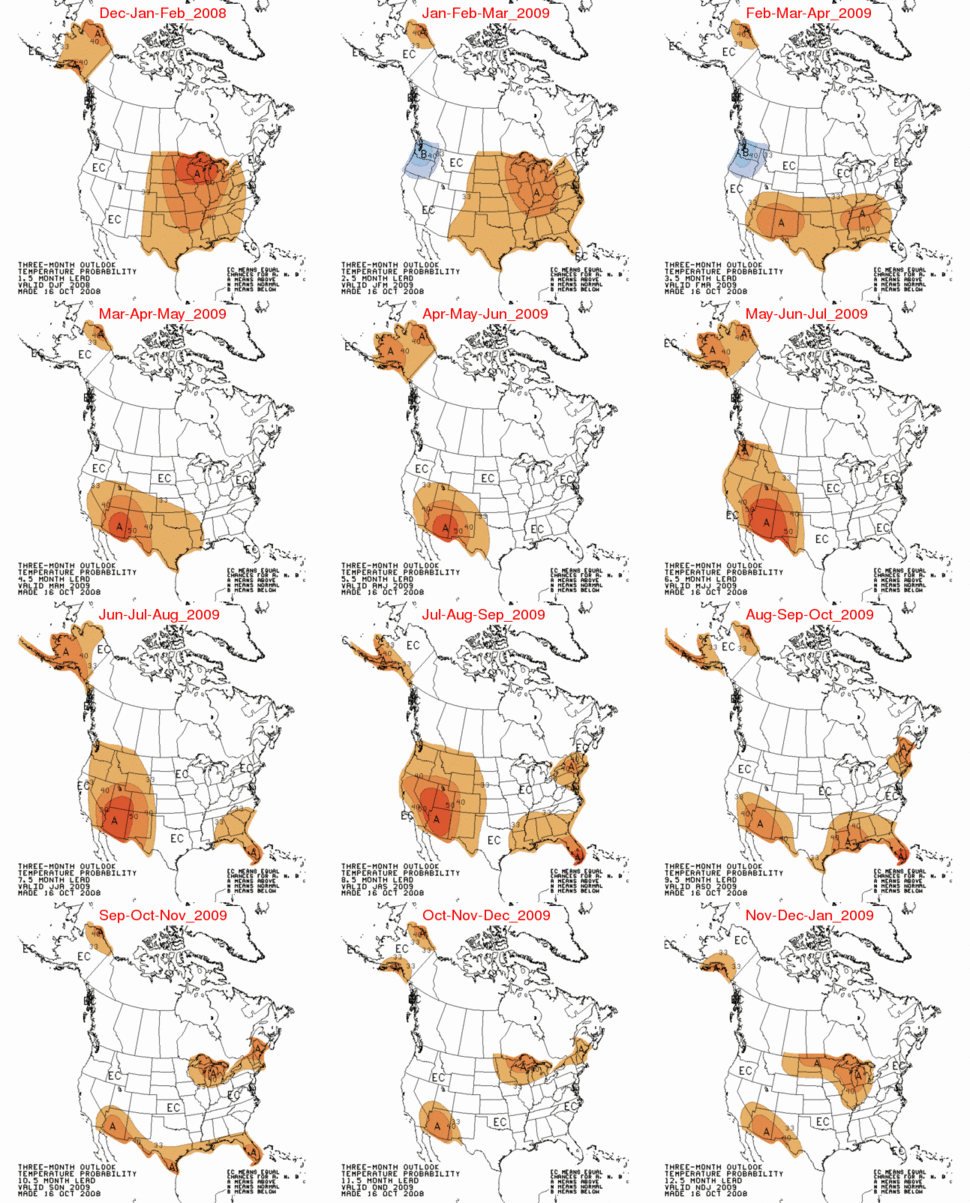
We are almost at the half way point for the meteorological winter (December through February) and it is a good time to evaluate how the NOAA CPC (Climate Prediction Center) and UK Met Office winter forecasts are doing so far. As seen below, CPC forecast the highest probability of warmth for Alaska and the upper midwest.


Trend of mild winters continues
25 September 2008
The Met Office forecast for the coming winter suggests it is, once again, likely to be milder than average.
Their scorecard is doing equally well, with the UK having it’s coldest winter in decades, as reported by the BBC.
last month proved to be the coldest December in more than 30 years, with the average temperature at 1.7C (35F), compared with the long-term average of 4.7C (40F) for the first part of the month.
On December 12, they issued this press release:
The Met Office seasonal forecast predicted the cold start to the winter season with milder conditions expected during January
Yet the Met Office appeared undaunted by yet another incorrect seasonal forecast, as reported by the always faithful Guardian earlier this week.
In the midst of a cold snap – a hot weather warning
As temperatures stay stubbornly well below freezing, it may feel like the last issue on anyone’s mind, but the government has been warned it may need to start thinking about introducing emergency hot weather payments to help poorer households keep cool.
The cold spell caused significant problems in many areas of the country. The Government’s bill for Cold Weather Payments is expected to rise to more than £100 million
How we did
The Met Office correctly forecast the spell of cold weather and kept the public informed via our various forecasts.
I think more at issue, is to explain to the general public that the problem was one of a breakdown of good scientific process and check and balance by an honest no agenda peer review process.
We should be careful about “punishing the snake oil salesmen of global warming”, it could result in a general back lash against science, rather than reinforcing good science unless carefully done to reinforce the concept of good science.
The best way to “punish” in my view, would be to use this recent scandal to demand the teaching of good honest no agenda science in our schools. The future of the respectability of science is to show that many “scientists” who were not degree’d, or tenured, or even professional scientists in the traditional sense, did see this breakdown, and tried to warn the public about it.
The primary failure was a media that was not scientifically competent or good enough journalists to ask probing questions of the high profile advocates of global warming, and hold them accountable for failed predictions and to adequately communicate the level of uncertainty of their “projections/predictions” to the public.
As mentioned in some previous posts on this blog, the skeptical citizen scientist has been the only honest peer review in many cases for the current state of climate prediction, and we need a cultural shift where the ownership of a degree or a title does not give undue weight to an expressed opinion. Sound and well reasoned review by people “outside” the priesthood of the current fad of science need to be given their appropriate level of respect in the media based on knowledgeable evaluation of the quality of their science, not on their resume.
If you have ever seen some of the very old articles in Scientific American about highly reputable scientists of years gone by making predictions or assertions of complete understanding of processes that are today seen as obviously flawed or even absurd shows this is in no way new.
The political leadership needs to be held accountable for not having adequate independent scientific review of the data, and predictions, and the primary custodians of that data need to be both properly funded to do good work, and held accountable for proper quality control of the data so it is reliable.
At least that is my view.
Larry
I don’t know if this has already been commented on but it appears Germany is very cold…
http://translate.google.com.au/translate?u=http%3A%2F%2Fwww.sz-online.de%2Fnachrichten%2Fartikel.asp%3Fid%3D2042096&sl=de&tl=en&hl=en&ie=UTF-8
D Caldwell,
Amazing Mauna Loa values. Of course they are subject to adjustment.
Here’s a thought {I have them on occasion}:
AGW proponents are fond of making a fuss about how their models are forecasting future climate, not weather; implying that just because weather forecasts are so often wrong, the same cannot be said of climate forecasts.
So what we have here is a three-month climate prediction {not weather forecast} that is so wide of the mark that the question that should be asked is:
If NOAA can’t correctly predict the climate three months out, why should anyone believe any climate prediction for a hundred years out?
DaveE (11:53:53) :
I seem to remember the Met Office failing to predict the icy start to winter until AFTER the event, when I was telling everyone it was gonna be a brass monkeys Winter back in Summer.
They used to laugh but they don’t now. 😀
And that is how we will effect change. I have an engineer friend, fairly hard core green. For over 3 years I’ve been ‘working on him’ to get him to see that AGW was bunk. Slow, painful, one at a time baby step progress. I’d claim thermometer errors. Then have to spend 4 months to get him to look at the proof. Then method error (data massage). Same lag. Gave him Skeptical Environmentalist and Unstoppable Global Warming Every 1500 years (returned unread months later). I eventually got him to “I don’t know and maybe AGW is wrong, but I can’t say anything like that in public”.
This summer I predicted a very cold winter (based on Landscheidt et. al.) and got a polite “Yeah, sure”; though he did take the papers to look at. As of now, he’s reading some of the papers I’ve provided per the problems with AGW and snickering at the snide remarks about if it gets any warmer I’m gonna need new long johns.
There is nothing like being right about the cold to make a convert, especially when you’ve done it in advance. One person at a time is all it takes.
Here’s Joe D’Aleo’s forecast that he made back in October: http://icecap.us/images/uploads/DECMARUS.jpg
Joe has talent. He’s basically nailed it so far….
I know it will sound odd coming from me, but we can probably predict with better accuracy on climate, then weather.
Climate is the statistics of weather. Weather is mostly chaotic, so predictability is not high.
Lets say I throw a die. It has about a 17% chance of any particular number coming up. That’s weather.
Lets say I track this for 1000 throws. I can predict how many times a given number will come up, with pretty good accuracy. That’s climate.
For a given throw, no. But for a great number of throws, yes, prediction is possible.
If a number does not appear as predicted, within a certain confidence level, then we need to look at the die and see what changed. That’s climate change.
D. Caldwell: Where is Mauna Loa data at? The link I have only has data to 2007.
It’s also very cold in Madrid,
“However, it should be recalled that weather conditions are the result of extremely complex interactions, and, therefore, one particular event cannot be attributed to one specific cause,” the UN weather agency said.
John W. (09:27:58)
“I realize that on some arbitrarily short time period it’s “weather,” and some arbitrarily longer period it’s “climate.” I realize the AGW crowd is going to change that period to claim any specific data conforms to their agenda. What mystifies me is how they can assert a forecast for 5, 50 or 100 years, but they don’t understand the phenomenology well enough to accurately forecast a week or month out.”
One thing that’s clear from the instrumental record and documentary evidence (Danes in Greenland, grapes in England etc) is that climate is cyclical. Temperatures go up for a while (over decades at least, sometimes longer) and then it goes down for a while; then up again and so on. If you take data within any one cycle (eg based on the instrumental record since 1850 or so with several cycles) and extrapolate the resulting “projection” over anything more than a year or two is obviously complete nonsense. Pick a downward trend and you get an ice age, an upward trend and you get catastrophic warming. And if it isn’t bad enough with a 20 year extrapolation, try 50 years, then 100 years.
When the IPCC define “climate” as being over a 25-30 year time scale, I don’t think it’s arbitrary. Making a projection some time around year 2000 it is exactly the time scale you would choose to make the most of the warming cycle since about 1970. If you chose 70 years, going back to the 1930s (any takers on why 30 years is climate but 70 years isn’t?) you would include the cooling period that preceeded the latest warming period, with much less satisfactory results.
The other reason for choosing a time scale of 25-30 years is career progression. If you are a “climate scientist” over 35, and can get away with persuading people that observations over a period less than 25 years tell nothing about climate, you are guaranteed to be able to reach retirement before you are shown to be wrong. (Pity the under 35s)
So rather than being arbitrary, the time scale for “climate” is very carefully calibrated.
“Is a cooling ocean absorbing more CO2?”
A cooling ocean would hold more dissolved CO2.
But if you look at the global mean, it shows a larger increase in 2008 than in 2007. scroll down to “global”. But the global number doesn’t have December 2008 in the data set yet.
This summer I predicted a very cold winter (based on Landscheidt et. al.) and got a polite….
But is it a cold winter?
The UAH December anomaly for NH is +0.42. Sure – the UK and some parts of Europe have had a longer cold snap than is normal, in recent times at least, but it hardly ranks with some past winters. For us in the UK, this winter has been a bit of a shock because we’ve become accustomed to much milder winters in the past decade or so. People are reading far too much into this.
The Australian BOM have been continuously forecasting warmer conditions but not getting them. Seems as if they do not like to admit it, almost as if they cannot believe that the weather in places can actually get cooler:
Forecast –
http://www.bom.gov.au/announcements/media_releases/climate/ahead/20081126T.shtml
Actual –
http://www.bom.gov.au/climate/current/month/aus/summary.shtml
Sea Surface temp forecasts for the Great Barrier Reef are also for higher than normal temps:
http://www.gbrmpa.gov.au/corp_site/key_issues/climate_change/management_responses/coral_bleaching_status_2008-09/seasonal_bleaching_forecasts/poama_image
And the Coral Bleaching forecast is also high:
http://www.gbrmpa.gov.au/corp_site/key_issues/climate_change/management_responses/coral_bleaching_status_2008-09
But current GBR SST anomaly plot does not show anything alarming and I have not heard of any devastation yet this summer from the GBR:
http://www.gbrmpa.gov.au/corp_site/key_issues/climate_change/management_responses/coral_bleaching_status_2008-09/reeftemp_image
Global SST –
http://weather.unisys.com/surface/sst_anom.html
Oops, meant larger increase in 2008 than 2006, my bad.
Les Johnson
Up to date ML stuff is here
http://co2now.org/index.php/Current-CO2/CO2-Now/current-data-atmospheric-co2.html
TonyB
Here’s the Mauna Loa monthly mean data. Clicky
384.11
Same as last month. hmm . . .
My local radio station, “LincsFM” noted that the temperature at RAF Waddington airbase, near Lincoln, has been no higher than -2C all day!
There’s a column in today’s The Daily Telegraph, on the weather page.
The author, one Philip Eden, notes the claims being made for December being “The coldest since..”.
Depending on which days you pick, you’ve got since 1998 (Dec1st-8th), 1991 (1st-12th), 1976 (1st-10th)
He carries on to say that for the whole month of December, it was “the coldest for just 7 years, not 30”
Seems to be in a bit of a huff about it.
I’ve “Googled” him, he runs a weather site
http://www.climate-uk.com/
He notes on that website that December was “It was the driest and sunniest December, averaged nationally, since 2001, and the coldest also since 2001”.
As for windpower, well, it’s contributed a magnificent 0.5% of our national electricity usage, during the past few days or so, scarcely a breath of wind.
Bet Osama will strike anything related to ‘climate change’ during his speech if, indeed, the temperatures are in the single digits during the swearing-in ceremony.
John Finn (14:02:03) :
But is it a cold winter?
Yes.
Nice and simple explanation Les. But the problem is, we really don’t know how many dice we have, and exactly what numbers are on those dice.
D Caldwell said (11:33:34) :
“Has anyone noticed the latest from Mauna Loa?
2008 CO2 increase of just 0.24 – lowest since their records began.
Is a cooling ocean absorbing more CO2?
Or does it mean anything at all?”
Surely it shows the normal 2ppm increase over the whole year? Which data are you looking at?
ML is on a volcanic island over a continually outgassing warm ocean and mixing isn’t as great as is often claimed. If there is absorption going on and levels are dropping ML would probably be the last place it will show up
TonyB
hotrod (12:50:09) :
Very good points. More than that though, it is not just that the media is not scientifically competent to understand or report the uncertainty to the public, there has been a general dumbing down of scientific reporting in most of the MSM in the last 10 years. There is a fear of alienating audiences or readerships, and scientific documentaries are now full of recaps and summries. This has even been evident even in the BBC’s science programmes, such as the formerly excellent Horizon. It is maddening.
Having participated in several information films and been present when news crews report on science breakthroughs, you end up doing what they want and biting your tongue. They want to sensationalise any small breakthough, link any chemical to cancer, hype negative change, create fear in their audience who will then hunger for more information about how this will affect them.
They are shouting for attention too, and really fear not getting it. After all lack of readership or audience is death to MSM. Joe Public does not care about science, except when it might affect him. Create fear – make him read the article. It is no wonder science is viewed so negatively by so many.
Much colder weather allows the media to do what they want, hype the dire consequences.
Steve M: I totally agree. Weather and climate are hellishly more complex than dice.
But, I would have more confidence in a long range climate forecast, than a long range weather forecast.
And yeah, it would be nice to know how many sides on the dice, and what numbers, before we spent 40 trillion dollars betting on those dice.
Global mean temperatures from IPCC AR4 here. Labelled FAQ 3.1 Figure 1
http://ipcc-wg1.ucar.edu/wg1/Report/AR4WG1_Print_Ch03.pdf
Examples:
1) rise in T from 1860-1880 is about 0.6C; extrapolate 100 years to 1960, projected T about 17C, actual in 1960 about 14C
2) fall in T from 1880-1910 is about 0.6C; extrapolate 50 years to 1960, projected T about 12.5C, actual in 1960 about 14C; extrapolate 100 years to about now, projected T about 11.5C actual about 14.5C
Two points if you look at the graphs: other data sets I have seen (eg US) have the 1930-40 period much closer to T in 2000.
Look at the slopes of the segments 1860-80 and 1910-40 and compare with the slope of the segment 1970-2000. The slope is the rate of change of T. Pretty much the same? I’ve often hear it said that it isn’t the temperature itself that is of concern (this comes out when the possibility that the 1930s were about the same as now, not seen in this data set), but the unpredecdented rate of increase. Well, it isn’t unprecedented according to the IPCC data.
Noting the UK Met Office forward projections.
News release 19th Aug 2007
http://www.metoffice.gov.uk/corporate/pressoffice/2007/pr20070810.html
predicts:
“Over the 10-year period as a whole, climate continues to warm and 2014 is likely to be 0.3 °C warmer than 2004. At least half of the years after 2009 are predicted to exceed the warmest year currently on record.”
“1998 is the current warmest year on record with a global mean temperature of 14.54 °C”
30 December 2008 Press release
http://www.metoffice.gov.uk/corporate/pressoffice/2007/pr20070810.html
“2009 is expected to be one of the top-five warmest years on record despite continued cooling of huge areas of the tropical Pacific Ocean, a phenomenon known as La Niña. ….the global temperature is forecast to be more than 0.4 °C above the long-term average. This would make 2009 warmer than the year just gone and the warmest since 2005.”
“The warmest year on record is 1998, which was 14.52 °C, a year dominated by an extreme El Niño.”
1998 downgraded by 0.02°C in 18 months?