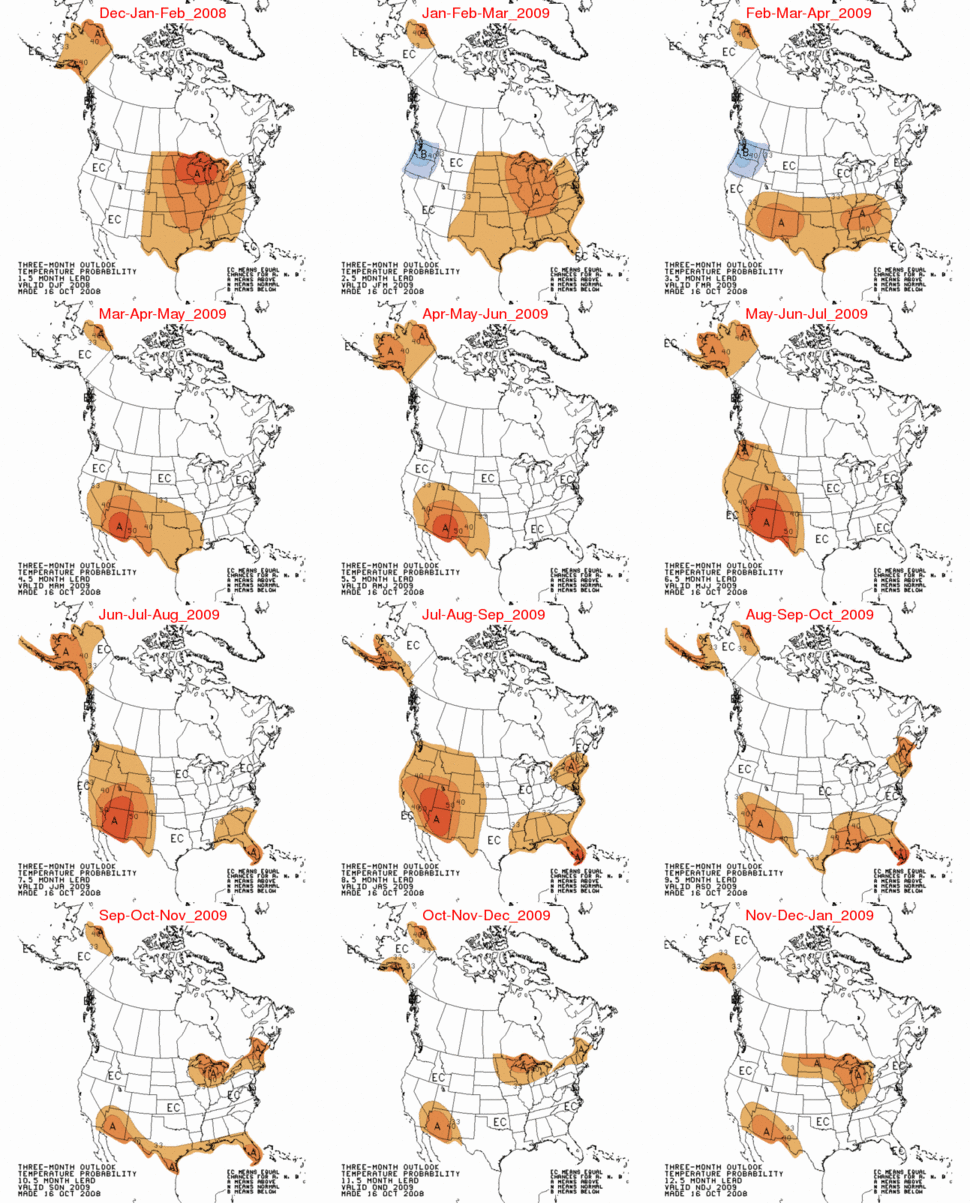
We are almost at the half way point for the meteorological winter (December through February) and it is a good time to evaluate how the NOAA CPC (Climate Prediction Center) and UK Met Office winter forecasts are doing so far. As seen below, CPC forecast the highest probability of warmth for Alaska and the upper midwest.


Trend of mild winters continues
25 September 2008
The Met Office forecast for the coming winter suggests it is, once again, likely to be milder than average.
Their scorecard is doing equally well, with the UK having it’s coldest winter in decades, as reported by the BBC.
last month proved to be the coldest December in more than 30 years, with the average temperature at 1.7C (35F), compared with the long-term average of 4.7C (40F) for the first part of the month.
On December 12, they issued this press release:
The Met Office seasonal forecast predicted the cold start to the winter season with milder conditions expected during January
Yet the Met Office appeared undaunted by yet another incorrect seasonal forecast, as reported by the always faithful Guardian earlier this week.
In the midst of a cold snap – a hot weather warning
As temperatures stay stubbornly well below freezing, it may feel like the last issue on anyone’s mind, but the government has been warned it may need to start thinking about introducing emergency hot weather payments to help poorer households keep cool.
The cold spell caused significant problems in many areas of the country. The Government’s bill for Cold Weather Payments is expected to rise to more than £100 million
How we did
The Met Office correctly forecast the spell of cold weather and kept the public informed via our various forecasts.
“Partly to Mostly with a Chance of…” -Sage advice on forecasting from and old
Weather Service forcaster i knew.Never go out on a limb…
Especially with an AGW saw in your hand….
The conclusion I draw is that the Met Office continually get it wrong but continually claim the opposite!
Well, this — the CPC forecast — is what you get when your primary model for forecasting is a 10 year trend. I.e., if you forecast a trend that comes from a time when a positive PDO and El Nino dominated Pacific SST’s, into a time when the PDO has gone negative an La Nina dominates, you should expect to be mostly wrong in your forecast.
Life At Negative 78 Degrees In Alaska
“Day to Day, January 9, 2009 · Right now it’s cold in Alaska. Really cold. In the town of Tok, it was 78 degrees below zero yesterday.”
“…rather than being dry because it is cold, the air instead becomes cold because it is dry.”
Brutal Cold in the IPCC Models versus Nature
January 9th, 2009 by Roy W. Spencer, Ph. D.
http://www.drroyspencer.com/2009/01/brutal-cold-in-the-ipcc-models-versus-nature/
What does all this mean for the theory of manmade global warming? How fast have these coldest airmasses warmed, compared to the IPCC models? Well, the location in Siberia that is traditionally the coldest, Ojmjakon, hit -60 deg. C (-76 deg. F) twice last month (December, 2008), a temperature that has been reached only one other time in the last 25 years. So, I suspect that global warming isn’t happening nearly fast enough for the folks who live there.
Coming soon to the USofA.
—————————————————
The Australian government has produced a draft document by the Department of Climate Change on Australian Climate Change Science – A National Framework
“The Exposure Draft on Australian Climate Change Science is planned as a justification for a massive new investment of public funds in a lot of very speculative ventures. It is produced entirely by the people who are seeking the funds. The authors are anonymous but obviously have a big vested interest in the result. The guiding principles are taken, not from science, but from political manifestos.”
http://carbon-sense.com/wp-content/uploads/2008/11/science-by-bureaucracy.pdf
The whole global warming hysteria (which underlies this entire document) rests on one fundamental and unproven assumption which can be summarised as: “Man-made emissions of greenhouse gases have caused unusual global warming and unless emissions are curbed by government caps and taxes, we will reach a tipping point and face runaway global warming which will cause significant damage to our environment.”
There is no empirical evidence from the past, and no scientific proof of this assertion. The ONLY “evidence” is the voluminous and continually changing output of several complex but un-validated computerised models of world climate. These models give different answers depending on the input assumptions.
I expect these nonsense predictions and claims from the mainstream propaganda outlets, but not from national climate centers. From now on, it appears that there are no “authoritative” sources for climate information that can be trusted.
The Met Office says “Met Office seasonal forecasts are expressed as variations from 1971-2000 averages”
So, for these forcasts they include the cooler period 1971-1978 and eliminate the warmer period 2001-2007 thus making the “average” temperature lower in an attempt to make current temps appear higher. I am finally beginning to understand climate “science”.
Great post.
And don’t forget that Siberia has been our AGW believer’s last stand for ‘unusual warmth’ this year.
http://www.allheadlinenews.com/articles/7009739004
Wow, a real heat wave.
The Met Office deserves the loss of credibility they are experiencing.
Don’t worry – it’s getting warmer fast.
From next week the UK is going back to warm, wet and windy weather
The odd thing about this spell of cold weather was that the Azores high actually joined up with the high over northern Europe and blocked all the depressions and warm fronts from getting into the UK. I don’t remember it doing it to this extent in the last 20 years which is probably why the sea froze for up to 20 metres off the Dorset Coast. http://www.bournemouthecho.co.uk/photos/flickr/4034746.The_big_freeze/
LOL. I wonder how many Brits will notice the Met Office’s big lie.
Weather and climate are both chaotic systems. Chaotic systems are inherently difficult to model. Why would anyone expect these kind of models to produce accurate predictions?
Oh I love this one http://icecap.us/index.php/go/political-climate
“Britain’s wind farms have stopped working during the cold snap due to lack of wind, it has emerged, as scientists claimed half the world’s energy could soon be from renewables. The Met Office said there has been an unusually long period of high pressure across the UK for the last couple of weeks, causing the cold snap and very little wind.
Since Boxing Day much of the country has suffered sub-zero conditions with frozen rivers and lakes and even the sea in the south of England, at Sandbanks in Dorset. In the last few days temperatures in southern England plunged as low as 17.6F (-8C). However the weather is expected to warm up over the weekend, with wind speeds also picking up. But sources in the energy industry say that the lack of wind has caused the country’s wind farms to grind to a halt when more electricity than ever is needed for heating, forcing the grid to rely on back up from fossil fuels or other renewable energy sources. “
The British are also getting a valuable lesson in just how useful wind energy is …
All that wasted opportunity cost.
The BBC changed their December story without comment today. It now reads:
The start of the meteorological winter is 1 December and last month proved to be the coldest December since 1996, with the average temperature at 3.1C (38F), compared with the long-term average of 4.2C (40F) for the first part of the month.
http://news.bbc.co.uk/2/hi/uk_news/7816005.stm
Looks like quite a demonstration of how a belief system can get in the way of objective analysis of facts. Looks like for the near future, reality will refuse to conform to warming belief system. And in the last couple of days the Arctic has gone back to building up the ice.
I can’t stand any more warming like we’ve been having of late.
So what can we infer from this? Even on the short time scales, models don’t reach claimed accuracy.
Anyone with too much time on his hands — here’s a fun exercise: print out the 10-day forecast off any of the popular online weather sites two or three times a day for 10 days, and see how they change. I’ve been trying this with The Weather Channel site for the last week or so, and I’ve seen temperature predictions for a given date fluctuate by as much as 20 degrees during the course of a day, and I’m talking about predictions that are only 24 to 72 hours out. Generally, by the time the 10 day mark is reached, it bears almost no resemblance to what was forecast 10 days before.
It also appears that the accuweather link in the article has disappeared.
http://www.accuweather.com/news-story.asp?article=5
The missing article was titled “Major arctic blast destined for East.” and you can still see the broken link to it from here.
http://www.accuweather.com/news-top-headline.asp?partner=accuweather&traveler=0&date=2009-01-09_21:55
Anthony,
The Winter outlook that I saved was issued as an updated version issued on 20 Nov 2008.
It shows the Alaskan “above” (40%) center shifted SW and expanded to take in about 1/3 of the state. The CONUS center over Wisconsin was pushed S and is centered over OK & MO. These forecasts of course, will be verified using the GISS data base which will be proof of a positive anomaly. In fact, my part of the country will have ZERO months of below average temps through next year according to the CPC . I’m already making plans for an unprecedented Summer!
“… Even on the short time scales, models don’t reach claimed accuracy. Climate models, though different in design and time scale have a 90% confidence level, as reportedly claimed by the IPCC.
“Of course, “Weather is not climate.” But, skill level in atmospheric model design should not automatically be assumed to be better for one than the other.”
As a general rule in my field, if the outcome of tests and experiments diverges wildly from the predictions based on models and simulations, we either:
a. Screwed up the test/experiment. i.e. We didn’t account for or control all external factors.
b. Our models/simulations are seriously flawed.
c. We’ve uncovered a previously unobserved behavior. (Which has happened. But we didn’t make that assertion until after MUCH review and evaluation of the test conditions, setup, simulations, etc.)
I realize that on some arbitrarily short time period it’s “weather,” and some arbitrarily longer period it’s “climate.” I realize the AGW crowd is going to change that period to claim any specific data conforms to their agenda. What mystifies me is how they can assert a forecast for 5, 50 or 100 years, but they don’t understand the phenomenology well enough to accurately forecast a week or month out.
The claim of “we can predict climate accurately, but not weather” sets my Fraud Detector off at max volume.
George Orwell’s “1984” is alive and well… cold is hot, snow is tropical rain, white is black, according to the AGW proponents.
A correction:
It was the coldest *start* to December in 30 years. However, December overall was the coldest since 1996, at 0.7C below the 1961-1990 average.
http://www.metoffice.gov.uk/climate/uk/2008/december.html
(As also stated in cited BBC article: “last month proved to be the coldest December since 1996……”; n.b. the bit which follows in the article doesn’t quite make sense but the statement just quoted is correct)
I think Winston Smith is running The Met Office.
So, despite all the money and effort we expend into these organizations, they still can’t make a better prediction than the Old Farmer’s Almanac. Just shows to go ya, it’s awfully difficult if not impossible to make any sense out of a chaotic system with so many variables that can affect it. That’s also why it’s so hard for us to screw it up with any one element, be it CO2 or anything else we do.
After a while, you’d think that people who “reason” only in terms of being politically correct would themselves even wonder why it is that they get nearly everything wrong, and, indeed, often exactly the opposite of what is and turns out to be the case – that is, why it is that their perceptions, fears, and wishes are not reality. But maybe that would simply be asking too much, given the mental substrate they apparently have to work with.