
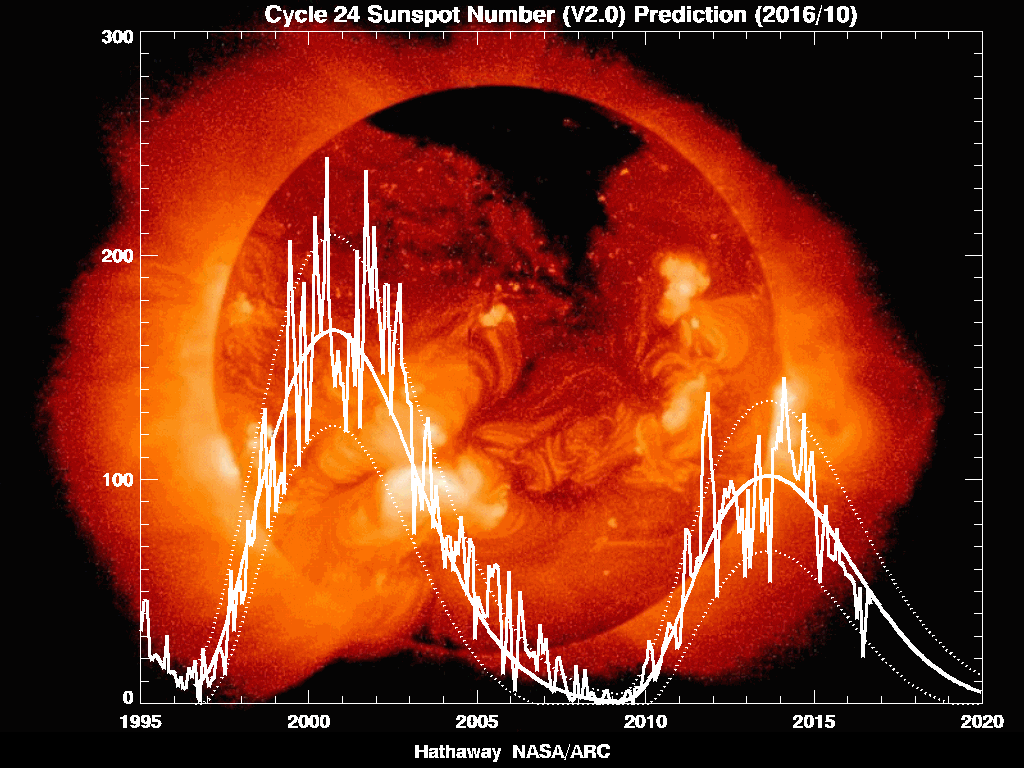
A few days ago I wrote in State of the Sun for year end 2008: all’s quiet on the solar front – too quiet that “No new cycle 24 predictions have been issued by any solar group (that I am aware of ) in the last couple of months.” Coincidentally and shortly after that, NASA’s David Hathaway updated his solar prediction page here. He’s made a significant backtrack over previous predictions, and now for the first time he is claiming cycle 24 will be less than cycle 23, not greater.
Kudos to our WUWT resident solar physicist Leif Svalgaard for his foresight. He has been saying for many months that cycle 24 would be significantly reduced, and not greater than 23.
Here is Hathaway’s most familiar graphic, which has an active sun in the background. Perhaps it is time to update that background to something more reflective of the times…..oh wait, read on.
Click for a larger image
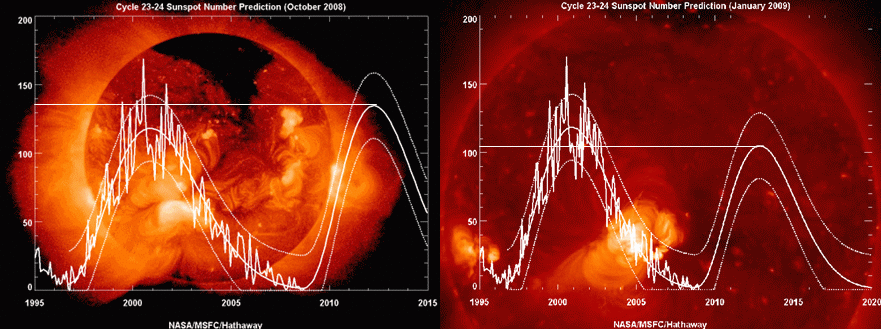
Here in this graphic, from Klimadebat.dk we can see how much has changed since Hathaway’s last prediction update in October 2008:
Click for a larger image
Note that Hathaway did indeed change background graphics from October to January. Its just not quite the smooth and nearly featureless ball we see today.
Courtesy of Mike Smith, here is the March 2006 prediction graphic:

Click for larger image
Hathaway’s predicted Cycle 24 maximun in March 2006: 145
Hathaway’s predicted Cycle 24 maximun in October 2008: 137
Hathaway’s predicted Cycle 24 maximun in January 2009: 104
I’d say that represents a sea change in thinking, but the question now is: How low will he go?
I was looking for a substantial quote from Hathaway in his prediction page, but it appears he is being quite conservative in his language, focusing mostly on methodology, not the prediction itself. I don’t blame him, he’s in a tough spot right now.
Meanwhile we’ve had an entertaining episode with the most recent Cycle 24 transient sunspot/sunspeck that appeared briefly yesterday then disappeared almost as fast as it appeared. See the area on the lower right of the sun:

In response to my query asking if he concurred with my assessment of it being an SC24 speck, (he did) Leif wrote to me: “Seems that it has received even a region number 11010. Somewhat ridiculous.”
Then about 12 hours later: “And SWPC has withdrawn the number. No numbered region after all.”
It will be interesting to see which organization counts this event, or not, in the month end tally. Up until this point, we had 25 consecutive spotless days. Now we have more, or not.
h/t to Frank Lansner for the Klimatdebat.dk graphic link and a bunch of other commenters who made note of the Hathaway page
Greg Smith (23:03:14) :
This may be related
Nasa have found to their amazement that the level of the ionosphere has dropped to previously unsuspected levels and that this drop is due to the lack of activity in the sun
http://www.nasa.gov/topics/earth/features/outer_atmosphere.html
Solar activity such as magnetic storms heats the ionosphere and this is not happening now
Would a thinner atmosphere more easily propagate heat?
vukcevic (00:59:32) :
I think concentrating on the gravity alone is a waste of time. Gravitation forces alone could not regulate the Hale’s polarisation cycle. Thus, another factor (with a magnetic polarity property) must be in the play, which has to be related to the planetary orbital periods.
1) it doesn’t has to be
2) the planets don’t change their magnetic polarities in step with the Sun so magnetic forces are just as ineffective as gravity
3) the solar wind in supersonic and magnetic influences cannot travel upstream. [I think I have pointed that out to you 315 times or so]
Edward Morgan
Leif you missed this one,
How does the parcel become less under pressure? Wouldn’t other material be added to it under pressure and compacted where is the escape route for this material?
If I crushed an egg in a container with increased air pressure the only time the egg or anything else would escape (with a good seal) is when I released the pressure. So there is a need for another lifting force (planets) or a slackening of the braids.
By the way I have a picture of the last cycle of solar flares and spots and the difference between minimum and maximum is clear to the eye. Its massive. For these differences to make little or no difference is something you should know better than.
With Jupiter and Saturn their pull in one direction would be the opposite when on the other side of the sun like our tides. The change in flow are opposite/different polarities and many cycles including the German GDP and Lynx catches and the Earth’s magnetic field peak (maximum and minimum) when the centre of mass of the solar system and Jupiter are in line.
Also, interestingly the last phase where the centre of mass of the solar system hovers near the Sun’s surface for an extended period of time significant of a period of instability in solar activity and its terrestrial response began in 2002 just when all the indexes in the science section of this site started to dip. Until then the secular variation of the geomagnetic field was up. These instability periods switch the trend and since then we’ve been down. This is a fact and a correlate. If Leif you disagree people should check this out for themselves because I feel a lot of people are believing you without checking this out properly. Its easy to trust a Dr. people need to think for themselves.
Ed.
Ed
Didn’t say I was not voting daily, or that others should vote for CA…
JamesG (02:24:03) :
If any tiny change is deemed a priori unimportant then you have to also rule out CO2 as an influence on climate since that is also a tiny change in a trace gas.
Yes, and so one can do, and the problem goes away. You hangup is to connect the solar and CO2 problems. One camp claims that tiny changes in a trace gas regulates the climate, an other camp claims that tiny changes in solar activity regulates the climate. And the two camps are fighting over whose changes are the tiniest. I say that they are both wrong.
Hathaway has done far more than simply make predictions. He has stuck his foot in it telling the world plus dog that this is normal, when in fact we do not have the data to tell the difference between a 1910-13 event and a Dalton or a Maunder while it is yet unfolding.
Edward Morgan (07:31:55) :
Leif you missed this one,
How does the parcel become less under pressure?
Adding a magnetic field [amplified by braiding] increases the pressure in the parcel. Because pressure is quickly equalized from surrounding parcels, the parcel with the magnetic field loses material, hence becomes lighter, hence rises. More braiding, more rising.
With Jupiter and Saturn their pull in one direction would be the opposite when on the other side of the sun like our tides.
No, it doesn’t matter which side they are on, the resulting tides would be the same, just like our tides. Our tides at a place, P, go up when the Moon is on the opposite side of the Earth of the place P, because the Moon pulls the Earth away from P.
We have a sunspot! With a conundrum.
SIDC cancels ALL QUIET.” A small active region developed during
the first hours of Jan. 09th at about 45 degrees east and 20 degrees
north. It showed weak (below B level) but repeated flaring activity
and it is associated with sunspots according to Uccle white light observations.
“http://sidc.oma.be/index.php
Latest SOHO images confirm this region. It is readily observable
in all EIT frames, and MDI Magnetogram. MDI Continuum requires
full screen, but it’s there.
http://sohowww.nascom.nasa.gov/data/realtime/realtime-update.html
The bug-a-boo is, SWPC has “0” in the SWO Sunspot num. field in the daily
Geomagnietic and Solar Indices table for Jan. 9
http://www.swpc.noaa.gov/alerts/solar_indices.html
Is someone asleep at the switch, here?
Sunspotter (08:55:59) :
Is someone asleep at the switch, here?
They woke up:
http://www.swpc.noaa.gov/alerts/solar_indices.html
Sunspot Area
10E-6 Hemis. New Regions Spotted Regions
Jan 09 20 1 1
Jan 08 0 0 0
GES to Leif,
Thanks for the elucidation Leif. My post was of course tongue in cheek; but anything that can trigger an informative response, is worthwhile.
Now let me pick your brains some more. Do those white halos persist throughout the whole lifetime of the spot ? and is their increased emittance considered the primary source of the 0.1% or so enhancement of the solar constant, or is there some more global (sun) effect.
I suppose it is also possible that those halos could have a broader angular distribution pattern for their emission. I presume that for the most part, the solar surface is largely a Lambertian emitter (locally) but then since it is not an optical surface, it might be more isotropic.
It is not so difficult to believe that local disturbances such as sunspots can produce unusual radiation output; but somewhat harder to contemplate what might cause an increase in solar emittance over the whole body.
Which doen’t mean I have any of such explanations; just that they seem tenable.
George
“He has stuck his foot in it”
He has company. One sign of the approaching ‘Dark Age’ is lack of respect ‘science’ garners these days.
The reasons for this are legion, but money grubbing tops the list. When journalists, politicians and scientists are all agreeing and supping together trouble is bound to follow.
And it’s fading fast. Was much clearer earlier this morning on Cerro Tololo’s GONG image, but very mushy now.
Poor old Sun is really struggling.
Leif Svalgaard (07:20:30) :
vukcevic (00:59:32) :
I think concentrating on the gravity alone is a waste of time. Gravitation forces alone could not regulate the Hale’s polarisation cycle. Thus, another factor (with a magnetic polarity property) must be in the play, which has to be related to the planetary orbital periods.
1) it doesn’t has to be
2) the planets don’t change their magnetic polarities in step with the Sun so magnetic forces are just as ineffective as gravity
3) the solar wind in supersonic and magnetic influences cannot travel upstream. [I think I have pointed that out to you 315 times or so]
1) it doesn’t has to be
Considering the equations and the associated graphs
http://www.vukcevic.co.uk/combined.gif (take a look at the updated version)
http://www.vukcevic.co.uk/GrandMinima.gif
it would be a minor miracle if this is just a coincidence.
2) the planets don’t change their magnetic polarities in step with the Sun so magnetic forces are just as ineffective as gravity.
Correct, but I have not come across a good explanation why Hale cycle for global field should change at max and for the sunspots at min.
One of possible reasons for a flip caused by planets could be: magnetic forces as any other forces should add in a vector type manner. Since J & S move above and below the solar equatorial plane, then their combined fields would at the centre of the solar system have two components (if resolved along solar axes). H component will be always in the solar equatorial plane pointing to the centre with a nearly constant intensity. V component will be aligned with the solar axis of rotation, pointing alternatively either S or N, in the process its intensity falling to zero.
3) the solar wind in supersonic and magnetic influences cannot travel upstream. [I think I have pointed that out to you 315 times or so]
I take your point about solar wind (perhaps sq. root of 324), but there are other possibilities: one follows directly from the above analysis; another lets say a ‘disturbance’ within the asymmetric heliospheric magnetic field, due to the magnetospheres orbital passage.
The sun is needing a blood transfusion, becoming more pale every day, as Livingston and Penn predicted.
I have it projected and the secondary very faint spot (leading). A hint of a tertiary more towards the equator. If you aren’t looking right at the spot’s area on projection, you’ll miss it. Took several minutes of sliding paper back & forth to find the area.
I am an hour from noontime (transit) here, and I could not see it an hour ago.
JamesG (02:24:03) :
Indeed an extreme oddity in this debate is how climate scientists will continually claim that exceedingly tiny changes in the content of the atmosphere from manmade GHG’s can have huge effects, yet they simultaneously fail to consider the logical counter-argument that therefore tiny changes elsewhere (say Tsi, solar wind, cosmic rays, weakening magnetic fields, Jovian influences, planetary wobbles, etc.) might, by exactly the same argument, also have a disproportionate effect. Leif falls right into this category too. If any tiny change is deemed a priori unimportant then you have to also rule out CO2 as an influence on climate since that is also a tiny change in a trace gas. Conversely if one tiny change is deemed important then we should consider all such tiny changes. Not doing so seems to be more political or dogmatic than scientific. .
I agree that CO2 is tiny, and total solar irradiance, averaged over a year, is also small. BUT the sun radiance has enormous variation within the 24 hours ( from 1200 watts/m**2 at noon where i am ( Greece) to 0 at night. It also changes on average 7 percent between winter and summer, but geographically it also changes for something like 800 to 0 at the poles. So if we go away from the thought process that believes that yearly averages and a black body sphere can describe the mathematics of climate, we get out of the box and can think how these enormous heat inputs and changes hitting the oceans and land and atmosphere at yearly and monthly rhythms surely create all these PDOs and ENSOs and …. what nots that are really what are affecting our climate.
sorry , not editing , I mean ofcourse the change in TSI.
George E. Smith (09:59:33) :
Now let me pick your brains some more. Do those white halos persist throughout the whole lifetime of the spot ? and is their increased emittance considered the primary source of the 0.1% or so enhancement of the solar constant, or is there some more global (sun) effect.
Yes, they even precede the spot and last longer than the spot and are indeed the reason for the TSI enhancement: they are brighter than the spot is dark, so the net effect is extra emission.
I suppose it is also possible that those halos could have a broader angular distribution pattern for their emission.
No, not in the sense I think you are contemplating. The brighter areas are found around the spots. Now, this is not quite true. There are also such bright spots around each pole. These occur at and around solar minimum and are due to the polar magnetic fields, but make a very, very small contribution to TSI.
gary gulrud (10:00:49) :
One sign of the approaching ‘Dark Age’ is lack of respect ’science’ garners these days
Combined with the fact that most science has become incomprehensible to even educated people, which means that simple pseudo-science in 19th century style often takes the place of modern view points.
vukcevic (10:23:38) :
it would be a minor miracle if this is just a coincidence.
No, because the wiggle matching is poor. They don’t line up and the amplitudes don’t match. Make a scatter plot of values for each year and show us.
Correct, but I have not come across a good explanation why Hale cycle for global field should change at max and for the sunspots at min.
This was explained by Babcock in 1961. http://en.wikipedia.org/wiki/Babcock_Model
‘disturbance’ within the asymmetric heliospheric magnetic field, due to the magnetospheres orbital passage.
The magnetosphere’s have no influence [except locally near themselves] on the heliospheric magnetic field [which is not asymmetric – please, no silly NASA press releases about that]
“Combined with the fact that most science has become incomprehensible to even educated people”
A group sometimes including scientists if rarely journalists or politicians.
Leif said
“Adding a magnetic field [amplified by braiding] increases the pressure in the parcel. Because pressure is quickly equalized from surrounding parcels, the parcel with the magnetic field loses material, hence becomes lighter, hence rises. More braiding, more rising.”
Where does the parcel lose it to? Surely if it was still under pressure there would need to be a less pressurised area for this sort of shift/escape.
Leif said,
“No, it doesn’t matter which side they are on, the resulting tides would be the same, just like our tides. Our tides at a place, P, go up when the Moon is on the opposite side of the Earth of the place P, because the Moon pulls the Earth away from P.”
The tides wouldn’t be the same because the centre of gravity of the solar system is varying its not a closed system ours vary too due to different alignments (is this really news to you) My point is that the fact that the alignments are opposite is important because of the opposite nature of poles hence the polarity reversal.
Ed.
Edward Morgan (17:23:11) :
This argument, however, does not take into account that the Sun’s eruptional activity (energetic flares, coronal mass ejections, eruptive prominences), heavily affecting the solar wind, as well as softer solar wind contributions by coronal holes have a much stronger effect than total irradiance.” Theodore Landscheidt,
Leif said
This is an example of the nonsense I was talking about. These things do not have a ‘much stronger effect’. The solar wind is contains 3 protons per cubic centimeter, the air you breathe contains 30,000,000,000,000,000,000 molecules per cc, just to give you a feeling for the magnitudes involved.
However
“Large Flares release energy equivalent to the explosion of 200 million hydrogen bombs in A FEW MINUTES time sufficient to meet man’s energy demands for 100 million years.” Theodor Landscheidt “Sun-Earth-Man”
A stark contrast here Leif. Like fact from fiction. Ed
I think Hathaway is right now about the position of 24’s leading ramp. 23 is months dead and buried. As a couple of others have noted above, the scale of the ramp up is bats.
Leif Svalgaard (12:02:01) :
vukcevic (10:23:38) :
it would be a minor miracle if this is just a coincidence.
No, because the wiggle matching is poor. They don’t line up and the amplitudes don’t match. Make a scatter plot of values for each year and show us.
I have taken your point about solar wind. Perhaps you should take my point that there are two equations (with two graphs) there.
http://www.vukcevic.co.uk/combined.gif
The blue graph (with its equation) is meant to identify zero crossings only, which correspond to the minima. It is not there to show any correlation with the amplitude or shape of the individual cycles (I could just put a square waveform with the same zero crossings). Fact that for 7out of the last 8 matches the amplitude is just an extra result. It is in no way meant to mach shape of cycle (power3 up, exponential down), it is just a simple sine wave. Even so correlation for the last 8 cycles is 0.74, if smoothed annual values are used than is well in excess of 0.80. I’ll make point again: its purpose is just to identify zero crossings, wich I am interested in. The amplitude and shape of the cycle is a different mater. I promise to make a scatter plot for the zero crossings vs solar minima over next few days.
The amplitude envelope may be simulated by using sub harmonics and combinations of the two frequencies used for periodicity. It is a simulation only, and out of 18 cycles reasonably indicates value of 15 maxima. I will also do a scatter graph for amplitude envelope values vs. smoothed annual peaks.
I find it surprising, I hope that it does not irritate you, to find that for SC 24 peak (now we have to think of a slow rise and 2014) both equations give prediction of 77-80 which is so close to your estimates.
This was explained by Babcock in 1961. http://en.wikipedia.org/wiki/Babcock_Model
To anyone with a bit more than basic knowledge of electromagnetic fields suggested explanation is less than satisfactory (borders on irrelevant).
‘disturbance’ within the asymmetric heliospheric magnetic field, due to the magnetospheres orbital passage.
The magnetosphere’s have no influence [except locally near themselves] on the heliospheric magnetic field [which is not asymmetric – please, no silly NASA press releases about that]
Parabolic shape of the heliosphere assumes it is asymmetric, we may discus that one on another occasion.
My apologies for thread-hijacking, but I’ve responded to Pierre Gosselin’s interest in betting over sea level rise in an older thread, here:
http://wattsupwiththat.com/2008/12/28/nasas-twist-on-global-sea-ice-loss/#comments
Again my apologies, just didn’t want the response to be missed in case Pierre’s interested….