
A few days ago I wrote in State of the Sun for year end 2008: all’s quiet on the solar front – too quiet that “No new cycle 24 predictions have been issued by any solar group (that I am aware of ) in the last couple of months.” Coincidentally and shortly after that, NASA’s David Hathaway updated his solar prediction page here. He’s made a significant backtrack over previous predictions, and now for the first time he is claiming cycle 24 will be less than cycle 23, not greater.
Kudos to our WUWT resident solar physicist Leif Svalgaard for his foresight. He has been saying for many months that cycle 24 would be significantly reduced, and not greater than 23.
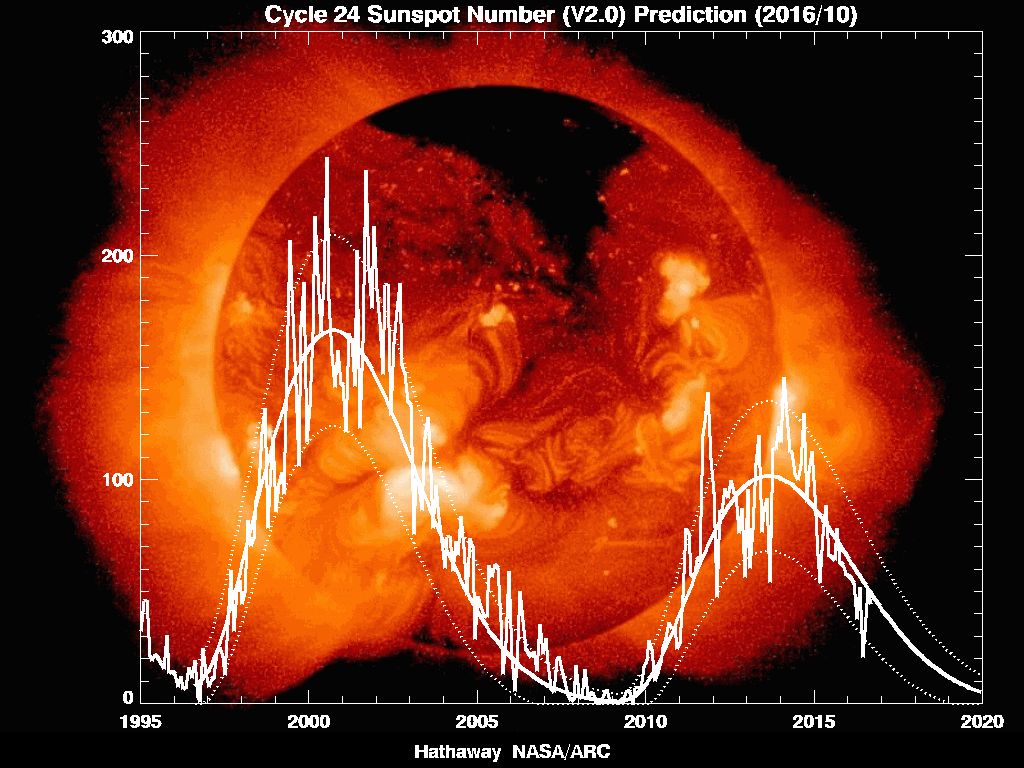
Here is Hathaway’s most familiar graphic, which has an active sun in the background. Perhaps it is time to update that background to something more reflective of the times…..oh wait, read on.
Click for a larger image
Here in this graphic, from Klimadebat.dk we can see how much has changed since Hathaway’s last prediction update in October 2008:
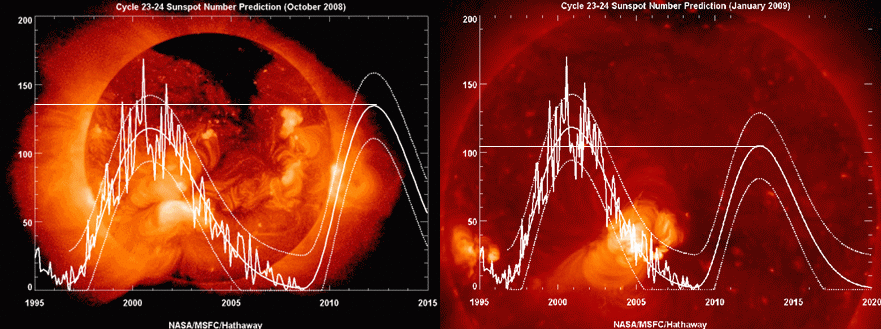
Click for a larger image
Note that Hathaway did indeed change background graphics from October to January. Its just not quite the smooth and nearly featureless ball we see today.
Courtesy of Mike Smith, here is the March 2006 prediction graphic:

Click for larger image
Hathaway’s predicted Cycle 24 maximun in March 2006: 145
Hathaway’s predicted Cycle 24 maximun in October 2008: 137
Hathaway’s predicted Cycle 24 maximun in January 2009: 104
I’d say that represents a sea change in thinking, but the question now is: How low will he go?
I was looking for a substantial quote from Hathaway in his prediction page, but it appears he is being quite conservative in his language, focusing mostly on methodology, not the prediction itself. I don’t blame him, he’s in a tough spot right now.
Meanwhile we’ve had an entertaining episode with the most recent Cycle 24 transient sunspot/sunspeck that appeared briefly yesterday then disappeared almost as fast as it appeared. See the area on the lower right of the sun:

In response to my query asking if he concurred with my assessment of it being an SC24 speck, (he did) Leif wrote to me: “Seems that it has received even a region number 11010. Somewhat ridiculous.”
Then about 12 hours later: “And SWPC has withdrawn the number. No numbered region after all.”
It will be interesting to see which organization counts this event, or not, in the month end tally. Up until this point, we had 25 consecutive spotless days. Now we have more, or not.
h/t to Frank Lansner for the Klimatdebat.dk graphic link and a bunch of other commenters who made note of the Hathaway page
Leif Svalgaard (19:55:40) :
to
vukcevic (13:27:16) :
the magnetic field on CMEs [clouds] is closed [has both feet on the Sun] and spiral inside the loop as the picture shows. Energetic particles will gyrate around the spiraling field lines and can reach us at much higher speeds than the Alfven speed as also cosmic rays can……….
There are cases where bodies in the magnetic field of another body react back. There are aurorae on Jupiter that are caused by Io interacting with Jupiter’s magnetic field. But in the case of the Heliomagnetic field, the Sun it the body that injects 99.99…9 % of the particles into the closed fields in the Heliosphere, not the planets, so any planetary effect would completely drown. In fact, we observe electrons going both ways in the closed loops: coming up one leg, going all the way out to the top of the loop, then continuing back to the sun down the other leg, turning around and repeating this many times. The same thing happens in the Earth’s Van Allen Belts. But all these particles do not constitute electrical currents and have nothing to do with the HCS.
Dr Svalgaard
Thanks for the comments and the links. I am obviously guilty (among many other things) of using wrong terminology. The above explanation is precisely what I wonted confirmed, i.e. that loop has “has both feet on the Sun”, and the particles circulate within. I do understand that the magnetosphere do not inject anything into the loop.
However, properties (be it electrical, magnetic, rate of spin, momentum, energy or whatever else) of the loop’s particles will surely change in some way when the loop hits magnetosphere. Current consensus may be that if there are such changes, they may not matter, those particles may not constitute electric current and they cannot initiate feedback, etc. However, the loop is a close circuit and there must be a change within its properties.
In interest of peace and good will, I shall not mention f (feedback) word. Thanks again.
vukcevic (02:08:34) :
that loop has “has both feet on the Sun”
The loops are not part of the ‘regular’ solar wind. They are drawn out by CMEs. If there were no CMEs [like the situation near solar minima where the CME rate is very low] there would be no such loops. So the loops are a consequence of solar activity and not the cause of it.
Leif Svalgaard (04:09:21) :
to
vukcevic (02:08:34) :
that loop has “has both feet on the Sun”
The loops are not part of the ‘regular’ solar wind. They are drawn out by CMEs. If there were no CMEs [like the situation near solar minima where the CME rate is very low] there would be no such loops. So the loops are a consequence of solar activity and not the cause of it.
Thanks for the note. I absolutely agree, intention was to imply that magnetic loops provide a bidirectional link (Ok, only in case of CME, avoiding the f word) between a magnetosphere and the Sun’s active regions.
However at this point I am interested in a point you made in the previous post:
Although most of the solar wind magnetic field is ‘open’ [extends to ‘infinity’], the magnetic field on CMEs [clouds] is closed [has both feet on the Sun]
I have some reservation (goes against my logic) towards existence of an open magnetic field. I assume that all lines of the Earth’s magnetic field close within its magnetosphere. Similarly, I would expect that solar wind and interplanetary magnetic fields would close somewhere within outer regions of the heliosphere, before the heliopause.
Could you recommend one of your many papers with a detailed description of properties and events within HCS.
Thanks.
vukcevic (05:11:03) :
that magnetic loops provide a bidirectional link
The existence of bidirectionality is not interesting. We earthlings are planning to send a spacecraft into to Sun; there is a link from a planet to the Sun. The important thing is how much goes in to Sun compared to what goes out. If the former is minuscule enough it can [and must] be ignored in discussions of what makes the Sun tick.
I have some reservation (goes against my logic) towards existence of an open magnetic field.
In science we often employ concepts that are illogical or known to be plainly wrong as long as they are useful. The ‘solar system’ picture of an atom is a good example, or considering gravity to be a force. Same with ‘open’ field lines [which do not exist].
I assume that all lines of the Earth’s magnetic field close within its magnetosphere. Similarly, I would expect that solar wind and interplanetary magnetic fields would close somewhere within outer regions of the heliosphere, before the heliopause.
Your assumption is contradicted by direct observations. For the Earth, there are several pieces of evidence that the Earth’s magnetic field leaks out of the magnetopshere:
1) the Svalgaard-Mansurov effect that shows that solar and terrestrial field lines are directly connected all the time
2) the importance of ‘southward’ pointing interplanetary magnetic field in generation of magnetic storms and strong aurorae
3) the ‘polar rain’ where particles from the Sun has direct access along connected field lines to one or the other polar cap depending on the direction of the IMF
4) direct spacecraft measurements [in the news lately – magnetic portals, etc].
That solar and Jovian field lines are connected [reaching out of the Jovian magnetosphere] is even an integral part of your own theory [appropriately modified to be physically plausible – i.e. abandoning the speed-of-light electromagnetic feedback].
Similarly, the solar wind magnetic field is connected with the galactic field, e.g. http://www.ias.ac.in/jarch/jaa/21/431-437.pdf
Could you recommend one of your many papers with a detailed description of properties and events within HCS.
Thanks.
Here’s an interesting article about Ol’ Sol that came out on Friday. It may provide a good topic for futher discussion and it’s a wonder they didn’t try to blame mankind as the cause.
http://www.foxnews.com/story/0,2933,478024,00.html
It also has a link to Hathaway’s prediction last November. I’m surprised this article is still avaiable .
http://www.space.com/scienceastronomy/081107-new-sunspots.html
vukcevic (05:11:03) :
Could you recommend one of your many papers with a detailed description of properties and events within HCS.
Google “heliospheric current sheet” will point you to many papers [not all good].
A nice illustration of what the current sheet looks like in a meridional cut is Figure 1 of:
http://icrc2005.tifr.res.in/htm/PAPERS/SH34/jap-miyake-S-abs1-sh34-oral.pdf
Especially the solar maximum look [figure 1c] is often a surprise to people.
Can’t see hide nor hair of 1010 today.
Tried the SOLIS data information, but couldn’t find anywhere they keep the data on the Gauss reading for sunspots.
Maybe that is Livingston’s personal work?
Robert Bateman (12:13:44) :
Maybe that is Livingston’s personal work?
It is. Bill will tel me tomorrow or so what the result was.
I wrote a new Google search parameter which allowed me to identify additional Sunspot predictions by Dr. David Hathaway, from public websites, without finding too many false positives and/or duplicates. A total of eight (8) additional images were recovered and there are several more candidates to which I don’t have access. New predictions were not issued every month and there was one period during NASA budget cuts then predictions stopped altogether. Here are the latest animated GIF archives and the new months which have been recovered.
http://commons.wikimedia.org/wiki/File:SSN_Predict_NASA_Pre2004.gif
2001-04
2001-08
2002-04
2002-10
http://commons.wikimedia.org/wiki/File:SSN_Predict_NASA.gif
2004-03
2005-06
2007-09
2007-11
The newly recovered images for 2007 were a plus because that is the year when it became obvious that the old predictions were not working. If anyone is using my GIF files as a source for edited animations please take note. Remember, other than adding the images to an animated GIF, I have not edited the images in any way. Anyone using the predictions should reference the Wikimedia pages.
For some reason the Wayback Machine has not been doing a very good job of late, recording changes to Internet websites, which is why I have to go dumpster-diving via Google. There is a timed embargo on archived content but in the last few years the archiving process has not been as complete as it was in the past.
I will keep looking; nothing is ever completely deleted on the Internet.
Mike
Re: Tom’s post on low Tropical Cyclone Energy (TCE), I was struck dumb after reading this news report a couple of weeks ago: “Forecaster tips big cyclone season for [Queensland, Australia]”:
http://www.abc.net.au/news/stories/2009/01/07/2460962.htm
It contains this quote from long-range weather forecaster Hayden Walker:
“I base my forecasts on sunspot activity and there’s certainly been an intense
number of sunspot activities and this time through it’s more prolific than normal,”
he said.
Huh? Did I blink and miss these “prolific” sunspots?
His website can be found here: http://www.worldweather.com.au
I’m no expert, but it smells of pseudoscientific techobabble.
As a Meteorological Forecaster (37 years in the business), one thing I have learned, is that statistics are nice, but may not account for all the potential dynamics a system can throw our way. How well we do as forecasters is a matter of time and spatial scales we are attempting to forecast, and our understanding of the forecastability of the system. The devil is in the details. Ever see a rain accumulation pattern forecasted in detail by a parameterized statistical model? Statistics are fine, but only go so far in generating estimates of what is really going to happen. In the case of our blank Sun, we may be learning something new that past statistical models do not yet understand. This is a good thing. Forecasting is frequently a humbling art. We should have patience, watch and learn…and have a little mercy on the guy trying to make sense of it.
Kortom, dat hele 2012 is allemaal geklets in de ruimte en hebben en maken we ons zelf gek met al die mooie verhalen over maya’s, poorten en wat nog meer zo zij. Het enigste wat ons mensen dus nog kan redden is een gewapende revolutie tegen alle hebzuchtige graaiers en uitzuigers. Laat liefde heersen via de revolutie. ♥