
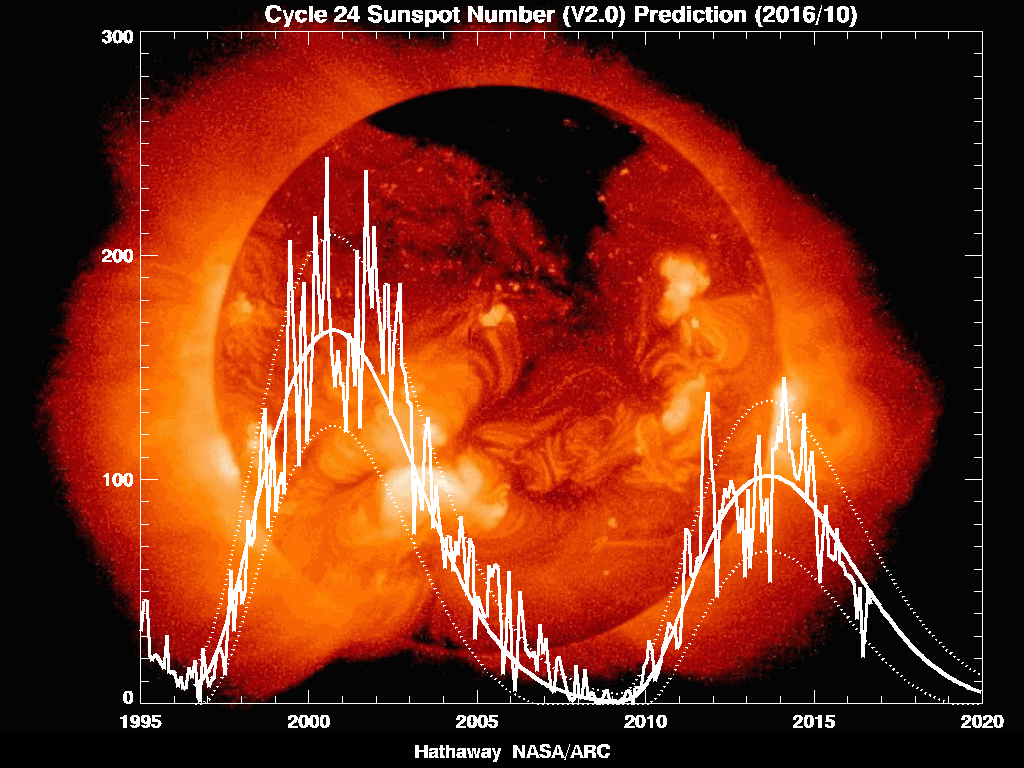
A few days ago I wrote in State of the Sun for year end 2008: all’s quiet on the solar front – too quiet that “No new cycle 24 predictions have been issued by any solar group (that I am aware of ) in the last couple of months.” Coincidentally and shortly after that, NASA’s David Hathaway updated his solar prediction page here. He’s made a significant backtrack over previous predictions, and now for the first time he is claiming cycle 24 will be less than cycle 23, not greater.
Kudos to our WUWT resident solar physicist Leif Svalgaard for his foresight. He has been saying for many months that cycle 24 would be significantly reduced, and not greater than 23.
Here is Hathaway’s most familiar graphic, which has an active sun in the background. Perhaps it is time to update that background to something more reflective of the times…..oh wait, read on.
Click for a larger image
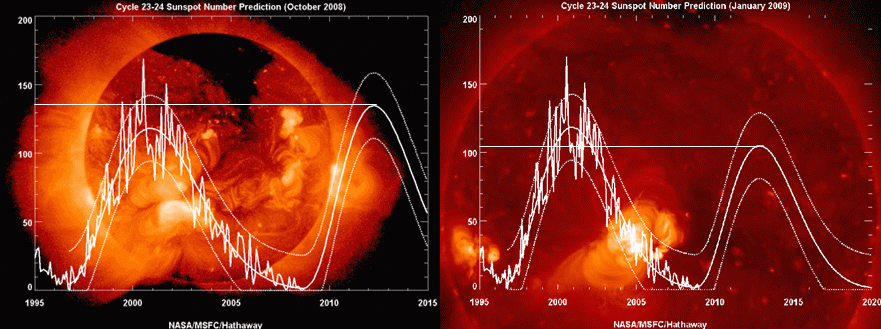
Here in this graphic, from Klimadebat.dk we can see how much has changed since Hathaway’s last prediction update in October 2008:
Click for a larger image
Note that Hathaway did indeed change background graphics from October to January. Its just not quite the smooth and nearly featureless ball we see today.
Courtesy of Mike Smith, here is the March 2006 prediction graphic:

Click for larger image
Hathaway’s predicted Cycle 24 maximun in March 2006: 145
Hathaway’s predicted Cycle 24 maximun in October 2008: 137
Hathaway’s predicted Cycle 24 maximun in January 2009: 104
I’d say that represents a sea change in thinking, but the question now is: How low will he go?
I was looking for a substantial quote from Hathaway in his prediction page, but it appears he is being quite conservative in his language, focusing mostly on methodology, not the prediction itself. I don’t blame him, he’s in a tough spot right now.
Meanwhile we’ve had an entertaining episode with the most recent Cycle 24 transient sunspot/sunspeck that appeared briefly yesterday then disappeared almost as fast as it appeared. See the area on the lower right of the sun:

In response to my query asking if he concurred with my assessment of it being an SC24 speck, (he did) Leif wrote to me: “Seems that it has received even a region number 11010. Somewhat ridiculous.”
Then about 12 hours later: “And SWPC has withdrawn the number. No numbered region after all.”
It will be interesting to see which organization counts this event, or not, in the month end tally. Up until this point, we had 25 consecutive spotless days. Now we have more, or not.
h/t to Frank Lansner for the Klimatdebat.dk graphic link and a bunch of other commenters who made note of the Hathaway page
Well, I suppose we will all know for certain within 20 years 🙂
And again, there is something crackpot-ish that I can’t ignore and am quite prepared to say he is a rather interesting kook, but if he turns out to be correct ….
And thank you for the plasma link, Leif Svalgaard!
Hehe, yeah.
Edward Morgan (11:33:44) :
In principle something that’s changing cannot be the same. I’m being exacting. The only time they would be the same is when the centre of gravity is in the centre of the sun exactly, then the forces on both sides of the sun would be equal creating equal tides of course if the sun was perfectly uniform in its matter. When Jupiter and Saturn are on the other side of the sun in conjunction producing a centre of mass of the solar system not in the centre of the sun then the eddy currents they produce will be LARGELY opposite to where THEY were because the centre of gravity would be largely opposite to where it was. This is what causes the change in polarity.
One of the problems with this theory is that the cycles of Jupiter and Saturn DO NOT stay in step with the sunspot cycles. But the planetary positions you suggest are responsible for the major bulk of angular momentum in our solar system with J+S together the strongest and J+S opposing the weakest. I see it as a separate engine acting in the background that controls solar cycle modulation strength and with N+U around can create grand minimum type events.
See Carl’s graph http://landscheidt.auditblogs.com/files/2008/12/sunssbam1620to2180gs1.jpg
There is another set of planetary positions that do keep in step with the sunspot cycles and there is argument that there is a minimal tidal effect in play. J+E+V most aligned days (non aligned days creating neap tide effect). Perhaps this is a more likely explanation for the timing and polarity change of a solar cycle.
http://landscheidt.auditblogs.com/files/2008/11/sun_fig5.gif
The spots visible the last 2 days exhibit an uncharacteristic neutral gray tone.
They are not as dark as I expect them to be. Has this condition been noted by observers in the past during minima?
Would the magnetic plage strength index http://www.astro.ucla.edu/~obs/150_data.html#plots
from Mt. Wilson being so low be the cause of this effect that I am seeing?
And in keeping with current conversation:
I. R. G. Wilson, B. D. Carter, and I. A. Waite have written a paper titled
Does a Spin–Orbit Coupling Between the Sun and the Jovian Planets Govern the Solar Cycle?
Abstract:We present evidence to show that changes in the Sun’s equatorial
rotation rate are synchronized with changes in its orbital motion about the
barycentre of the Solar System.We propose that this synchronization is
indicative of a spin–orbit coupling mechanism operating between the
Jovian planets and the Sun. However, we are unable to suggest a plausible
underlying physical cause for the coupling. Some researchers have proposed
that it is the period of the meridional flow in the convective zone of the Sun
that controls both the duration and strength of the Solar cycle.We postulate
that the overall period of the meridional flow is set by the level of disruption
to the flow that is caused by changes in Sun’s equatorial rotation speed.
Based on our claim that changes in the Sun’s equatorial rotation rate
are synchronized with changes in the Sun’s orbital motion about the
barycentre, we propose that the mean period for the Sun’s meridional flow
is set by a Synodic resonance between the flow period (?22.3 yr), the overall
178.7-yr repetition period for the solar orbital motion, and the
19.86-yr synodic period of Jupiter and Saturn.
This paper is now available free, see discussion here: http://landscheidt.auditblogs.com/
Robert Bateman (20:13:39) :
The spots visible the last 2 days exhibit an uncharacteristic neutral gray tone. They are not as dark as I expect them to be. Has this condition been noted by observers in the past during minima?
What Livinsgston and Penn are seeing is that the spots are getting warmer, hence less dark with less contrasts.
Ok, the sunspots are warmer. Any change to the surrounding plage of note?
Edward Morgan (11:41:23) :
anna v said,
“No, it does not. The only effect of planets on the sun are the tides, and those are miniscule.”
What if this effect is amplified by resonance with canals of liquid in between braids in accordance with George Biddell Airy’s theory of a theoretical canal around the sun through the changing centre of mass of the solar system. The main planets involved here (being the most masseous) are Jupiter and Saturn.
Ed
Look, the reason I made my list of five steps above is that I thought: what would I have to do to prove that the planetary motions are affecting the climate on earth ( were I forty years younger and starting now). What you say might be one possible thought to explore. After all the tides on earth are 40cm high but the tides on some shores can vary by 10 meters due to the morphology of the ocean bottom. BUT before one can start considering such models as important for earth climate one has to prove that the magnetic sphere of the sun affects the climate on earth, which still is not nailed down and is a hypothesis with the galactic cosmic rays. Maybe in a hundred years we will have a proof. Any planetary influence would be a fine structure on this effect, so the road is long and cannot be handwaved with barycenters.
p.s I thought canals was a “structure” in the plasma of the sun when I replied above.
I will repeat again: barycenters are irrelevant, are theoretically useful points and that is all. They do not carry the forces, it is the planets that carry the forces and can have any, even if miniscule, influence. The barycenter is like the callender on the wall, it does not create the days, just records them.
Here is an example: two equal weight and height people are walking in parallel along a road, left and right. Their barycenter walks the middle of the road. A car goes through their barycenter, does anything happen to the men, anything at all? If a car went through one of them, i.e. what carried force interacted with the matter of one of them, then the results would be tragic.
Re Solar winds and earths rotational period.
I’m astonished to read that during periods of intense solar winds the earths rotation period normally 84600 seconds can be slowed as much as 7 to 16 miliseconds in one day. The energy transfers involved must be enormous.
Back in the 1960’s Dr A Danjon announced he had detected a change in LOD (Length of Day)associated with great solar flares , in 1972 Gribbin & Plagemann confirmed the effect with a great flare in 1972 when the earth slowed 16 miliseconds in one day instead of the usual 3 miliseconds per day.
The effect has not been thoroughly studied but consider the energy required to brake the planet by 16 miliseconds is huge. A calculation was done that the earth brake energy that day was of the order of 10^15 Kilowatthours.
would that amount of energy imparted into the planet cause signifigant heating ?.
equally when the planets rotation speeds up would there be a cooling effect ?
This phenomonon does not seem to have been studied at any great length, but it might be usefull to include in the climate change process.
“Scientists, researchers feel pain of NASA budget cuts”
The coming pain will be felt by by better performers than our Heliophysicists.
“were I forty years younger and starting now”
The Lorentz Force holds more promise than carrying water against the Barycentre. If current models cannot tell us even Rmax let alone mark its arrival what is the point of apology, eulogy is in order.
Lindsay H (01:25:08) :
Re Solar winds and earths rotational period.
I’m astonished to read that during periods of intense solar winds the earths rotation period normally 84600 seconds can be slowed as much as 7 to 16 miliseconds in one day. The energy transfers involved must be enormous.
I agree with the energy transfer (it could be calculated knowing the Earth’s mass and the angular velocity). This could only happen via magnetosphere’s interaction with solar wind. The energy released turns into heat, question is how much of it is radiated into the atmosphere. Solar wind’s loop
http://umbra.nascom.nasa.gov/istp/lepping-5.gif
being highly conductive will conduct any electromagnetic disturbances in its structure back, at speed of light ( although solar wind is moving forward supersonically, for the electromagnetic forces propagation along it is almost static), to the source, hence heliospheric current feedback.
Evidence of this feedback is clearly perceptible in the structure of solar cycles.
http://www.vukcevic.co.uk/SC17-SC23.gif
For more details see also:
http://www.vukcevic.co.uk follow link for Solar Subcycle.
For heliospheric current feedback see:
http://www.vukcevic.co.uk follow link for Solar current.
vukcevic (06:00:07) :
Solar wind’s loop being highly conductive will conduct any electromagnetic disturbances in its structure back, at speed of light
We have gone over this so many times. Your basic problem is the word ‘electromagnetic’, that confuses you [or is intended to confuse others]. If you change electric or magnetic fields at one end of a highly conducting loop or rod, the change will propagate as an Alfven wave [30 km/s in the solar wind] and not as an electromagnetic wave with the speed of light.
vukcevic (06:00:07) :
For heliospheric current feedback see:
http://www.vukcevic.co.uk follow link for Solar current.
I was one of the discoverers of the heliospheric current sheet [HCS]. For HCS, see: http://www.leif.org/research/A%20View%20of%20Solar%20Magnetic%20Fields,%20the%20Solar%20Corona,%20and%20the%20Solar%20Wind%20in%20Three%20Dimensions.pdf
Your description of the current at your link is muddled. E.g. you show a Figure of a spiral passing by Saturn and Jupiter before plunging into the Sun. It is labeled ‘Heliospheric current spiral’. There is no such current spiral. The magnetic field would have this spiral shape, the current is perpendicular to the magnetic field.
Anna V
Are you saying that if I broke down the force holding this solar system together that the planets would stay where they are, like your two parallel men when the car passes in between?
Maybe you would enjoy reading some Theodor Landscheidt and Percy Seymour as these things are explained very well and as you will see there is more to this than you think. Cheers, Ed.
Geoff,
“DO NOT stay in step with the sunspot cycles”
Well Jupiter’s orbit and the schwabe cycle are pretty close and of course there is an interaction between different beats. Cheers, Ed.
Anna with the car theory the force of gravity overcomes the very small forces between the car and the man so much so you don’t see any difference although there is a tiny one. Basically you forgot that gravity is there at the same time and far stronger. Ed.
Livingston & Penn’s paper didn’t mention anything about the plage areas changing, just the sunspot contrast and magnetic field strength in them.
Projection results for today: The main spot is all that is left and it’s no more than a shadow.
11:50 am PDT. Bad Gauss day to be a sunspot.
What are we at baseline for 01/09? 2000 Gauss?
I’ll venture to say that if the coming SC24 sunspots don’t start darkening, it’s obvious where this leads.
Robert Bateman (11:54:31) :
Livingston & Penn’s paper didn’t mention anything about the plage areas changing, just the sunspot contrast and magnetic field strength in them.
Eamil exchange with Bill L:
—-
William Livingston
to leif@leif.org
date Sun, Jan 11, 2009 at 7:56 AM
Leif, I did get an obs of these N spots yesterday. Seeing is poor but the field was defined. Today the group seems weaker. No penumbra that I can see.
William Livingston to leif
show details 9:03 AM (3 hours ago)
no reductions [of measurements] yet. Doesn’t seem like much.
—–
In a few days we’ll know what the field was.
The SOHO MDI Continuum from this morning (8am my time) to now (noon)shows the spots fading fast.
Leif Svalgaard (09:54:19) :
vukcevic (06:00:07)
re: comment.
Firstly, I hope someone somewhere appropriately rewords your achievement (contribution) in discovering HCS, since I believe that it is of the fundamental importance in regulating solar activity, even if you may not agree with the last point.
Let’s consider things going backwards (in my case usually wrong way around).
As far as spiral is concerned the graph is a free copy of the Parkers spiral from NASA’s website:
http://beauty.nascom.nasa.gov/~ptg/mars/movies/planets/sat_31.jpg
I agree, I should have modified the paragraph reffering to that point.
Looking at
http://umbra.nascom.nasa.gov/istp/lepping-6.gif
If Bo is magnetic field than the inner spirals are charged particles paths i.e. electric current. If the graph shows a continuous loop, it follows that there is a close circuit current and an opportunity for a feedback. Once the loop hits a magnetosphere there would be a disturbance within its electric and magnetic fields (I should avoid using electromagnetic for short). Propagation speed of these disturbances, I assume, should be independent of the actual particle velocity within the loop or speed of the loop itself. Ok it may not be speed of light, but eventually will reach the source (just over a day if it is at 30km/sec, sounds a bit slow for a field propagation).
A muddled description in my writings is due to a muddled reasoning (a kind of thought dyslexia, perhaps I should keep out of complex maters, but it is a challenge) and combined with a bit of ignorance [or is intended to confuse others] , it is certainly not malicious, although may appear to be so to a sceptic. Dr. H. once failing to read my article said: It is somewhat disturbing the Mr. Vukcevic stops his plot at about 1810. The attached plot shows what happens with this formula for earlier dates – it gets totally out of phase with the sunspot cycle! Yes, it does 90 degrees (sin instead of cos).
Maybe being a sceptic goes with the profession.
How you get a whopping 20 sunspot # and an area of 50 out of a dying sunspot grounp when the day before was 17 and 30 is beyond me.
Take a look at this:
http://www.solarcycle24.com/pictures/sc24/spothistory.gif
The #’s belie the wimpiness of 11010.
Incredible!
vukcevic (13:27:16) :
As far as spiral is concerned the graph is a free copy of the Parkers spiral from NASA’s website:
The spiral shows the magnetic field lines, not the electric current.
If the graph shows a continuous loop, it follows that there is a close circuit current and an opportunity for a feedback.
The curved lines are magnetic field lines. Although most of the solar wind magnetic field is ‘open’ [extends to ‘infinity’], the magnetic field on CMEs [clouds] is closed [has both feet on the Sun] and spiral inside the loop as the picture shows. Energetic particles will gyrate around the spiraling field lines and can reach us at much higher speeds than the Alfven speed as also cosmic rays can, but these particles do not constitute a current [and certainly not the HCS] as they are accompanied by electrons and the whole ensemble is neutral [the protons can even capture some of the electrons and get a stream of neutral Hydrogen atoms as recently observed http://www.universetoday.com/2008/12/15/the-neutral-hydrogen-gun-a-new-solar-flare-phenomenon/ ]
If you want magnetospheres to feed something back to the Sun you need them to produce lots of very energetic particles and inject then into the closed magnetic fields of CMEs when they go by. Our spacecraft would have observed these if they exist and we don’t see them.
There are cases where bodies in the magnetic field of another body react back. There are aurorae on Jupiter that are caused by Io interacting with Jupiter’s magnetic field. But in the case of the Heliomagnetic field, the Sun it the body that injects 99.99…9 % of the particles into the closed fields in the Heliosphere, not the planets, so any planetary effect would completely drown. In fact, we observe electrons going both ways in the closed loops: coming up one leg, going all the way out to the top of the loop, then continuing back to the sun down the other leg, turning around and repeating this many times. The same thing happens in the Earth’s Van Allen Belts. But all these particles do not constitute electrical currents and have nothing to do with the HCS.
The important point is that whatever particles the magnetospheres produce or accelerate, the Sun makes many, many more, drowning out any planetary contributions.
vukcevic (13:27:16) :
If the graph shows a continuous loop, it follows that there is a close circuit current and an opportunity for a feedback.
Here are some observations of energetic particles from Jupiter:
http://www.ieap.uni-kiel.de/et/ag-heber/cospin/gallery.php
But, remember the main point: the Sun produces vastly more than Jupiter.
The population of energetic particles in the heliosphere is modulated by the solar activity. At the solar minimum, the main sources of the energetic particles observed at 1 AU are:
1. The interstellar medium in the form of galactic cosmic rays observed at energies above 200 MeV for protons and above 3 MeV for electrons
2. The termination shock in the form of anomalous cosmic rays
3. The corotating interaction regions which accelerate electrons up to around 300 keV and ions up to a few MeV/nucleon; and
4. the Jovian magnetosphere that generates electrons observed at 1AU during quiet times in the range from a few hundreds keV to a few MeV.