reposted from ICECAP
By Dr. Richard Keen, University of Colorado
I’m the NOAA co-op observer for Coal Creek Canyon, Colorado, elevation 8950 feet, in the foothills NW of Denver. Here is a graph of average temperatures for the past ten years. 2008 is by far the coldest year in the past decade, with an average of 39F.

See larger image here.
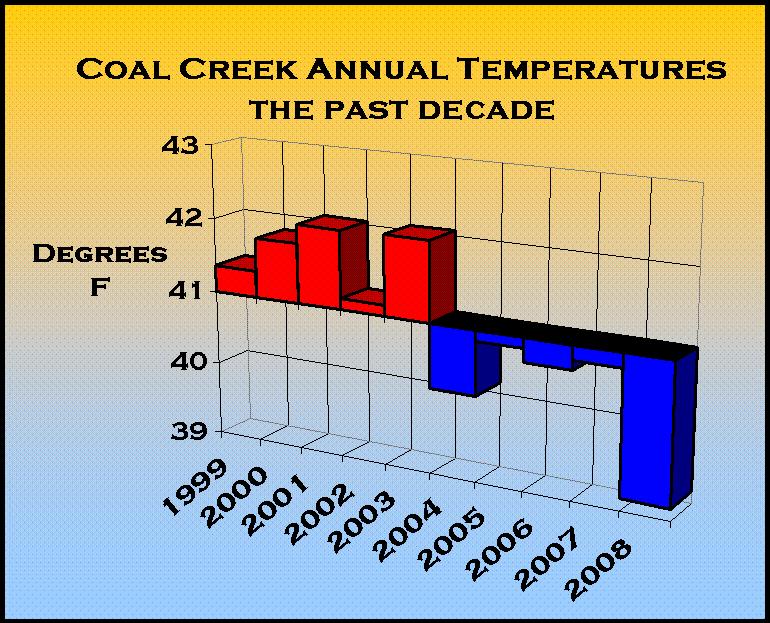
That’s full 3 degrees F colder than 2003. Each of the past five years is colder than any of the previous five years.
This is only one station of the thousands in the NOAA co-op network, but I thought I’d show you the data before it’s adjusted and homogenized by the usual suspects.
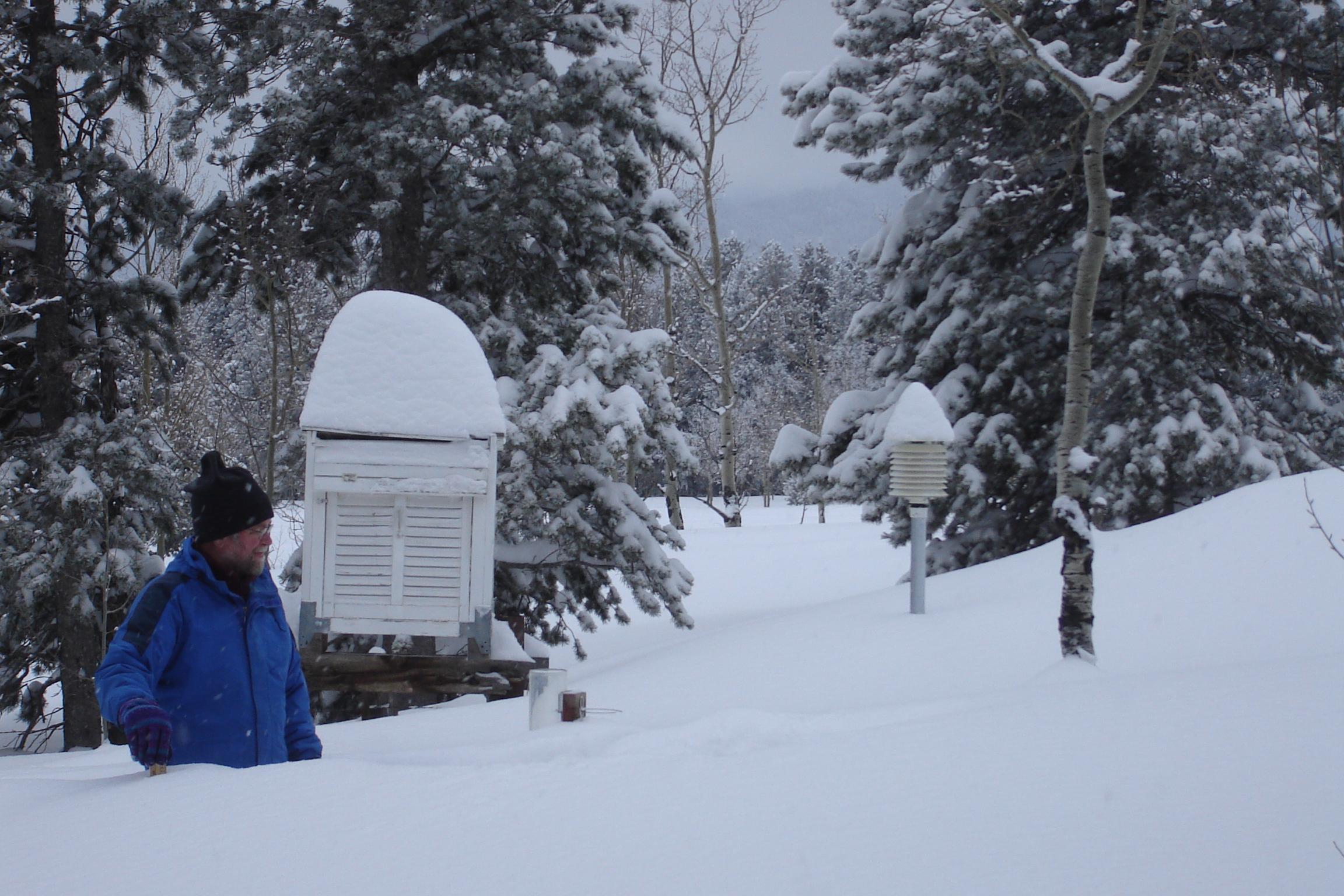
Here’s a photo of the station in January 2007, in the midst of a record round of snow storms in Colorado.

See larger photo here.
Discover more from Watts Up With That?
Subscribe to get the latest posts sent to your email.
btw – I meant to write “graph” not “graft” in the above comment….. but on second thought, maybe not.
Steve,
Coal Creek Canyon is in the mountains between Golden and Boulder.
Regarding ice growth, you must take into account where it already is stable, and where the soft edge is, ocean currents (warm and cold) in and out of the area, surface winds, and jet stream, as well as pressure gradients and air temperature. Ice growth is a function of all of this.
A couple of minor details about the shelter. It has an interior baffle below the roof, and the space between is ventilated, allowing it to approach exterior air temperature. So, the effect of the snow on top is greatly reduced. Also, the lower edge of the roof extends away from the sides enough to generally prevent melt from clinging to the louvers.
And a major detail. Anyone else priced one of those things? Nearly a $Grand with the legs and other accessories.
Patrick, thank you. Google Earth and Maps has a Coal Creek, Colorado SW of Florence, SSW of Denver. After delivering lumber from Walden to Kansas, and Denver to Cheyenne during the 70s, I thought I knew N. Colorado pretty well. Yet one of the best things about this great state is after 35 years of hiking, camping and fishing it; there is always somewhere new to explore.
With all the comments on record snow, here is one from California’s official water department. They measure snow in the Sierra mountains to predict how much water will be available after the spring melt.
“DWR Announces Snow Survey Results
The Department of Water Resources (DWR) first snow survey of the 2008/2009 winter season indicates snow water content is 76 percent of normal for the date, statewide. This time last year, snow water content was 60 percent of normal statewide. While this year’s water content is higher than last, winter storms arrived late. It is too early to tell whether improved figures will translate into a better water year than the state experienced last year, when winter storms ended early leading to California’s driest spring on record. (12/30/2008)”
The snow survey was from one location on December 30, 2008, near Lake Tahoe.
source: http://www.water.ca.gov/news/
Roger E. Sowell
Marina del Rey, California
Obviously Dr. Keen is not much of a scientist. We all now know that real scientists work with corrected data and not the stuff actually observed. Any high school chemistry student knows – you have to screw around with the data to get the result the teacher wants.
Dr. Keen – Did you pass high chemistry?
/sarcasm
Pat Henry is correct, Coal Creek Canyon is near Golden. The NCDC has been receiving month data from it since November, 1993. The observer sheets do not give an observer name but the data collected is very thorough. There is a Coal Creek town located south of Canon City with a population of around 200 people.
Interesting confirmation from other valid stations in proper locations. I wonder if this is truely a ‘cooling’ trend or a ‘normalizing’ trend. Granted, the planet is cooler than the mid evil warm period, but that was also abnormal. If we go back to ’50s to ’80s temps that would really be considered ‘normal’ ..
It’s as I’ve been saying all along. Some places have gotten warmer, some cooler, some remained the same. Nothing “global” is happening here. Taking the temperature at numerous points, taking a mean, and calling it a “global temperature” is meaningless.
Umm, it’s just “icicles”. “Icecicles” are something you get from the Ice Cream Man 😉
The hazards of global warming.
—————————————————–
12 deaths blamed on snow and cold across Europe
http://www.breitbart.com/article.php?id=D95IFM200&show_article=1
ak (05:31:09) :
@Anthony, i came here looking for good counterpoints to my own belief – that humans are affecting our environment, and one consequence of that will be warming of the earth. i believe that good arguments can be made.
First of all, everyone knows that humans affect our environment, so just put that ridiculous little strawman argument of yours away, and concentrate on your belief in AGW. This particular thread is about the evidence for cooling. Sure, it’s at one location, and over “only” a decade, but there have numerous reports here, and in the news about extreme cold and snow contraindicating the alarmist cries of global warming, such as this
Have you even bothered looking at some of the other posts? Look around, and you will see many posts which deal more directly with climate, and with AGW. Stick around, read some of the previous posts which might be of more interest, and ask questions. But, I suggest you put away the snarkiness and misplaced contempt you have shown so far. That will not get you very far here.
JUNEAU, Alaska – Ted Johnson planned on using a set of logs to a build a cabin in Alaska’s interior. Instead he’ll burn some of them to stay warm.
Extreme temperatures — in Johnson’s case about 60 below zero — call for extreme measures in a statewide cold snap so frigid that temperatures have grounded planes, disabled cars, frozen water pipes and even canceled several championship cross country ski races.
Alaskans are accustomed to subzero temperatures but the prolonged conditions have folks wondering what’s going on with winter less than a month old.
National Weather Service meteorologist Andy Brown said high pressure over much of central Alaska has been keeping other weather patterns from moving through. New conditions get pushed north or south while the affected area faces daily extremes.
“When it first started almost two weeks ago, it wasn’t anything abnormal,” Brown said. “About once or twice every year, we get a good cold snap. But, in this case, you can call this an extreme event. This is rare. It doesn’t happen every year.”
Temperatures sit well below zero in the state’s various regions, often without a wisp of wind pushing down the mercury further.
Johnson lives in Stevens Village, where residents have endured close to two weeks of temperatures pushing 60 below zero.
The cold has kept planes grounded, Johnson said. Food and fuel aren’t coming in and they’re starting to run low in the village, about 90 miles northwest of Fairbanks.
Johnson, whose home has no heater or running water, said he ventures outside only to get more logs for burning and to fetch water from a community facility. He’s been saving the wood to build a cabin as a second home, but that will have to wait a few years now because the heat takes precedence.
“I’ve never seen it this cold for this long,” he said. “I remember it 70 below one time, but not for a week and a half.”
In Anchorage, Alaska’s largest city, residents are used to lows of about 10-degree temperatures in January — not 19 below zero, which is what folks awoke to Wednesday morning.
Temperatures finally settled to about 10 below at midday, but that was cold enough to cancel races in the U.S. Cross Country Ski Championships.
Skiers won’t compete unless it’s warmer than 4 below zero, but the numbers have ranged between 10 below and 15 below.
That has led to four days of canceled or postponed competition with organizers hoping to get a set of races under way on Thursday, the event’s final day.
Meanwhile, in Juneau, the state’s capital is enjoying balmy weather by comparison with lows in the single digits.
A conundrum has been puzzling me lately. All these “surface stations”
are elevated, and so, are in fact measuring atmospheric temp.
If we really want to know what’s going on with the Earth, shouldn’t we
also be measuring the temp. in the surface? At, say, a depth of
2-1/2 to 3cm? Just a thought.
“weather” is a single day or maybe even a single season when maybe a stubborn weather system sets in and the result is an anomalously warm or cool season. The thing that is interesting here is that the temperatures are *annual averages* over a period of several years. Forget the picture of the snow for a moment and focus on the graph. The annual average temperatures for 5 years running have been cool. *That* is not weather.
A cool day or week or month will get swamped out in the averages. A cool year can be a blip among many and only causes a wiggle in a smoothed average over time. But when you have several years in the same direction end to end, that is what is called a trend and now we start to get into “climate” rather than “weather”.
The graph is significant because CO2 is “well mixed” in the atmosphere and “Global Warming” is supposed to be, well, global. The same CO2 that would cause overall warming in Omaha should also cause overall warming in Coal Creek. If the atmosphere itself is warmer, than the entire atmosphere should be warmer.
What we see here is yet another indication that there is no “global warming” and that the warming we saw in the 1990’s was temporary and probably a natural cyclical event.
Also, greenhouse warming should raise average temperatures by decreasing nighttime lows. CO2 would prevent heat from being radiated into space at night. It should have its greatest impact in winter when nights are longer than days. It would have still greater impact at higher latitudes where night is much greater than day in length. CO2 would not be expected to increase daytime high temperatures much because in addition to blocking IR from the Earth being radiated to space, it would also block IR from the sun reaching the surface. So turning your face to the sun on a sunny day would feel a little less warm. It would act to moderate the difference in temperatures and mostly increase the lows. Greenhouse warming should make record low temperatures more and more of a rarity. That isn’t happening.
Also, since the CO2 would absorb IR from both sun and Earth, the atmosphere that is absorbing all that heat should show a heat anomaly. It isn’t.
The bottom line is that observations are showing rather conclusively that Hansen’s hypothesis if human caused global warming due to increased CO2 from the burning of fossil fuels simply isn’t happening. There really is no additional argument needed. It simple isn’t there. His models show a system that does not reflect what is happening on Earth and no amount of argument or equations or adjustment can change the fact that the properties that would *have* to be true in order for the hypothesis to be true simply do not exist.
The hazards of global warming.
———————————————————
Global Warming Horror Flick Put on Ice
How embarrassing is it when you produce a horror movie based on global warming and when the time comes to release it, the planet is experiencing some of the coldest weather in decades? Such is the case with The Thaw starring Val Kilmer. Filmed in Canada last summer, it should be ready for release by now but even though the trailer has been produced, no specific release date has been announced. Perhaps the producers realize how much of a laughingstock this movie would become if a movie based on the premise of global warming were released when their potential audience is freezing.
The Thaw Trailer
That’s a horribly simplistic misunderstanding of how climate works.
the_Butcher (23:37:32) :
New Zealand is burning at the moment with temperatures of +40C +
According to the New Zealand Meteorological Service, the highest forecast high for today is 29C in Christchurch. I’m going to pass on the opportunity to be snarky. You are the second person (that I’ve noticed) in as many days to fabricate abnormally high temperatures (yesterday’s fabricator hailed from Sydney). This is dumb: it’s boringly easy to locate an accurate source of weather information and expose the fabrication. I won’t infer any motive on your part, but you should be aware that you completely discredit yourself as a contributor to the discussion.
Nelthon, true, it is overly simplistic but over a period of several years it has to be true. It would be impossible for the entire atmosphere to trap heat and, over a period of many years, a place not become warmer.
Sure, a place can be cooler for a day or a season or even a single year. But overall global atmospheric warming *must* show overall global atmospheric warming … else it isn’t overall global atmospheric warming.
Now what *is* happening are a lot of local areas of warming due to land use changes, irrigation, cultivation, urbanization, deforestation, etc. And that can cause misleading results. If I have 10 stations scattered around a given area and all 10 of them are near areas of growing urban development, I can create what looks like “global” warming when in reality I have 10 spots of local warming.
NOAA did the same thing when they dropped literally thousands of rural stations from the monthly averages (stations where daily data is still available). What was left were a greater proportion of urban stations and (surprise!) temperatures shot upwards at the same time the rural stations were dropped.
But overall, if the entire atmosphere is warmer, there would be no escaping rising temperatures over the long trend. One might get a cool year, but one should never see a generally cooling trend lasting several years and particularly so the farther one gets from the equator.
Nelthon (09:30:47) :
The graph is significant because CO2 is “well mixed” in the atmosphere and “Global Warming” is supposed to be, well, global.
That’s a horribly simplistic misunderstanding of how climate works.
True….
Almost as simple as “CO2 is causing Global Warming!”…which we all hear on a frequent basis….
I think most of us understand the points that crosspatch is making…if he is keeping it simple, it is so a poor ole biologist can follow the conversation…cdl
Nelthon
“That’s a horribly simplistic misunderstanding of how climate works.”
Want to try to give us an explanation of how climate works that isn’t just as bad or worse? How would you describe the entire idea that CO2 causes warming?
I am not saying the original post was not over simplified, I am pointing out the old pot calling the kettle…
Nelthon (09:30:47) :
The graph is significant because CO2 is “well mixed” in the atmosphere and “Global Warming” is supposed to be, well, global.
That’s a horribly simplistic misunderstanding of how climate works.
Well, that is the crux of their argument isn’t it? CO2 (especially the nasty, dirty man-made variety) is well mixed in the atmosphere and causes global warming, yet here is a location in our atmosphere that has (presumably) well mixed CO2 and yet global warming is not present, in fact it is clearly cooling at this location, despite the rise in CO2. How does the conventional AGW theory explain away this Nelthon?
NOAA: 2008 Temperature for U.S. Near Average, was Coldest Since 1997; Below Average for December
http://www.noaanews.noaa.gov/stories2009/20090108_decemberstats.html