From the UCLA Newsroom: Pacific Ocean’s response to greenhouse gases could extend California drought for centuries
Warming forces have caused millennia of dryness in California’s prehistory, and greenhouses gases could do the same
Clues from prehistoric droughts and arid periods in California show that today’s increasing greenhouse gas levels could lock the state into drought for centuries, according to a study led by UCLA professor Glen MacDonald.
The study, published today in the Nature.com journal Scientific Reports, looked at how natural climatic forces contributed to centuries-long and even millennia-long periods of dryness in California during the past 10,000 years. These phenomena — sun spots, a slightly different earth orbit, a decrease in volcanic activity — intermittently warmed the region through a process called radiative forcing, and recently have been joined by a new force: greenhouse gases.
As long as warming forces like greenhouse gases are present, the resulting radiative forcing can extend drought-like conditions more or less indefinitely, said MacDonald, a distinguished professor of geography and of ecology and evolutionary biology.
“Radiative forcing in the past appears to have had catastrophic effects in extending droughts,” said MacDonald, an international authority on drought and climate change. “When you have arid periods that persist for 60 years, as we did in the 12th century, or for millennia, as we did from 6,000 to 1,000 B.C., that’s not really a ‘drought.’ That aridity is the new normal.”
Researchers tracked California’s historic and prehistoric climate and water conditions by taking a sediment core in the Sierra Nevada mountains. They pulled a 2-inch-wide, 10-foot-deep cylinder of sediment from the bottom of Kirman Lake and analyzed it in third-of-an-inch sections, creating the most detailed and continuous paleoenvironmental record of California.
The team correlated their findings with other studies of California climate history, and for the first time, united all the studies and cross-referenced them with histories of the Pacific Ocean’s temperature taken from marine sediment cores and other sources.
What they found was not only that periods of increased radiative forcing could produce drought-like conditions that extended indefinitely, but that these conditions were closely tied to prolonged changes in Pacific Ocean surface temperatures.
Changes in ocean temperatures are linked to El Niño and La Niña conditions, which increase and decrease precipitation in California. Until now, no one had the long, detailed record of California’s dry periods needed to show that that aridity went hand-in-hand with changes in the prehistoric climate records of the Pacific Ocean, MacDonald said.
“Climate models today have a challenging time predicting what will happen with Pacific sea-surface temperatures in the face of climate change, and we hope that our research can improve that,” he added.
The researchers chose Kirman Lake in central-eastern California for its sensitivity to climate changes and its stable geologic history. Today, it’s a small, freshwater lake full of trout and about 16 feet deep, with a small marsh at one edge.
The team found evidence though that through the millennia Kirman Lake has grown more and less salty, dried until it was exclusively marshland and refilled again. All the while, sediment accumulated on the lake’s bottom, forming a record of lake conditions, the changing climate and the surrounding environment.
The research team spent years analyzing the core sample, which revealed California’s history layer by layer:
- charcoal deposits indicate when wildfires were more prevalent.
- layers of fossilized pollen shows eras of more pine trees or drier sagebrush.
- shells from mollusks indicate times of deeper water.
- single-celled algae and molecules of carbon and nitrogen give clues to the lake’s depth and salinity, and the abundance or waning of plant and animal life.
From 6,000 to 1,000 B.C., during a time geologists refer to as the mid-Holocene, the core sample captures a 5,000-year dry period in California that has been seen in less detail through other paleoenvironmental records. This arid period is linked to a slight variation in Earth’s orbit that increased the amount of solar energy received by the Northern Hemisphere in the summer months. California was warm and dry, while marine sediment records show the Pacific was in a La Niña-like state, likely reducing precipitation.
A similar dry period was seen from about 950 to 1250 B.C., a time known as the medieval climate anomaly. Increased radiative forcing and warming at this time is connected to decreased volcanic activity and increased sunspots. Again, La Niña appears to have reigned in the Pacific Ocean.
“We suspected we would see the millennia of aridity during the mid-Holocene at Kirman Lake, but we were surprised to see a very clear record of the medieval climate anomaly as well,” MacDonald said. “It was very cool to see the lake was sensitive on the scale of not just thousands of years, but also something that lasted just a few centuries.”
Even more exciting to the researchers was a brief shift in the record toward moister conditions around 2,200 B.C. In the middle of thousands of years of mid-Holocene dryness, Kirman Lake suddenly became moister again, MacDonald said, while simultaneously the Pacific Ocean record switched to more El Niño-like conditions.
“This change at 2,200 B.C. was a global phenomenon,” MacDonald said. “It’s associated with the collapse of the Old Kingdom in Egypt. It’s linked to the decline of the Akkadian Empire in Mesopotamia and similar Bronze Age societal disruptions in India and China. It was amazing to find evidence of it in our own backyard.”
That blip in the record was a reminder that El Niño and La Niña weather patterns have global repercussions. It also confirmed the accuracy and sensitivity of Kirman Lake’s record, and the strong link between the ocean and California’s weather.
All this has consequences for California, the researchers said. Drought-like conditions can last indefinitely as long as increased warming, or radiative forcing, is present. And greenhouse gases are currently expected to increase.
“In a century or so, we might see a retreat of forest lands, and an expansion of sagebrush, grasslands and deserts,” MacDonald said. “We would expect temperatures to get higher, and rainfall and snowfall would decrease. Fire activity could increase, and lakes would get shallower, with some becoming marshy or drying up.”
California might remain an agricultural state, thanks to irrigation and engineering, though productivity might decrease and crops might change, said MacDonald, who emphasized that while the past is no guarantee of the future, in this case it does provide cause for concern.
“I think we would find a way to keep our cities going through prolonged drought, but we’re not going to engineer a way to conserve or preserve the ecosystems of the state,” MacDonald said. “We can’t save our huge expanses of oak woodlands, or our pine and fir forests, or high-elevation alpine ecosystems with irrigation projects like we might our orchards and gardens. I worry that we will see very different wildlands by the end of this century.”
###
The study:
Prolonged California aridity linked to climate warming and Pacific sea surface temperature
Glen M. MacDonald, Katrina A. Moser, Amy M. Bloom, Aaron P. Potito, David F. Porinchu, James R. Holmquist, Julia Hughes & Konstantine V. Kremenetski
Scientific Reports 6, Article number: 33325 (2016) doi:10.1038/srep33325
Abstract:
California has experienced a dry 21st century capped by severe drought from 2012 through 2015 prompting questions about hydroclimatic sensitivity to anthropogenic climate change and implications for the future. We address these questions using a Holocene lake sediment record of hydrologic change from the Sierra Nevada Mountains coupled with marine sediment records from the Pacific. These data provide evidence of a persistent relationship between past climate warming, Pacific sea surface temperature (SST) shifts and centennial to millennial episodes of California aridity. The link is most evident during the thermal-maximum of the mid-Holocene (~8 to 3 ka; ka = 1,000 calendar years before present) and during the Medieval Climate Anomaly (MCA) (~1 ka to 0.7 ka). In both cases, climate warming corresponded with cooling of the eastern tropical Pacific despite differences in the factors producing increased radiative forcing. The magnitude of prolonged eastern Pacific cooling was modest, similar to observed La Niña excursions of 1o to 2 °C. Given differences with current radiative forcing it remains uncertain if the Pacific will react in a similar manner in the 21st century, but should it follow apparent past behavior more intense and prolonged aridity in California would result.
The full paper is here, and is open access: http://www.nature.com/articles/srep33325
Certainly, California has experienced megadroughts before. During the most recent one, we covered a study that showed they were quite common:

Source: Cook et al, 2007 and L.A. Times. https://wattsupwiththat.files.wordpress.com/2014/08/nadrought.pdf
But the most important statement in their study is this one:
Given differences with current radiative forcing it remains uncertain if the Pacific will react in a similar manner in the 21st century…
That’s very true, we just don’t know. Some people claim we’ll see more precipitation and we’ll be in a more El Niño like state rather than La Niña. Just a few months ago we heard this in a story we covered:
Global warming will increase rainfall in some of the world’s driest areas over land, with not only the wet getting wetter but the dry getting wetter as well.
Only Nature knows for sure, and I’m not talking about the journal.
Discover more from Watts Up With That?
Subscribe to get the latest posts sent to your email.
On one hand, they’ve been telling us that global warming is changing everything.
On the other hand they point out that during warm periods in the past, CA saw drought so if it warms up CA is going to see drought again.
So, which is it. CO2 is different from previous warmings, or it’s the same as previous warmings?
MarkW — You are absolutely correct. The authors are trying from the air that warming is taking place with CO2 and so warming affecting rainfall. Under drought condition temperature increases — at all India level in 2002 and 2009 the southwest monsoon rainfall was 0.81 and 0.73% of average and the temperature rose by 0.7 & o.9 oC.
Dr. S. Jeevananda Reddy
Dr. McDonald misspoke: ““When you have arid periods that persist for 60 years, as we did in the 12th century, or for millennia, as we did from 6,000 to 1,000 B.C., that’s not really a ‘drought.’ That aridity is the new normal.”
He meant to say, “Today’s aridity means we are returning to the pre-manmade OLD normal climate.”
Are they trying to obfuscate (i.e., hide) the Medieval Warm Period by referring to it as an anomaly? Those of us who know our history won’t be fooled.
So what is THEIR definition of THEIR “Radiative Forcing” ??
Why don’t Climate worriers use regular terminology of the physical sciences ?
What is the SI definition of “Radiative forcing”, and how is its standard unit defined, and maintained ?
g
So megadroughts are quite common.
So we knew that already. California is a desert. There’s a place called “Death Valley” that hasn’t had a whole lot of rain in a coon’s age. All of it not caused by GHGs.
G
Overall, CA is semi-arid but technically not a desert, although it contains areas of true desert. Average rainfall in Los Angeles is about 15 inches, vs. the ten inches usually defining a desert. But for the past five years, rainfall has indeed been below ten inches at the LA Civic Center:
http://www.laalmanac.com/weather/we13.htm
Annual average for San Francisco is about 24 inches, but for the past 30 years, it has been less than 21 inches.
The state average precipitation is almost 25 inches, much of it falling as snow. The north is rainy.
Of course, during the drought centuries, deserts expand.
But during wet centuries, the Central Valley contains lakes that are now dry beds.
Average for wetter conditions, less rain when dryer…
It’s normal for California to have dry periods. Even a sixty year period of dry conditions is not unusual.
Californians need to accomplish more with less water, or buy some almost used fresh water generating facilities from Australia.
If it has cactus, it’s a desert. Probably tumble weeds too.
g
I presume that tumble weeds are designed to pull out of the crappy soil, and bowl along in the wind, until the roll into some water non desert area where they can deposit their seeds, and try again.
Funny. I always thought that areas with higher concentrations of greenhouse gases – like WATER vapor – tended to be more lush – humid even. Some might even say ‘tropical’.
Heck, I find if I exhale toxic C02 on a mirror it fogs up with… moisture, I guess you’d call it.
But there I go, believing my lying eyes.
You also exhale water vapor. It’s the water vapor condensing,not CO2 that fogs up your mirror.
Yes, I know – the primary greenhouse gas.
No one has a clue what caused the MWP. It was something ‘natural’. Ditto the LIA. And no one has a real observational clue whether the warming from 1975 to 2000 was mostly GHE or mostly natural, because it is essentially indistinguishable from the 1920-1945 warming that could not have been mostly GHE. Natural variation has not magically sropped. The present 4 year drought is taking place during a period when it wasn’t warming unless surface records are fiddled, except for the now rapidly cooling 2015 ElNino spike which also brought much needed precipitation. And, the first pictured medieval megadrought occurred during the cold Dark Ages, the second during the MWP. So much for the general drought/warming thesis of this paper.
Good points. If I am not mistaken, much if not most of California would geographically be classified as a desert. To say GHGs would lead to mega droughts in California is akin to saying the same about Central Libya. And my reaction is: So what?
Three desert areas cover much of southern CA, including the Mojave, but they don’t add up to most of the state. However, as mentioned above, based upon the past five years, even LA would rate as a desert.
Central CA has a Mediterranean climate, ie semi-arid, while the north is Western Marine, like western Oregon, ie wet.
So actually, it seems to me that the last couple of centuries have experienced unusually wet conditions brought on by climate change, which science tells us is always bad. Such a relief then, to the wise and progressive leaders of the state to learn that the horrible damp of the modern period will soon give way to the more normal condition of pleasant, reliable aridity that prevailed before the industrial era.
The Lord giveth and the Lord don’teth!
North California is wetter only near the coast.
The eastern part of the state is desert; right up to Oregon and Nevada’s desert regions.
There are large areas of California that easily achieve an arid condition. Cacti, succulents and other desert plants love growing throughout.
Portraying California as anything less than arid is incorrect, with the exceptions of a very narrow temperate zone along portions of the coast.
Quibbling about a few inches of rain before classifying California as desert is disingenuous. California is arid, and if not clearly desert, it is borderline desert.
The part of the state where most of the State’s people, and nearly all of the State’s influential people live, is mostly a desert.
They have built millions of houses in places where no sane person would build a house.
At least the pioneers had the good sense to try their luck in some place with a stream or river running through it.
The part of California that is not a drought normal desert, also has almost no people living there, and certainly no people who have any political influence over what they are told to do. There also are a couple of prominent places where mostly fringe people create their mayhem.
G
IMO, the LIA was mainly caused by three or four solar minima in rapid succession, the Wolf, Spörer, Maunder and Dalton. Its depths occurred during the mighty Maunder. The Wolf could be assigned either to the Medieval WP as a counter-trend cycle or mark the onset of the LIA, as it was followed by a warm cycle that neared the prior, long MWP peak. Like the following minima of the LIA, the Wolf brought famine, war and plague.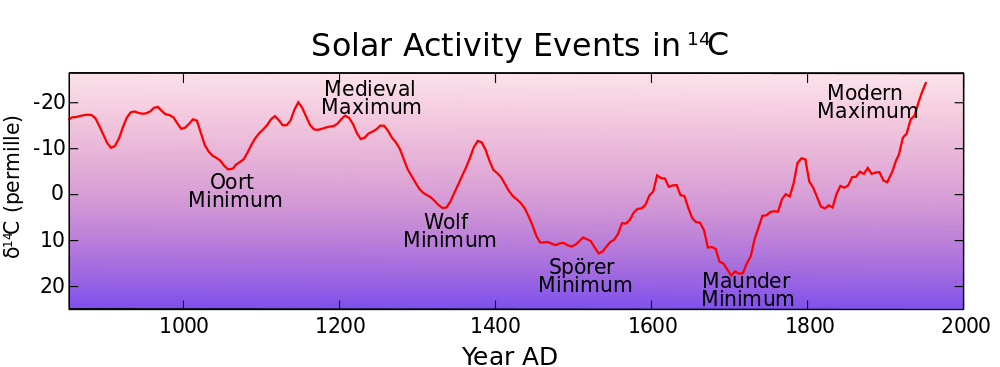
G, dunno. I find all the solar/sunspot stuff unconvincing because there are no testable causal linkages, and mere correlation is not causation. Might be true but personally suspect not. Do know that Svensmark’s new paper most definitely did not advance the solar cause. See comments on it in previous thread here. Bad stats, plus Forbush events are transient. And Zarkova’s weird magnetic dynamo stuff does not even hindcast correctly, so forget about her forecasts.
R,
IMO GCR modulation by magnetic flux isn’t needed as a mechanism. Decades of lower than average solar radiation can IMO account for the observed climatic cycles. TSI and its spectral composition don’t need to change much to have cumulative effects on climate.
The Maunder climatic catastrophe was followed by the early 18th century warming, which was greater in magnitude and duration than the late 20th century warming. In its case and the other up and down cycles in the above graph, correlation with solar activity and causation seem obvious.
Before that, climate deteriorated globally from the balmy MWP conditions as the Wolf Minimum kicked in, as shown both by historical records and paleoclimatic data. Ditto the Dalton at the turn of the 18th/19th centuries.
Ristavan, neither do climate models, they are tuned to hindcast
Not that GISS let that stop them, they made changes to 1880s temps this year, because models said so
I would like to mention that the article said, “…950 to 1250 B.C., a time known as the medieval…”. That would be AD, not BC: It accounts for the time when Greenland was settled by the Norse from Iceland and primitive agriculture was able to be successful there.
ristvan
+1 X 100
What? I thought Michael Mann and his acolytes had demonstrated that the Medieval Warm and Little Ice Age were limited to Northern Europe. Obviously, the Pacific samples must be in error as they violate received TRUTH/sarc
The new California sediment core only violates treemometer ‘truth’. They just need to throw in one Yamal larch and a couple of stripbark bristlecones and all will be well…. (No need for sarc).
Translation:
– Climate models demonstrate no skill at predicting what will happen to SST’s in the Earth’s largest ocean assuming climate changes are due to anthropogenic CO2. Our paleoresearch will likely inform us little since paleoclimatists assume pCO2 held steady during the Holocene until man began burning large amounts of fossil fuel 100 years ago. But send money, and we’ll research it anyway.
Random quote: “The experiment’s outcome was not too surprising, because prior simulations had predicted it. But the researchers wanted the scientific community to have physical proof that feels trustier than proof from a computer. “It’s a computer algorithm. It will do what you will tell it to do,” Gaucher said.”
“A similar dry period was seen from about 950 to 1250 B.C., a time known as the medieval climate anomaly.”
Should this be AD 950 to 1250, ie during the Medieval Warm Period?
…How sad, they can even do enough real research to get the dates right !
BC, AD. After all, what to expect from a UCLA press release? Surely not competence or truth.
Close enough for government work!
What’s a couple of thousand years between bureaucrats?
They moved the medieval times 2000 years back! A new adjustment!
Am I ignorant but note how it is not medieval warm period, but climate anomaly. There was no medieval warm period, but when climate folks need to talk about it, it will be called an anomaly.
I love the way they make messages!
And note the use of “climate anomaly” rather than warm period, because identifying a pre-industrial warm period is just too painful.
+1 Should have read this before writing.
Usually we see dates B.C. diminishing toward the present, e.g., 1250 to 950 B.C.; obviously, the author meant A.D. (Thank God he didn’t use a barbarism such as B.C.E.) A.D. still means Anno Domini, In The Year of Our Lord.
Less than 10 years ago, NONE of the models cited by the IPCC predicted decreased precipitation in California with increasing CO2. Most predicted increased precipitation, with some predicting 100 – 150% increases over the long term.
You mean to say that the IPCC models have as much skill with precipitation as with temperature? I am shocked, shocked. Anyone have this on a graph?
The title is speculative. Should be emphatic regarding what is actually known: Greenhouse gases not guaranteed to extend California drought.
So a single two inch diameter pinpoint area of California can be extrapolated out to determine climate conditions across the whole state? I’m not buying it.
If you live in Cali, your money is indeed, “buying it”!
What do our stats majors say about one borehole in one lake being a representative sample?
would have been better to give a questionnaire to the trout
Actually it’s called the Nyquist Sampling theorem.
And I doubt that Stats Majors would know anything at all about it.
G
Scientists find link to drought…and sanctuary cites
…film at 11
Our experts told us the same thing here in Australia. We built 5 desalination plants at 25 Billion a piece to fix it. Unfortunately they are all under water now.
Did they all get bonuses like the U.S. administrative examples of this kind of this “expertise”?
???? Financially or literally under water? I doubt there’s been enough sea level rise for them to literally be under water.
Better start preparing for the flooding now. Just take it from the carbon tax fund.
What I get out of this is: Things have been worse in the past, during time periods when humans could not have any appreciable effect on climate, than they currently are today. (This assumes we are having some appreciable effect today.)
Sounds to me like the so called climate scientists need to figure out the bounds of natural climate variation and the causes of natural climate variation before they start screaming it’s all man’s fault. Unfortunately, that sounds like it would require some real science to be done and that’s just kind’a boring…Plus it doesn’t bring in gobs of money.
Its real hard to mitigate natural variation with renewables. So not worth studying.
Huh, ya don’t say…Go figure. 🙂
In Australia faced with equivalent circumstances we found a solution to preventing normal climate variation turning into devasting century long droughts. We built at huge cost to taxpayers desalination plants to service all major cities. In the ten or so years since ,water storage levels in the existing dams have never been higher with higher than average rainfall in all years since. Much more effective than any rain dance or climate model and the effect was almost immediate. So what if a few desalination plants remain dormant at great ongoing expense , it saved Australia from a far worse fate.
DS, Hawaiians sacrificed virgins to volcanoes to appease Pele. Aussies sacrificed dollars to bureaucrats to appease Warmunists. Sort of the same, IMO. At least your sacrifice ‘worked’ to bring rain. Perhaps your dollars are dearer than virgins? It surely cannot be that Warmunists are more powerful than Pele in peoples minds down under. Oh, wait a minute…
Hello DavidS,
Bang On.
Our Victorian Dam levels (with a ludicrously low capacity due to green Influence preventing a new dam thru the 90s and onward) went down to about the mid 30s level due to a drought that started in 2005. So The Water Board and its sustainability clowns panicked and convinced an idiotic Labour Govt to spend about 4 Billion initially to set up this massive desal plant.
The final cost, over about 30 years. is expected to be about 22 billion Aussie dollars (75% US)
As soon as it was ready to go it was’mothballed as our 2005 to 2010 drought broke and we went to nearly 80% dam full. That is about 4 years of storage which should be double that given our expected population rise in the next decades. But try getting The Greens to accept that new Dams are essential.
Every day that the desal plant is mothballed it requires maintenance to keep it ready to switch on that costs 1.8 million per day.
We have, as usual, experienced a couple of years of lower than usual rainfall and our storage went down to 57/58% so the genius of a State Labour government made an order in March 2016 for 50 Gigalitres which will be delivered this summer. December, The Cost is 50 million Dollars.
Since the March order it has pretty much rained Cats and Dogs and we are currently in Spring, typical rainy time, and our dam levels are approaching 70%.
Brisbane and Sydney also have these Desal Scams and both of them are also mothballed as Brisbane,virtually a subtropical climate that can get torrential downpours and Sydney which also gets massive East Coast Lows and deluges have an 81% and a 95% storage rating and a big storage capacity.
Today is dry for once which is a relief to those in the North and Western district of the Victorian State as they were close to being, once again ,flooded when the rains returned,
So instead of using these funds to mitigate these North and Western district townships, and other parts of the State, from typical and expected heavy rain periods we spend Billions on these ridiculous Sustainability Toys.
Further details from The Australian ‘Billions in desalination costs for not a drop of water’ Oct 18 2014.
‘ABC News Victorian weather: Hamilton flood threat subsides but warnings in place across state. Wednesday.'(This shows basic examples of the impact of the heavy rain)
Note these are not your dire floods that wash away towns but a typical happening to a lot of rain in Victoria, Australia. But our political wonder stooges choose to showboat and splurge massive sums of money on their pathetic toys when simple mitigation would go a long way to fixing these flood issues.
Aussie readers will know what I mean when I say that we have all been Tim Flanneried. Again.
International readers might like to check out ‘Climateer Tim Flannery sacked in Oz’
Anthony Watts / September 18, 2013. particularly the post of Rick Bradford at 11.50
I have heard that Mark Steyn is filling in on Friday September 16. I think there are people here who may like to know that. Up to mod.
…Ummmmm, filling in what ?
Rush Limbaugh
GHG idea is nonsense details in devbahadurdongol.blogspot.com
Sorry to say but the crackpot index is pretty high on that site.
More Katherine hayhoe-esque permanent drought. Someone got a new model and it’s not Christmas yet
Poor Katherine. Her earnest permanent drought predictions already flooded out. Her God is apparently not just to the faux righteous. He and Ma Nature both seem especially angry with those who also worship warmunism, as she does.
lol.
You can be wrong, that’s cool, but her reaction when you mention it, Instablock.
The woman is unhinged
Have you seen her talks and youtube vids, the woman is a pseudo scientist
And she calls herself a fundamentalist Christian — and she has no problem “bearing false witness.”
GHG idea is stupidity GHE due to gases is impossible Gases can not make a green house Details in devbahadurdongol.blogspot.com
Go away and learn some basic science and semantics. In one trivial sense your comment is literally true, yet in another completely and profoundly false. Literal Greenhouses work by inhibiting convective cooling. The atmospheric GHE works by inhibiting radiative cooling. So, literally, the GHE is not a ‘true’ greenhouse effect. Semantic quibble. Both effects work by inhibiting cooling, so your position is just profound basic nonsense. All well established by laboratory experiment. Now how strong the GHE is given feedbacks is an entirely different question from whether it exists.
Nonsense visit my blog for learning GH idea and GHE
Things are looking mighty toasty in China-Mongolia under that Greenhouse LDPE layer!!
LDPE is mostly carbon, so the carbon demon raises its head and meows.
Now, I’ve seen it all. From indrdev’s blog….apparently his version of the atmospheric layer.
http://3.bp.blogspot.com/-6YSOIOt4gGo/Vbb21VOLB_I/AAAAAAAAAIM/BGn4ur1YUWc/s1600/half%2Bsunny%2B%25283%2529b.jpg
Mr. Watts, you can’t have seen it all, nobody can. You’ve just managed to see enough to no longer be surprised when a new manner of stupidity shows up. 🙂
I can see my house from here! Lol!
What ! Anthony.
You are back on your feet already, so soon after falling on your A*** and throwing up over that unintelligible total bull shit on that web site.
I’m probably going to need the rest of this week just to stop laughing, at the thought that there still exist some people that are so totally ignorant of just plain common sense ideas, even at just the 4-H Club level.
And I think I only read the first three lines.
If there is one wisdom I have learned from WUWT, it is to NEVER go and visit ANY website that some poster on WUWT tells you to “go and visit my website.”
I’m pretty sure I am now cured; or will be after I clean up the mess from my past half digested breakfast.
G
[?? .mod]
Claim: ‘greenhouse gases could cause arachibutyrophobia’
GHG is nonsense
See reply above. No, you are nonsense. Stop giving informed skeptics a bad rep via your stupid silliness. Or was that your intent as a false flag troll? Either way, just go away.
Visit devbahadurdongol.blogspot.com for details on GH and GHE then you would know who is stupid
visit devbahadurdongol.blogspot.com for science on GH and GHE
nope, a true believer, but I agree that CO2 is NOT pollution
thinks we can be a water-powered only world
Flannery tried to pull that permanent drought stuff here, in Australia. In return, they made him the giant flop = Australian of the year. Gave him awards and an $180,000 a year job for 2 days a week.
Then the rain started and the dams filled and they have stayed full for a decade.
Might add, he introduced desalination plants to each state. Plants that have never produced a drop of water but punch out something like $800,000 a day for the owners.
Don’t know about you but that smells like, walks like and quacks like a scam. To the pedants, scams make a noise like a duck.
Any comment on this?
November 13, 2007 – NASA Sees Arctic Ocean Circulation Do an About-Face
Here: http://www.jpl.nasa.gov/news/news.php?release=2007-131