
Guest essay by Eric Worrall
Associate Professor in Organic Chemistry Maurie Trewhella, of Victoria University (Australia), has just made a stunning claim about global warming, in a letter to the editor.
According to Trewhella;
Ian Dunlop’s warning (Comment, 7/4) is especially sobering. The slowing of atmospheric temperature rise over the past 15 years or so, used by climate change sceptics to debunk the work of the IPCC, is, on the contrary, evidence that the solar energy delivered to the Earth is being absorbed by the oceans. The Arctic and Antarctic ice sheets are acting as giant dampers to contain temperature rise in the oceans. When both of these ice sheets melt away in the next decade or so, the rise in both ocean and atmospheric temperatures will accelerate rapidly and demonstrate that the passing of the tipping points that Dunlop expresses concern about has, indeed, occurred. …
I’m not certain which article by Ian Dunlop Professor Trewhella was responding to, but this article, full of alarmist claims about tipping points and the “dangers” of economic growth, seems fairly typical of Dunlop’s writing.
Professor Trewhella is a person of substance within Australian academia. The press release Ephedrine’s green dream details advanced work being performed by Associate Professor Trewhella and colleagues on yeast, to economically produce important medicines (interestingly their innovation, in this case, involved large quantities of CO2).
To obtain a Chemistry qualification in Australia, you have to study Thermodynamics at an advanced level. Part of being a qualified Chemist in Australia, is knowing how much heat it takes to melt a block of ice.
Does Professor Trewhella really believe that the Antarctic and Arctic ice sheets will “melt away in the next decade”? I hope not. But whatever led to this letter being published, it seems careless to say the least, for the reputation of a man of science, to be associated with such a ridiculous claim.
For that to be true, this graph has to start to show a positive second derivative.
http://sealevel.colorado.edu/
It must be worse then we thought, the Antarctic graph has just shown another uptick. It will now start melting faster.
For that Colorado graph to be true, it has also to show a positive first derivative. This requires that (a) the splices between three datasets be valid (and not just done in order to keep a straight line going through all three) (b) the adjustments to the slopes of the graph are valid. The adjustments are predicated on a sufficiently accurate knowledge of the confounding factors in the measurement, such as but no limited to, the rate of change of optical path length caused by variation in water vapour along the measurement path. I don’t see the same three millimetres per year in the Envisat data, but I doubt if they used the same model for adjustments to the raw data. http://i39.tinypic.com/243pvv7.jpg
Yes, that, and a equally positive 3rd, 4’th, 5’th, ….. and so on
Or even a positive 3rd derivative which is called jerk. A very appropriate term in the field of CAGW.
Right, satellites can accurately measure a dynamic surface through dynamic optical conditions within a tenth of a mm but when it comes to estimating an average temperature for the entire lower atmosphere we’d better stick to a few ground based measurements. What a joke.
I wonder if there is a “land level” satellite data collection?
Let me be more specific. When temperature rises, there are two obvious ways this raises sea level – sea water expansion and ice melting. But these two have different functional relationships to increasing temperature.
As temp rises, the ocean expands (all else being equal …). Thus, the first derivative of sea level and the first derivative of temperature should be related.
Also, as temp rises, the rate of ice melting rises (all else …) Thus, the first derivative of the rate of ice melting and the first derivative of temp should be related. But the rate of ice melting relates to the first derivative of sea level. Thus, the second derivative of sea level and the first derivative of temperature should be related.
Of course, there are plenty of compounding influences. But if sea level rise was primarily driven by the increasing rate of melt from increasing temp, the colorado.edu graph would be parabolic. It’s apparent lack of ANY parabolic component is strong evidence that ice melting is not contributing AT ALL to the rise in sea level. It’s all expansion.
All those predicted tipping points are now long overdue and the whole tipping point alarmism is turning into an epic fail. The sea level data is the most solid evidence against CAGW alarmism.
Then there is Stefan Rahmstorf, who found that the first derivative of the sea level was INVERSELY related to the first derivative of the temperature. But don’t worry: he was still able to extract scary disaster from this bogus relationship. See…
https://climatesanity.wordpress.com/2010/03/21/rahmstorf-2009-off-the-mark-again-part-1/
I think earth will definitely leave this interglacial within the next week or 10,000 years or so.
LOL nice one
Initially I misread the title as “meet” not “melt”. I thought it was ridiculous, as the global cooling that some predict would surely not act that fast. Corrected, it seems even less plausible.
give or take a millenium or two.
“give or take a millenium or two.”… a millenium isn’t needed. Just long enough to collect a few more research grants.
Halt !! They all forget the GOD factor, he has almost finished his trip around the universe and its earths turn for miracles !,
I salute you sir.
Precisely!
Just flew over Greenland and the Canadian Arctic. It’s frozen good and solid from Scandinavia to northern Lake Michigan. Even the ocean between Greenland and Canada is covered in solid ice pack. Looks like an ice age.
Except in an Ice Age, the ice would be a mile closer to your plane.
BS baffles brains. Another academic trashes their reputation. Very sad to see.
Reputation with whom? Seeing that the UK’s Royal Society has quite thoroughly joined the dark side. And that the general population are not perturbed by an image of a Polar Bear alongside a news article discussing the Antartic (and yes I have personally seen that).
So, if a society is converted to alarmism, then such claims are the route to reputation.
Just look at Lewandowsky. His career is heading for the stratosphere, as far as I can see.
And all that money can’t hurt.
“an image of a Polar Bear alongside a news article discussing the Antarctic ” The first climate change refugees?
The professor is an organic chemist, working in a government organisation, whose claim to fame is that he helped invent a new way of making cough investment.
A good candidate for Cook’s “97% of all climate scientists”……………………..
Meanwhile, back on planet earth…
Not sad at all, simply another academic baying with the ranks of the absurd. The only “sad” part of this is that people let these fellows teach their children.
The sad part is that society lets these people teach YOUR children.
Oh good, another prediction we can [laugh] at in 10 or so years.
Sorry, “laugh”, stupid auto correct got me again!
We’re laughing at it now.
Unfortunately, there are a lot of professors who are so full of their own intelligence that they just have to share their stupendous wisdom with others, and in the process show their blinding ignorance to anyone not already blind.
Amen to that!!
Interpretation: head where the sun does not shine…
There are also untold numbers of politicians who fall in this category. Especially here in California!
I’ve seen this referred to as “Disabled by education”
I’ve heard “Educated beyond their intelligence.”
“Strange as it seems, no amount of learning can cure stupidity, and higher education positively fortifies it.”
Stephen Vizinczey, An Innocent Millionaire
Or as Boilleau put it back in the 17th ceantury:
“Education can make an unlearned man learned, but not a stupid man wise”
One more academic who hasn’t yet learned the scientific method
Victoria University is a bit of a new-kid-on-the-block uni. Surely, their academics would be especially cautious about making rash statements that will undermine the institution’s quest to establish a reputation for excellence.
Or is it just another case of follow the money?
Seems a little non-obvious for an o-chem prof to be chasing AGW funding, but not impossible — sub-specialities do happen.
Entering in Warmist – sorry Climate Change – bandwagon is the faster way to “Reputation”.
The “Reputation” that matters is if Journalists-Political complex likes you or not.
I like warmist better than alarmist, which does make me bridle. My view also is that science tends to converge on reality, i.e., not all bandwagons are necessarily fallacious. Doesn’t mean one should take their eye off the ball … I’m not one for blind trust.
I guess its pointless to even suggest as no one ever takes me up. But Id be willing to put a few thousand against that prediction. I might send Maurie an email and see if hes game.
I’d start first by asking him to clarify what he meas by “ice sheet”.
I think he means ice block, as in the ones that are in your whisky glass. The more whisky you poor on it the faster they melt
Should have pour, but then if the alarmist have their way it will make us poor
it depends on the temperature of the whisky
Le Chatelier’s Principle, besides applying to chemistry, also applies to climate. Nature is full of negative feedbacks. If this were not so, we would not be here to discuss this. For an excellent article on Le Chatelier’s Principle and climate, see:
http://motls.blogspot.ca/2007/11/le-chateliers-principle-and-natures.html
Yoikes, Werner Brozek, I’ve been pushing LCPrinciple as my climate model and thought I was all alone on this one!!
Eric,
Looks to me like he does believe what he’s saying. He could only plausibly be talking about sea ice, but his statement is too ambiguous to be sure. Barring some extraordinary and unforseen cosmic event, or acts of god(s) should there be any, there’s no way that Arctic and Antarcic landed will be gone in a decade or two.
He could only plausibly be talking about sea ice, but his statement is too ambiguous to be sure.
In the quoted text, he uses the word “sheets” not once, but twice. So, either:
a) He meant land based ice sheets or;
b) He doesn’t know that ice sheets are different from sea ice
So nice attempt to give him a pass on what he plausibly meant, but he comes off as incompetent either way.
davidmhoffer,
He wrote: The Arctic and Antarctic ice sheets are acting as giant dampers to contain temperature rise in the oceans.
My vote is (b). His terminology is ambiguous if not strictly wrong, and he should have taken the time to write a more technically correct statement. One of my concerns is that asserting a total loss of Antarctic sea ice within one or two decades is not something I’ve seen in literature. As I’ve said elswhere on this thread already, I would take such a claim very dubiously indeed given that the multi-decadal trend is increasing, not decreasing, and literature is presently quite divided about why.
I think he stuffed it. Please kindly take your teeth out of my hindquarters.
Please kindly take your teeth out of my hindquarters.
I do from time to time misplace them, but if that is indeed where they currently are, I can assure you that I do not want them back.
I will dispose of them safely. I take it there are no other sharp and pointy things aimed at me from your quarter?
Sometimes I see exchanges on here which make me smile.
Sometimes I see posts in here which make me smile … and which partially restore my faint in humanity, giving me hope we can all communicate with each-other more easily.
Thanks for that moment, Brandon and David.
Dang it! “…which partially restore my faith in humanity…”
I’m glad you appreciated it, I certainly did.
Just what is he basing this claim on.?
ls he expecting there will be tropical heatwaves at both the poles for the next 10 years.
LSD
Well….. he is a ” mann of substance ” within Australian academia……..
He is an Associate Professor in Organic Chemistry. Maybe he got his rye mixed up with his yeast. That moldy rye is a source of LSD. Bet he’s laughing hysterically now.
Maurie T needs Al Gore with the flame-thrower making it so.
http://wattsupwiththat.com/2011/02/03/great-moments-in-snow-removal/
’cause, otherwise, it ain’t gonna happen.
Or so I think.
This boils down to a complete inability to comprehend scale.
As I understand it, it would require hundreds of years to melt Antarctica, even if the temperature there was suddenly averaging 40C.
CodeTech,
I worked it out as thousands and confirmed that with literature. I discussed it here within a month or so ago. I can dig up the cite if you wish. I have trouble believing he’s talking about Antarctic landed ice. And I’d be dubious of any claim about Antarctic sea ice going away within two decades.
No need, I don’t doubt it. Again, people just don’t get the SCALE of this planet. And honestly, believing that sea ice will “go away” on any time scale demonstrates a profound logic error.
CodeTech,
Sea ice, Artic and Antarctic both, are different animals from landed ice — there are wide seasonal variations, it melts and reforms. Being gone totally year-round is not on my radar AT ALL. Let’s be sure we’re talking about the same things here please.
Seems to me the only way “ice sheet” can “buffer” temperature rise is he’s talking about floating ice directly in contact with the oceans. I get the idea; its the same as ice cubes in a glass of water (or whiskey as some her mention). It will hold the temperature near the “triple point” (0 C) until the ice is gone.
However, the volume of ice during this process will decline at a rate proportional to the rate of heat energy being injected into the system. If, as seems to be the case, the volume of ice is relatively stable then the heat budget is more or less also stable.
The north pole, when covered in ice, is also very cold and thus does not radiate much heat energy. Should it melt, it will then be at or near 0 C and be radiating into space rather a lot of energy appropriate for that temperature. Of course its albedo will change but at that latitude there’s not much sunlight to be absorbed anyway.
So I see it as, overall, a negative feedback. Lose the ice, increase radiation, lose heat, gain ice.
I think you’re right. He’s definitely talking about sea ice, since the context is about the oceans absorbing the heat, and the loss of the ice being a tipping point. That would make sense, because the melting of the sea ice absorbs a lot of heat due to the heat of fusion, and if it were to all melt, this “damper” wouldn’t be there anymore. He’s just saying ice sheets when he means sea ice.
Predicting arctic sea ice being gone within about 10 years is also an outlandish claim in my opinion, just not as completely crazy as it would be if he meant the land ice.
Michael 2,
Basicially yes. My understanding is that it’s an albedo feedback. Ice over water reflects sunlight back out better than open ocean, which will tend to absorb. OTOH, and as you touch on in your own comment, open water is a better emitter in the IR. Annoyingly I can’t lay hands on one reference which nets those out and discusses them in plain Engrish. There’s got to be one, I’ll stumble on it eventually.
I’m dubious, critical even, of the way Trewhella talks about “and then warming will resume”. I don’t see ice albedo as an explanation for The Pause. I’m not even sure its plausible. A guy who’d know is Andy Lacis, radiative physics is his bag AND he knows a bunch about the rest of the system as well. The other day at Judith Curry’s place, he wrote a response to Steve Koonin, part of which I’ll quote here: http://judithcurry.com/2015/04/08/are-human-influences-on-the-climate-really-small/#comment-691948
Of greater interest is the “unforced” variability of the climate system on decadal time scales that arises from changes in ocean circulation patterns that are effectively un-influenced by changes in atmospheric radiative forcing. The deep ocean is a very large cold storage reservoir. An upwelling blob of cold ocean water can put a “pause” in the ongoing global warming, temporarily diverting the greenhouse “heat” to warming the ocean. But once that cold blob of ocean water has been warmed up to its equilibrium temperature, it is back to the business of continued global warming. And also note that the ocean cannot cause a decadal warming spurt – the deep ocean is colder than the surface biosphere, so it cannot be a source of heat.
That has been the primary mechanism invoked for the The Pause since I can recall. Yes, solar output has been falling, and yes China has been kicking up more aerosols and yes there’s been some talk about an increase in small volcanic eruptions doing the same — but the main story, and the one my money is on, is that it’s the oceans in general, not just the ice covered bits, and their internal dynamics responsible for the quasi-periodic 40-ish year cycles, the “down” part within which we find ourselves roughly 50% in the middle of.
The larger argument between Lacis and Koonin is about whether internal variability better explains longer term trends … such as the observed mid-20th century temperature rise. Andy essentially told Steve, “no, and as a fellow physicist you should know better”.
As a chemist, he very well may have been thinking that way. It’s annoying we don’t know … I really wish Worrall would have just shot the guy an email and asked him.
PS: (OT) did you finish reading Altemeyer?
Was he looking at a ice cube in his scotch and extrapolated from that perhaps in the “scientific” way? (must have been his fourth one at least!)
And I can’t wait for the 200 meter rise in the sea levels.
Maybe he’s a fan of Peter Wadhams and got Antarctica confused with the Arctic Ocean. But we can speculate all day and believe from that whatever we ant. If had written this article, I’d have sent him a note to ask him for clarification. It’s both the proper sceptical and journalistic thing to do according to how I look at things.
It matter not one wit what we speculate as here. The press will report it as and 97% CAGW story, and it will have the intended affect.
David A,
It’s already been published as a letter to the editor. I’m telling you that he’s wrong. He spoke out of his area of expertise without doing due diligence on what’s published in literature, which is sloppy. What do you want from me here, a pound of flesh too?
maybe he needs to use this ice:-) and scotch
http://twistedsifter.com/2015/04/suntory-whisky-cnc-mills-coolest-ice-cubes-ever/
Brandon
I applaud you for being objective.
Bob, noted with thanks. I agree with you guys an awful lot more than I let on. I’ll make an effort to let on more often and see how that goes.
The average temperature of Antarctica is well below zero, You would have to raise global average temperature about 50C to melt away Antactica in a couple of million years.
For Antarctica to “melt away in the next decade or so”, the oceans of the earth would need to be raised to the boiling point of water. Given that the average temperature of the oceans is about 4C, with only the top few hundred meters much warmer than this, where is such a fantastic amount of energy going to come from?
ferdberple,
Note he says “ice sheets” not “ice caps”.
Is not ice on a “cap” a sheet of ice?
Patrick,
There’s lay English and technical English and it looks like I myself have flubbed it:
http://ete.cet.edu/gcc/?/icecaps_icesheets
Those are all terms for landed ice. So technically he’s said Antarctic land ice is going to melt in one or two decades. I’m saying he can’t possibly have meant that and should have done a better job writing his letter to the editor. As well, calling the ball on Antarctic sea ice within two decades is completely beyond the pale of anything I’ve read in literature, so he should be dinged for that as well.
Save the weasel words. A sheet on a bed caps the bed. Antarctica has a sheet of ice capping a bed of rock. The ice cap doesn’t sheet the bed.
From wikipedia. Notice “polar ice sheets” and “Laurentide Ice Sheet”. Sheets are things, caps are actions. Cap is slang derived term for a type of hat, because the hat caps the head.
Ice age
An ice age is a period of long-term reduction in the temperature of Earth’s surface and atmosphere, resulting in the presence or expansion of continental and polar ice sheets and alpine glaciers.
Laurentide ice sheet
The Laurentide Ice Sheet was a massive sheet of ice that covered millions of square miles, including most of Canada and a large portion of the northern United States, multiple times during Quaternary glacial epochs.
Cap
A cap is a form of headgear.
http://en.wikipedia.org/wiki/Ice_age
http://en.wikipedia.org/wiki/Laurentide_ice_sheet
http://en.wikipedia.org/wiki/Cap
So technically he’s said Antarctic land ice is going to melt in one or two decades. I’m saying he can’t possibly have meant that
=======================
so our good professor, supposedly an expert, doesn’t even know the technical terms for polar ice?
A Drip Under Pressure
the word “expert” comes from a combination of the two Latin words “ex” meaning “a has-been”, and “spurt” meaning “a drip under pressure”.
http://blogs.msdn.com/b/alexhomer/archive/2009/08/16/a-drip-under-pressure.aspx
ferdberple,
An expert in organic chemistry by appearances, certainly not the cryosphere. No excuse for getting it wrong. I deem his comment sloppy and ill-informed — I know of no indications in literature calling for sea ice to be completely absent from the Arctic or Antarctic year-round within the next one to two decades. Certainly not in Antarctica, where the multi-decadal sea ice trend is increase in extent, not decrease; causes for which are still very much debated and disputed in literature.
I don’t know how much more clear I can be: he muffed it.
Brandon,
You’re no fun!
Please call Switzerland and get Daniel over here. Sir Harry, traffy, the sled-dog from Siberia, the idiot from the village.
They could muster a rationale for this dude’s delusion.
“He muffed it” is a bit mild, viewed from either side.
A bunch of cap, a lot of sheet, eaither way.
“Screwed the pooch” was next on my list, but you beat me to it.
oop, prev. comment addressed to mebbe
The Arctic has an ‘ice cap’ because it is on the ‘top’ of the Earth.
The Antarctic is on the ‘bottom’ so it should be an ‘ice diaper’.
Guys, give Brandon a break. He is making major effort/progress.
I give Brandon as much grief as anyone, but there is no arguing here he has been objective and honest. Something he has displayed more and more recently. I for one appreciate it.
Bob,
Mostly I’ve been working at modulating tone … return to form from when I first started participating here. It’s been an uphill climb, not unexpectedly or undeservedly. Your positive feedback here has encouraged me to keep it going.
Side note: I don’t mind being given a tough time so much as when that gets in the way of an interesting discussion. The one time I really got pissed off with you was the CO2 bubble conversation. I thought it would have been interesting to discuss from first principles, but we were already so locked in the “you prove it, no you prove it” cycle that it didn’t happen. I’d be glad if you filed that for future reference. Cheers.
Why, from CO_2 of course! There ain’t nuffin the Magic Gas can’t do!
Babsy, another True Believer!CO2 does EVERYTHING
ferdberple
April 11, 2015 at 6:43 pm
Save the weasel words. A sheet on a bed caps the bed. Antarctica has a sheet of ice capping a bed of rock. The ice cap doesn’t sheet the bed.
Ferd,
The ice cap doesn’t ‘sheet’ the bed….. but I do believe our good Associate Professor in Organic Chemistry Maurie Trewhella did! How will Maurie prevent another such mess? Depends….
Mac
Brandon, a “sheet” of ice is considered to be 50,000km squared. But anyway…AGW causes more snow and ice, right? Right?
Patrick,
At least, yes.
Depends on what you mean by “more”. Where is awful important. So is when.
At the moment, Antarctic sea ice extent is increasing, during the SH spring/winter. Little appreciable trend in summer/fall when most of it melts. Lotsa ice melting and reforming in terms of area. How much in volume, I’m not sure that’s been well-constrained.
In the meantime, Antarctic and Greenland land ice masses are losing volume at an accelerating rate despite The Pause in atmospheric surface temps.
So you tell me. Is it pixies wot diddit, or is something somewhere warmer than it has been in the past?
Atmospheric moisture content has been in declining trend since the 40’s, so that could mean that less snow falls on the Antarctic continent, thus not replacing any snow/ice loss due to sublimation. Recent discoveries have shown far more active under- ice volcanic activity than previously known. Those two factors might account for any continental ice mass loss, if there really is any loss. The conjecture is controversial, relying almost entire upon the uncalibrated GRACE satellite scans to show loss. In any case, for most of the continent, air temps never get warm enough to cause Antarctic ice melt, so no need to even go there.
Alan Robertson,
I don’t recall if it was you I discussed this with previously, but in the past I have poo-poohed the snow sublimation hypothesis to explain … not mass loss but … slower rate of mass replacement. Further readings suggest to me that it’s a viable hypothesis.
My default response, without even looking, is to ask whether that means an actual increase in undersea volcanic activity, or if it has been there all along at some relatively constant base rate — just not previously known as you say. In an equilibrium system, I see that as an essential question to ask — and attempt to confirm — before drawing conclusions.
Clearly yes, but now you’ve got three unresolved ifs which may all need to break your way for your hunch to be correct. As your opposing debate partner, AND fellow skeptical truth-seeker, I’m looking to you to answer them. You would, and will, demand the same of me, yes?
Summing up. The first thing I directly dispute is your leading statement about atmospheric moisture trends. Here are some plots: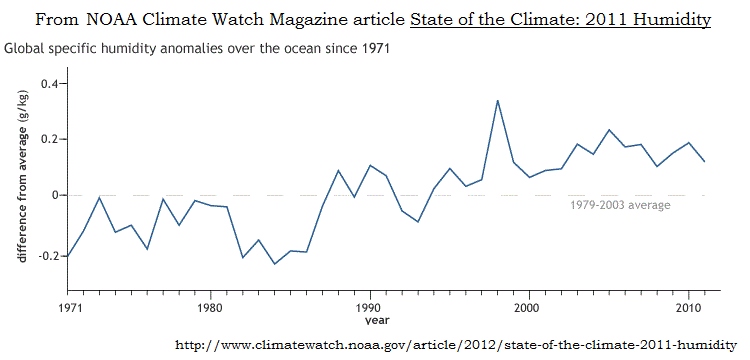
http://clivebest.com/blog/wp-content/uploads/2013/03/SH400mb.jpg
http://www.climate4you.com/images/NOAA%20ESRL%20AtmospericSpecificHumidity%20GlobalMonthlyTempSince1948%20With37monthRunningAverage.gif
http://images.sodahead.com/profiles/0/0/2/0/7/6/2/8/5/tpwv-110358445704.jpeg
Mixed bag, yes? Conflicting information? At first glance, yes. On closer examination, not so much. But they do raise some interesting questions about what’s really going on here. I don’t know the answers. The one I’ll lead with is: can we estimate Antarctic snowfall by direct observation rather than trying to infer it from moisture content? And obviously, have we?
The next thing, and main thing I dispute, is that Antarctic landed ice mass loss is a controversial conjecture. I accept that you see it that way. My reading of literature is that it’s anything but. There is high confidence across the board from multiple lines of evidence that rate of loss is negative and accelerating. Please don’t take that as a call to alarm — I’m not alarmed and I don’t intend to incite panic, that won’t do anyone any good.
Off the top of my head, the observations in support of the broad literature conclusion are:
1) Rate of movement of the ice sheets has been directly observed.
2) Rate of calving ice into the southern ocean has been directly observed.
3) The upper layer of the southern ocean has been directly observed to be freshening.
4) Subsurface layers of the southern ocean have been directly observed to be warming.
GRACE is the thing which has allowed them to put better constraints on the mass loss they had already been estimating from in situ measurements. I don’t consider it the primary evidence. Neither do I understand it to be the best place to look for causality, the main mechanism as I understand it being: basal melt of the glaciers where the warmer subsurface waters upwell near the coast. That increases the calving rate, thereby increasing the flow rate of the entire glacier backed up behind it.
What’s far less clear in literature is what to expect. I think it’s somewhat fair to say that nobody’s really figured out yet what in the heck is going on with Antarctic sea ice — it’s still at the “we’ve got lots of ideas” stage, not always in agreement with each other.
Hiroshima Atomic bombs of course silly !
Seems I recall there was a nuclear depth charge in the works at one point …
Devil worship.
What exactly are these tipping points? Are these scientific or found at the end of magic wands?
Leslie,
My favorite tipping point is a pub a couple of miles up the road. Or my front deck, when it’s not raining!
Mac
“Does Professor Trewhella really believe that the Antarctic and Arctic ice sheets will “melt away in the next decade”? I hope not. But whatever led to this letter being published, it seems careless to say the least, for the reputation of a man of science, to be associated with such a ridiculous claim.”
A ridiculous claim?
No it is pure WORLD CLASS STUPIDITY!
I doubt that DR. Trewhelia believes it.
Recently an “intergenerational” report was released in Australia about being and thinking “smart” for the future because the mining boom is behind us! (Mining boom and busts are part of Australian history) *sigh* I gasp at this nonsense! Australia, once the smart and lucky country, now seems to be the stoopid country! Derrrrrrrrr…..
Ian Dunlop was formerly an international oil, gas and coal industry executive, chair of the Australian Coal Association and CEO of the Australian Institute of Company Directors. He is a Member of the Club of Rome.
http://www.smh.com.au/comment/time-for-stateswomen-to-step-forward-on-climate-change-20150406-1mdgil.html
I was just about to put that in but had the wit to search/check first.
It’s a long windbag/rhetorical article and I think that Prof Trewhella has more chance of being right than the Club of Rome has.
clipe, thanks for the link to the Dunlop article. I’d just found it myself and was about to post it … glad I checked before doubling up on your research.
What research?
I’m not certain which article by Ian Dunlop Professor Trewhella was responding to, but this article, full of alarmist claims about tipping points and the “dangers” of economic growth, seems fairly typical of Dunlop’s writing.
http://wattsupwiththat.com/2015/04/11/claim-arctic-and-antarctic-will-melt-in-the-next-decade/
Ah. I didn’t even look at the embedded link. It was pretty darn clear to me that what I dug up on my lonesies was the correct article.
Well, the good perfesser is a waxy, white solid carbon chemist. One doesn’t have to know such pesky little things like basic thermodynamics, I suppose. Besides, q=mc(delta)T was something we covered in High School.
Had something like that been mentioned in a seminar at the chem department I was in, the guffaws would have lasted for the better part of an hour.
Was good professor’s letter to the editor peer reviewed?
NOT!
Do you think peer/pal review would have changed his statement?
No…of course not. They just need to push it harder.
It’s as good a lie as any of their others…right?
To Venus or the next Glaciation?
The British Antarctic Survey summarizes:
Increasing 40 C within a decade will indeed be a remarkable testable prediction!
Especially when we are already some 8,000 years AFTER the Holocene Climatic Optimum.
Will we be able to avoid the plunge into the next glaciation?
Odd, this claim by a member of warrenlb’s much-admired academic team of peer-reviewing writers in the professional journals.
See, the Antarctic sea ice last June set an all-time record high value for excess sea ice – the anomaly for Antarctic sea ice last June as 2.06 million square kilometers – an area of “extra” sea ice the size of the entire Greenland ice cap! Today, the “excess” Antarctic sea ice is “only” the size of Hudson’s Bay. At 33% ABOVE normal for the date, Antarctic sea ice not only shows no sign of melting (whether sea ice or land ice) but if today’s rate continue as they have for the last 4 years, the Cape Horn sea routes will be blocked by sea ice within 12-16 years. (Not likely, to be sure, but more likely than they all melting.)
http://arctic.atmos.uiuc.edu/cryosphere/IMAGES/seaice.anomaly.antarctic.png
The Arctic sea ice? Only 7% below normal for today’s date. Right at – but slightly below the 2 std deviation for the average area on this date.
This is what we should expect to see in the final desperation of the “Alarmist/Warmists”. They only way they can be heard is to shout about “denial” and make outrageously bizarre claims.
The end must be getting near……
Well here in Australia we apparently have yet another record to add to all those other records Australians have always managed to acquire.
When we look at the Proffessors Flannery, Steffen, Jones and Karoly of the BOM, Cook of Queensland Uni, Lewendowsky, Parcutt of Graz Uni of the “Skeptics should be executed” fame, Chris Turney of the melting Antarctica, “Ship of Fools” fame plus many, many others including the latest addition to that long list, that of Maurie Trewhella, Australian academics have shown that when it comes to global warming / climate change or whatever it will be tomorrow, our academics here in Australia can more than hold their own in the rabidly imbecilic stupidity stakes against some very, very stiff and very well qualified competition from the academic denizens of dozens of other National Institutes of Higher Learning across the globe.
It really does take a unique arrogance which only certain academics at the university level master, an arrogance based on a performance that a goodly percentage of Australian academics now appear to be well qualified in to be able to master to the extent that they have and using all the prestige of the title of “scientist”, they can so confidently step out into a field completely foreign to their own field of expertise and which they don’t have a clue about to provide such deep insights and such firmly enunciated predictions so as to appear almost unchallengeable.
Predictions in fact that are not even matched for their confidence levels even by those actual scientists working within the field of expertise they are so insistent on stupidly blundering into.
We Australians really have something that is close to unique in the very high levels and abilities of our academics from some of the most prestigious seats of learning in our nation to make utter idiots of themselves by so blatantly advertising their ultimate stupidity, ignorance and imbecilic arrogance in such a blatant and open fashion.
If anybody wants them I’m sure a lot of Australians would be happy for somebody to take them off our hands.
And it would help our national budget quite substantially as well not to have to support these long snouted academic “troughers” in the style they so arrogantly continue to demand.
It took me a few minutes to read and absorb your post Rom, but that is a brilliant summation.