Guest essay by Jim Steele, Director emeritus Sierra Nevada Field Campus, San Francisco State University.
On July 29, 2013 the BBC’s Hardtalk journalist Stephen Sackur wrote “The Alaskan village set to disappear under water in a decade.” He opened the story with “within a decade Kivalina is likely to be under water. Gone, forever. Remembered – if at all – as the birthplace of America’s first climate change refugees.” He then quotes a local who laments, “The US government imposed this Western lifestyle on us, gave us their burdens and now they expect us to pick everything up and move it ourselves. What kind of government does that?”

Given the context, such a statement sounds like the locals were feeling abandoned by global warming. But the tone also reminded me of the complaints by many native Arctic people who were relocated by the US, Canadian and Russian governments in a 20th century battle to secure claims to Arctic territory. Such a vulnerable location seemed odd for a permanent settlement.. Sure enough Wikipedia supported my suspicions Kitvalina. The original village was located at the north end of the Kivalina Lagoon but was relocated to its present location in about 1900. Reindeer were brought to the area and some people were trained as reindeer herders, suggesting there as a government attempt to force a permanent settlement. From the history I can glean on the internet “the people of Kivalina, like the Ipiutak before them, utilized the barrier reef only as seasonal hunting grounds, making camp there in warm-weather months.” Their recent plans to relocate due to erosion and an expanding population are opportunistically blamed on global warming.
The Arctic people have long been victimized by “southern people’s” politics. Relocation of indigenous families became a tactic employed by all the “polar bear countries” in an international chess match to stake claims on Arctic resources. In 1925, Denmark relocated families in Greenland to counter any Norwegian claims to the island. The following year the Soviet government moved a small Eskimo community to Wrangel Island in order to replace an occupation of Alaskan Eskimos that had been established there by American interests. The relocation of families was also a crucial cold-war tactic by Canada to insure their claims on the Arctic, but not just against any Russian threats, but more so from perceived encroachments by the United States.631
In 1944, Henry Larsen, a staff sergeant in the Royal Canadian Mounted Police, became the first to navigate the Northwest Passage from the west to east and back again. This celebrated feat greatly strengthened Canada’s claims to Arctic lands, and offset any potential Scandinavian claims based on Norway’s Roald Amundsen’s successful crossing of Canada’s Northwest Passage in 1903-06. However the US military bases built during World War II were now perceived as a threatening foothold. So in the 1950s Larsen was put in charge of relocating several Inuit families to Grise Fiord and Resolute Bay in the far northern reaches of the Canadian Arctic. Grise Fiord is known by its Inuit name that means “the place that never thaws.” Although these were strategic places in ongoing international maneuverings, it was a region long abandoned by the Inuit’s ancestors. Government stories of an unspoiled land where hunting was more bountiful enticed Inuit families to leave the milder climates of their villages along the central Hudson Bay. Government officials sealed the deal by suggesting there was absolutely no risk and promised a swift return passage if the families found their new settlement unsatisfactory.
But it was a promise that Canadian officials never intended to keep. Ironically, the woman who played Nanook’s wife in the popular 1930s documentary “Nanook of the North” and her son (who was fathered by the documentary’s producer) were among the families relocated to Grise Ford. Although “Nanook of the North” had enthralled Americans and Europeans with a glamorized depiction of Inuit resilience and adaptability, their new settlements doled out such incredible hardships their resilience was severely tested. The struggles of those families have now been well documented in the book, The Long Exile: A Tale of Inuit Betrayal and Survival. It was the film producer’s granddaughter, daughter of his half-Inuit, half-Caucasian son, who finally forced the Canadian government to own up to their betrayal. The Canadian government finally made a public apology in 2008 and paid reparations to the offended families.
Sackur’s article continues the long tradition of half-truths. To indict climate change he wrote:
- “Kivalina’s story is not unique. Temperature records show the Arctic region of Alaska is warming twice as fast as the rest of the United States.”
- “Retreating ice, slowly rising sea levels and increased coastal erosion have left three Inuit settlements facing imminent destruction, and at least eight more at serious risk.”
- “No longer does thick ice protect their shoreline from the destructive power of autumn and winter storms.”
However his story relies on zombie data. It was indeed true that Alaska had been warming twice as fast as elsewhere. In a 2012 paper climate scientists from Alaska Climate Research Center, University of Alaska reported, “a sudden temperature increase in Alaska was recorded starting in 1977, seemingly driven by the change in polarity of the Pacific Decadal Oscillation (PDO) Index, which went from dominantly negative before 1977 to dominantly positive values after that year” However unlike Sackur they also reported for the 21st century ” The mean cooling of the average of all stations was 1.3°C for the decade”1 Alaska is now one the most rapidly cooling areas on earth.
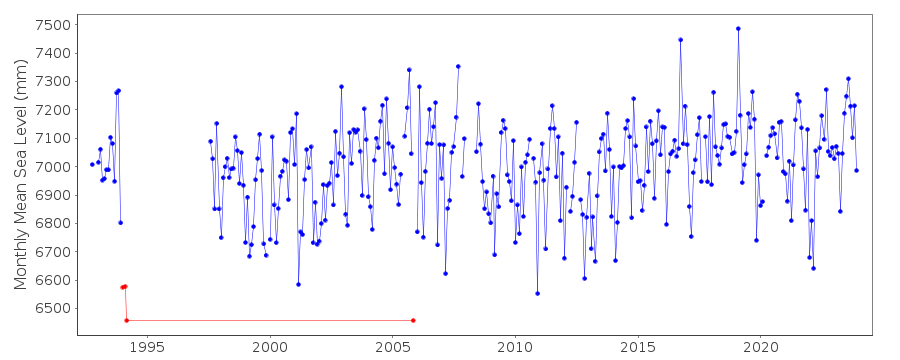
Sackur’s reference to “slowly rising sea levels” are also questionable. Go to the Permanent Service for Mean Sea Level website and view the 2 stations nearest to Kitvalina. At Nome Alaska the sea level is rising so slow it appears to be dropping over the last decade.
http://www.psmsl.org/data/obtaining/rlr.monthly.plots/1800_high.png

Or look at Prudhoe Bay .

http://www.psmsl.org/data/obtaining/rlr.monthly.plots/1857_high.png
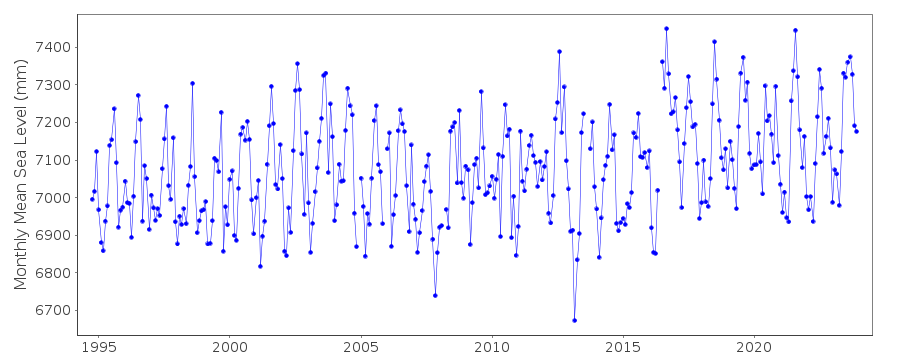
Except for a brief surge for a few months in late 2013, Prudhoe Bay sea level has been dropping there as well. The shifting PDO is also known to change sea level across the Pacific Ocean.
Finally it is hard to understand Sackur’s claim, “No longer does thick ice protect their shoreline.” In 2012 the National Snow and Ice Data Center reported “ice extent in the Bering Sea was much greater than average, reaching the second-highest levels for January in the satellite record.” NASA’s Earth Observatory wrote, “For most of the winter of 2011–2012, the Bering Sea has been choking with sea ice… NSIDC data indicate that ice extent in the Bering Sea for most of this winter has been between 20 to 30 percent above the 1979 to 2000 average. February 2012 had the highest ice extent for the area since satellite records started.” And in 2013 Bering Sea ice was again above normal as seen in National Snow and Ice Data Center picture.

So why has the BBC published this story filled with references to zombie data and half-truths? The region’s temperatures are cooling, sea level is dropping and sea ice is above average. The story about Kivalina has been published many times before and residents sued Exxon six years ago. Are they trying to rekindle global fear in a time of paused global warming? Are they now tools of the IPCC? Climategate emails revealed Michael Mann’s distress at a BBC’s story that the PDO could delay global warming, and he told his fellow advocates he would have a talk with their “science” writers. Did Michael Mann and the fellow IPCC warming advocates successfully pressure the BBC to present such a biased and unsupported story that does not educate the public about the complexities of climate change but instead attempts to instill gloom and climate fear? I once saw the BBC as a trusted source, but count me as a climate war casualty. I will never again trust another BBC climate article.
1. Wendler,G., et al. (2012) The First Decade of the New Century: A Cooling Trend for Most of Alaska. The Open Atmospheric Science Journal, 2012, 6, 111-116
Mr. Steele is author of Landscapes & Cycles: An Environmentalist’s Journey to Climate Skepticism
A strong complaint to the BBC would seem to be in order!
The BBC have been serial offenders in this respect, this is nothing new to us in the UK. There has been a small (sea) change recently, but there are still the odd weird alarmist stories like this, to keep the troops happy I expect. Supertankers don’t suddenly turn around, they do a wide circle.
” I once saw the BBC as a trusted source, but count me as a climate war casualty. I will never again trust another BBC climate article.”
Given that the BBC has had such a bias for some time e.g. programmes like “Meltdown”,and “Climate Wars”, how could anyone have trusted the BBC to be impartial about climate!
The Beeb has not been trusted on its climate-related stories for a long time.
The 28-gate affair proved that.
Relevant articles by its ‘science’ team and Harrabin are frequently illustrated by photos showing steam or flue gases back-lit to imply ‘visible-particulates’ to the uninitiated.
It’s no longer about science for the nutters. It’s all zombie apocalypse, all the time.
“Will the Cost of the Climate Wars be the BBC’s Integrity?”
A null question. It’s integrity was destroyed years ago.
In Their Own Words
When people ask for evidence of an institutional Left-wing bias at the BBC, this is the place to go for evidence. Out of the mouths of Beeboids….
http://biasedbbc.org/quotes-of-shame/
The BBC has been on a climate crusade for over a decade, and rational, impartial reporting has gone out of the window. Their crew of ‘science’ reporters are all press release and PC merchants. The best science journalist they ever had was Dr David Whitehouse (who writes much common sense about climate science – what the BBC should have been doing all along) who, as far as I know, left in circumstances that have never been fully explained. I was a fan of his at the BBC as he seemed to be trying to push them in the right direction. Now what does the know nothing about climate science Stephen Sackur phone when he wants to know about climate science – Roger Harrabin or David Shukman – say no more.
Oh,and…
Bring back David Bellamy!!!!!!
I went to the Beeb’s website hoping to be able to leave a comment and a link to your article, but none allowed. I noted that they said they were also broadcasting another programme on Climate Change at the same times today. It looks like the BBC’s assault on promulgating the warmist meme is ‘hotting’ up, while temperatures remain static.
” I once saw the BBC as a trusted source, but count me as a climate war casualty. I will never again trust another BBC climate article.”
The BBC has always been a propaganda arm of the state and it has served its master well over the years. The thing is … the internet now allows people to research many different sources very fast and see for themselves what is going on. An alternative site like WUWT gives people a chance to read real science and to check out another view other than the hysterical media’s myth of impending doom.
The internet may someday be credited with saving humanity by breaking the choke-hold of the information gatekeepers. (well, it is at least possible)
Reblogged this on Climate Ponderings.
I wonder if the Beeb is even aware how far their credibility has fallen?
The Beeb has been compromised for a long time, and not just on climate, it no longer provides real fourth estate journalism on any subject at all. I now view it as a propaganda outlet with occasional current events reporting (disasters, royal births, test cricket, etc).
If the BBC was a person it would be a jaded, alcoholic, sixties feminist. It has campaigned for free love and drugs all its life and is dismayed to discover nobody respects it now it’s middle aged. It still jumps on every hippy band wagon, but it gets to the demos by flying first class. It firmly places it’s politics on the left but it’s really just champagne socialism and enjoys the high life on other people’s money. It tells everyone how to live better lives but gets sulky and spiteful when others point to its own failed lifestyle. It despises traditional values and paints a road to ruin as progress. It’s a national embarrassment that fawns over good looking youngsters that find the attention a bit creepy. Aunty Beeb is a complete slapper that has never lived up to the respect it earned when it was at least fresh and original.
And don’t forget how they treated Benny Hill. Disgraceful.
I’m ashamed to say that the integrity of the bbc is shot to pieces. I was brought up on a diet of the ‘Horizon’ program which induced me take up a science career. In those days the science was the centre of the program. There was no presenter, just a voice over and this held one’s attention.
All we get now is close up shots of ‘attractive presenters’ often gazing wistfully into the distance, or some flashy useless graphic to bedazzle the watcher.
Its about the presenter and not the subject matter. I don’t think the current crop of producers understand how to communicate science or engineering.
Its a shame
Well they did push this out back in 2007 but i suppose they like many others hope people have short memories http://news.bbc.co.uk/2/hi/7139797.stm
Limey here. The BBC is long past its best. having been taken over by the Left Liberal class. Everything that goes with that is thrust down our throats, and the fact that people have to pay £140 a year to listen to or watch this crap makes many very angry. Yes, they do some great stuff – their sports coverage, for example, is excellent (especially the radio), however the current affairs is appalling, because of their in-built bias. And their coverage of Israel/Palestine is sickening. This is utterly against their charter, but nothing ever happens about it.
If you don’t have a TV, you don’t have to pay the BBC Poll Tax.
We don’t have a TV.
Join the club. If you live in the UK and you know the truth about global warming, you will be sickened by the BBC’s biased reporting.
Much nearer to home, last evening, they were reporting on the stand off between ultra left wing hippies protesting in the village of Balcombe and Quadrilla, an exploration company attempting to test drill the area. The local community in Balcombe who had initially objected, had disowned the hippies and did not wish to be associated with these criminals. Yet the BBC reported the dispute as if Quadrilla were in the dock. And to reinforce the legitimacy of the protesting hippies, they even showed multiple images taken from U Tube videos of flames shooting out from water taps. They knew there was no substance to such reports and even said that the videos had been largely disproved of being genuine, so what can have been their reason for showing these images, other than to reinforce the myth and add justification to the protests?
Mr Steele, Mod or Anthony. there is a typo that needs correcting:-
“Except for a brief surge for a few months in late 2013, Prudhoe Bay sea level has been dropping there as well. The shifting PDO is also known to change sea level across the Pacific Ocean.”
The brief surge was for a few months in late 2012 (and not 2013, since we aren’t there yet).
Here’s how the BBC is protected by the BBC Trust. A perfect example
http://www.dailymail.co.uk/debate/article-2381603/DAILY-MAIL-COMMENT-Proof-positive-BBC-biased.html
“markstoval says:
July 31, 2013 at 2:42 am
The internet may someday be credited with saving humanity by breaking the choke-hold of the information gatekeepers. (well, it is at least possible)”
I don’t see that happening at all, in fact quite the opposite. The NSA in the US, the UK has plans to “protect internet users” from “inappropriate material”, New Zealand is about to pass a bill to expand surveillance powers of their GCSB and similar policies planned for Australia too. Anyone would think we all live in China or N.Korea.
As a Brit, I tend to be proud of the BBC; but that is based on its historical record (WWII, the World Service, its reporters in the 70s and 80s); however, when I was In Britain in October last year, I was appalled by the general parochialism of reporting in the main BBC news programmes (not its dedicated news channel). It was as if nothing was happening in the rest of the world. But, as in my post on The Grauniad, I don’t give up. The BBC is an institution which forms part of the strange democracy that exists in the UK, and it has a commitment to objectivity. If it fails in that respect, well, let’s criticise and correct it. After all, that’s what democracy and freedom are about, aren’t they?
“jeremyp99 says:
July 31, 2013 at 3:01 am
If you don’t have a TV, you don’t have to pay the BBC Poll Tax.”
I am sure that is not correct. If you watch a broadcast, either live or recorded, on, it seems these days, any device, mobiles, computers etc, you need a license. I recall when I lived in the UK, before smart phones, a PC in each home and tape recorders etc, the fee covered mains powered radio sets.
The BBC has produced some great documentaries such as Orbit: Earths Extraordinary Journey. Not one bit of aCO2 driven climate catastrophe mentioned.