From Fujitsu’s press web site: Fujitsu Develops Hybrid Energy Harvesting Device for Generating Electricity from Heat and Light
Paves the way toward widespread energy harvesting, generating self-sufficient power from the surrounding environment
Kawasaki, Japan, December 9, 2010 — Fujitsu Laboratories Ltd. today announced that it has developed a new hybrid energy harvesting device that generates electricity from either heat or light. With this single device, it is possible to derive energy from two separate sources, which previously could only be handled by combining individual devices. Furthermore, because the cost of the hybrid device is economical, this technology paves the way to the widespread use of highly efficient energy harvesting devices. The new technology has great potential in the area of energy harvesting, which converts energy from the surrounding environment to electricity. Since there is no need for electrical wiring or battery replacements, this development could enable the use of sensors in previously unserved applications and regions. It also has great potential for powering a variety of sensor networks and medical-sensing technologies.
Details of this technology will be presented at the IEEE International Electron Devices Meeting 2010 (IEDM 2010) being held from December 6-8 in San Francisco.
About Energy Harvesting
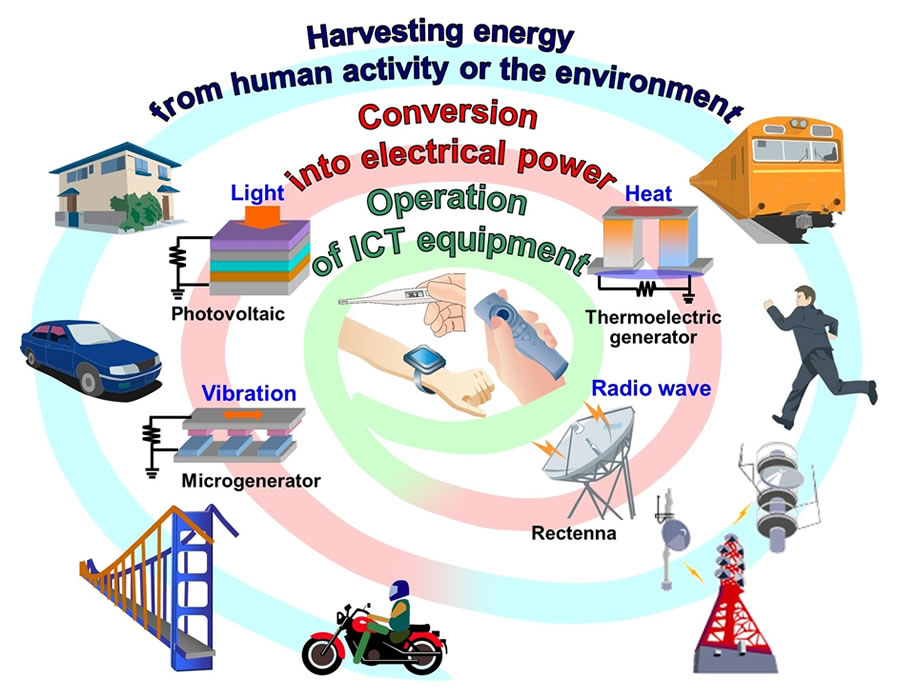
Energy harvesting is the process for collecting energy from the surrounding environment and converting it to electricity, and is gaining interest as a future next-generation energy source. Conventionally, electricity is supplied by either a power plant or a battery, requiring electrical wiring and replacement batteries. In recent years, the idea of using ambient energy in the forms of light, vibration, heat, radio waves, etc. has become increasingly attractive, and a number of methods to produce electricity from these different kinds of energy sources have been developed. Energy harvesting technology would eliminate the need for replacing batteries and power cords.
 Figure 1: Overview of energy harvesting
Background
Electrical power that can be generated by energy harvesting from surrounding light, vibration, heat, radio waves, etc. is minute compared to what is available from power plants or batteries. Thus, in order to operate ICT equipment by energy harvesting, devices that can generate more power would be needed. For example, light and vibration are not always available in the ambient environment. Therefore, there is a growing demand for devices that can efficiently derive energy from the surrounding environment at any time, thereby enabling the devices to be used at all times.
Technological Challenges
Since the amount of power available by energy harvesting is quite limited, there has been interest in utilizing multiple forms of external energy simultaneously – such as light and heat, or light and vibrations – in order to collect a sufficient amount for practical use. In the past, this has been achieved by combining different kinds of devices, which leads to higher costs.
Newly-developed Technology
Fujitsu Laboratories has developed a new hybrid harvesting device that captures energy from either light or heat, which are the most typical forms of ambient energy available for wide-scope application. This makes it possible for a single device to capture energy from either heat or light without combining two harvesting devices. In addition, as it can be manufactured from inexpensive organic materials, device production costs can remain low.
Details of the new technology are as follows.
1. New structure for hybrid generating devices
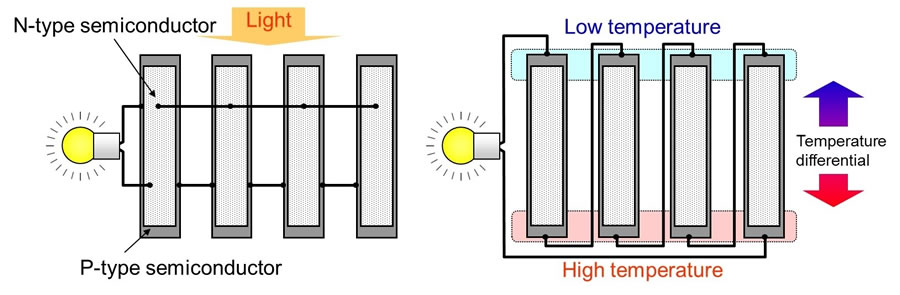
By changing the electrical circuits connecting two types of semiconductor materials – P-type and N-type semiconductors – the device can function as a photovoltaic cell or thermoelectric generator (Figure 2).
2. Development of an organic material for hybrid generating devices
Fujitsu Laboratories successfully developed an organic material that is suitable for a generator in both photovoltaic and thermoelectric modes. The organic material features a high generating efficiency that can produce power from even indoor lighting in photovoltaic mode, and it can also generate power from heat in thermoelectric mode. Since the organic material and its process cost are inexpensive, production costs can be greatly reduced.
 Figure 2: Single device featuring operation in both photovoltaic mode (left) and thermoelectric mode (right)
Results
Until now, photovoltaic cells – which generate electricity from light, and thermoelectric devices – which generate electricity from temperature differentials, have only been available as separate devices. This new technology from Fujitsu Laboratories doubles the energy-capture potential through the use of both ambient heat and light in a single device. In medical fields, for example, the technology could be used in sensors that monitor conditions such as body temperature, blood pressure, and heartbeats – without batteries and electrical wiring. If either the ambient light or heat is not sufficient to power the sensor, this technology can supply power with both sources, by augmenting one source with the other. In addition, the technology can also be used for environmental sensing in remote areas for weather forecasting, where it would be problematic to replace batteries or run electric lines.
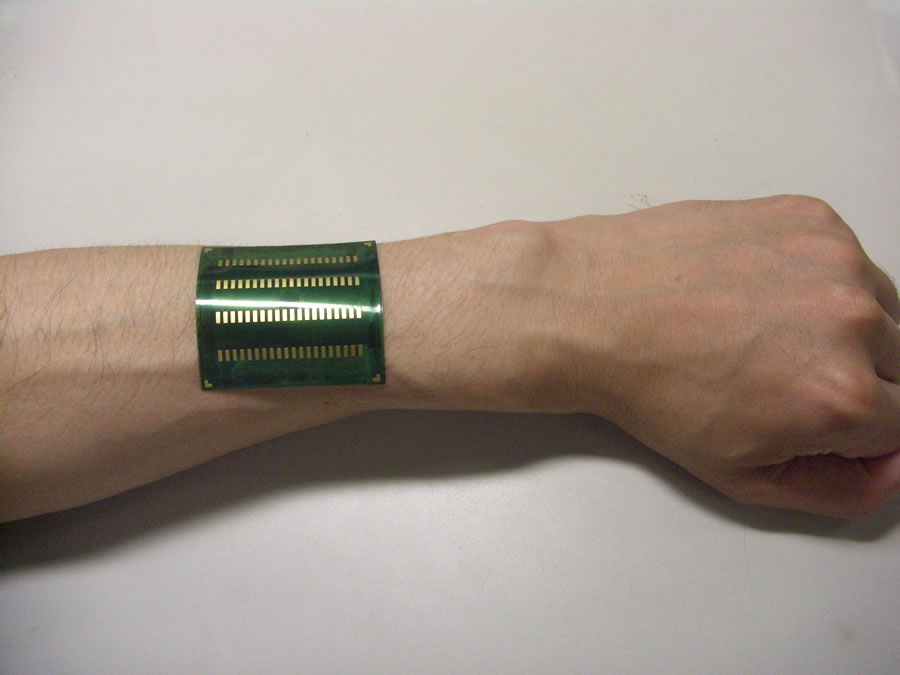
 Figure 3: Prototype hybrid generating device manufactured on flexible substrate
Future Plans
Fujitsu Laboratories will continue with further development of this new technology to increase the performance of hybrid devices, with aims to commercialize the technology by around 2015.
Production of energy is not a problem, there’s an ocean of oil and gas below, and nuclear power will keep us going even if that vast ocean would ever be used up.
Accumulation and transmission of energy, on the other hand, are costly problems without any breakthrough in sight.
I don’t think I’ve ever read an article which says the same things so many times to tell us almost nothing.
Human batteries! Matrix anyone?
Interesting, but also very annoying as no data on output voltage, operating temperature range, cost, output current, etc. Going to Fujitsu’s web site yields no further information. If such a unit can produce milliwatts of power cheaply, then it would be very useful for powering remote sensors. One of the biggest problems I find with all of the electronics devices I have for physiologic monitoring and temperature monitoring is that I’m constantly changing batteries and having batteries go at most inopportune times. Thanks for posting this link and I’ll be watching for this device to find out when I can buy a few units to play with.
A simple thermoelectric device which I use frequently during the winter is the stovetop fan on my workshop wood stove which uses the temperature differential between the hot stove and surrounding air to power the fan. I’m amazed that the unit hasn’t burned up with some of the hot fires I’ve had when warming the shop up fast from an initial temperature of -20 C, but the airflow past the cooling fins is sufficient to prevent the plastic motor components from melting and it moves a surprising amount of air.
How much? (energy, that is)
Boris Gimbarzevsky says:
December 12, 2010 at 1:03 am
Agree.
I had 11 remote, wireless sensors / thermostats for controlling temperature in my house.
All gone now. Cannot go on changing batteries for 11 units.
Now I have a wire instead. I2C bus.
Boris Gimbarzevsky says….
I agree, Boris
Volts, and current capacity per unit would be nice.
dwright
Well, you can’t harvest more than is there.
So, fishing for subsidies. Hold on to your
wallets boys.
Alexander Feht says:
December 12, 2010 at 12:16 am
“Accumulation and transmission of energy, on the other hand, are costly problems without any breakthrough in sight.”
Yes, but there are small steps almost on a monthly basis. These steps are certainly not created by WWF or Greenpeace or similar people.
I have an example of a small step forward;
A123 batteries, also called Life batteries.
Based on Li Fe SO4 ( aka Life ) .
-Can be fully charged in 7.5 minutes, lots and lots of amps.
-Can be charged without any explosion-danger ( as opposite to LiPos)
Perfect for the electric car, Power drills, brushless electric motors.
Boris Gimbarzevsky says:
December 12, 2010 at 1:03 am
Interesting, but also very annoying as no data on output voltage, operating temperature range, cost, output current, etc. Going to Fujitsu’s web site yields no further information. If such a unit can produce milliwatts of power cheaply, then it would be very useful for powering remote sensors.
Specifications are essential: I feel the “writer” (if not the company itself) is trying not to say that they can generate 1 milliwatt from that little receiver: Remember, it’s ALL about efficiency/economy/expense. (But even the first solar cells were so expensive NASA could only use them where all other power supplies were too heavy, too big, required fuel and oxidizer, etc. Now, they are useful in many remote areas – but still can’t compete against plug-in power anywhere a power line is already run. But at 5,000.00 per mile to run a power line to a remote cabin, solar cells make sense for low power needs.)
So if the “available power” is the heat of the body’s arm (98.6 nominal F) compared to the room (70 F nominal) you can’t heat up the room with the receiver! If the extra power is from the room’s lightbulb, you can not power the light bulb and the computer and the modem from the light bulb by waving the arm up and down.
tallbloke has my vote for best blog quote of the year for 2010.
In the grand scheme of things, I don’t see this as changing much. What is the total energy input vs output of those type of devices. What we need is higher density energy that are cheaper then what we have today. Like a nuclear power station build by China that will produce large amount of electricity at around 3cents per kw/h. We need to invest in a future where energy will cost so little that it will be provided as a “free” service by our societies paid by our taxes.
I like to think more like in Startrek than the Matrix. 😉
I need a dense source of energy to get my car running for 1000km and keep me warm in the -20c of Canadian winters…. Like my TDI is doing.
Rectenna?? I hope that isn’t what I think it is…!
“Since there is no need for electrical wiring…’
How is that again?
Alexander Feht says:
December 12, 2010 at 12:16 am
“Accumulation and transmission of energy, on the other hand, are costly problems without any breakthrough in sight.”
Tesla was transmitting energy without wires in the late 19th century.. thats what Wardenclyffe Tower was built for.
I giggle when I saw the graphics in the press release. They clearly show that their energy-harvesting device lights up a small incandescent lamp. The implication is that the power output is around, say, 300mW. My baloney-detector keeps triggering…
I thought it was just me. Holy repetition Batman!
There has been a device around for many years that is slightly similar to what they are doing, it’s called Ecofan® .
Ecofan® Wood Stove Fans generate power off the heat of your stove to uniformly circulate air through your home or work. Simply place Ecofan on your stovetop! Efficient and ultra quiet.
Designed for freestanding wood stoves with surface temps of 400-650°F; temps above 700°F will damage Ecofan. Use of stove thermometer recommended.
Matt Hardy says:
December 12, 2010 at 4:09 am
“Rectenna?? I hope that isn’t what I think it is…!”
I knew all those probes had to be for something. Turns out the aliens were our friends after all…..
Yonatan Ben Dovid says:
December 12, 2010 at 4:42 am
“My baloney-detector keeps triggering…”
Why?
Typical useful application;
Yesterday I glued in a transceiver for passing through automatic road pay-stations.
Its glued into typical the engine room of the car. It receives a trigger signal (not a baloney detector) and sends back data so that the pay-station undersands that you have paid.
Ingenious. Except; It lasts 5 years. Then the battery must be replaced. One of those circuits could have helped charge that little battery.
It’s a neat idea, but I find it hard to think of any practical applications. A medical sensor could work off the heat of the human body, right enough, but then there’s no need for the photovoltaic part at all – unless the patient is dead! Photovoltaics are good for powering calculators, but these are unlikely to have any significant heat gradient to tap. Generally speaking, if the heat source is reliable enough to substitute for the light source, it will do the job by itself; and if not, sometimes both will be out at the same time. There might possibly be applications where the heat source is warmed up during the day, to take over from the solar cell at night; but even then, a small rechargeable battery would seem a simpler solution.
kwik says:
December 12, 2010 at 3:00 am
Energy density of LiFE batteries is lower than LiPos which is a large disadvantage in applications where minimal weight is important which applies especially to hand tools as the heavier the tool the more stress on the operator. Faster charge time isn’t always a consideration especially when the difference is 7.5 minutes vs. 15 minutes and batteries are simply swapped – one charges while the other is being used. For very intermittant operation LiFE capacity degrades less in storage but in an electric car that’s driven frequently or tools that are used often it makes no difference. Explosion danger is something to consider of course but you’re more likely to get hit by lightning than hit by shrapnel from an exploding LiPos battery.
I couldn’t find a white paper mentioned on another site, but that individual said that the paper claimed an output of only 0.02mW. Still, they are making some amazing nano-scale (MEMS) sensors that require tiny amounts of power.
For those expecting information from a press release, they should realise that press releases have many purposes for a company, including misleading competitors and influencing investors. Imparting understanding is rarely an objective.
By the way, rectantennae are used for recieving electrical power distributed wirelessly, typically at microwave frequencies.