From Fujitsu’s press web site: Fujitsu Develops Hybrid Energy Harvesting Device for Generating Electricity from Heat and Light
Paves the way toward widespread energy harvesting, generating self-sufficient power from the surrounding environment
Kawasaki, Japan, December 9, 2010 — Fujitsu Laboratories Ltd. today announced that it has developed a new hybrid energy harvesting device that generates electricity from either heat or light. With this single device, it is possible to derive energy from two separate sources, which previously could only be handled by combining individual devices. Furthermore, because the cost of the hybrid device is economical, this technology paves the way to the widespread use of highly efficient energy harvesting devices. The new technology has great potential in the area of energy harvesting, which converts energy from the surrounding environment to electricity. Since there is no need for electrical wiring or battery replacements, this development could enable the use of sensors in previously unserved applications and regions. It also has great potential for powering a variety of sensor networks and medical-sensing technologies.
Details of this technology will be presented at the IEEE International Electron Devices Meeting 2010 (IEDM 2010) being held from December 6-8 in San Francisco.
About Energy Harvesting
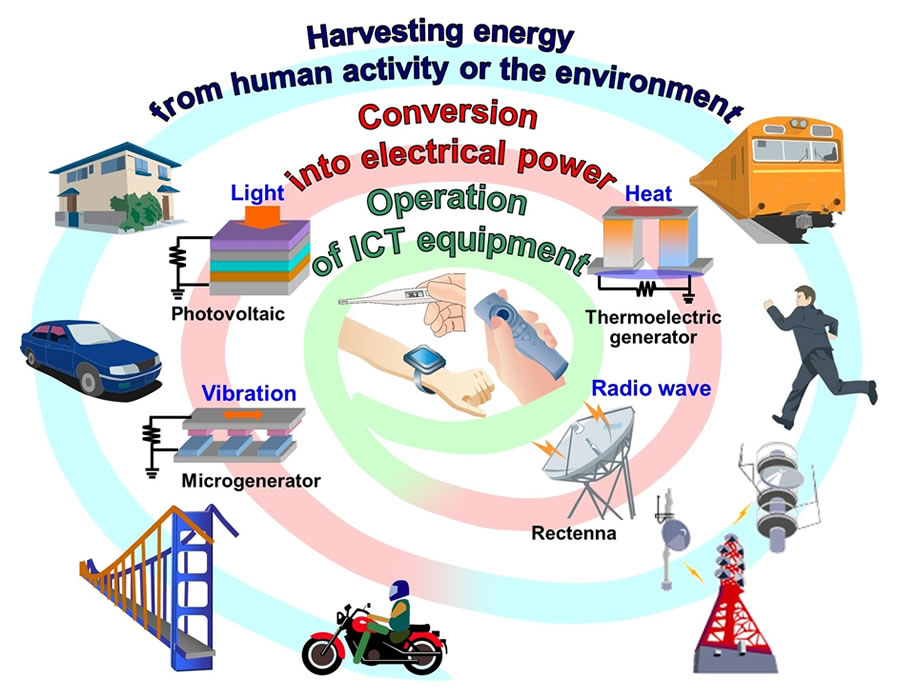
Energy harvesting is the process for collecting energy from the surrounding environment and converting it to electricity, and is gaining interest as a future next-generation energy source. Conventionally, electricity is supplied by either a power plant or a battery, requiring electrical wiring and replacement batteries. In recent years, the idea of using ambient energy in the forms of light, vibration, heat, radio waves, etc. has become increasingly attractive, and a number of methods to produce electricity from these different kinds of energy sources have been developed. Energy harvesting technology would eliminate the need for replacing batteries and power cords.
 Figure 1: Overview of energy harvesting
Background
Electrical power that can be generated by energy harvesting from surrounding light, vibration, heat, radio waves, etc. is minute compared to what is available from power plants or batteries. Thus, in order to operate ICT equipment by energy harvesting, devices that can generate more power would be needed. For example, light and vibration are not always available in the ambient environment. Therefore, there is a growing demand for devices that can efficiently derive energy from the surrounding environment at any time, thereby enabling the devices to be used at all times.
Technological Challenges
Since the amount of power available by energy harvesting is quite limited, there has been interest in utilizing multiple forms of external energy simultaneously – such as light and heat, or light and vibrations – in order to collect a sufficient amount for practical use. In the past, this has been achieved by combining different kinds of devices, which leads to higher costs.
Newly-developed Technology
Fujitsu Laboratories has developed a new hybrid harvesting device that captures energy from either light or heat, which are the most typical forms of ambient energy available for wide-scope application. This makes it possible for a single device to capture energy from either heat or light without combining two harvesting devices. In addition, as it can be manufactured from inexpensive organic materials, device production costs can remain low.
Details of the new technology are as follows.
1. New structure for hybrid generating devices
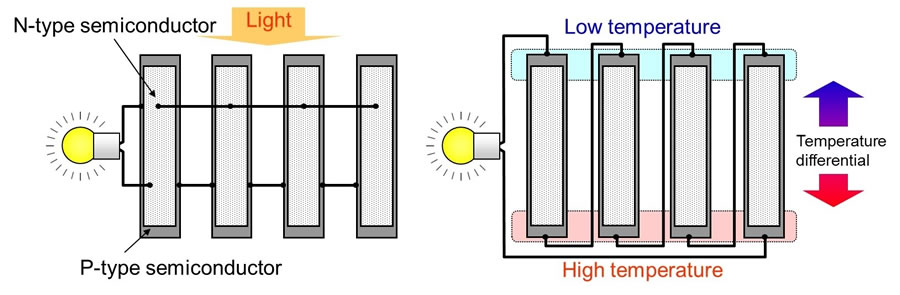
By changing the electrical circuits connecting two types of semiconductor materials – P-type and N-type semiconductors – the device can function as a photovoltaic cell or thermoelectric generator (Figure 2).
2. Development of an organic material for hybrid generating devices
Fujitsu Laboratories successfully developed an organic material that is suitable for a generator in both photovoltaic and thermoelectric modes. The organic material features a high generating efficiency that can produce power from even indoor lighting in photovoltaic mode, and it can also generate power from heat in thermoelectric mode. Since the organic material and its process cost are inexpensive, production costs can be greatly reduced.
 Figure 2: Single device featuring operation in both photovoltaic mode (left) and thermoelectric mode (right)
Results
Until now, photovoltaic cells – which generate electricity from light, and thermoelectric devices – which generate electricity from temperature differentials, have only been available as separate devices. This new technology from Fujitsu Laboratories doubles the energy-capture potential through the use of both ambient heat and light in a single device. In medical fields, for example, the technology could be used in sensors that monitor conditions such as body temperature, blood pressure, and heartbeats – without batteries and electrical wiring. If either the ambient light or heat is not sufficient to power the sensor, this technology can supply power with both sources, by augmenting one source with the other. In addition, the technology can also be used for environmental sensing in remote areas for weather forecasting, where it would be problematic to replace batteries or run electric lines.
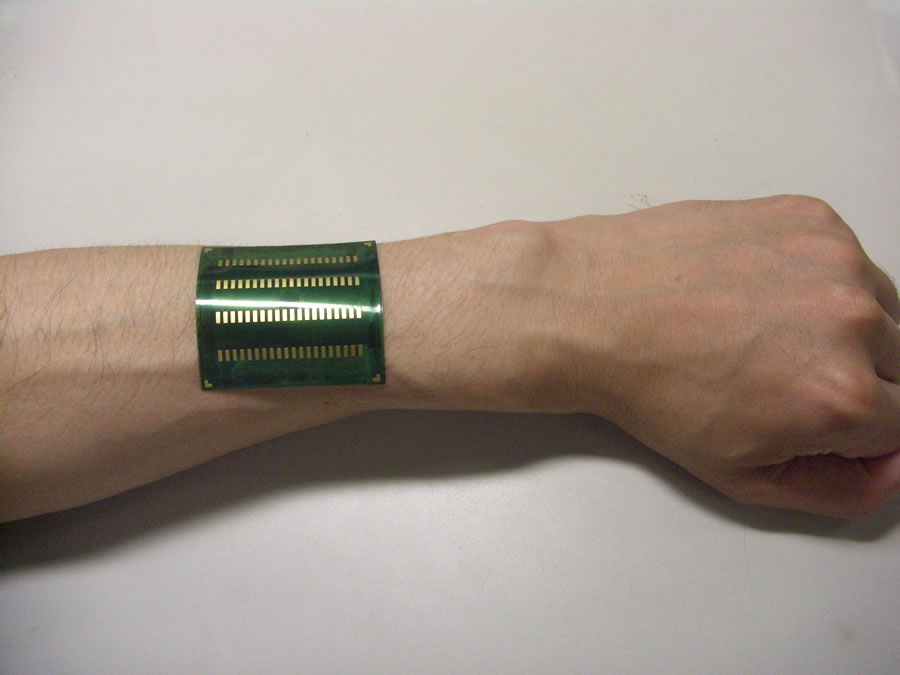
 Figure 3: Prototype hybrid generating device manufactured on flexible substrate
Future Plans
Fujitsu Laboratories will continue with further development of this new technology to increase the performance of hybrid devices, with aims to commercialize the technology by around 2015.
Phooey.
I should have added that the “rect” bit relates to rectification of the microwave signal to yield DC power, rectantenna = rectifying antenna.
What is the “organic” in organic semiconductor? Soylant Green?
Soon you will see articles stating that if you mount this in the wall of your house, you can generate electricity via the heat leakage to the outside (in winter in the north) and heat leakage to the inside in summer (pretty much all over). Small problem, you are stealing from your heating or cooling source to generate electricity inefficiently. It is going to be like the Israeli piezoelectric speed bumps that stole a little energy from each car that went over them. I am sure there are some specialty applications that this will be useful for, but you get nothing for nothing but nothing.
As for transmitting energy without wires, the sun has been doing it for 4.5 billion years now.
I just organised an international scientific conference about that subject: microsystems for energy harvesting and power conversion. This conference is called PowerMEMS and is organised each year. More information can be found on http://www.powermems.org. The goal is not to solve any real or imaginary energy problem, but provide power to portable devices and wireless sensors.
This is another carrot for the “We don’t need fossil fuel or nuclear power anymore….” stick. “Just wait a few years and our energy problems will be solved.” Meanwhile the Western economies atrophy.
This demonstrates that there are no water-tight compartments between different wave frequencies.
http://www.giurfa.com/unified_field.mht
I wonder if they`re using some of this.
http://sedgemore.com/2008/09/infrared-antennas-for-solar-energy-generation/
The photoelectric phenomenon was understood as light exited the zinc plate on the electroscope making it produce electrons while really the photon contained those electrons. This is the real meaning of M.Planck´s equation.
Dave Springer says:
December 12, 2010 at 5:47 am
“Energy density of LiFE batteries is lower than LiPos which is a large disadvantage in applications where minimal weight is important which applies especially to hand tools as the heavier the tool the more stress on the operator.”
Yes, Dave, I agree with almost all you say. I use LifeSO4 batteries in “gadgets” and handtools to enjoy life, not to solve imaginary scares like the AGW hysteria.
I’ve had Lipos exploding on my terrace while charging them. They burn like phophouros bombs. LiFeSO4 not so. Thats why they use LiIon batteries in mobile phones, not Lipos.
Try to use Lipos when the temperature is lower than, say minus 5 degrees Celcius. They are worthless. Not so with LifeSO4. Just as powerful.
So, there are pluss and minus’es…. but nothing that can solve the imaginary AGW scare.
The Norwegian government is perhaps the greatest hyphocrates of them all, exporting enourmous quantities of natural gas to other nations, instead of building Gas Powerplants in Norway. They should be ashamed of themselves.
If you could convert heat energy from the interior of the human body into electricity, then you could power pacemakers, insulin sensors & pumps, drug therapy sensors & pumps etc… You could provide real time monitoring of chemical & toxin content in blood or organs. It could also power the internal iPod, virtual reality contacts or pre-Borg implants. It would also revolutionize the tatoo industry by overlaying traditional ink designs with quantum-dot holographic displays. OK, maybe that last one is a stretch. Standard definition reception on your fore arm might be sufficient.
There’s a heat pump system that works on the principle that the temperature in the ground at about 15′ deep is fairly constant around the average yearly surface temperature. It seems to me that that’s where we should be monitoring temperature, if we were serious about detecting trends, not on the ground where instantaneous temperature is subject to the vagaries of weather. It would be interesting to see the difference, if any, between a physical representation of a local average and the average derived from surface or satellite readings.
Slightly off topic, but the thermoelectric effect brought it to mind.
Poor information – and very likely an impractical method of power generation and ultimately will require some form of ‘battery’ to store useful energy? Until battery storage is better and more efficient, micro generation is unlikely to be practical?
BTW – I don’t trust Fujitsu – some years ago (15-20?) they set up a factory in Newton Aycliffe with loadsa government money and then shut it down due to reduced demand for chips!
kwik;
The gas price is collapsing due to abundant supply; it’s down 2/3 in 2 yrs, and falling. http://www.forbes.com/forbes/2010/1108/opinions-steve-forbes-fact-comment-energy-crisis-over.html
BTW, hyphocrates might be some ancient Greek, possibly a foe of Socrates, but I think you mean ‘hypocrites’, who are modern double-talkers.
No, there’s actually only one photon and one electron, which travel back and forth in time to create the illusion of plurality.
I just received a tachyon message revealing this discovery.
The problem with harvesting power from very diffuse sources of energy is always the same. Because the energy source is very diffuse the ratio of incoming energy per unit area of hardware is correspondingly low. In other words, cost of harvesting per unit of power is very high.
There is no way round this. That is why appeals to intuition, such as ‘the sun is free’ or ‘wind is free’ are non sequitors. The hardware is certainly not free – and you need lots of it. Lots and lots.
You canna change the laws of physics, cap’n.
Sounds like one of the endless arrays of technical innovations that will revolutionize everything in 10 years, but then you never hear about them again.
Any info on watts harvested per deg C difference?
Brian H says:
December 12, 2010 at 9:03 am
-“The gas price is collapsing due to abundant supply…”
-“BTW, hyphocrates…..but I think you mean ‘hypocrites’”
-Yes, much smarter to burn the Gas in Norway, and export the power, or even for domestic use.
-hypocrites, yes, thank you. Cannot edit anything here after the fact.
So I guess the “skinny” of it is this device could power the display of my Timex watch and charge the Li-ion cell , but not much else.
A glorified solar cell that runs on infrared radiation – novel, but not earth shaking.
I forsee an unlosable “tap&go” type credit card and identification system being developed out of this … one that literally never needs to leave your hand, let alone be put in your wallet.
regarDS
derspatz says:
I forsee an unlosable “tap&go” type credit card and identification system being developed out of this … one that literally never needs to leave your hand, let alone be put in your wallet.
——————————————————————
I still don’t trust that tech, auto thieves have used RFID “codegrabbers” for decades to steal cars- anything with RF emissions can be picked up and used.
If I get a credit card with a “quikpass” chip in it I smash the chip with a hammer and say “sorry, we have to swipe through the machine and enter my PIN.
dwright
What I suspect we really have here is a “rectilinear research grant harvesting device”. Put this little baby out into that green field and watch is gobble.
This remind me a story about the great Tesla.
I once read on the internet a report from a friend of his who said that he traveled with Tesla in a car with a non conventional motor : more a less a motor powered by sort of power directly drawn from the air or space.
Did not take note of the link, and never able to retrieve it !
This would only be good for powering some really miserly devices. The thermodynamic efficiency of using body heat exhausting to room temp is pretty awful, a handful of percent, and assuming a steady state weight balance a person puts out about 100W total power. If you were to completely cover a person with this and capture the heat of expelled air and wastes you’d get a few watts of useful power. I think I’d prefer a glucose fuel cell instead.