
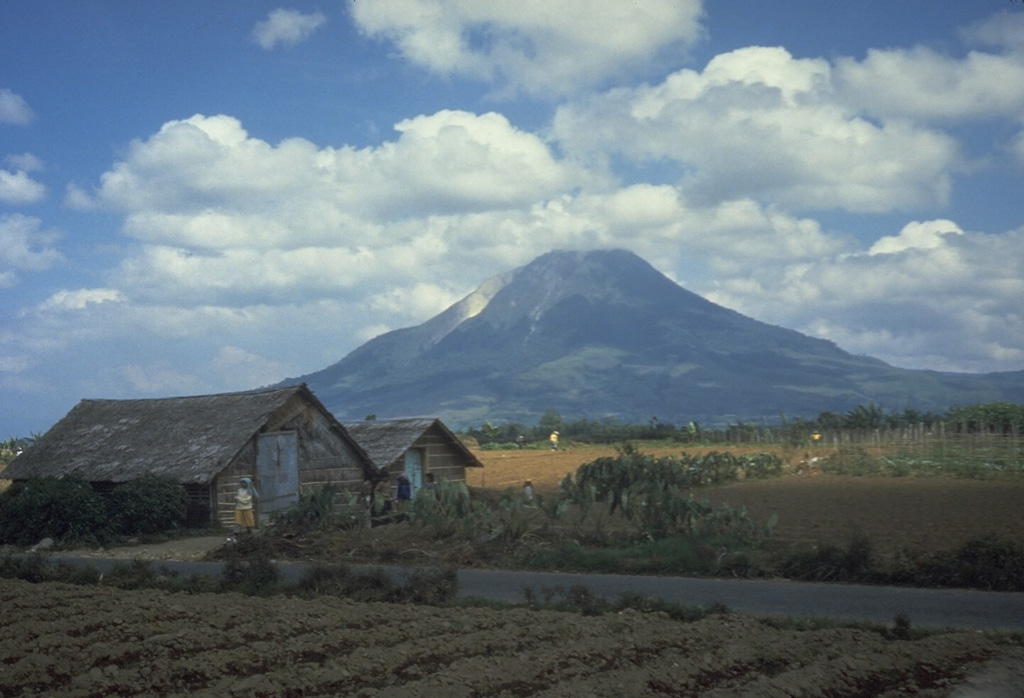
Located at 3.17°N 98.392°E the volcano erupted suddenly and without warning. The Jakarta Post and Xinhua have photos of the eruption: 
Mount Sinabung erupts: (Tribun Medan/Dedy Sinuhaji) Mount Sinabung in North Sumatra erupted on Sunday at 00.15 a.m. Antara news agency reported local villagers did not expect the eruption as the geophysics and meteorology agency just declared a normal status for the mountain. Villagers fled home to a safer location, but no police officers yet helped the evacuation process. On Saturday, the 2,400 meter-high mountain showed its volcanic activity by spewing black clouds. ===========================
From Xinhua: 
Villagers ride a motorcycle while covering their mouths at the district of Tanah Karo outside the city of Medan, North Sumatra, as the Mount Sinabung volcano spews smoke in the background August 28, 2010. (Xinhua/Reuters Photo)
Spokesman of National Disaster Management Agency Priyadi Kardono said the eruption has not been predicted much earlier like other volcanoes and authorities must conduct a quick preparation for emergency work as mount Sinabung’s seismic activity has been monitored intensively only since Friday after it showed an increase in activity.
Over 10,000 people have been internally evacuated after the eruption, Secretary of the provincial administration Edy Sofyan told Xinhua by phone.
Priyadi said that aid from Jakarta will be sent within days.
Mount Sinabung, whose last eruption occurred 400 years ago, is classified at category “B” which means it is not necessary to be monitored intensively, but other volcanoes in category “A,” must be monitored frequently, head of National Volcanology Agency named only Surono told Xinhua over phone from the province.
====================================================
The near equatorial location is in a position to have a lot of ash swept into the ITCZ and will bear watching.
h/t to WUWT reader Daniel H
Any initial estimates on how much particulate is being spewed into the atmosphere?
-Scott
Sinabung’s only a stone’s throw from Toba…
http://en.wikipedia.org/wiki/Lake_Toba
“Over 10,000 people have been internally evacuated after the eruption”, could be messy.
When you say “without warning” in Indonesia, that is like saying with full notice to anyone paying attention. If there were a more irresponsible nation on earth regarding the scientific observation of natural calamity, they should make themselves known. This is the place where “foul” and “corruption” meet. For desert, after dining in Afghanistan.
” the geophysics and meteorology agency just declared a normal status for the mountain.”
Surely, if the “experts” have already confirmed everything is hunky dory, why would we believe the lying eyes of these benighted and non peer-reviewed villagers?
Have they not been told the Science is Settled?
This is actually on the northern flanks of Mount Toba, the worlds largest volcano and source of the worlds largest eruption.
There is a known negative correlation between seismic activity and the 11-year solar cycle.
Thanks for the h/t Anthony. I feel honored!
It’s interesting that this eruption is now the number one most popular news story on CNN’s International Edition web site. They recently moved it to the top of the home page:
http://edition.cnn.com/
This is in sharp contrast with the US Edition home page where you would never know that this story exists. The only mention of a volcano in the US Edition is regarding the red alert on Colombia’s Mount Galeras stratovolcano:
http://us.cnn.com/2010/WORLD/americas/08/25/colombia.volcano/index.html
Strange that!
Toba, Yellowstone, Mammoth Lakes, Santorini, Tambora, Cumbre Vieja on La Palma, etcetera. Not to mention ”ordinary” volcanos near populated areas:
Just here in WA: Rainier, Baker, Adams, Glacier Peak, St. Helens.
Down the coast: Lassen and Shasta.
And of course Vesuvius, Iceland, etcetera; and many in the ring of fire around the Pacific basin, that are disposed toward explosive eruptions (as compared to the (usually) relatively benign eruptions of volcanos like Mauna Loa and Mauna Kea).
Geologic time is a very long horizon for we humans. But it’s only a question of when the next major eruption will occur, not if; that will throw who knows how many cubic km of material and gases into the atmosphere. . . .
Just think:
Even something as relatively ”small” as Tambora in 1815 (estimated to have ejected 100 times as much material as Mt St. Helens) would largely throw all the existing climate models out the window.
FOOTNOTE to my last:
While I usually and in general take Wikipedia entries with a grain of salt, this one on the world’s largest explosive (and other) eruptions seems particularly well done. At least it certainly is very well referenced:
http://en.wikipedia.org/wiki/World%27s_largest_eruptions
Here is yet another example of Catastrophic Anthropogenic Global Warming at work. I’ll bet a 6-pack of Sierra Nevada Big-foot Ale that the CAGW-caused Russian heat wave or the CAGW-caused Bolivian deep freeze that triggered this eruption.
I told you I was only dormant. Though I am surprised that there were no signs of movement in the volcanic vent. Perhaps the local watchers were asleep when rumblings started.
The increasing volcanic activity was predicted by Czech astronomer Charvatova and it is related to the chaotic pattern of the solar system barycenter.
It is the Jovian cycles, stupid! as someone who knows said.
I bet that the local CO2 levels have recently gone up – more proof positive of the link between CO2 levels and volcanic disasters! It’s an evil gas, I tell you.
Hope this isn’t a harbinger of more activity to come from Pacific Rim of Fire! Worrying that there was little or no notice of this eruption and that experts had “…just declared a normal status for the mountain.”
It would seem that despite our best efforts, the science of predicting volcanic activity still has a long way to go!
How long before someone blames this on CO2 emissions?
Thinking back, Tallbloke predicted an eruption right about now.
Since I’m not now speaking from the base of the volcano, I can safely say that this event looks very unimpressive, at least from the few photos I’ve been able to find. I wouldn’t even call it an eruption at this stage, more like a little venting. It’s sending ash and smoke a mere 1500 meters up, with most of the smoke seeming to hug the ground.
However, should it really pop its cork, then it’s situated to have the most impact on climate.
Weve also had 2 other eruptions this week – Mt Etna and Columbias Galero volcano
A new “Tambora” volcano? Strong La Nina this year. In Europe we are still waiting for Katla’s eruption. The next months will be very interesting.
Anthony,
You’re ahead of the pack with this one. 😉
http://scienceblogs.com/eruptions/
http://www.volcano.si.edu/world/find_names.cfm
This is near the tropics. If it’s as bad as Pinatubo, it will cool the whole globe.
How long until we learn that it was due to global warming?
IanM
Progress Report Sinabung Eruption Disaster
Sunday, 29/08/2010 06:54:16
Update from BNPB Indonesia
http://translate.google.com/translate?js=y&prev=_t&hl=en&ie=UTF-8&layout=1&eotf=0&u=http%3A%2F%2Fbnpb.go.id%2Fwebsite%2Findex.php%3Foption%3Dcom_content%26task%3Dview%26id%3D2832%26Itemid%3D60&sl=id&tl=en&swap=1
Infojunkies need data, now damnit! :p
Shame that Dr Klemetti is busy and ill and the Smithsonian/USGS pages only get updated once a week. And in a correlation hopefully not equalling causation kind of way, this isn’t prophetic:
“Another volcano anniversary falls this week – this time the 1883 eruption of Krakatau in Indonesia.”
From what I can find, so far Sinabung doesn’t appear to be doing that much, and hopefully it’ll stay that way.