The Heliospheric Current Sheet Tilt Angle and Implications for Friis-Christensen and Lassen Theory

Guest post by David Archibald
The Chairman of NOAA’s Solar Cycle 24 review panel, Douglas Biesecker, said back in March 2007 that the flattening of the heliospheric current sheet was one of the expected signatures of solar minimum (the Solar Cycle 23/24 transition). At times of weak solar activity, the month of transition can be relatively hard to pick, except for the flattening of the heliospheric current sheet, shown following:

This graph of the heliospheric current sheet tilt angle from 1976 shows sharp transitions from one solar cycle to the next. The data is from www.wso.stanford.edu
By comparison, Dr Svalgaard’s plot of four solar parameters from 2008, available at http://www.leif.org/research/TSI-SORCE-2008-now.png , shows a lot of latitude in picking the month of transition:
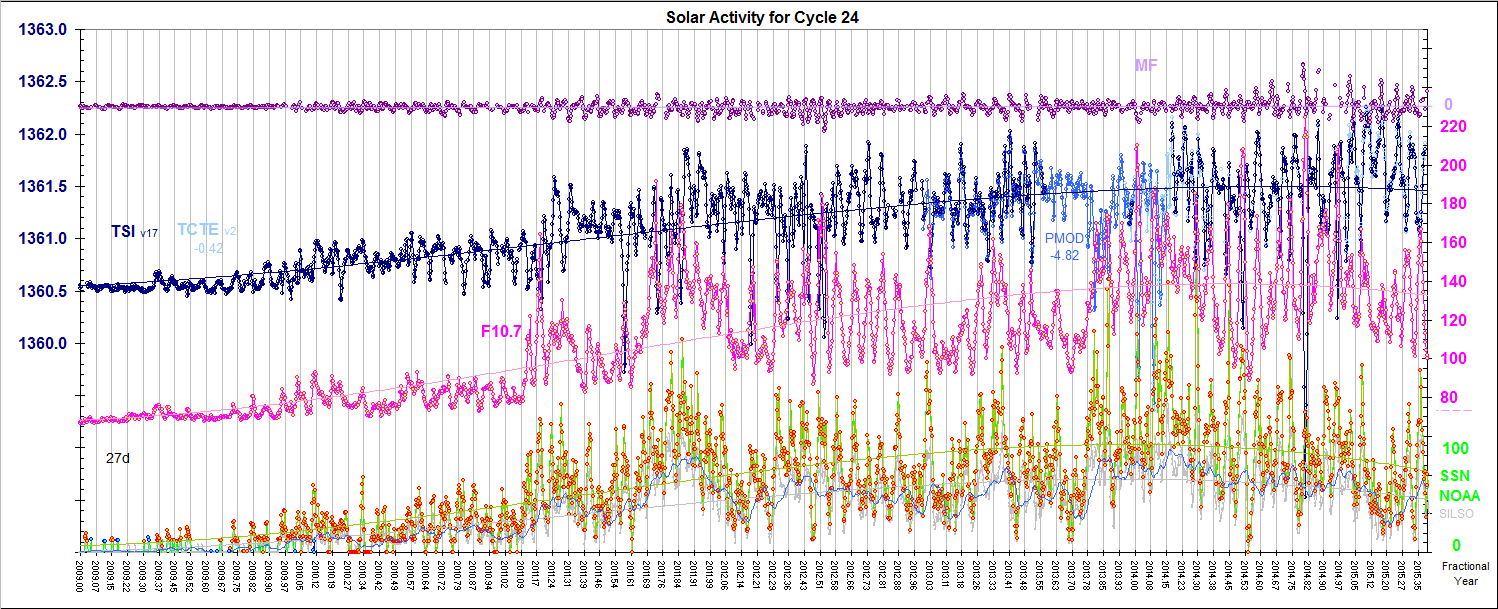

On top of his graphic I have plotted December 2008 which is commonly accepted as the month of the Solar Cycle 23/24 transition and October 2009, which was Carrington rotation 2089 and the month of transition based on flattening of the heliospheric current sheet. The MF doesn’t change character until this later date.
The big question is,”What are the implications for Friis-Christensen and Lassen theory?” Friis-Christensen and Lassen based their theory on a couple of hundred years of sunspot data, but what if the true relationship between solar cycle length and the Earth’s temperature over the following solar cycle is based on solar cycle length as measured from the flattening of the heliospheric current sheet rather than the rather subjective choice of minimum sunspot number? We will need possibly another hundred years of tilt angle data to get a definitive result, but in the meantime we can calculate the consequences.

Plotting the heliospheric current sheet-based data onto Butler and Johnson’s 1996 graphic for Armagh, Northern Ireland results in having to plot outside their graphic. These solar cycle length conditions are unprecedented in recorded Armagh history. They result in the predicted temperature decline over Solar Cycle 24 at Armagh to be 2.4°C, a full one degree cooler than the result based on commonly accepted solar cycle length data.
Applying heliospheric current sheet-based data to the plot for Hanover, New Hampshire derives a 3.1°C temperature decline, about one degree more than previously calculated. This is more than four times the purported 0.7°C temperature rise of the 20th century.

There is one way to determine whether or not Friis-Christensen and Lassen theory should be based on solar cycle length based on flattening of the heliospheric current sheet. If the average temperature decline at Hanover, New Hampshire over Solar Cycle 24 is 3.1°C rather than the previously predicted 2.2°C, then that will be early confirmation that flattening of the heliospheric current sheet should be used. We will only have to wait until early next decade for that data.
David Archibald
August, 2010
Science: States the theory, describes what is expected, and sets the requirements for support of that theory. Refreshing.
Rsq = 0.53 is not particularly significant. In this correlation I have Rsq = 0.8933
http://www.vukcevic.talktalk.net/NFC1.htm
dR. sVAALGARD WILL BE HEAR SOON TO TELL YOU THAT YOU ARE WORNG – FOR SOME REASON. hE AGREES WITH NOONE.
That said, this does look interesting…
Egads! HCS again. Last time I read posts on this and weakening magnetic poles my head hurt for days trying to understand it. I’ll lay in a supply of Tylenol and try and keep up.
I’ll wait for Dr Svalgaard’s comment 🙂
The flattening of the HCS is but one of the parameters that gives clues to the when the minimum is, and is a particular bad one for this reason: The flatness depends on the ratio between the polar fields and the magnetic field in low-latitude coronal holes. The polar fields ‘belongs’ to the new cycle and the low-latitude field ‘belong’ to the old cycle and have little in common. The top [purple] curve in the graph D.A. shows in his second slide is a measure of the low-latitude fields and it is clear that they peter out almost a year later than the ‘real’ minimum at the end of 2008, and therefore skew the time maximum flatness [least warp-angle, don’t call it ’tilt’ that is a misnomer as the HCS is not tilted, but warped]. You can clearly see the transition from SC23 to SC24 in this plot: http://www.leif.org/research/Active%20Region%20Count.png that shows the number of active regions per month.
Using a single location in New Hampshire as a proxy for global [or even regional] temperature is just bad science.
This is interesting data. I don’t understand much of the terminology, though. If someone has a link for a good layman’s explanation, please post it. (wikipedia defines the heliospheric current sheet, but not in a way that explains its relevance to climate science)
Anyone know how the CLOUD experiment is progressing?
Brrrr!!
Gods above! What would a 3.1°C reduction do to our world?
David Archibald,
Do you have links to the “Butler and Johnson’s 1996 graphic for Armagh, Northern Ireland” that you mention? Also, do you have a link to “the plot for Hanover, New Hampshire” that you mention?
I do not understand what temperature on the vertical (y) axis is supposed to represent.
Thanks,
John
Negative global warming!
Apart from Svensmark’s idea that the solar wind (active sun) prevents neutrons from deep space from seeding cloud formation, are there any other explanations as to why cycle length could affect climate?
Thoughts:
1) If the flattening of the heliospheric current sheet provides an “abrupt” marker for the beginning of the new solar cycle, this would certainly make calculating the cycle length easier.
2) Having said that, I don’t think you can apply the most recent cycle length per the heliospheric current sheet to the curve based on sunspot number. If you had enough data for the cycle lengths based on heliospheric current sheet you could calculate a curve to make such a prediction, but the slope of that curve would no doubt be different from the sunspot slope…and therefore the prediction would be different. Perhaps significantly. You just can’t mix the apples and oranges like that.
3) So I’m not putting much credence in the “new” temperature prediction. It may get lucky, but it’s not…ah…uhm…”robust.”
4) And we need to be careful about the mixing of apples and oranges. This is a tactic AGW proponents often use when their facts are weak. Let us not weaken our argument by giving reason to dismiss out of hand what may be good evidence someday.
Mr. Archibald,
RE: The last figure (Hannover, NH),
Doesn’t the data to produce the point for the green lines already exist? If so, it would be informative to see where it falls on the plot.
wso.stanford.edu is correct, NOT www.wso……
agh..solar tilt….you mean the sun has it’s own precession (wobble)…I bet they never thought of that
While having an untrained eye, watching the shape of the sheet near the Sun gave late spring 2009 as an indication of minimum-when the shape had the ‘pushed-down skirt’ appearance. Along with the dual minimum in the SS sum, I agree a date later than 12/2008 seems more sensible.
Don’t expect too many comments if one doesn’t give a brief “heliospheric current sheet tilt angle for dummies” paragraph.
We won’t see anything like that fall in temperature, because the oceans are carrying a lot of extra energy accumulated since 1935 and particularly in the 47 years from 1955 to 2002. They will tide us through most of the forthcoming period of low solar activity, with a max drop in temperature globally of around 1.2C assuming a Dalton like minimum. The minimum drop I have calculated from my simple energy model would be around 0.65C over the next 20 years.
I hope to be able to tighten up the spread of this engineer’s estimate as time goes on.
If David Archibald is taking bets I’d like some of the action.
Love your pinball pic, Anthony
Look at the the falling temperatures during the Maunder minimum in the beginning of the CET record: some 1C during 30 years. Our planet has obviously tremendous heat capacity. Good news are, that as soon as the sun cycles went up, temperature quickly followed.
http://blog.sme.sk/blog/560/195013/armaghcetssn.jpg
well that looks like a solid method for determining the turnover for the solar cycle
it’s difficult to make a historical comparison, however
if the method rewrites the current cycle length, would it not also rewrite the historical cycle lengths from which the temperature correlation is derived?
Friis-Christensen and Lassen, based their idea on X measurements , it would be a stretch to use their conclusions to extrapolate a conclusion based on different measurements.
I always find these solar articles interesting, primarily because I know almost next-to-nothing about it.
But the graphic for this post is classic. “Leif-Archibald Edition”. Now *that’s* funny!
Incoming Lief!