Of course with H1N1 influenza concerns now reaching another peak in the media, this is bound to add fuel to the fire now that NOAA has announced we’ll likely see our present weak El Niño strengthen and continue into this winter.
Of course it is all based on a model. On the plus side, he argues against greenhouse gases making stronger El Niño events. – Anthony
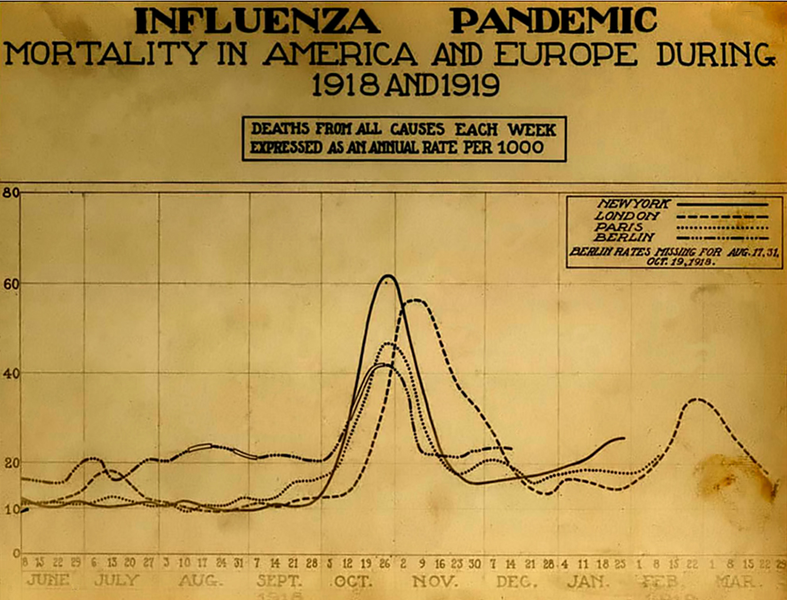
From a Texas A&M News release
Texas A&M researcher shows possible link between 1918 El Niño and flu pandemic
Research conducted at Texas A&M University casts doubts on the notion that El Niño has been getting stronger because of global warming and raises interesting questions about the relationship between El Niño and a severe flu pandemic 91 years ago. The findings are based on analysis of the 1918 El Niño, which the new research shows to be one of the strongest of the 20th century.
El Niño occurs when unusually warm surface waters form over vast stretches of the eastern Pacific Ocean and can affect weather systems worldwide. Using advanced computer models, Benjamin Giese, a professor of oceanography who specializes in ocean modeling, and his co-authors conducted a simulation of the global oceans for the first half of the 20th century and they find that, in contrast with prior descriptions, the 1918-19 El Niño was one of the strongest of the century.
Giese says there were few measurements of the tropical Pacific Ocean in 1918, the last year of World War I, and the few observations that are available from 1918 are mostly along the coast of South America. “But the model results show that the El Niño of 1918 was stronger in the central Pacific, with a weaker signature near the coast,” Giese explains. “Thus the limited measurements likely missed detecting the 1918 El Niño.”
Giese adds, “The most commonly used indicator of El Niño is the ocean temperature anomaly in the central Pacific Ocean. By that standard, the 1918-19 El Niño is as strong as the events in 1982-83 and 1997-98, considered to be two of the strongest events on record, causing some researchers to conclude that El Niño has been getting stronger because of global warming. Since the 1918-19 El Niño occurred before significant warming from greenhouse gasses, it makes it difficult to argue that El Niño s have been getting stronger.”
The El Niño of 1918 coincided with one of the worst droughts in India, he adds. “It is well known that there is a connection between El Niño and the failure of the Indian monsoon, just as there is a well-established connection between El Niño and Atlantic hurricane intensity,” Giese says. In addition to drought in India and Australia, 1918 was also a year in which there were few Atlantic hurricanes.
The research also raises questions about El Niño and mortality from the influenza pandemic of 1918. By mid-1918, a flu outbreak – which we now know was the H1N1 strain that is of great concern today – was sweeping the world, and the resulting fatalities were catastrophic: At least 25 million people died worldwide, with some estimates as high as 100 million deaths. India was particularly hard hit by the influenza.
“We know that there is a connection between El Niño and drought in India,” Giese notes.
“It seems probable that mortality from influenza was high in India because of famine associated with drought, so it is likely that El Niño contributed to the high mortality from influenza in India.”
The flu epidemic of 1918, commonly called the “Spanish Flu,” is believed to be the greatest medical holocaust in history. It lasted from March of 1918 to June of 1920, and about 500 million people worldwide became infected, with the disease killing between 25 million to 100 million, most of them young adults. An estimated 17 million died in India, between 500,000 to 675,000 died in the U.S. and another 400,000 died in Japan.
Could the events of 1918 be a harbinger of what might occur in 2009?
Giese says there are some interesting parallels. The winter and spring in 1918 were unusually cold throughout North America, just at the time influenza started to spread in the central U.S. That was followed by a strengthening El Niño and subsequent drought in India. As the El Niño matured in the fall of 1918, the influenza became a pandemic.
With a moderate to strong El Niño now forming in the Pacific and the H1N1 flu strain apparently making a vigorous comeback, the concerns today are obvious, Giese adds.
Giese’s work will be published in the current “Bulletin of the American Meteorological Society,” and the research project was funded by NOAA (National Oceanic and Atmospheric Administration) and the National Science Foundation.
Contact: Benjamin Giese at (979) 845-2306 or b-giese@tamu.edu or Keith Randall at (979) 845-4644 or keith-randall@tamu.edu
About research at Texas A&M University: As one of the world’s leading research institutions, Texas A&M is in the vanguard in making significant contributions to the storehouse of knowledge, including that of science and technology. Research conducted at Texas A&M represents an annual investment of more than $582 million, which ranks third nationally for universities without a medical school, and underwrites approximately 3,500 sponsored projects. That research creates new knowledge that provides basic, fundamental and applied contributions resulting in many cases in economic benefits to the state, nation and world.
There has not been that many deaths from H1N1. There are deaths all the time from diseases. H1N1 deaths are not unusually high.
Things must be kept in perspective. I don’t like to be carried away by media hysteria.
—-
It is interesting that there could be a connection to El Nino’s.
And there I was thinking that influenza came from outer space…
http://www.space.com/scienceastronomy/planetearth/flu_in_space_000121.html
The panspermia concept is appealing, but this swine flu did originate in Mexico. Perhaps it’s time we should curtail those interminably long technical meetings and stay in our offices and send emails instead.
I seem to have a cough now….
I was about to dismiss the El Nino – flu link as coincidence, but the cold weather angle does favor influenza survival and transmission. The nature of the virus strain, an immunologically naive population, and the worldwide traffic due to the war were almost certainly much bigger factors though.
This Nino is not a strong one,Moderate, possibly weak likely,I say neutral by Dec…
The details of the reported deaths from the H1N1 version show many pre-conditions such that the individuals are susceptible to complications or some other factor making the disease more deadly. This is probably always the case but with early diagnosis and treatment healthy folks that contract H1N1 seem to recover as with other strains. This is from a small sample reported state-wide. Maybe someone has a broader picture of this. Any one know?
The tie-in with weather along with the other things happening in 1918 is rather amazing. On the other hand, it is a big world. It is bound to be wet and cold somplace. Same with 5 o’clock.
These is, however, a connection between Romulan spaceships kidnapping children and solar minima – since their cloaking devices can only work when the solar radio wave emissions are low.
Hey, just because the Galapagos turtles are breeding doesn’t mean that there is a connection between a lot of turtles and a Democratic gain in Congress in 2010. There is a difference between coincidence and correlation.
I remember there was the hypothesis when I was in stats class in college that Superbowls caused the stock market to rise and fall. AFC victory = bear market and NFC = bull market. This held true for at least a couple decades at the time, if memory serves (of course this was back in the late 80’s). I wonder how the ex post analysis has fared…
I am reminded of a favourite quotation from “The Mining Town” by R.E. White (if anyone knows where I can get a copy, please holler):
“Pure gold was hidden in the quartz, they said. ‘Twas proved by dreams and signs, and rods diving. By chemic tests, and spirits of the dead. In fact by everything – except by mining.”
‘Tis pure gold that…
John F. Hultquist (21:27:24) :
They say the lucky ones get it early on in this bout of H1N1.
California is ground zero in the US.
H1N1 did the rounds in the winter just gone in Australia. There was much media hype, and absolutely no unusual death rates compared to previous flu seasons. If anything this is a mild one… so far. Could it mutate into something worse? well, of course, but right now it is a normal annual flu bug. Take the usual precautions.
http://www.vlib.us/medical/parsons.htm
Of course, there is always a hard change in the climate, or simply going from one climate to another, that proves deadly.
In the Newfoundland Regiment, those already over there fared well, while those who were newly shipped over did poorly with the disease. For those who were over there and returned home from the war, the disease was waiting for them.
But, even at that, those who stayed in Newfoundland ???
Is there any rhyme or reason to H1N1?
Get it early, and develop the immunity.
I doubt this link between the virus and El-Nino.
I just find it hard to believe that any flu virus can influence the Pacific water temperature.
There are two important pieces to this story, one of which most things I have read about ‘flu pandemics seem to forget. They are mutation and SELECTION. My understanding is that the environment that led to the selection of the vicious Spanish Influenza strain back then was the trenches and rudimentary hospitals of the 1st world war. These were very particular conditions, allowing the virus to kill its host extremely quickly but not, thereby, destroying its ability to spread (dead people don’t cough or sneeze). There is very little chance of a deadly pandemic unless the particular conditions develop that allow its selection. In other words, deadly influenzas kill their hosts too quickly to spread. So I doubt the ENSO cycle had anything to do with it.
It reminds me a little of the Black Plague. It only became a huge issue in Europe after the Little Ice Age weakened the population dramatically, through hunger primarily, I believe. Or so runs one theory.
Amir Hawk (22:26:06) : …influence the Pacific…
The Pacific has a fever. 😉
The 1918 Spanish Flu pandemic is a very interesting topic… it seems to have so much in common with AGW… bogus statistics… bogus science…
THE SPANISH INFLUENZA EPIDEMIC OF 1918 WAS CAUSED BY VACCINATIONS
http://www.whale.to/vaccine/sf1.html
With so many things these days we need to keep an open mind and look for the real pearls of wisdom hidden from public view by vested interests…
GRAPHICAL EVIDENCE SHOWS VACCINES DIDN’T SAVE US
http://www.vaccinationdebate.com/web1.html
I have no idea where the truth lies… but nothing surprises me after checking out the bogus AGW alarmism promoted by government bodies and the main stream media….
When I was in school a kid asked if South America and Africa ever fit together. So when I see this I think, did they ever fit together. I’m so clever I love myself and my hologram.
Re the sparse measurements of the Pacific surface temperature around that time; what about all that data in all those ship’s logs?
BTW can anyone tell us how THAT research is going? Or are all those measurements providing an embarrassingly inconvenient real climatic picture? ……
And that is no snide remark, just a reflection of the apparent state of climate ‘science’, where objectivity is clearly being compromised by institutional and personal needs on a global basis. Are we looking at the Global Warming of the economic temperature inside academic and government institutions rather than the real environment?
And on the correlation between El Nino and Spanish Flu, what about the correlation between WW1 and CO2 emissions and El Nino? During the 4 years of that war, the most stupendous ‘blip’ in CO2 emissions must have ocurred. Does this show up on the graphs?
And then, there is the even more fantastic ‘ blip’ in CO2 emissions that must have occurred between ’39 and ’45 … and surely this lot must have shown up in the record … would any climatologists care to comment?
1997/8 super El Nino + Hong Kong Avian Flu panic. Yeah, I think I can see cause and effect coming into play here…
The greatest medical holocaust in history surely must be “the black death” in medieval Europe and Asia. It killed about one third of the population in Europe. I don’t know what was the death poll in Asia, but probably it was similar. The Spanish flu is nowhere near those numbers.
The door has just been opened for the flash CNN/BBC breaking news :
“Climate change link to H1N1”.
Watch this space !
Wouldn’t it be ironic if they had to cancel Copenhagen because of H1N1?…
They used a model to reconstruct the El Nino of 1918 as there are few Pacific Ocean temperature records for that era. How did they calibrate their model; with El Nino-rings?
Seriously, how confident can we be about the accuracy of their assertion of the strength of the 1918 El Nino?
Heat and drought are 2 things influenza really doenst like, thats why influenza does its thing mostly in the winter.
the 1918 H1N1 was exceptionaly virulent and could even survive and spread/infect during the summer, and therefore cause a pandemic,
El nino has noting to do with it. on average it would probably decreased the number of cases.
A harsh winter on the NH would have made it a lot worse.
John Barry has written a fantastic book, “The Great Influenza” which analyzes all the evidence about the 1918 pandemic. He also writes it from the point of view of the early medical researchers who were frantically racing to figure out how to treat it, some of whom died from it as they worked on it.
It’s *very* unlikely that an El Nino had anything to do with it – as others have side, the very fast worldwide propagation had more to do with the spread of the virus in the trenches of WW1 and then the quick return of all those soldiers to their home country’s.
Also, although the drought in India may have helped to increase the death total *there*, the death rate from the 1918 strain of the flu was incredibly high *Everywhere*, not just in India. One of the hallmarks of the 1918 flu was that the stronger and healthier a person was, the more likely they were to die quickly from it, which meant that it hit healthy adults in their 20’s and 30’s harder than any other segment – a uniquely perverse hallmark of that particular epidemic. Barry does a very good job of explaining why this happened from a medical perspective; this particular flu seemed especially effective at provoking massive immune system overreactions, which were the worst in the people with the healthiest immune systems. Their lungs would clot and swell completely shut within 48 hours, it was horrific.
Just doing back of the envelope calculations, it looks to me as though the current flu (as it’s appeared so far) is *at worst* maybe 1/10 of 1% as dangerous as the 1918 bug – and in fact that is probably quite an overestimate. Given our current population rates and conducive conditions in the slums of Mexico, if this bug was anything at all similar to the 1918 bug we would have seen 1,000,000 bodies stacked up by now. Obviously, we haven’t – and these pandemics usually *lesson* in severity as they go on, because the nastier mutations burn themselves out.
It is good for everybody to know that the alleged antiviral TAMIFLU it is an extract of Star Anise, which is mainly cultivated in China.
http://en.wikipedia.org/wiki/Star_anise
There was an intense El Nino during 1957-58 and the then called “Asian Flue”, which caused many deaths (btw I got it in july 57´).