reposted from ICECAP
By Dr. Richard Keen, University of Colorado
I’m the NOAA co-op observer for Coal Creek Canyon, Colorado, elevation 8950 feet, in the foothills NW of Denver. Here is a graph of average temperatures for the past ten years. 2008 is by far the coldest year in the past decade, with an average of 39F.

See larger image here.
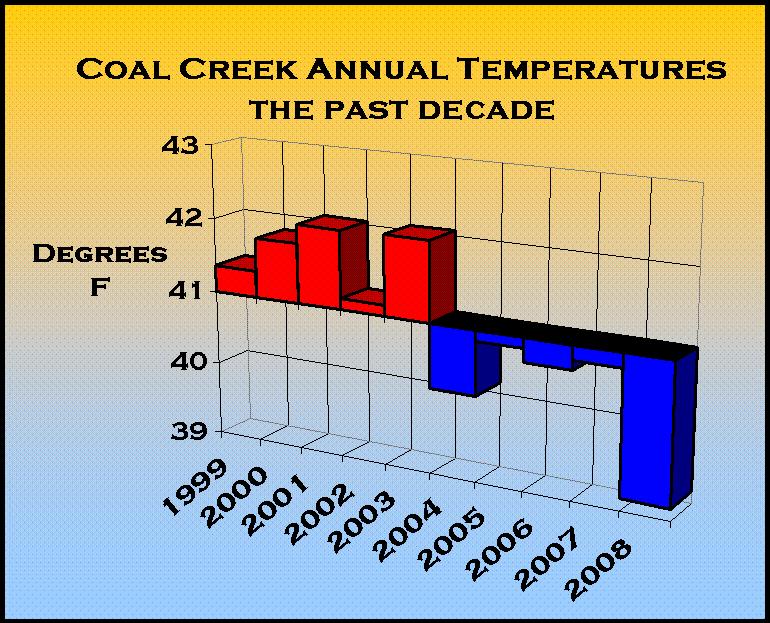
That’s full 3 degrees F colder than 2003. Each of the past five years is colder than any of the previous five years.
This is only one station of the thousands in the NOAA co-op network, but I thought I’d show you the data before it’s adjusted and homogenized by the usual suspects.
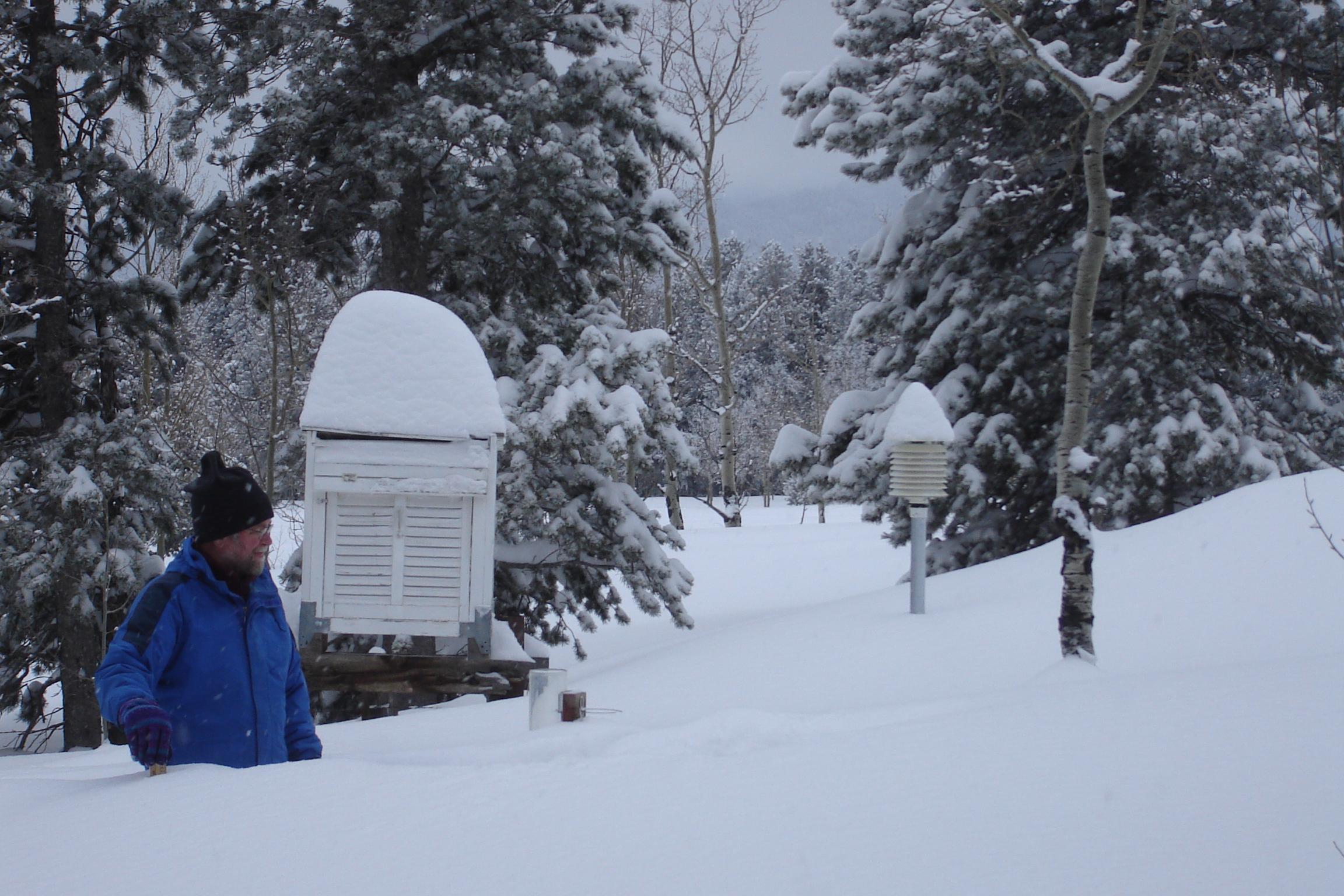
Here’s a photo of the station in January 2007, in the midst of a record round of snow storms in Colorado.

See larger photo here.
The only problem with this being posted by the observer of record is that the alarmists will accuse him of cooking the books before they’re cooked by others.
didn’t really think you couldn’t scrape up any less significant data than your previous post, but you managed to do it. good luck with the weblog awards. 🙂
REPLY: Insignificant in your view, which apparently is only global. We however don’t view individual or regional issues as insignificant as they make up the whole record, and individual examination of these stations is what we do. If you don’t like it, then please don’t dwell here simply to cast snark. – Anthony
How very interesting. The temps start dropping on the descent into the mushy SC24 from the peak of SC23. As if the change occured then.
Just like the temps of the 1590’s in Europe got horridly colder for that decade, prior to the runup to the Maunder and the Little Ice Age.
The shoe fits.
The pattern repeats.
Would it be possible to get the post adjusted data for this site and compare?
This is a great article–many thanks to Dr. Keen. In the interest of forwarding citizen science could anyone post how the yearly average is calculated for a station. Is it simply the arithmetic mean of the daily average/365? How many readings are sufficient for a daily average?
Thanks
Writing from Georgia, it looks positively balmy out there!
Question: Is it policy to remove the snow? I would think that it would make a difference.
[sarcasm]Oh come on! Of course its showing its colder. They built it where there was SNOW! How can anyone expect an accurate reading of all this global warming when there is snow everywhere. Its OBVIOUS that the snow is masking all this warming and that the temperatures would be much higher if they weren’t.[/sarcasm]
Out of curiosity, isn’t snow on top of the instrument kind of bad for taking good temperature measurements?
It is interesting that there are are several prominent organizations a few miles away in Boulder, who keep insisting that the climate is getting warmer. Apparently some people don’t get out of their computer models very often.
Seems to come with professional territory.
The Met Office said yesterday: “We may be going through probably the coldest spell since 1996, but it is probably a bigger medium-term problem that we are going to see some very hot summers
http://www.guardian.co.uk/uk/2009/jan/08/summer-aid
Showing? Somethings showing? Oh how embarrassing. That happens when its colder.
Now where did that apostrophe go? I am always losing that damned thing.
No wonder you get cold readings. Look at all the snow on top of the shelter cooling it.
Not sure about how or where to post this. This is my first time so be gentle,
I happened to look at the Arctic Sea ice web site: http://nsidc.org/data/seaice_index/images/daily_images/N_timeseries.png
It appears a little odd as I remember the 2008 line never crossed the 2007 line last year. Well, it now does. Any thoughts from anyone?
Wolf Creek Ski Area in Colorado has already received 20 feet of snow this winter.
http://www.wolfcreekski.com/snow.asp
Meanwhile, Boulder climate experts predict the demise of the ski industry, due to a lack of snow.
http://www.iht.com/articles/ap/2008/12/16/sports/SKI-Disappearing-Snow.php
ak (20:02:36) :
didn’t really think you couldn’t scrape up any less significant data than your previous post, but you managed to do it. good luck with the weblog awards. 🙂
Are you saying that all station records are insignificant or just this one because it doesn’t suit your mindset?
“didn’t really think you couldn’t scrape up any less significant data than your previous post, but you managed to do it. good luck with the weblog awards.”
ak you seem to miss the point of this site, we are not big pretty picture “science” here. I for one don’t care about a science screw up in a popular movie or tv show, or how religion is evil (how is that even science?) . I really don’t care.
I CARE about the infrared properties of white wash vs latex paint, and how an improperly placed air conditioner can raise a MMTS weather station .12 degree F, and exactly what is the diameter difference between a sun spot or a sun speck, and exactly how many days has the solar wind speed density been under 9.98 p/cm^3.
The people who frequent Wattsupwiththat, climateaudit, climatesci.org are proud to be called Dorks, Nerds, and Geeks, because we breath the minutiae of science, because in the end, that’s where all real science is done.
Now if you don’t mind I’m going to go read up on ocean heat thermal dynamics and the proper methodology to measure tree ring chronologies.
Have a nice day 🙂
ArCtic ice is something like caring for a toddler in an open park. Or like herding cats caught in a kennel.
Temperatures plunge unevenly as the winter season begins and waters begin to freeze. Ice floats, and it’s a bit chunky and soft around the edges. Wind blows (from pressure variants) and pushes ice, sometimes to warmer waters, sometimes to colder waters. Never the same from day to day. Currents underneath carry it to and fro as well. Jet stream influences wind patterns that circle the Arctic. It will grow, just like cats having babies, but you still won’t be able to herd it. During the melt season, seasonal tilt of the Earth and the Sun’s rays do the rest.
I am surprised he has a 4″ plastic precip gauge instead of a
Standard 8″ gauge. With that much snow it seems his readings for total precip may be too low.
From the Anchorage sea-ice desk
…JANUARY YEAR GROUP ANALYSIS AND OUTLOOK…
ICE EDGE LOCATIONS IN THE BERING SEA ARE 30 TO 40 PERCENT ABOVE
NORMAL. ACTUAL ICE EDGE POSITIONS THIS YEAR ARE 60 TO 100 NM SOUTH OF
THE SAME TIME LAST YEAR. ICE IN COOK INLET IS 25 TO 35 PERCENT ABOVE
NORMAL AND EVEN GREATER IN KACHEMAK BAY.
THE YEAR GROUP FOR JANUARY IS 1975 FOLLOWED BY 2000. BOTH OF THESE
YEARS WERE DURING LONG PERIODS OF LA NINA CONDITIONS IN THE PACIFIC.
THIS YEAR WE ARE ALSO IN A LA NINA THAT IS EXPECTED TO CONTINUE INTO
THE SPRING. LA NINA WINTERS ARE USUALLY COLDER THAN NORMAL IN ALASKA.
SEA ICE CONDITIONS IN JANUARY 2000 WERE SLIGHTLY MORE SEVERE THAN IN
2009 AND SLIGHTLY LESS ADVANCED IN THE BERING DURING 1975.
THE BERING SEA AND COOK INLET WILL HAVE EXTREME ICE SEASONS THIS YEAR
WITH MUCH GREATER THAN NORMAL ICE AREAS. EXPECT THE ICE EDGE TO REACH
POSITIONS NEAR AND BEYOND THE BERING SHELF SEVERAL TIMES THROUGH
FEBRUARY AND INTO EARLY MARCH. ICE WILL MOVE IN AND OUT OF SAINT PAUL
WITH PASSING WEATHER SYSTEMS. ICE WILL SURROUND SAINT GEORGE AT
TIMES FROM LATE JANUARY THROUGH FEBRUARY. ICE WILL ALSO DEVELOP AND
RETREAT THEN RE-DEVELOP ALONG THE BERING SIDE OF THE ALASKA PENINSULA
THROUGH EARLY FEBRUARY.
ICE WILL CONTINUE IN LOWER COOK INLET INTO APRIL AND UPPER COOK INLET
THROUGH APRIL. ICE THICKNESS IN COOK INLET WILL GROW UP TO 30 TO 36
INCHES FOR AREAS NORTH OF KALGIN ISLAND BY EARLY FEBRUARY.
KCOLE 2009
Neither did the sea ice shrink to the 2007 levels this year, as imaged.
Don’t know about Russia this winter, but Canada, Alaska and N. Europe are getting blasted with severe cold.
That’s gotta do some serious freezing out in the Arctic Ocean.
Data Fudge anyone?
To all who think snow on top of the “housing” will makesa difference in an annual measurement…why not try an actual experiment?
Get two thermometers, and put one of them in tupperware.
Put them both in your freezer, and put ice on top of the tupperware.
Is there a difference? 😉
Unusually intense pressure gradients have (according to the ice people) caused unusually strong Southerly winds East of Greenland preventing ice from expanding in that area in the usual fashion.
Its weather.
Tom, you just posted eye candy. Ice edges. I lurv ice edges.
New Zealand is burning at the moment with temperatures of +40C +
Because the daily extent chart now shows the winter of 2006 to 2007 (dashed green line) not 2007 to 2008. NSIDC say that the graph will continue to show 2007, which went on to reach the lowest summer minimum in the satellite record.
I think this is the chart that you recall:
http://i251.photobucket.com/albums/gg311/johnnyrook1/SeaiceextentDecember202008NSIDC.png