Essay by Eric Worrall
But abolishing 30% of household energy bills by cancelling the green energy transition might help.
EU governments helpless as energy prices soar to four-year highs
There’s a ‘difficult’ winter coming, and ministers have few solutions.
OCTOBER 29, 2026 8:00 PM CET
BY BEN MUNSTER AND ELENA GIORDANO
LUXEMBOURG — Europe’s energy ministers are running out of ideas to protect citizens from surging energy prices as winter approaches.
…
European gas prices soared above €100 per megawatt-hour on Wednesday for the first time since 2022, as last-minute panic-buying to fill European gas reserves added to supply pressures linked to the war in the Middle East.
…
“We’ve exhausted most of our short-term options,” said one senior European energy official, granted anonymity to offer a candid perspective. “What’s left is really crisis management.”
…“The EU and member states don’t have a magic wand to make the price increases go away,” Irish Energy Minister Darragh O’Brien, whose government holds the EU’s six-month rotating presidency, told reporters. “There’s a lot of measures that have been taken already in the short term. What today is about is actually seeing how we can move to more sustainable measures.”
…“I don’t want to see that we will limit people,” said Mika Nykänen, the state secretary to Finland’s energy ministry. Instead, he called for policy designed to “change behavior” and reduce energy consumption less painfully. “Industry does it naturally. Normal households, normal families — they sometimes need encouragement,” he said. “For instance, subsidies to invest in the energy efficiency of houses, windows.”
…
Read more: https://www.politico.eu/article/eu-energy-prices-fossil-fuels-gas-middle-east-four-year-high/
Pundits covering widespread riots in Europe are careful to describe the problem as “cost of living”, rather than specifically mentioning energy. But there is no doubt energy costs are at the root of much of the hardship driving public anger.
Massive protests sweep Europe over cost of living and strained public services
Germany, France, Spain and Italy are among the nations protesting on Halloween following a recent wave of Gen Z-led marches across the continent.
Oct. 31, 2026, 9:39 PM GMT+10 / Updated Nov. 1, 2026, 7:35 AM GMT+10
By Freddie Clayton
Massive protests were sweeping Europe on Saturday as part of demonstrations driven by the cost of living and deficient public services, with police bracing for potential violence after recent looting and riots.
Germany, France, Spain and Italy are among the nations where demonstrations were being held on Halloween following a recent wave of Gen Z-led marches across the continent.
French officials said they would deploy 70,000 police on Saturday following some of the worst rioting in decades, which erupted in cities across the country after student protests about the state of education evolved into wider demonstrations about the cost of living and social security.
…
Read more: https://www.nbcnews.com/world/europe/europe-braces-massive-halloween-protests-cost-living-public-services-rcna606671
The Irish Energy Minister’s claim that the EU and member states don’t have a magic wand to make the price increases go away in my opinion rather understates what they do have the power to do.
Bill attribution is an absolute rat’s nest of indirection, so I asked Claude to make sense of it.
What proportion of consumer electricity bills in the EU are levies intended to fund the green energy transition?
…
Can you produce a shorter summary emphasising the hidden grid fees – I’m looking for an estimated aggregate cost number.
…
My estimate is that about 20–35% of the average EU household electricity bill, centrally around a quarter, is attributable to the green transition once grid and carbon costs are counted alongside the explicit levies.
There’s no official aggregate figure, so this is a rough estimate built from three parts:
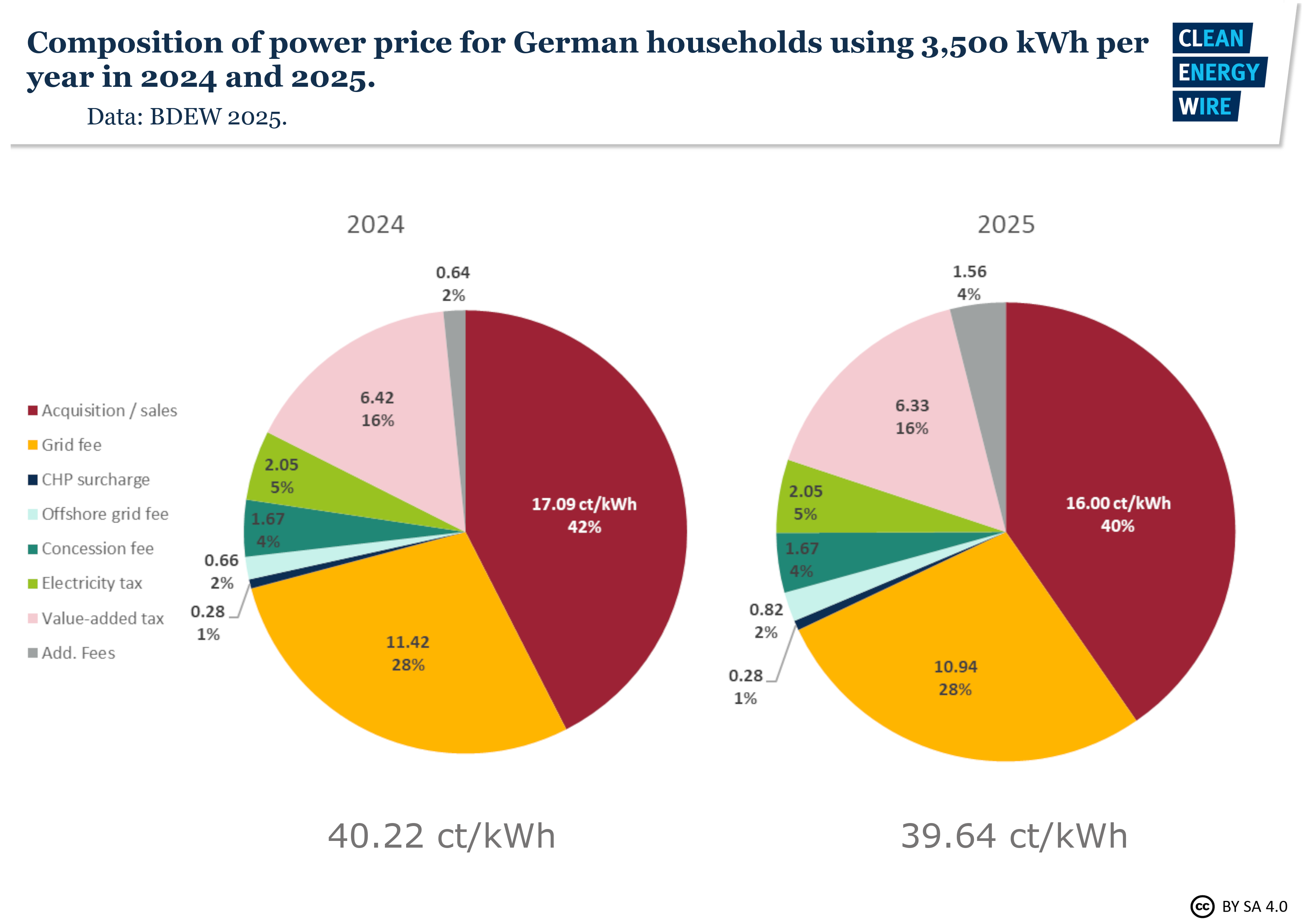
Component Share of bill Basis Explicit renewable levies ~5–10% Part of the 10% “other taxes” slice in ACER’s 2024 breakdown (48% energy, 27% network, 15% VAT, 10% other taxes) Transition-driven grid fees ~8–13% Assumes a third to a half of network charges come from integrating renewables. This is my assumption; no EU-wide split is published. Carbon cost in the energy price ~7–15% Carbon prices make up 20–50% of the wholesale price across European markets, according to AFRY, applied to the energy component Total ~20–35% Why grid fees are the “hidden” part. Network costs show up on bills as delivery charges, not as green levies. Network tariffs make up about 25% of the bill, and regulators estimate grid costs for consumers could nearly double by 2050. The pressure is visible at country level. In Germany, the regulator found that customers in regions with strong renewable growth were bearing all the costs of integrating renewable energy, and it began spreading those costs nationally from 2025. In the Netherlands, the average household grid tariff could nearly triple, from €400 to over €1,100, after the planned offshore wind build-out.
Caveats:
- The grid figure is the weakest part of the estimate. Some network spending would happen anyway, for ageing infrastructure and rising demand.
- The estimate is gross, not net. Renewables also push wholesale prices down in many hours, and governments recycle ETS carbon revenue, partly back to households.
- National differences are large. Germany or the Netherlands would come out well above this range, and Malta or Hungary well below it.
Sources:
Full transcript: https://claude.ai/share/528761de-7d8b-42c0-a055-59caf3253daf
- ACER – EU household price breakdown 2019–2024
- AFRY – Impact of European Green Deal on the EU ETS
- Heinrich Böll Stiftung – Fair allocation of energy network costs
- Green European Foundation – Grid tariffs brief
- Bundesnetzagentur – Network tariffs press release
- Brussels Signal – Dutch offshore wind grid costs
What can I say? The Irish energy minister is right that a magic wand won’t reverse cost increases, and obviously some of the estimates above are based on incomplete data, but the possibility of abolishing up to 35% of energy bills by cancelling the green energy transition is surely worth a second look.
Note that Claude’s estimates of the potential savings from cancelling the green revolution swing wildly depending on what instructions it is given, so Claude is having just as much trouble untangling what makes EU energy so expensive as I am. Claude also sometimes struggles to give coherent answers to questions on sensitive topics like the green energy transition, for obvious reasons. In addition I suspect the EU are deliberately obfuscating source information to conceal the damage their green energy obsession is causing, though I can’t prove that assertion at this stage.
Whatever the true figure, cancelling a significant percentage of people’s energy bills, and improving energy security by say repealing EU bans on fracking, would go a long way towards easing pressures on people’s finances. Such immediate cost of living relief would surely help calm the anger which is driving the rage on Europe’s streets.