From Dr. Roy Spencer’s Global Warming Blog
by Roy W. Spencer, Ph. D.
This month I’m adding Australia to the Global, USA48, and Canada time series plots.
The Version 6.1 global average lower tropospheric temperature (LT) anomaly for May, 2026 was +0.53 deg. C departure from the 1991-2020 mean, which is up from the April, 2026 value of +0.39 deg. C..

The Version 6.1 global area-averaged linear temperature trend (January 1979 through May 2026) remains at +0.16 deg/ C/decade (+0.22 C/decade over land, +0.13 C/decade over oceans).
A Note on These Tropospheric Temperature Anomalies vs. Surface Temperature Anomalies
It has been a while since I have discussed the main reason why our global monthly satellite-based tropospheric temperature anomalies can sometimes differ by quite a lot from the global monthly surface temperature anomalies. A good example is the last 2 months. In April, our +0.39 deg. C anomaly was statistically identical to the +0.38 deg. C surface temperature anomaly from the NOAA Climate Data Assimilation System (CDAS, which I take from WeatherBell.com maps). But then last month (May) the CDAS anomaly went down slightly (+ 0.34 deg. C), while our UAH anomaly went up considerably (+0.53 deg. C). These month-to-month fluctuations in the relationship between surface and tropospheric temperature changes are almost certainly dominated by fluctuations in moist convective heat transfer from the surface to the free troposphere. When there is a burst of extra convection (usually in the tropics), it cools the surface and warms the free troposphere more than normal, which is probably what happened last month (May).
The following table lists various regional Version 6.1 LT departures from the 30-year (1991-2020) average for the last 29 months (record highs are in red).
| Year | Mon | Globe | NHem | SHem | Tropic | US48 | Arctic | Aust. | Can. |
| 2024 | Jan | +0.80 | +1.02 | +0.57 | +1.20 | -0.19 | +0.40 | +1.12 | +0.97 |
| 2024 | Feb | +0.88 | +0.94 | +0.81 | +1.16 | +1.31 | +0.85 | +1.16 | +2.45 |
| 2024 | Mar | +0.88 | +0.96 | +0.80 | +1.25 | +0.22 | +1.05 | +1.34 | +1.12 |
| 2024 | Apr | +0.94 | +1.12 | +0.76 | +1.15 | +0.86 | +0.88 | +0.54 | +1.39 |
| 2024 | May | +0.77 | +0.77 | +0.78 | +1.20 | +0.04 | +0.20 | +0.52 | +0.67 |
| 2024 | June | +0.69 | +0.78 | +0.60 | +0.85 | +1.36 | +0.63 | +0.91 | +0.19 |
| 2024 | July | +0.73 | +0.86 | +0.61 | +0.96 | +0.44 | +0.56 | -0.07 | +1.15 |
| 2024 | Aug | +0.75 | +0.81 | +0.69 | +0.74 | +0.40 | +0.88 | +1.75 | +1.36 |
| 2024 | Sep | +0.81 | +1.04 | +0.58 | +0.82 | +1.31 | +1.48 | +0.98 | |
| 2024 | Oct | +0.75 | +0.89 | +0.60 | +0.63 | +1.89 | +0.81 | +1.09 | +0.89 |
| 2024 | Nov | +0.64 | +0.87 | +0.40 | +0.53 | +1.11 | +0.79 | +1.00 | +1.61 |
| 2024 | Dec | +0.61 | +0.75 | +0.47 | +0.52 | +1.41 | +1.12 | +1.54 | +1.65 |
| 2025 | Jan | +0.45 | +0.70 | +0.21 | +0.24 | -1.07 | +0.74 | +0.48 | +1.04 |
| 2025 | Feb | +0.50 | +0.55 | +0.45 | +0.26 | +1.03 | +2.10 | +0.87 | -0.35 |
| 2025 | Mar | +0.57 | +0.73 | +0.41 | +0.40 | +1.24 | +1.23 | +1.20 | +0.80 |
| 2025 | Apr | +0.61 | +0.76 | +0.46 | +0.36 | +0.81 | +0.85 | +1.21 | +0.45 |
| 2025 | May | +0.50 | +0.45 | +0.55 | +0.30 | +0.15 | +0.75 | +0.98 | +0.81 |
| 2025 | June | +0.48 | +0.48 | +0.47 | +0.30 | +0.80 | +0.05 | +0.39 | -0.22 |
| 2025 | July | +0.36 | +0.49 | +0.23 | +0.45 | +0.32 | +0.40 | +0.53 | -0.23 |
| 2025 | Aug | +0.39 | +0.39 | +0.39 | +0.16 | -0.06 | +0.82 | +0.11 | +0.62 |
| 2025 | Sep | +0.53 | +0.56 | +0.49 | +0.35 | +0.38 | +0.77 | +0.30 | +2.44 |
| 2025 | Oct | +0.53 | +0.52 | +0.55 | +0.24 | +1.12 | +1.42 | +1.67 | +2.59 |
| 2025 | Nov | +0.43 | +0.59 | +0.27 | +0.24 | +1.32 | +0.78 | +0.36 | +1.47 |
| 2025 | Dec | +0.30 | +0.45 | +0.15 | +0.19 | +2.10 | +0.32 | +0.37 | -1.86 |
| 2026 | Jan | +0.35 | +0.51 | +0.19 | +0.09 | +0.30 | +1.40 | +0.95 | +1.17 |
| 2026 | Feb | +0.39 | +0.54 | +0.23 | +0.03 | +1.91 | -0.48 | +0.73 | +0.32 |
| 2026 | Mar | +0.38 | +0.33 | +0.42 | +0.07 | +3.74 | -0.48 | +1.14 | -3.17 |
| 2026 | Apr | +0.39 | +0.43 | +0.34 | +0.23 | +1.20 | +0.30 | +0.70 | -0.89 |
| 2026 | May | +0.53 | +0.53 | +0.53 | +0.58 | +0.21 | +0.33 | +0.10 | +0.21 |
| Year | Mon | Globe | NHem | SHem | Tropic | US48 | Arctic | Aust. | Can. |
Time Series Plots for USA48, Canada, and Australia


The full UAH Global Temperature Report, along with the LT global gridpoint anomaly map for May, 2026 and a more detailed analysis by John Christy, should be available within the next several days here.
The monthly anomalies for various regions for the four deep layers we monitor from satellites will be available in the next several days at the following locations:
No surprise, the lower troposphere is responding to the onset of El Super Duper El Niño.
Well, maybe a tad premature . . . The National Weather Service Climate Prediction Center currently “notes a high likelihood” of an El Niño emerging by mid-summer in the northern hemisphere.
Obviously you glossed right over the word “onset” and assumed I said there was an El Niño right now, which I didn’t say or infer.
No it’s not premature as the Niño onset is evident, and UAH lags Global SST by 3 months. Global SST has risen for at least 5 months, long enough for UAH LT to respond positively.
This is month 5 of 24 in the window. I’ll update it here monthly through 2027.
“Obviously you glossed right over the word ‘onset’ and assumed I said there was an El Niño right now, which I didn’t say or infer.”
No. I equated the word “onset” with the word “emerge” that was used by the NWS Climate Prediction Center.
And in fact you did post:
“No surprise, the lower troposphere is responding to the onset of El Super Duper El Niño.”
and I do believe the phrase “is responding” is recognized as present tense.
You and others are getting carried away picking nits over ‘onset’. The course is set, there is an El Niño on the way. I call the onset period the time after the 0.5°C threshold is met but before the 5-month duration condition is met.
UAH is responding to the Niño onset in the present tense, originally driven by the increase in Pacific subsurface heat, that ripples through the climate in a specific order.
UAH normally follows SST by 3 months. It is doing it again in the present tense.
Language precision is always critical in communications involving science and engineering.
asfaik, there is no official label given to the lead-up period before an El Niño ’emerges’, so I gave it one, without defining it in my first comment, and without labeling it in my plots. Next time I will.
Turning now to the important issue, this is a learning opportunity for everyone to see it unfold from where Niños and global warming begin, in the Pacific top 300 meters, to all the subsequent climate responses such as from UAH LT.
All Equatorial Ocean Heat Content anomaly data anywhere near the recent monthly values always preceded an El Niño. There is no reason today to think an El Niño isn’t coming this year. Niño history indicates we can expect about a year of above average EqOHC anomalies as long as the Kelvin waves keep coming.
A 2026 heat record will depend on this summer’s Kelvin wave strength.
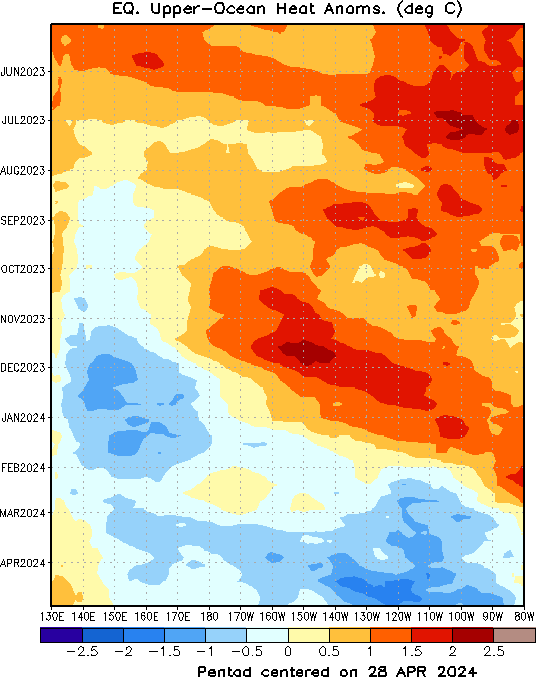
On June 11, eight days after my post, NOAA released the following ENSO Discussion:
ToldYouSo, I told you so!
Second-warmest May on record.
Still ENSO neutral.
El Nino forming…
The alarmists claim warming is an existential threat to humanity … and root for the record to show more warming?
I find this behavior to be inexplicable.
Makes no sense.
Alarmists would be scared of the prospect of future warming, not rooting for it.
C’mon man.
Alarmists LIVE for announcements of increasing temps, heatwaves, ice melting, seas boiling, floods. Even when they’re just ordinary weather events.
Exactly! They do live for it. Which makes sense as it is the only thing they have to talk about.
If the temperatures start trending downwards, we won’t be hearing from the Climate Alarmists. Their whole reason for existence will be gone.
That is what climate cults does.
“Makes no sense.”
Correct. But only with correction of your second sentence.
“Alarmists
wouldSHOULD be scared of the prospect of future warming, not rooting for it.”I don’t think they’re rooting for more warmth, instead just reminding everyone of the facts. Some on here need to take remove the blinds. Given that so many here have their heads so deeply buried in the sand, reminders of what the evidence is actually telling us is completely acceptable.
Can WUWT get a filter to prevent the “heads buried in sand” (and all versions)? As a metaphor it is silly and as a natural phenomenon of Ostriches it is false.
It’s not false when many (not all) refuse to accept reality!
Reality is temperatures have been just as warm as today, and after that, temperatures went into a cooling trend.
You assume there won’t be a cooling trend after the current warming. Based on nothing.
Why should anyone be scared of a few tenths of a degree of warming?
The current temperatures are cooler than we have been for over 90% of the last 10000 years.
If it were 5 degrees warmer, I wouldn’t need to wear a light jacket on mornings in May.
Who said anything about being scared? This was simply a response to reporting the data…..
“The current temperatures are cooler than we have been for over 90% of the last 10000 years.‘
You keep peddling this same lie Mark. Even when evidence is presented you still do it. that makes you a liar. Sorry but it is the truth.
What is the actual evidence telling you?
“What is the actual evidence telling you?
I think it’s pretty obvious from a number of sources……that it’s that the earth remains on a warming trend, at least for now. It may be temporary or it might be longer term. It might be serious or it might not. However, the data clearly points to warming. It’s perfectly acceptable for anyone, those who who agree with AGW theory or those who are skeptical to point this out. Anyone who takes exception to it effectively has their head in the sand – it’s a very apt expression for many (not all) on this platform.
And whoever it is who points to such evidence doesn’t deserve the slating they receive habitually by many (not all) on this platform.
“However, the data clearly points to warming.”
Yes, and the data from 1850 to the 1880’s clearly pointed to warming. And then, after that, the temperatures cooled by 2.0C.
The data from 1910 to the 1930’s clearly pointed to warming. And then, after that, the temperatures cooled by 2.0C.
The data from 1980 to today clearly points to warming. And then, after that, what happens?
exactly where is the evidence that the global temperatures cooled by 2 degrees in either the 1880’s or the 1930’s? Even a cooling of 0.2 degrees during that time period isn’t apparent in the data. Have a look at Berkley Earth temperature record for example.
https://berkeleyearth.org/press-release-berkeley-earth-2025-was-the-third-warmest-year-on-record-extending-an-unprecedented-run-of-global-heat/
“I think it’s pretty obvious from a number of sources……that it’s that the earth remains on a warming trend, at least for now.”
You will be hard pressed to find anyone who denies that.
What is totally missing is a definition of optimum climate.
Without clearly defined metrics that are measurable and testable by anyone, how can we claim we are departing from the optimum? Is 1850 the optimum? I think not.
For all we know, after more than 50 years of alarmism, we could be slowly progressing TOWARDS an optimum.
There are periods of time in the last 10,000 years that demonstrated human civilization benefitted from warmer much more than from colder.
Plausible!
“AGW “theory“
?
My understanding of the classic Scientific Method is that –
natural phenomena are observed, which prompt curiosity as to possible causes & effects;a Hypothesis is posed to explain the phenomenon, which MUST be accompanied by a Null Hypothesis, specifying evidence that would dismiss the crafted Hypothesis as false; studies and/or experiments are designed to test the probability of acceptance of the Hypothesis and the Null Hypothesis;should the Hypothesis stand up to the possibility of being found real, the Null Hypothesis can be set aside;then a Theory explaining the reality of the studied cause & effect of the phenomenon is written and submitted for critique by suitably knowledgeable / recognized experts in the same or relevant fields;should general proving of the Theory’s accuracy be demonstrated and accepted, a Law may be postulated, proven in the real world, and adopted as a basis for further related scientific research, testing, proving and referential reliance.Now, I’ve asked this many, many times of AGW boosters, but have never received an answer –
please tell me what the Null Hypothesis says that applies to the AGW CONJECTURE
(because without a proper Null Hypothesis, AGW doesn’t even make it to the status of a Hypothesis, let alone a Theory. It remains Conjecture).
?
Neutral1966, can you believe you’ve received 15 downvotes (at the time of writing) for a completely neutral comment? What does that say about these commenters?
Please review my response above, to Scissor!
In fact I take it as a complement to receive downvotes from those who are unwilling to accept perfectly sterile data. It shows that my comments are obviously having some degree of effectiveness – even if unreasonablly negative.😉
Also, if you took the time to read some of my other posts, with a completely unbiased and calm mind, you would see that I often provide evidence that helps to dilute some of the more extreme headlines on global warming.
Just recently, for example, I offered a reasonable explanation for some of the heat spikes recorded in the UK – related to cold air being locked up in the higher Arctic. The UK often experiences colder air plunges from the Arctic during the spring months. Although this did happen this year for a short periods, mostly affecting the north of the country, by the time the hot air arrived from the Sahara, later in May, the cold air had become locked up in the far north of the Arctic above 80 degrees north. This meant that there was very little cold air over the mixing zone, which is where the UK sits. Conversely 80 degrees north, the Arctic had been a fair bit colder than normal.
So, please try to be equally as balanced in your responses!
We can do that if you do not have wording that is too easily read as insulting. So, please try to be equally neutral in YOUR posts.
Apologies, I think I may have misinterpreted your question! Yep, good question indeed…. what does it say about many (but not all) those commenting on this platform.. 😅
No worries.
And yes, a good question indeed.
If you think the comment was completely neutral, that explains almost every post you ever made.
This is not neutral.
“Some on here need to take remove the blinds. Given that so many here have their heads so deeply buried in the sand, reminders of what the evidence is actually telling us is completely acceptable.”
Those so called reminders are biased opinions.
Please explain why simply reporting the data is a biased opinion. According to that stance, then potentially all science is biased opinion!
“Facts”?
bwahahaha
I accept that “facts” might be the wrong term. How about “best available evidence” instead…. which is all we have at our disposal in coming informed conclusions?
Gee another false narrative from a warmest/alarmist…….. how so typical that is.
No one here is disputing the warming.
They want an excuse to exert power. That is all.
“They want an excuse to exert power. That is all.”
Conspiracy theory and conjecture….
The truth is they also know that there is nothing to fear, however they are convinced they can use the panic they are trying to cause as a vehicle to give them the power they seek.
Second warmest May on record… since when???
Of the 4.5 billion year history of the planet, they proclaim that the last 50 are the only ones that matter.
Funny, I didn’t see where TheFinalNail said that.
So dishonest.
What’s dishonest about it?
This article is entitled:
Therefore the “record” they (and I) refer to is the ‘UAH v6.1 Global Temperature record’.
Does absolutely everything need to be spelled out?
You’re misunderstanding my point.
What I called dishonest was the user’s claim that you were arguing only the last 50 years matter. Not you.
Sorry.
Since the record began in Dec 1979.
Still waiting for the surface temperature producers to report.
Dec 1978, sorry. So the first May on the UAH record was May 1979.
0.53 degree C is distant from 0.77.
0.53 degree C is distant from 0.30.
Who said it wasn’t?
I said it was the second-warmest May temperature anomaly on record (the ‘UAH record’, for those who didn’t notice the title of the article).
The record is too short to make anything of any “records”.
Beyond that, current temperatures are still less than the Medieval Warm Period as well as the 4 other warm periods since the end of the Holocene Optimum, as well as at least 2C cooler then the entirety of the 5000 year long Holocene Optimum.
And yet Monckton had many convinced here that small subsets of this record were substantial enough that one could determine if the warming had stopped or not.
BTW…where is Monckton anyway?
“BTW…where is Monckton anyway?”
I’m sure people were asking the same question between March 2016 and December 2020, when Monckton also stopped publishing his “pause” updates.
Monckton just showed a that the warming was not measurably caused by CO2 evidenced by the pause.
Any punter could also stage 3 graphs on a page showing CO2 increasing, matched by wind & solar installations growth, and rising temperatures constructs.
The only observable logical conclusion by any rational person would be that the “Green Energy Revolution” is a crock.
For that matter, one could demonstrate sales of McDonald’s Big Macs cause the temperature rise.
That’s total nonsense isn’t?
Why is it that so few seem to understand that natural climate variability continues alongside the warming trend (whatever might be driving the warmth, CO2 or something else or combination of factors)? Why would anyone with even the merest ability to analyse, expect CO2 to produce a completely linear trend in warming?
Well, it was true that before the pause started, multiple climate scientists claimed that a ‘pause’ of more than a decade would throw serious doubt on their CO2 conjecture.
Until 15+ years of pause happened, then they shut up about how pauses invalidate their conjecture.
Seems like since then they ‘adjusted’ the records so that the pause was minimized.
Any CO2 caused warming cannot be evidenced in the short periods that encompassed Monckton’s “pauses”. They instead showed short term natural variability in the climate. Chiefly that of ENSO and the cycling from LNs to ENs to LNs etc
And yes, there are some here that realise this, hence the rumbling about a coming super EN.
If Monckton thinks the pause-up-pause-up pattern falsify the hypothesis that CO2 can influence global temperatures then his argument is flawed due to the reduction fallacy.
Males keep setting high school girl track records.
Radical Democrats hate women.
Those same RDs want to pass a law giving woman 12 days paid leave during their menstrual cycles.
12 days/year so one day a month seems reasonable.
Is say it is more the Rape-ublicans that hate the women given their lack of effort to bring Epstein’s victims justice.
I would like to see every trans-girl/woman athlete answer the question of how their menstrual cycle affects their training and competitive performance.
In addition, how many “feminine hygiene” products they consume per year.
And also, how worried are they (swimmers in particular) of leaving a pink trail as they swim or whatever.
Credit to Mulvaney when “she” laughed at becoming the new tampon spokesperson.
The population of Great Britain is at its highest in recorded history.
So, weather IS climate. Got it.
No, climate is +0.16C per decade statistically significant warming since Dec 1979 (+0.18C per decade over the past full 30-years).
Nope. Calculations of Tave are not temperature.
Temperature is an intensive property and cannot be averaged in any meaningful way.
There is no global climate. Can one average the Sahara with Antarctica?
Oversimplifications do not get accurate results.
Yes. The planet is warming and all signs presently show this is a good phenomenon. But not all micro climates are warming.
Agreed, it’s difficult to produce a meaningful global temperature. However, there is enough evidence from a number of sources that there are more regions of the globe warming than there are cooling. Any idiot understands that that the Sahara climate is not the same as that of Antarctica – although they are both technically deserts.
UAH does not use calculations of ‘Tave’. They use measurements of upwelling radiance taken continuously by microwave sounders. UAH and other satellite producers convert these data into temperatures using inversion algorithms.
Yet nearly everyone here thinks (or at least used to think) that satellite data are less adjusted than directly-measured surface station data.
Hmmm . . . 0.14 deg-C jump in GLAT from end-April to end-May 2026.
Might that qualify as being a “dead-cat bounce” as regards the aftereffects of the January 2022 Hunga-Tonga undersea volcano eruption? /sarc
0.5 C per DECADE!
How come he does not so?
“A Note on These Tropospheric Temperature Anomalies vs. Surface Temperature Anomalies”
One difference is that, at least to now, satellite data reliably appears. Surface monthly data was collated in the GHCN collection, by NOAA, and reliably updated every day for the last fifteen years. But so far, no May data at all, and no updates sinse 30 May.
The purple-veined, hypertension afflicted orange and his administration must have been especially fearful of global warming this past month, which is why they felt compelled to censor it.
Well, the data might have been deemed to not support his agenda
Now we enter the agenda debate.. we’re on dodgy ground……. because that could work both ways couldn’t it?
Why would any rational person have to “censor” global warming?
I mean, if it’s global, and happening, someone somewhere would have experienced it, and made a youtube on it with clear pics & videos.
It would be found in the youtube classification of either Comedy or Entertainment.
(free subscription of course. I mean such productions are only there to pull in the punters and bombard them with ads for self-peeling bananas cause by – you guessed – global warming)
The missing data was station data.
“I mean, if it’s global, and happening, someone somewhere would have experienced it, and made a youtube on it with clear pics & videos.”
Which makes the decision to censor it all the more peculiar. But I suppose many Trump supporters place their loyalty to Trump above what their own senses tell them.
But I suppose many Trans-Reality Alarmists place their loyalty to cause above what their own senses tell them.
The Climate Cartel has a problem with Trump. We get it. Unfortunately for you climate ideologues, Climate Reality doesn’t care who’s in office. To be honest, I don’t like Trump either. So what. His energy policies are pro-America, and will benefit all Americans, and the world. I don’t care about Trump. I care about America. Climate Liars hate America.
“To be honest, I don’t like Trump either. So what. His energy policies are pro-America, and will benefit all Americans, and the world. I don’t care about Trump. I care about America. Climate Liars hate America.”
Where have you been for the last three months? Gas prices have rose significantly as a result of a war Trump launched.
And America LOST the war. The Strait of Hormuz remains strategic leverage over America and America didn’t achieve any of its stated objectives (regime change, dismantling nuclear program). Instead, the regime remains in power and will likely be even more hostile and difficult to deal with.
“Gas prices have rose (sic) significantly as a result of a war Trump launched.”
Someone who struggles with basic English grammar probably has little to contribute on other matters.
Yes, quick typing does that.
(There are also some grammar errors from others in the thread, such as Bruce capitalizing “H” after a comma.)
To expand on my point:
“Instead, the regime remains in power and will likely be even more hostile and difficult to deal with.”
Trump was gullible in believing that eliminating their leader would cause the entire regime to collapse.
Iran’s system is highly resistant to regime change because its rule of law is deeply institutionalized and distributed across multiple centers of power. It doesn’t rely on a single government branch.
I’m impressed by how sophisticated and well structured it is. It reflects strong long term planning on their behalf.
Somebody is gullible.
I don’t think it is Trump.
Iran is a country captured by a rogue fundamentalist religion (ideology) that has brutally suppressed the citizens, and also by funding and arming a cabal of like-minded 4 other terrorist groups in the region, continuously rains violence on surroundin ME nations, principally Israel.
Now, if Iran was a place that wasn’t blessed with a source of essential energy that the world relies on, and carried on as it does with its appalling human rights transgressions (which the UN seemingly doesn’t gaf about, it would still present a big problem for the world, but largely manageable.
But Iran developing nuclear weapons while openly declaring their intent to deploy them in their stated objectives of obliteration Israel and bringing “death to America”, while using critial fuel oil & other derivatives as hostage to manipulate & inflict economic harm on the citizens of many other nations is a situation that simply cannot be tolerated to continue,
And since Iran and its fellow members of the ME “Five Families” terror cabal, ONLY understand military actions as a way of achieving their control and objectives, THAT is the only way for the world to deal with them.
And right now that conclusion needs to be enacted in the interests of what’s left of world fragile stability & order.
The USA, Israel and other unwillingly engaged parties need to double down on putting the Iranian “Five Families” (IRGC, HAMAS, Hezbollah, Houthis, PLO) totally out of existence.
“And America LOST the war.”
You sound like a Democrat.
The only way the war will be lost is if the Democrats lose it for us. And they are doing their best to do just that. Just like they do with every war the U.S. gets into.
But Trump is still in charge and the war will end with Iran having no nuclear weapons, which is the goal of the war. Regime change was not one of Trump’s goals, but it should be because you really can’t make a deal with religious fanatics because their god interferes in their thinking.
The way to peace in the region is to depose the religious fanatics in Iran. Enable the Good Iranians to oust the Bad Iranians.
I’ll be surprised if the fanatics make a deal before military action resumes. And I wouldn’t trust them to abide by any deal they make.
With the War Powers Resolution just passed by the House, yes, America LOST the war by declaration of CONGRESS.
Do they not realize they just ended any chance of a peace deal?
Or do they actually want Iran to launch atom bombs at the US?
This war started 47 years ago. The US Cyber Command was formed to counter Iranian digital attacks.
They’ll abide by a deal until the less than wise U.S. voters put a wimp democrat back in the oval office and they can then go back to their old ways.
“The only way the war will be lost is if the Democrats lose it for us. And they are doing their best to do just that. Just like they do with every war the U.S. gets into.”
Tom, who was in charge during the 2003 Iraq invasion? As I recall, George W. Bush was a Republican.
We agree on everything else.
“The purple-veined, hypertension afflicted orange and his administration…”
Whoa, why are you making fun of a person’s skin color and medical condition? I thought you leftists weren’t supposed to do that. That would be like me making fun of the last president who you voted for an denied that he had any problems. You can get counseling, you know.
“thought you leftists weren’t supposed to do that”
Are you kidding!?
Character Assasination is standard operating procedure for Leftists. It’s all they do. It’s their only argument.
I believe you understand, but the concept and the johnesm sarcasm.
No bias in that comment. /s
🤣
You do know that satellite measurements have errors.
You do know that measuring EM, converting to electrical voltage and current, sampling, etc. give results that are then fed into a conversion model.
There was a stretch of time when the data had to be adjusted to account for the satellite orbit decreasing.
Hot Earthers! You gotta luv ’em. They keep the comments active and robust.
Kind of like the way hemorrhoids keep things active and robust.
Hot Earthers?
In the past the term was Flame Warriors.
Although I would suggest that they’re realists , rather than hot earthers (mostly), “active and robust” certainly sounds a whole lot better than irrational and blind to the data, which is how many (but not all) contributers on this forum present themselves!
I have a bit of difficulty understanding why the recent high temperatures are generating so much controversy. It is a fact that it was very hot for late May. Comparable heat has been recorded in France during the same period of the year. The meteorological station network is considerably more extensive today than it was a few decades ago; therefore, I believe one should be relatively cautious when speaking of warming “of unprecedented magnitude.”
Weather is not climate, everyone takes it as a given. The fact that such episodes punctuate an underlying warming trend does not seem abnormal to me. Just as it could be unusually cold one of these coming months. There were heatwaves during the Little Ice Age.
Alarmists are, as usual, seizing upon the slightest weather event to support their predictions of great disasters (even though the AR6, in its first working group report, identifies no signal emerging from the noise with regard to extreme events, except for heatwaves — which is rather logical during a period of warming — and, I believe, very heavy precipitation, but only in specific regions. The absence of a signal is also projected for most extreme events under RCP8.5, which should further temper warnings about an impending climate apocalypse).
As for whether the atmospheric phenomena that cause these heat domes are being intensified by the aforementioned underlying warming trend, yes, perhaps they are. Climatology is, however, staggeringly complex, and it might be better to refrain from making such simplistic and reductive arithmetic deductions.
+100
The world continues to rapidly warm despite repeated denials from demiers
The climate continues to do what climate always does despite the continued lies by the Climate Liars.
No, he’s right.
Wrong, He’s delusional. As are you.
Great response. Very substantiative.
Correct.
“Great response. Very substantiative.”
He learned from an expert – you.
“He learned from an expert – you.”
Entirely devoid of any truth in that statement!
🤣
May 2024 was 45% warmer than May 2026.
If the Earth was 45% warmer 2 years ago, is the Earth warmer today?
Global
May 2024 +0.77
May 2026 +0.53
You don’t understand anomalies or percentages 🙈
Before you used percentages, you must convert to Kelvin.
Victor,
May 2026 was 0.49°C warmer than May 2018.
Therefore, Earth warmed 0.49°C in only eight years.
See how easy it is to reach absurd conclusions when you cherry pick data points instead of examining the broader trend?
The climate doesn’t always warm this rapidly. You are misinformed
Who are these “demiers”?
“Crucify ’em,” I say!!
or have a public stoning for blasphemy?
(I mean it’s right up there with saying “jehovah”)
Climate Realists DENY the right of Life Haters to destroy life!
Lives are being destroyed by the rapidly changing clinate
No that is another lie as many know that cold weather kills far more people than hot weather does by around a 10 to 1 rate.
“Who are these “demiers”?”
There’s bnice2000, who repeatedly claims that an El Niño event occurred in 2025, yet the available data shows that La Niña conditions developed in mid-2024 and remained in place thereafter.
There’s Jim Gorman, who conflates “estimate” with “fraud”, particularly when discussing the Met Office’s interpolation methods.
There’s strativarius, who cites temperature changes over the past 500 million years as an argument against the significance of the current warming trend.
Says the Climate Liar.
https://wattsupwiththat.com/2026/05/30/a-grand-solar-minimum-has-arrivedglobal-cooling-of-at-least-1c-is-expected-by-the-2030s-2040s/#comment-4201095
https://wattsupwiththat.com/2026/06/02/are-heat-spikes-becoming-more-common/#comment-4202168
https://wattsupwiththat.com/2026/06/02/are-heat-spikes-becoming-more-common/#comment-4201584
Don’t go producing evidence – it’s not well received by many (not all) on this forum!
“Says the Climate Liar.”
So if we’re taking exception to the expression “heads in sand”, I would suggest the term “liar” to be much more offensive.
Deniers all around
Sometimes I wonder if those who refuse even to accept the best available evidence, and who respond negatively on principle, rather than on reason, should even be dignified with a response to what is effectively blind faith in their own stance. This of course can be read and understood from both sides of the divide 😅.
You really don’t know?
April 1998 was warmer than April 2026.
If the Earth was warmer 28 years ago, is the Earth warmer today?
Global
April 1998 +0.62
April 2026 +0.39
Who are the climate deniers?
Who are spreading disaster scenarios?
When will these disaster scenarios occur?
“April 1998 was warmer than April 2026.
If the Earth was warmer 28 years ago, is the Earth warmer today?”
No. The high point of 1998, is warmer than all the years after that, except for 2016 and 2024, where it is a few tenths of a degree cooler.
Temperatures are currently cooler than 1998, 2016, and 2024, so it is not warmer than 1998, at the present time.
You are misinformed
You don’t understand anomalies
Is that what you’re identifying as now – an “anomaly”.
.(must admit, I hadn’t seen that one before.
Does it require testerone or estrogen injections)
Or linear regression…
Whilst the monthly temperature anomaly in April 1998 was higher than in April 2026, there’s this thing called ‘all the other months in between‘.
The temperature change in those months is measured using linear regression. That shows us that between April 1998 and April 2026, there was a warming trend in UAH of +0.2 C per decade, giving a total warming over that period of +0.55C.
Is “linear regression” applied to temperature anomalies the same kind of torture treatment as “water boarding” being applied to un-cooperative ‘anomalies’?
I ask because Eric Flesch might now be identifying an an ‘anomaly‘ who is “not being “understood” by others (see above concern comment as a cry for help / empathy, so understandably for it/they/she/he, the prospect on having to have its/their/her/his identity beliefs water-boarded out of them/her/him would be troubling, to say the least.
Let’s show a modicum of understanding for Eric here, folks!
“Whilst the monthly temperature anomaly in April 1998 was higher than in April 2026, there’s this thing called ‘all the other months in between‘.”
There is also this thing where if the measurement uncertainty is greater than the difference you are attempting to find, then you don’t actually know if April 2026 is greater than April 1998 or not!
Since measurement uncertainty accumulates it is undoubtedly greater than +0.2C per decade. Since the base components typically have a measurement uncertainty of +/- 0.3C to +/- 1C there simply isn’t any doubt that when you sum this over a month, even using root-sum-square, that your uncertainty is greater than the difference you are trying to find. 0.3^2 = .09. .09 x 30 days = 2.7. sqrt(2.7) = 1.6. So your monthly average has a measurement uncertainty of +/- 1.6C. When you subtract April 1998 from April 2026 you ADD their uncertainties. Using root-sum-square that’s +/- 2.3C. Since that is greater than the .02C value you really don’t know the sign of the difference let alone its actual value.
Of course YOU, and the rest of climate science as well, just assume that measurement uncertainty is random, Gaussian, and cancels. I.e. the standard deviation of the measurement values = 0. That way *any* difference at all is assumed to be 100% accurate!
Completely backwards.
It certainly does not accumulate.
If each day’s temperature had a random measurement uncertainty of +/-0.3C, then the uncertainty of the monthly mean would be
0.3/√30 = 0.05C
Furthermore, global datasets are not a single thermometer. They use thousands of stations and observations.
You are displaying the typical climate science misunderstanding of measurement uncertainty.
0.3/√30 = 0.05C
This is meaningless. The measurement uncertainty is *NOT* sampling error which is what the sqrt(n) is used to estimate.
Here is your data set:
11 +/- 0.3
12 +/- 0.3
11 +/- 0.5
12 +/- 0.5
14 +/- 1.0
10 +/- 0.5
These are all given as “estimated value +/- measurement uncertainty” of 11 different things.
The mean is (11+12+11+12+14+10)/6 = 70/6 = 11.67. Using significant digits the mean would be 12. The standard deviation is 1.2. The SEM is 0.4
If these are all measurements of different things then the measurement uncertainty is the root-sum-square of the individual measurements = 1.
If each of the uncertainties was 0.3 then the total measurement uncertainty would be sqrt(11 * 0.3^2) = 1.
Sampling error is the standard deviation of the sample means. The sampling error tells you nothing about the accuracy of the mean of the parent distribution. The sampling error is typically estimated with the equation of σ_mean = σ_population/ sqrt(n), where n is the sample size. This only tells you how precisely you have located the mean of the parent population. Precisely locating the mean of the parent population does *NOT* tell you anything about how accurate that mean is.
Assume that each of the data elements above has a systematic bias of +1 unit. The “true value” data set would be
10
11
10
11
13
9
The mean would be 11, not 12. The standard deviation is 1.2. The SEM is 0.4
Note carefully that the propagated measurement uncertainty is 0 (zero) if these are the true values. The standard deviation and the SEM are the same as for the actual measurements – BUT THE MEAN IS DIFFERENT.
Your formula would lead one to believe that the mean should be given as 12 +/- 0.05 indicating that 12 is a very accurate estimate. Yet it isn’t. It’s off by one whole unit! It’s actually a 9% relative uncertainty! That’s pretty darn large!
If this data set was repeatable measurements of the same thing the measurement uncertainty would be the standard deviation of the measurement population = 1.2. Very close to the propagated measurement uncertainty for different things of 1.
You are a prime example of how lacking in knowledge of metrology that climate science is. You aren’t alone. There are at least two others on here that, even after three years or more of attempted teaching, stil confuse the SEM with measurement uncertainty instead of it being sampling error –TWO ENTIRELY DIFFERENT THINGS.
And I’ll remind you yet again of NIST TN 1900 E2 in which they averaged temperature measurements of different parcels of air on different days with wildly different values and still invoked JCGM 100:2008 4.2.3, 4.4.3, and G.3.2 to compute u = s/sqrt(N) despite your faux assertions that it is wrong to do so. Not that this matters to you since you still think it is wrong for NIST and JCGM (and everyone else) to average temperature anyway since it is an intensive property whose average is meaningless and useless.
Asked and answered innumerable times — not that this matters to you, but why did NIST assign a value of zero to the individual measurement station uncertainties?
I didn’t ask a question.
They did no such thing. In fact, it was one of the 3 components of uncertainty that they were trying to determine. See pg. 30 paragraph 9.
What a load of bullshite.
—————————
The {Ei} capture three sources of uncertainty: natural variability of temperature from day to day, variability attributable to differences in the time of day when the thermometer was read, and the components of uncertainty associated with the calibration of the thermometer and with reading the scale inscribed on the thermometer.
Assuming that the calibration uncertainty is negligible by comparison with the other uncertainty components, and that no other significant sources of uncertainty are in play, then the common end-point of several alternative analyses is a scaled and shifted Student’s t distribution as full characterization of the uncertainty associated with r.
—————————– (bolding mine, tpg)
Like I keep saying – YOU HAVE NEVER READ AND UNDERSTOOD THE ASSUMPTIONS IN TN1900, EX 2.
Possolo specifically assumes
This means variability due to day-to-day and time-of-day are not significant sources of uncertainty.
That leaves the only source of uncertainty as the standard deviation of the observed values.
READ THE DAMN TEXT!!!!!
He won’t answer. It would mean he would have to actually read TN1900 and understand the assumptions Possolo made.
It would also expose for all to see his blatant cherrypicking to get the answer he wants.
YOU STILL HAVEN’T FIGURED OUT TN1900. It’s been explained to you ad infinitum that the assumptions Possolo laid out in that example were to make the example into multiple measurements of the SAME THING under repeatable conditions.
You have never once, NOT ONE SINGLE TIME, laid out all of Possolo’s assumptions in TN1900 and explained why he specified those assumptions.
u = s/sqrt(N) IS THE PRECISION STATEMENT FOR HOW CLOSELY THE MEAN OF THE POPULATION HAS LOCATED. That is EXACTLY WHAT THE GUM IN SECTION 4 SAYS.
You don’t even quote the equation correctly. It is *NOT* u = s/sqrt(N).
The GUM says
s^2(q_bar) = s^2(q_k)/N.
Note carefully the term q_bar. The standard deviation of q_bar is the standard deviation of the sample means. The standard deviation of the sample means is *NOT* the standard deviation of the population. s^2(q_k) is the standard deviation of the population.
The GUM says: “This estimate of variance and its positive square root s(qk), termed the experimental standard deviation (B.2.17), characterize the variability of the observed values q_k , or more specifically, their dispersion about their mean q_bar.”
The GUM defines measurement uncertainty as: “uncertainty (of measurement) parameter, associated with the result of a measurement, that characterizes the dispersion of the values that could reasonably be attributed to the measurand”
I have highlighted the applicable phrases. The measurement uncertainty is *NOT* the sampling error associated with locating the mean of the population. It is the dispersion of the observed values surrounding the mean.
To be complete the sampling error, s^2(q_bar), should be added to the standard deviation of the population, s^2(q_k) to fully characterize the measurement uncertainty.
Why you can’t seem to grasp the difference between s^2(q_bar) and s^2(q_k) is beyond me. You just keep beating the same dead horse over and over trying to convince everyone that s^2(q_bar) is the same as s^2(q_k) – the measurement uncertainty associated with measuring a measurand.
They are *NOT* the same thing. One is sampling error. The other is the measurement uncertainty based on the population values.
And as I keep saying if you think different parcels of air on different days with different properties can be said to be the same thing then your definition of “same thing” is worthless.
And its ironic that you accuse of me of not reading NIST TN 1900 E2 even though I’m the one that brought it to your attention for the first time.
I’ll repeat again.
1) NIST indisputably and unequivocally believes there is enough meaning and utility in averaging intensive properties that they did so in TN 1900 E2.
2) They scaled the estimate of uncertainty of the average temperature that was computed in TN 1900 E2 by 1/sqrt(N).
I’ll grant you the last word in the subthread because I neither have the time nor the motivation to rehash this with you.
1. We have been trying to educate you for more than two years on TN1900. You didn’t bring it up just now.
2. You can average multiple measurements of an intensive property for a SINGLE MEASURAND in order to determine a “best estimate” for the value of THAT SINGLE MEASURAND’S intensive property.
2a. As I pointed out, the assumptions in TN1900 are meant to make the example into multiple measurements OF THE SAME THING. Without those assumptions Possolo’s methodology simply doesn’t work.
3. Possolo’s assumption of the distribution being a student-t along with no other component of uncertainty is meant to allow the SEM to be the measurement uncertainty. That simply doesn’t apply in the real world where multiple measurands are involved.
Everyone knows why you are running away from discussing this further. You have not refuted a single assertion I have put forth on the impacts of Possolo’s assumptions in TN1900, EX2. You just keep on pretending that his assumptions apply as a general rule in all situations.
You cannot combine the intensive properties of different things to create a larger system. If you can’t create a larger system then calculating an average value is non-physical. You can perform the mathematical masturbation of calculating a value but it is meaningless in the reality in which most of us live. Meaning the GAT is physically meaningless. Consensus by climate science in using it doesn’t make it reality.
bdgwx
“2. You can average multiple measurements of an intensive property for a SINGLE MEASURAND in order to determine a “best estimate” for the value of THAT SINGLE MEASURAND’S intensive property.”
https://www.bipm.org/documents/20126/2071204/JCGM_GUM-1.pdf
Measurand: The quantity intended to be measured is called the measurand
We have multiple measurands, since the database contains estimates of regional and global average temperatures derived from thousands of samples.
“You can perform the mathematical masturbation of calculating a value but it is meaningless in the reality in which most of us live. “
These people in reality? HAHAHAH
Consider some of the comments in this thread.
“0.53 degree C is distant from 0.77.”
“Monckton just showed a that the warming was not measurably caused by CO2 evidenced by the pause.”
“May 2024 was 45% warmer than May 2026.
If the Earth was 45% warmer 2 years ago, is the Earth warmer today?”
“The high point of 1998, is warmer than all the years after that, except for 2016 and 2024, where it is a few tenths of a degree cooler.”
Mathematical masturbation indeed!
Why are these people so dishonest? Their partisanship is obvious.
I have multiple issues with the Gorman’s arguments. The one’s relevant to this discussion are a faux requirement of sameness (at least the way they define it) and a faux prohibition of averaging intensive properties. JCGM 100:2008 does not advocate for either of these. And NIST TN 1900 E2 and E35 are examples that are contradictory to them.
The reason I limit my engagement with the Gorman’s is primarily because they create absurd strawmen that I’m expected to defend, ignore/deflect/divert away from my salient points, post irrelevant content from documents, and in the off-chance that the content is relevant insinuate that it invalidates all of the other relevant content from the same source.
I’m still naive enough to think that someday I can convince them that their contrarian views are not correct which is why I do continue to engage from time to time.
“And NIST TN 1900 E2 and E35 are examples that are contradictory to them.”
They are not contradictory. You can’t even apparently comprehend what Possolo is saying when he states “The equation, ti = r+Ei, that links the data to the measurand, together with the assumptions
made about the quantities that figure in it, is the observation equation.” (bolding mine, tpg)
The measurand is Tmax. A single measurand with multiple measurements that make up the observation equation.
Nowhere in the GUM does it advocate of averaging the intensive property of multiple measurands. You’ve even tried to characterize multiple measurements of the same water bath as being multiple measurements of different things when that is *NOT* what the example in the GUM lays out!
Regarding “faux requirement of sameness”. You’ve *NEVER* bothered to understand the relationship of “X” and “x” in the GUM.
GUM:
————————
3.1.4 In many cases, the result of a measurement is determined on the basis of series of observations obtained under repeatability conditions”
————————–(text bolded in the GUM)
The GUM defines repeatability as:
—————————–
B.2.15
repeatability (of results of measurements)
closeness of the agreement between the results of successive measurements of the same measurand carried
out under the same conditions of measurement
NOTE 1 These conditions are called repeatability conditions.
NOTE 2 Repeatability conditions include:
— the same measurement procedure
— the same observer
— the same measuring instrument, used under the same conditions
— the same location
— repetition over a short period of time.
———————–(bolding mine, tpg)
None of these are strawmen arguments. They are direct quotes from the GUM. You’ve been told MULTIPLE TIMES that you need to stop cherry picking from the GUM, as well as other metrology texts by Taylor, Bevington, and Possolo, and actually read the texts for context and meaning. Instead you just keep making the same old claims over and over;
The REAL reason you don’t like to engage on the subject of measurements is that you are always shown to be making incorrect assertions concerning measurements and metrology in general.
You simply will not accept that the mean of the intensive property values of multiple objects is mathematical creation and does not represent an intensive property value nor is it a thermodynamic state value of any system. The sad thing is that climate science believes as you do – that the GAT is a physical thing that represents a thermodynamic state value for the earth.
Eldrosion,
In regards to NIST TN 1900 E2 what Possolo is effectively doing is declaring the spatial and temporal domain that embodies the average as the single macro-object being measured. The average of this macro-object is the measurand.
To measure this macro-object he probes it 22 times not unlike the example in H.6 in JCGM 100:2008. The probes are of different micro-objects within the macro-object. This is okay because the same measurement system is used. The error introduced as a result of probing different micro-objects is not a result of the measurement system itself. Instead it is actually one of the components of uncertainty that is being determined. That’s why Possolo can declare a repeatability condition here.
In that same context it is no more a stretch to declare the 9504 cells in the UAH grid (micro-objects) as being probes of the single globe (macro-object). The same measurement system is used. In the same manner as above the repeatability condition is satisfied and we can proceed with JCGM 100:2008 section 4.2 by computing the standard deviation of the grid and dividing by sqrt(9504). The result is consistent with other Type A evaluations and the Type B evaluation provided by [Christy et al. 2006].
The salient point…the averaging is done on an intensive property of different things.
As usual, you run far and fast away from repeatability conditions.
Why is this?
It’s because he knows that repeatability just blows all of his assertions about measuring temperature out of the water.
He simply can’t afford to distinguish between multiple measurements of the same thing using the same device under the same environmental conditions from multiple measurements of different things using different devices under different environmental conditions. Distinguishing between the two just invalidates *all* of his assertions.
“In regards to NIST TN 1900 E2 what Possolo is effectively doing is declaring the spatial and temporal domain that embodies the average as the single macro-object being measured. The average of this macro-object is the measurand.” (bolding mine, tpg)
And yet you refuse to understand the difference between singlular and plural. Object – singular. Objects – plural.
You have just agreed with what everyone has been trying to tell you! Possolo’s assumptions make the data into multiple measurements of an OBJECT (singular). It’s no different than measuring the temperature of A water bath every 10 seconds for a minute to estimate the intensive property known as “temperature” for THAT (singular) water bath!
GUM, H6:
—————————–
“In this example, the hardness of a sample block of material”
—————————–
The words “a sample block” indicates a single object being measured. It’s no different than measuring the temperature of “A” water bath by measuring its temperature in each of the four corners. You have four measurements of the same thing (“A” water bath). You are measuring the intensive value of “A” object.
Except your sample block can be considered as a homogenous object. The earth cannot. As noted in H6:
————————–
“sp(dk) is the pooled experimental standard deviation of the depths
of indentations determined by “repeated” measurements on a block known to have very uniform hardness”
—————(bolding mine, tpg)
The earth does *NOT* have a very uniform temperature. Nor are the measuring devices continually calibrated against a national standard. Nor is the same instrument used for each measurement. Each measurement is actually of a different object, not on “a” block with uniform temperature.
You keep being told continually to stop cherry picking and actually read the GUM and the other metrology texts for meaning and context.
You ABSOLUTELY refuse to do so. You just continue to cherry pick things that you think confirm your misconceptions – and you keep getting shown how you didn’t bother to read the entire text for meaning and context.
Likewise. The main reason I post corrections to their assertions is in hope that others won’t mistakenly believe what they’re saying.
Do you know what “repeatability conditions” means?
No, he doesn’t. I just can’t believe the number of people today that don’t even know the basics of metrology. What has happened to our education system, most people should learn these basics in high school chemistry, biology, and even general science let alone physics.
Cherry picked data if ever I saw it!
I remember several years ago on WUWT, many crowing that sea ice trend was healthy, when the graph very briefly showed the current ice extent coming up to the long term average. In essence, for that day or two, sea ice extent could be described as normal. What a complete deception! As the the rest of the year slipped back down onto the long term recession. But that’s what we have here on WUWT. Those who are so quick to shout “liar” at those who simply present the evidence, yet they themselves cherry pick with astounding dishonesty to suit their own pathetic stance. Hypocrisy at its absolute ugliest.
The world isn’t warming any more rapidly today than it has done in the recent past.
It is. The rate of change is increasing
Is there some “maximum” rate of change that is purely natural?
So, you feel it necessary to make your point and simultaneously try to silence the opposing point of view by employment of insults?
Warming. Yes.
Rapidly. No.
Now you are simply LYING here since no one dispute that it has been warming, the dispute is in the causes of the warming which has been well addressed for years now.
Dr. Spencer himself disputed that it had been warming. [Spencer & Christy 1990]
Don Easterbrook said the Earth was not warming. [1]
Javier said the planet is no longer warming. [1]
In 2023 Andy May said the planet stopped warming prior to 2001. [1]
David Archibald said the Earth is definitely no longer warming. [1]
430 ppm today…335 in 1979
Plug that into Myhre equation F=5.35Ln [C/C0]
You get TOA forcing of 1.34 watts /sq.M.
Multiply by 398/240=1.67 for surface instead of TOA assuming NASA energy budget numbers
Plug into SB…P/a=5.67e-8 x T^4 results in about 0.4C surface increase from T0 of 288 K to 288.4
Dr. Spencer’s graph shows 0.8 C warming over that time frame.
Comments anyone ? Shouldn’t the simple forcing approach give better numbers ? I would have expected sat. readings to be lower than this calculation (cuz convection of surface heat up to a shorter path to radiate to outer space).
Yes I am trying to avoid the Lamda factor by using SB directly here…obviously if Lamda was .8/1.34=0.597 , (or .99 if you use TOA forcing) it would work out nicely, but Lamda is well, as Frank from Nova says “phenomenological” meaning fairly conjectural.
What a lot of discussion about a non-physical metric from which no meaningful conclusion can be drawn. This topic is a total waste of time. When are people going to get it through their skulls that temperature is an intensive property?
+100
I would prefer seeing minimum and maximum temperatures plotted along with the median.
That would be much more informative.
And, not monthly average max and min. The actual recorded data.
A few observations, my 2 pence worth.
The known knowns:
i) the climate is changing, no one is denying that.
ii) the climate is warming in different parts of the planet, no one is denying that.
The known unknowns:
i) the impact of anthropogenic causes
ii) the impact of clouds
iii) the impact of solar output
iv) the interplay of the above
v) reliable historical data
Unknown unknowns
i) How the atmosphere really works.
ii) other factors
Finally, what is the point of publishing the monthly average, surely it’s statistically insignificant? It would be meaningless for me to take the temperature across my garden either every hour of every day for a month or use a max/min thermometer, determine the mean and use that as a useful metric. Climate isn’t global it’s macro and micro.
The T anomaly increase over land is faster than over sea, the way it is measured and presented.
How can this be for more than a short time?
It cannot go on forever, can it, because it is hard to imagine mechanisms.
Question 1: For how long can this asymmetry continue?
Q2: Are there measurement artifacts like averaging hemispheres with different sea and land areas and opposite seasons?
Q3: Would inclusion of measurement uncertainty estimates help to clarify?
Q4: Can we adequately model possible consequences such as change of weight of water carried from sea to land?
Q5: Also, model secondary effects such as biological growth over time, related to T and rain?
Geoff S
In order to get a T anomaly, one first has to calculate a Tave, which is not data, and them do an arithmetic manipulation on an intensive property.
Dr Roy,
Thank you for this monthly report with data and comments, including the Canada and Australia graphs that wriggle match rather well.
In Australia, we have found and investigated some new advances about the historic daily temperature land surface official data set that affects comparison with your work. The date of release of analysis rests with a colleague who has spent months of work with neat software like SAS JMP. The results question the authenticity of the main raw data set on the official Climate Data Online web site that is supposed to be unadjusted by people. I would like to reveal more, but for the moment I suggest caution about just about all of the Australian temperature based past interpretations on topics like global warming. Some authenticity questions continue operating to the present day. Geoff S
I would prefer seeing plots of minimum, maximum, and MEDIAN temperature data.
The range of the monthly NOAA satellite absolute temperatures for the < 10 km altitudes is about –100°C to just a few degrees more than 0°C. Few people would pay any attention to the UAH plots if they didn’t use anomalies because it would be obvious it doesn’t represent where humans dwell.
With regard to max and min, there are the problems of the discontinuous satellite sampling…
A brief catch up, now I’m back from holiday.
Here’s the UAH anomalies for Mar – May.
As the map suggests, Scandinavia through to Central Asia had the highest anomalies
The countries with the highest NH Spring anomalies were
1 Finland 2.17
2 Tajikistan 2.02
3 Kyrgyzstan 1.98
4 Sweden 1.83
5 Kazakhstan 1.80
6 Norway 1.64
7 North Korea 1.61
8 Estonia 1.57
9 Afghanistan 1.56
10 Japan 1.48
Whilst the lowest anomalies were:
1 Canada -1.28
2 N. Cyprus -1.13
3 Syria -1.10
4 Lebanon -1.03
5 Cyprus -0.98
6 Israel -0.84
7 Palestine -0.83
8 Jordan -0.80
9 Iraq -0.78
10 Turkey -0.68
Here’s the Mar-May trends since 1979.
It’s interesting that Canada is about the only land area to have a negative Spring trend, along with the Atlantic south of Greenland.
Here are the 20 fastest warming countries during NH spring.
and the slowest warming
Canada still has a slight warming trend due to it’s far northern land mass.
The fact that so many small islands feature on the slower warming charts is possibly an artifact of the 2.5° X 2.5° UAH grid. It’s mostly recording the sea temperature, and oceans are not warming as fast as land.