A recent article at Climate Change News discussing this week’s 2026 World Economic Forum (WEF) meeting at the Davos, Switzerland ski resort worries that climate change is no longer such a high priority for the attending global elites, while also attempting to reassure readers that the topic hasn’t disappeared entirely. It is true that climate change is dropping on the list of elites’ concerns, but it is not a bad thing, although the attendees’ concerns are still wildly out of step with the concerns of average people who are impacted the most by the policies discussed and pushed at Davos.
The article, titled “Ahead of Davos, climate drops down global elite’s list of pressing concerns,” was written before the Davos event kicked off Monday, January 19th, and focuses on a survey conducted by the WEF’s Global Risks Perception Survey of “experts” and leaders in advance of the meeting. This year, the survey found that for the first time in years, “climate change, pollution, and biodiversity loss have dropped down an international ranking of short-term concerns for high-profile business leaders, academics, and politicians,” as priorities shifted towards more concern over “economic risks like geoeconomic confrontation, economic downturn, inflation, and asset bubbles bursting.” (See the graph, below, from the WEF).

Considering the organization is the World Economic Forum, this shift should never have been necessary in the first place, as economic troubles should have always remained a top priority for these elites. Economics are consistently a concern for everyday people, after all, with climate change in particular generally ranking very low.
Polling in the United States and Europe show that climate policies which would impact economic opportunity, like carbon taxes, banning combustion engine vehicles, among others, are broadly unpopular, and that other concerns rank higher.
Ipsos, a market research company which the WEF themselves frequently look to, reports in their annual “What Worries the World?” survey that climate change barely makes the top ten issues most people in the world are concerned about. (see the graph, below)

Crime and violence is number one, and even immigration ranks above climate change. By contrast, neither of those issues, nor others average folks said they were more concerned about than climate change like education and poverty, made the top ten concerns at the Davos survey, unless you count the nebulous “social polarization” category:


In surveys specifically about environmental issues, pollution is one of the top environmental concerns for the average person, yet it ranks lowest for Davos attendees, while climate related issues are the elites’ top concern, an exact reversal of the common man’s priorities.
The director of the climate alarmist Potsdam Institute for Climate Impact Research, Johan Rockström, assured readers that “priorities shift but it doesn’t mean that they’re not interconnected,” and that “to reduce inequality also means providing energy in the cheapest way possible – and that’s with renewables.”
This is false, but is a common claim from renewables peddlers and climate alarmists. If renewables like wind and solar were so cheap, they would not need to be propped up by government subsidies and special aid from global banks. In addition, if they were so cheap, energy prices in places which have invested in renewables the heaviest would not be higher, and rising faster, than in states and countries that still rely primarily on traditional sources of electric power, like coal, hydropower, natural gas, and nuclear. Rockström may be talking about biomass, which is often classified as a renewable, but burning wood and animal dung for cooking fuel and energy is not a positive in most of the world.
In fact, data show that fossil fuels are the cheapest energy sources even with government subsidies giving wind and solar a leg up. Cheapest of all is natural gas, and these resources are also the most reliable, able to work in conditions where wind and solar fail.
This article and the poll underlying it reinforces the fact that global elites really are disconnected from the concerns of the rest of us, and reality. Scientific data show that climate change is not an existential threat, not to humanity and not to the planet, which even fellow-elite Bill Gates recently affirmed.
Climate Change News and the WEF should get with the program and realize that their concerns do not reflect the needs of the people they are supposed to represent. These business leaders and politicians have an outsized power over the rest of us, and it is worrying that their priorities have long been and remain so out of step with the needs and priorities of the vast bulk of the human population.
The Davos crowd isn’t interested in what’s practical or makes sense. It’s about wealth redistribution for the WEF and UN. Redistributing it from western nations and citizens (yes, me and you) to favored groups and, most of all, to the pockets of the elites. Climate policy is a tool to achieve that end.
Based on photographic evidence, it sure looks like Gore is transitioning into manbearpig. https://dailycaller.com/2026/01/21/howard-lutnick-al-gore-wef-davos/
Of course, if you have trump ruining The US economy and force a global trade realignment and shift away from the US – economical worries rise. And having him blackmail countries increased crime.
Gasoline prices plummeting in the USA. No doubt that’s painful for you. The last quarter- economy grew 5%. Now you’ll probably be very depressed. 🙂
No, it’s fun to watch US shale go belly-up between the low oil prices and trumps tariffs
Yet US shale oil production continues to increase.
I guess you did not pay attention when all the majors bought in to the Permian Basin and brought with them their long-term view of assets and understanding of short-term commodity cycles.
Looks like the shale oil guys will be expanding globally.
I’m sure “developing” countries will love the industry and income that comes with it.
Progress and development on the back of FOSSIL FUELS.. 🙂
You do seem to be following the simpleton troll handbook on issues like this one. The troll guide sheets tend to be outdated, exposing you to experts calling you out. I thought we were long past the early days of comments saying the shale plays were not economic, quick to decline, etc. etc. I was just thinking the other day about those old days of troll behavior and how no amount of information or education would work with them. Then you showed up to remind me there can be echo effects of the same nonsense. I learn something new every day about behaviors I really didn’t want to be exposed to in the first place.
As a proxy, XOM is up 20% in the last year, up over 180% in the last 5 and it pays a 3% dividend on top of that.
you’re so funny 🙂
Citadel CEO points out facts.
https://www.realclearpolitics.com/video/2026/01/21/ken_griffin_you_cannot_imagine_how_bad_it_was_under_biden_administration_it_cost_the_us_economy_so_much.html
“And having him blackmail countries increased crime.”
I like a Machiavellian president with brass balls. It’s about time.
Hope you are not in the US. Because in the end you will pay for it – not trump and his friends.
I searched for a biography for MyUsernameReloaded, and it appears he is the Grand Imperial Wizard of LaLa Land.
A relation of Nostra-dumb-ass no doubt.
Doesn’t have a clue what is happening now, and thinks “they/them” can somehow predict the future by reading propaganda article from far-left rags, which have proven to be wrong , time, after time, after time.. and again.
“Nostra-dumb-ass”
I like that !! (:-))
Yesterday I had to log into a medical office’s web site in preparation to going to that office. Lots of info they didn’t really need- they required- like I had to tell them my f*cking pronouns. There was no way to tell the site that I don’t do that. When I looked on the site at the staff’s info- each doctor, nurse, etc. listed their f*cking pronouns. This pronoun BS is one of the craziest cultural BS of the wokesters. I predict it won’t last long- it’s just way to absurd.
What is particularly amusing is one does not use those pronouns when directly addressing the person.
Right- that’s why I just don’t get what their point is. And, I have no interest in what my medical professionals consider to be their sex or gender- so why do we need to be exposed to such facts? And why do they need to ask me? I went to an Ear, Nose, Throat doctor. Why the hell do they need to know any of that about me? All they gotta do is look at me- a fairly tough looking old guy with a bushy beard. Sheesh. And, if you challenge these idiotic institutions about this they won’t be able to give an answer.
My Wokeachusetts is loaded with such folks. They run the state and most communities. They are hegemonic within this state. Skepticism is barely tolerated. They sneer at “fly over states”. They consider most of their fellow citizens outside of the state (not counting the left coast) as deplorables.
In the US we pay for it all no matter if it’s President Trump or President Auto-Pen.
US will be paying LESS than other places..
Try not to complain too much !
I do live in the world’s hegemon and like it indeed.
US economy is surging, GDP growth something like 5%+, share prices rising quickly, massive influx of new industry.
Global trade realignment was much needed to a much more level playing field.
The crime in the USA is all coming courtesy of the Democrats and their zombie protest brigades, who still haven’t accepted that they LOST the 2024 election and are no longer in charge.
And now I see the superior mastermind, intellect that is Trump, has announced….
A) he will not use force to get Greenland
B) he will not impose tariffs on Nato countries.
This is all code for he once again is full of shite and has done a TACO. We will hear how he has secured the best deal the world has ever seen, but it will just be they are going to put more bases there… which was always the case in the first place. Kinda predictable and really just a complete waste of time and energy… except… it has taken eyes of his Epstein involvement.
“it has taken eyes of his Epstein involvement.”
No doubt he did something so heinous and dark that he’s terrified of the world finding out. I just hope that poor girl is okay: she’ll likely need years of therapy.
Did you know that the Clintons refuse a subpoena to go in front of the house committee.
Did you know that Epstein was a major donor to the Democrat party, because that is were all his “friends” are.
When does your therapy start ??
Did you know Trump was Democrat for a good number of years?
Did you know that I don’t care what party they belong to, if they abused these young girls, they should be held to account?
Surely any moral reasonable person would agree with this? Surely?
No evidence.. as usual Just blah, blah… fuelled by TDS.
Pam Bondi said 1000 girls were abused. Was she lying.
Who was (were) the abuser(s)? Names please.
It will take some time to go through the 5 million-plus documents to get that answer.
Worth doing though. Right? for the sake of the girls?
Are you being funny?
Trump was a democrat and involved with H. Clinton’s Presidential run against Obama. When Obama won in 2008, Trump changed to Republican soon after in 2009 because of Obama’s economic philosophy/policies. H. Clinton never forgave him.
Nope. This is all evidence that you take everything DJT says literally and do not consider any alternatives, how he employs tactics, the art of the deal, etc.
You have forgotten your childhood lesson: Actions speak louder than words.
“Actions speak louder than words.”
Oh I get it now. When he screwed that porn star and his wife was pregnant at the time, he meant be a philandering SOB. He was saying this is who I am.
But when he said he cared about the worker and the little guy, he was lying. Got it.
So, we have an adult performer who has 200+ movies plus script writing and directing (obviously skilled in those arts) recalling events from more than 10 years prior in minute by minute explicit detail and that does not raise question of credibility?
It has not been proven DJT had intimate relations with SD. Nor has it been proven that he did not. I do find is suspicious that one so accomplished “passed out” during that alleged encounter.
SD wanted to be on DJTs Apprentice show. He did not allow that. Funny how she decided to come public in the throws of a Presidential campaign hours after that Access Hollywood (privacy violation by the way) transcript and tape were made public. Creates suspicion she was piling on.
Now, you bring to bear events reported (not proven) in decades past to somehow prove something happening today. They are unrelated to anything except your massive TDS obsession.
Got it.
Yes, He seems to have reached an agreement to “AQUIRE” what is needed by other means.
Tariff ploy works wonders, yet again.. well done Trump 😉
As for your Epstein dependency…
Did you know that the Clintons refuse a subpoena to go in front of the house committee.
Did you know that Epstein was a major donor to the Democrat party, because that is were all his “friends” are.
“Did you know that the Clintons refuse a subpoena to go in front of the house committee.
Did you know that Epstein was a major donor to the Democrat party, because that is were all his “friends” are.”
Yeah you said that. Is there a small problem with your memory perhaps. Here’s a question, do you know the difference between Iceland and Greenland? If so great, but I know a president who doesn’t.
https://www.stuff.co.nz/world-news/360928142/trumps-biden-moment-world-stage-he-repeatedly-calls-greenland-iceland
Trumps which is which… you and your comrades are clueless what he was saying..
He will now get access to BOTH, and other parts of the Arctic.
BIG WIN for Trump and the USA.
You are perennially confused and deluded by your deep-seated TDS, aren’t you.
It is quite hilarious. 🙂
“He will now get access to BOTH, and other parts of the Arctic.”
And he didn’t before? No one in NATO is saying no to US bases. Thats the stupid thing about all this. Stick your missile where you want Don was what they were saying. Except Stormy she has had it with him.
Read what was said..
Try not to weep an wimper, little TDS patient.
Yeah right, he said he had a framework for a health system a few years ago. Still waiting.
Another diversion.
Expert sophistry.
FYI, that health legislation is in Congress.
Really? You mean this one that has nothing of Trumps work. He just says stuff. You must have worked that out.
https://www.politico.com/live-updates/2026/01/20/congress/health-care-policy-plan-congress-trump-appropriations-00736100
You have never misspoken even once during your entire troubled lifetime.
You are perfect. You know everything.
Got it.
Try to stay on topic. I know it’s a challenge for you, but do try.
“You have never misspoken even once during your entire troubled lifetime.”
I did once. I said Trump was “great” once… but I meant to say “fake.” Oh ell Greenland, Iceland…. great, fake. Easy mistakes.
And that penny candy you stole when you were a child?
You are still a criminal.
Trump is having such fun..
By bring up Iceland several times.. he adds it to the mix..
And the clowns fall for it !! Thanks guys.. doing exactly as expected.
The Art of War. 🙂
Oh so you think Dementia Dons mistakes are deliberate? He really is a clever clogs isn’t he
Trump has an IQ at least 3 times yours.. !
Yes, far cleverer than you will ever be.
You know you could always just purchase some sexual accessories and a Trump doll.
But his Hitler and Musolini dolls would get jealous.
If you say so… I mean he is famous for recognising an elephant… and being proud of it.
Ah. So now you are the world’s expert in dementia.
How can one person be so expert in every single area of physics, engineer, psychology, science, finance, etc., is beyond my ken.
Oh shucks….I do my best… like others here.
Your best does not come close, not even slightly close to the others here. Your ego is inflated enough without fooling yourself an equal to intelligent people.
Oh who got out on the wrong side of the bed this morning?
Now be specific so I can discuss issues with an adult. What did I get wrong?
I bet you think Trump causes ingrown toenails, too.
climate change is no longer such a high priority
This news will be more than poorly received by the most devout in the congregation; particularly the BBC, the Guardian and the global like. They’ve only just got the lawfare thing going.
Half of world’s CO2 emissions come from just 32 fossil fuel firms, study shows – Guardian
Still, no pain, no gain. But are you able to pay:
Labour’s warm homes plan is all carrot and no stick for UK households – Guardian
For able-to-pay households even with the grants there are likely to be additional costs of installing the technologies. – BBC
Like this
UK secures record supply of offshore wind projects – BBC
Will trickle down apply in this case?
A horrid thought is that the WEF might be sincere greens. The leadership of the NSDAP was mostly sincere, as was Mao or the Old Bolsheviks.
Which does not mean that they are not as destructive as they are utterly bugf**k.
Considering that he is an intelligent man with access to all the data concerning climate issues, Rockstrom’s comment that renewables are the cheapest source of electricity must be nothing other than a lie clearly known to him. Does that not qualify him to be dismissed from Potsdam?
“Net-zero” ideologies are NOT affordable by the more than 6 billion on this planet living in poverty.
but their goal is nothing about the climate – climate change is only the tool used to advance socialism/communism & destroy capitalism which is the only economic system shown to have raised the standard of living for billions of people
UN officials have stated that on multiple occasions.
Here is a quotation by German economist Ottmar Edenhofer:
“Climate change policy is about how we redistribute de facto the world’s wealth”.
This site has his top eight quotations:
TOP 8 QUOTES BY OTTMAR EDENHOFER | A-Z Quotes
These quotes are about wealth redistribution. He was an original member of the IPCC. In 1988, the great climate change scam started. President Trump is determined to put an end to this scam.
James O’Keefe in Davos for WEF:
https://www.youtube.com/live/gHqBu0pWEog?si=VtoMFBB1QrxhOpYh
The climate ain’t on my top 100 things to worry about. The weather is. You get to know what’s really important the older you get.
Like the upcoming winter event this weekend.
Weather forecasters say they can’t predict yet, but stay tuned. It could be a dusting, a couple of inches, or over a foot.
And it will be cold.
“climate change, pollution, and biodiversity loss have dropped down an international ranking of short-term concerns for high-profile business leaders, academics, and politicians,”
Article source lumps climate change, pollution, and biodiversity together to borrow pollution’s prestige. Plus, eg whales v offshore wind, biodiversity fans should be offended to be dragged into it.
“China is smart. They make windmills, sell ’em for a fortune, and sell ’em to the STUPID PEOPLE that buy them!”
https://x.com/EricLDaugh/status/2013974925162201558
One minute: ‘We need to get Greenland because climate change is opening up access to Russian and Chinese vessels in the arctic!’
Next minute: ‘Climate change is a hoax!’
“climate change is opening up access to Russian and Chinese vessels in the arctic”
Not the increasing fleet of nuclear powered icebreakers?
Are you attributing the words ““climate change is opening up access to Russian and Chinese vessels” to DJT?
Ctrl-f does not find it on this page except comments. Going to Internet.
Nope. Google got me nowhere. Who are those quote marks quoting?
Man made climate change is a hoax. Your silly attempt to confuse natural warming and its effect in the Arctic with the climate hoax shows exactly how dishonest you are.
“Climate change” as in “actual and natural changes to the Earth’s climate” Is not a hoax.
“Climage change” as in “human induced disaster that requires we do [long list of batshit stupid things]” IS a hoax.
Do try and keep up.
Poor thing.. Still haven’t learnt the difference between natural climate variability, which is real…
and human cause “climate change” which you have yet to produce one single bit of evidence for.
Did you know that current levels of Arctic sea ice are far higher than they have been for most of the last 10,000 years..
A long recovery until they reach Holocene norms !
By far the bigger threat to society and the world economy are the actions used to combat the mythical “human caused climate change”.
Things like Net Zero, erratic electricity supplies etc, are causing environmental and economic chaos where-ever politicians are stupid enough to implement them.
The only crisis is the proposed “solutions.”
It looks like the elephant in the room escaped unnoticed again at WEF, that being the scourge of dictatorships, strong men, democracy terminators, and cartel leaders. I guess that would hurt attendance though, except for the fact that those same “leaders” need to check in with their Swiss bank account handlers while visiting. Maduro will have to miss his visit this year.
About Greenland… stay posted… 😉
Very nice Linnea. I struggle to see the benefit of the WEF.
World Eco-Fascists
Of course the self-appointed ‘elites’ are highly concerned about “climate change.”
They’re the ones profiting from the grift.
Funny how the world’s “best and brightest” economists have morphed into the world’s “best and brightest” scientific minds.
The Greta effect looms large.
Read the headline and know all and proclaim “the science says.”
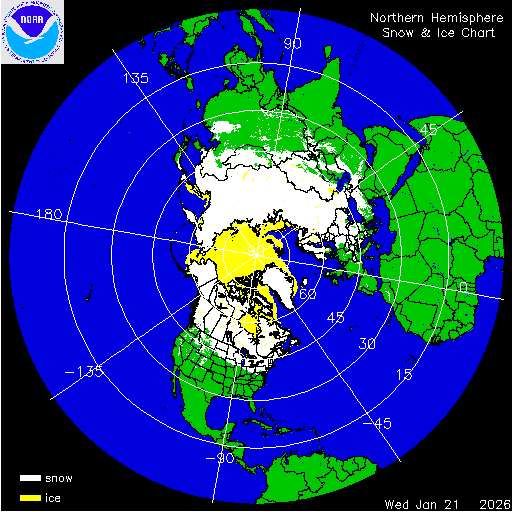
Certainly doesn’t look much like Davos is feeling the effects of AGW this winter. In fact, I think it’s worth noting that by far the majority of Alpine Ski resorts are benefitting from a pretty decent crop of snow this season. Oh, and wait a minute, there has also been more snow than average in NW Iran, and most of Turkey. That’s not mention record breaking amounts of snow in the far East and Japan. N America about to feel winter bite, very soon but already, not exactly mild. Ukraine really warm currently as well, a balmy -19C a few days ago – ice fishing on the rivers. NH winter doesn’t seem to have changed very much at all, despite second hottest year ever, hype.