From the University of Helsinki and the “of miniscule importance” department comes this exercise in futility.
A new method to capture carbon dioxide from the air has been developed at the University of Helsinki’s chemistry department.
The method developed by Postdoctoral Researcher Zahra Eshaghi Gorji is based on a compound of superbase and alcohol. Tests done in professor Timo Repo’s group show that the compound appears promising: one gram of the compound can absorb 156 milligrams of carbon dioxide directly from untreated ambient air. However, the compound does not react with nitrogen, oxygen or other atmospheric gases. Capasity clearly outperforms the CO2 capture methods currently in use.
The CO2 captured by the compound can be released by heating the compound at 70 °C in 30 minutes. Clean CO2 is recovered and can be recycled.
The ease of releasing CO2 is the key advantage of the new compound. In current compounds, releasing CO2 typically requires heat above 900 degrees Celsius.
– In addition, the compound can be used multiple times: the compound retained 75 percent of its original capacity after 50 cycles, and 50 percent after 100 cycles.
Non-toxic and cost-effective
The new compound was discovered by experimenting with a number of bases in different compounds, says Eshagi Gorji. The experiments lasted more than a year in total.
The most promising base proved to be 1,5,7-triazabicyclo [4.3.0] non-6-ene (TBN), developed at in the professor Ilkka Kilpeläinen’s group, which was combined with benzyl alcohol to produce the final compound.
– None of the components is expensive to produce, Eshaghi Gorji points out. In addition, the fluid is non-toxic.
The compound will now be tested in pilot plants at a near-industrial scale, rather than in grams. A solid version of the liquid compound must be made for this purpose.
– The idea is to bind the compound to compounds such as silica and graphene oxide, which promotes the interaction with carbon dioxide.
Link to article https://pubs.acs.org/doi/10.1021/acs.est.5c13908
So then, what do you do with it, once it’s “captured”?? The average human exhales about 40 gallons of it per day At STP
Well, just like cars have catalitic converters humans might be forced to have one with a yearly check at a human centre..
Humans exhale about 8 billion kilograms of CO2 everyday. To this should be added all the CO2 exhaled by domestic animals ranging from cattle to canaries.
CCS is still a sillyass endeavor, no matter the cost.
Sometimes I miss Sam, our erstwhile resident CCS evangelist….
There is no evidence that shows CO2 needs to be captured.
There is no evidence that CO2 is anything other than a benign gas, essential for life on Earth. Not one shred of evidence. None.
Delusions are a horrible thing to watch. Epecially when this particular CO2 delusion detrimentally affects hundreds of millions of people.
The lack of substantiation for CO2 being anything other than benign is stunning. Yet many of our leaders think it is an established fact that CO2 needs to be reduced. It is not an established fact. Some of our leaders don’t understand how science is done, and have assumed too much. Assumptions are not established facts, and assumptions are all there is to climate change alarm.
Well said Tom. The delusional scientists wasting so needlessly the research grants should be locked up in padded rooms and the keys should be thrown away. Luckily, they will not, at least in foreseeable future, be able to remove enough CO2 from the atmosphere as to threaten the life on Earth. All they will achieve is, wasting a lot of money. Shame…
They’re not delusional, they’re fulfilling their propaganda mission.
I would add that there’s no evidence that we’re experiencing any weather that is not part of natural variability/cycles.
I agree.
Nail. Head. Hit. There is no conceivable technology for carbon dioxide capture that would even show up as a rounding error in the rate of carbon dioxide uptake by the earth’s vast biome. The carbon cycle moves truly awesome amounts of CO2 in and out of the atmosphere on a daily basis. What small fraction we add through burning fossil fuels is almost immediately compensated for through enhanced growth of plants evidenced by observed greening. And it doesn’t cost tax payers a dime.
This obviously won’t last long. The activists will hate it because it allows people to still use fossil fuels for cheap and reliable energy. The realists will hate it because it removes valuable plant food from the atmosphere,
It’s a lose-lose situation.
I get an image of a dozen folks in white lab coats sucking Lake Superior dry using those newly demonized paper straws. Someone needs to tell them they need to stop the Saint Louis River!
Did you mean the St. Lawrence River?
The St. Lawrence ends at Lake Ontario.
indeed it does, yet it ultimately is the largest “straw” sucking water out of Lake Superior. The St. Louis River provides an inflow.
I’d be surprised if none of the solvent is lost in the process.
Ahhhhh, then you didn’t see the sleight-of-hand that was played near the end of the above article, repeated here (with my bold emphasis added):
“– None of the components is expensive to produce, Eshaghi Gorji points out. In addition, the fluid is non-toxic.
“The compound will now be tested in pilot plants at a near-industrial scale, rather than in grams. A solid version of the liquid compound must be made for this purpose.”
My read of this: although it is claimed to be “inexpensive” to produce, we only used grams in our laboratory, and beyond that for some reason we can’t say, we need to make a solid version of a compound that naturally exists as a liquid . . . while, of course retaining all the same chemical reactivity . . . you know, along the lines of solid water or solid hydrochloric acid (/sarc).
There are these things called plants they take in carbon and store it in the bodies and roots, then when they die or get cut back, the roots drop and decay in the soil leaving the carbon there. Why is this so complicated?
THIS !
Because some c#%t wants to make money out of it
They cut down all the plants to make room for wind and solar farms. Now we “need” industrial scale CO2 capture… to keep the plants from growing back?
Super bases are the lye / caustic soda version of superacids. Non toxic in the sense it can be converted to harmless compounds for disposal I accept: But spill a drop on your skin and you end up with a big hole in you.
Baddies in movies use it get get rid of bodies 😉
On the farm we always had a bag of lime in the outhouse so we could throw a cup full down the hatch.
I’ve actually used the precursor compound for the study (DBU) and I always wear protective gloves and typically used it in a closed system, glove box, so their claim of the chemicals being nontoxic did not seem right to me either.
That said, compared to HF, these compounds are relatively safe. An accidental drop on the skin could be readily washed off with water. One problem we chemists have is we sometimes don’t detect such drops. Over my career, I’ve ruined a few lab coats and pants, especially bad for cotton is sulfuric acid, though holes in jeans are not the worst thing.
The desorption temperature of 900C that they mentioned for a competitive method is for KOH (potassium hydroxide). No chemist should seriously suggest that. Thus, that claim is in a way a red herring. Otherwise, I appreciate the chemistry they’ve developed, from an academic perspective. Still like everyone else here, it has no practicality of need or application.
Sequestering CO2 must be one of the stupidest ideas ever.
Second only to the most stupid idea-that adding CO2 to the atmosphere makes the earth warm up measurably. All that CO2 sequestration would accomplish is the shrinkage of plant life with no appreciable effect on temperatures.
Actually , I doubt that CO2 sequestration would have any effect on anything, except cost of electricity.. ↑↑
98% of “free” CO2 is the oceans, and any sequestration would be a relatively very, very tiny amount indeed.
It is a left wing thing, the most stupid ideas are considered perfect.
It’s taking the food out of the mouths of baby plants. Shameful.
Well, there is Mamdani.
WHY BOTHER !!! unless you are using it for some industrial or plant growth purpose.
Counter-Productive !
“a compound of superbase and alcohol”
I wonder how much energy is needed to make them, and how much CO2 is released.
Considering how plants, trees and flowers do better under conditions of more CO2, one way to get enviro-mobsters (who label us as planet killers) to comprehend how ludicrous their ideas are would be to show them how they are the people who are trying to kill the planet.
As trees growth should be within the exponential spectrum,
it may be safe to assume that the 835 ppm tree should have about 4* the mass than the 385 one.
Which also means that it absorbs and stores exponentially more CO2,
which makes me think that CO2 in combination with plants is its own carbon capture system
as trees absorb more the bigger they get.
(we also grow way more food with the same investment)
“Larger, older trees absorb significantly more CO2 than smaller ones, with studies showing that the rate of carbon uptake increases with tree size for most species, … even though young trees absorb proportionally more as they grow rapidly”
Checked true.
Grants for this just waste money.
Could be worse. Fortunately, I’ve never encountered a Somali chemist.
Why don’t they make meth or fentanyl in Somalia? You just answered that question!
All life on the planet are dependent on enough CO2 in the atmosphere. Preferably double or tripple the corrent content — about 0.04%…
4 digit co2 ppm should be mandatory for this planet.
Here’s another reason for not cheating plants out of their food:
The Calculation Every Lawmaker Needs to See Before Voting on Climate Spending
Intro for Lawmakers
Before voting on climate spending, every policymaker should understand one critical fact: the assumption that excess CO₂ stays in the atmosphere for thousands of years is mathematically wrong. The Earth’s carbon cycle clears nearly all excess CO₂ within decades, thanks to massive natural sinks like oceans and vegetation. This means trillions in climate initiatives may deliver almost no long-term benefit—because nature already solves the problem far faster than policy assumes.
Why CO₂ Doesn’t Stay for Millennia: The Math Everyone Ignores
Climate policy assumes excess CO₂ stays in the atmosphere for thousands of years. But when you look at the actual carbon cycle math, the picture changes completely. Here’s the step-by-step calculation.
Step 1: How Much CO₂ Is in the Atmosphere?
Current atmospheric CO₂ is about 870 gigatons (Gt).
Step 2: Annual Flux
Nature moves enormous amounts of CO₂ every year:
• Natural emissions: 770 Gt/year (from oceans, vegetation, soil respiration)
• Natural absorption: 770 Gt/year (into oceans and plants)
• Human emissions: 36 Gt/year
So humans add less than 5% of the total annual flux.
Step 3: Observed Increase
Despite 36 Gt/year from humans, the atmosphere only increases by about 4 to 5 Gt/year.
This means the system is removing almost everything we emit plus some natural excess.
Step 4: Calculate Effective Removal Rate
Atmospheric stock ÷ Residence time = Removal rate
870 Gt ÷ 4.6 years = 190 Gt/year removal rate
So the system effectively clears about 190 Gt of CO₂ per year, which dwarfs the 36 Gt humans emit.
Step 5: How Fast Does Excess CO₂ Decay?
Use a simple decay model:
Remaining fraction after time t = e ^ (-t ÷ tau)
For t = 55 years and tau = 4.6 years:
t ÷ tau = 55 ÷ 4.6 ≈ 12
e ^ (-12) ≈ 0.000006 (virtually zero)
So after 55 years, more than 99.999% of excess CO₂ is gone.
Understanding Tau
Tau (τ) is the time constant in an exponential decay model. It represents how quickly a system removes excess CO₂—in this case, about 63% every 4.6 years. When we calculate t ÷ tau = 55 ÷ 4.6 = 12, the ratio is unitless because both values are in years. This means 12 time constants have passed, leaving virtually zero excess CO₂.
Step 6: Why Oceans and Vegetation Are Massive CO₂ Sinks
The Earth’s oceans and biosphere act like giant sponges for CO₂:
• Oceans: Dissolve CO₂ into surface waters and transport it to deeper layers through currents. This process accelerates as atmospheric CO₂ rises because the concentration gradient drives faster absorption.
• Vegetation: Plants pull CO₂ from the air during photosynthesis and store it in biomass and soils. Higher CO₂ levels often boost plant growth, increasing uptake.
Together, these sinks handle hundreds of gigatons per year—orders of magnitude larger than human emissions. That’s why the system can clear excess CO₂ so quickly.
Conclusion
The math shows that excess CO₂ is cleared in decades, not millennia, thanks to massive natural sinks and rapid turnover. This flips the entire logic of climate policy: emissions cuts deliver almost no long-term benefit. If the science behind tau is correct, we’re spending trillions to solve a problem that nature already solves.
For details see: Scrutinizing the Carbon Cycle and CO2 Residence Time in the Atmosphere Hermann Harde, (2017)
Sandberg, csn you send a copy of this to Ed Miliband? He needs to see the futility of spending £22billion on carbon (sic) capture is a pointless/futile endeavour.
I would like to use you clear comment is it OK for me to copy it to others?
D Sandberg, some of that is correct, but a lot of it is incorrect. Please forgive my negativity by focusing on the errors.
First, you’ve confused GtC (gigatonnes carbon) with Gt CO2 (gigatonnes CO2). You wrote:
”Despite 36 Gt/year from humans, the atmosphere only increases by about 4 to 5 Gt/year.”
That’s not correct, because the first figure is Gt of CO2, and the second figure is Gt of carbon, and CO2 is only about 27.29% carbon.
(Aside: Gt or gigatonnes is sometimes written as Pg or petagrams. They are synonyms. So, for example, GtC ≡ PgC.)
36 Gt/year figure is about right for anthropogenic “fossil” CO2 emissions. Divide by 3.66419 to convert it to GtC, i.e., about 10 GtC/year.
We know quite precisely how much N2, O2 & Ar there is in the atmosphere, so you can convert from GtC to molar fraction of the dry atmosphere, i.e., µmol/mol, which is often abbreviated ppmv or ppm, by dividing by 2.12940 GtC/ppmv.
Mankind is adding nearly 5 ppmv of ‘fossil” CO2 to the air each year (and probably a little more than 5 ppmv if “land use change emissions” are added). But averaged over the last decade the atmospheric CO2 level has only risen by about 2.5 ppmv per year, because natural “carbon sinks” are removing about 2½ ppmv per year.
The higher the CO2 level rises, the faster those natural carbon sinks (ocean uptake, terrestrial greening, etc.) remove CO2 from the air. Averaged over the last decade, the CO2 level was about 135 ppmv above its average “preindustrial” level of 280 ppmv, and as a result the net rate of natural CO2 removals accelerated from zero to about 2.5 ppmv/year: i.e., by about 2.5/135 = nearly 2%/year.
In other words, for each 50 ppmv rise in atmospheric CO2 level, the net rate of natural CO2 removals (due to accelerated ocean uptake, greening, soil enrichment, etc.) increases by roughly 1 ppmv/year.
That makes the effective atmospheric lifetime of added CO2 approximately 50 years. We call that the “adjustment time.” (Note: Harde [2017] got that wrong by about a factor of ten!)
That makes the effective half-life of CO2 added to the atmosphere about 50 × ln(2) ≌ 35 years.
If we calculate the rate of natural CO2 removals (the difference between emissions and the rate of CO2 level rise), and plot it vs. atmospheric CO2 level, we’ll see that same approximate 2% slope from 1958 (when precise atmospheric CO2 level measurements began), and the relation is obviously approximately linear:
That 35-year half-life means that about 35 years from now half of the increase in CO2 level which resulted from human CO2 emissions this year will be gone. The 50-year “adjustment time” means that about 50 years from now 63% of it will be gone.
(Aside: the percentage of actual original “fossil” carbon atoms gone from the air by then will be even greater, because of processes which exchange carbon in the air for carbon in other “carbon reservoirs” without changing the respective total amounts of carbon. That’s irrelevant for climate.)
It also means that if CO2 emissions were merely (approximately) halved, the CO2 level in the atmosphere would cease rising (i.e., the so-called “airborne fraction” would be zero), and if they were reduced more than that the CO2 level would be falling (and the “airborne fraction” would be negative).
It also means that if anthropogenic CO2 emissions were to continue indefinitely at the current rate, the CO2 level would plateau at only about 50 × 2.5 = 125 ppmv above the current level.
(Obviously those facts are impossible to reconcile with the “Net Zero” campaign.)
The mistake Harde made (and you made) w/r/t Tau (𝝉) is confusing the 50 year adjustment time with the 3 to 5 year “residence time,” a/k/a “turnover time.” You can learn about them here:
Burton, D.A. (2024). “Comment on Stallinga, P. (2023), Residence Time vs. Adjustment Time of Carbon Dioxide in the Atmosphere.” OSF Preprints. https://doi.org/10.31219/osf.io/brdq9 (and supplemental material here https://sealevel.info/Comment-on-Stallinga2023/ )
I think that your calculated 35 year half life for excess atmospheric CO2 is too long. I did a much simpler calculation many years ago – it is easy to do with just the totals and CO2 partial pressures – and if my memory is correct the half-life of excess CO2 in the atmosphere is around 12 to 14 years.
“excess CO2 in the atmosphere”
There is no excess CO2 in the atmosphere…
… it is currently way below optimum for plant life.
But there is no real evidence that CO2 has any effect on our global climate system. The AGW hypothesis has been falsified by science. I have grown plants on my property that take in CO2 and H2O and use them to make cellulose and other organic compounds. There are plants that have the capability to hold on to the carbon derived from CO2 for hundreds of years.
“But there is no real evidence that CO2 has any effect on our global climate system.”
Exactly.
Climate Alarmists are invited to provide any evidence they have for such an effect right here.
Don’t expect any response from Climate Alarmists because they don’t have any evidence that CO2 affects anything in Earth’s atmosphere.
If they had any evidence, you could be sure they would pounce on a post like this so fast your head would swim. The fact that they won’t should tell you all you need to know about the science of Human-caused Global Warming/Climate Change. They don’t have any science to back up their claims.
I disagree. Rising CO2 levels have profound effects on our global climate system… and those effects are overwhelmingly positive, just as pioneering climatologist and Nobel laurate Svante Arrhenius predicted, over a century ago.
https://sealevel.info/learnmore.html?0=arrhenius#arrhenius
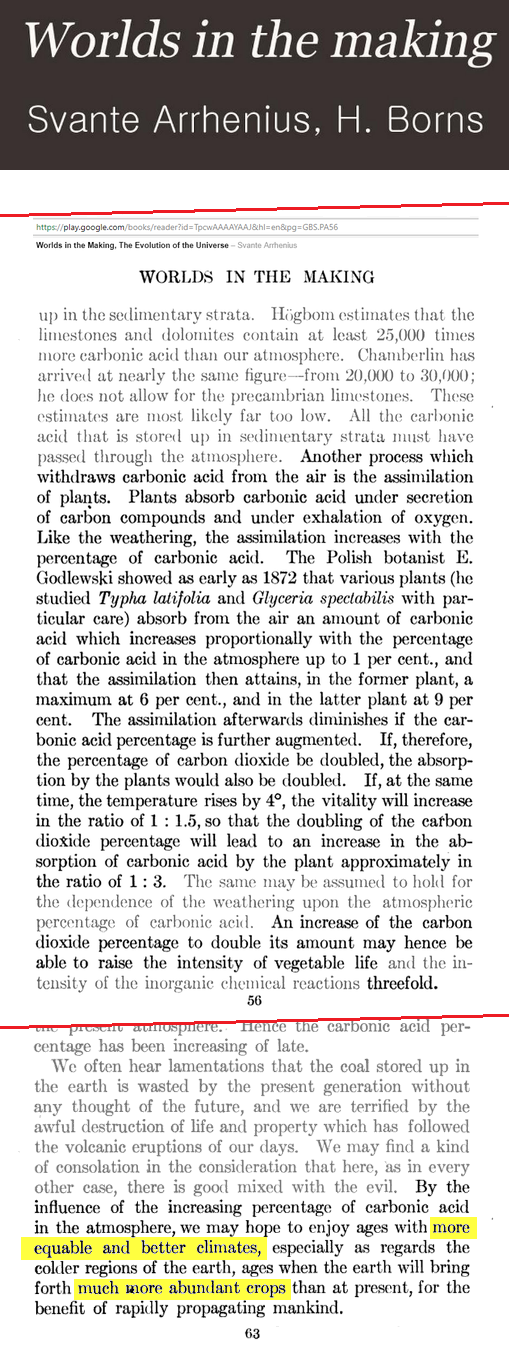
Source: https://tinyurl.com/arrhenius1908p63
Note: climate is a lot more than just temperature. By far the most important effect of rising CO2 levels is the benefits for plants, including both agricultural plants and natural ecosystems.
Elevated CO2 is “greening” the world! The environmental benefits are so dramatic that NASA measures them from space:
https://www.youtube.com/watch?v=zOwHT8yS1XIRT
(That’s a NASA video)
CO2 also has a large effect on global temperatures, but added CO2 had only a small effect. It is determined spectrophotometrically, or by laborious calculations of the “radiative forcing.”
The most comprehensive analyses are by van Wijingaarden & Happer. This is one of their papers:
https://arxiv.org/abs/2103.16465
This is their figure, except that I added the blinking purple ovals:
The blinking ovals highlight the small effect (only about 3 W/m²) on radiative emissions to space from doubling the CO2 level. (The IPCC claims 3.7 ±0.4 W/m², but that is almost certainly too high.)
You cannot calculate CO2’s effect using radiative properties only.
Bulk air transfer of energy is magnitudes larger.
… any possible radiative effect of CO2 is akin to a flea bite on an elephant’s posterior
But a lot has gone on in atmospheric physics since the time of Svante Arrhenius. Please tell us in hour own words, How does adding CO2 to the atmosphere affect the surface temperature. At the center of this entire problem is the climate sensitivity of CO2. Please tell us what do you believe to be the climate sensitivity of CO2, the exact number. Along with your answer please provide a description of the atmospheric physics that supports your answer.
If adding CO2 to the atmosphere caused surface warming I would expect that we would see the effect in terms of an increase in the dry lapse rate in the troposphere in the troposphere but instead adding CO2 to the troposphere causes a slight decrease in the dry lapse rate which causes a slight cooling of the surface. In general the greenhouse gases act as coolants radiating away LWIR energy to space from the Earth’s atmosphere.
Another waste of time and taxpayer money…. the poor efficiency of compression alone makes this whole process energy stupid. And what happens when the green idiots have a CO2 blowout?
Can someone please explain in words of one syllable how this mixture is created, how it is heated,, what safety precautions are required, how the equipment is manufactured and how much carbon dioxide is produced in the process?
Does planting and growing trees and other plant life create less carbon dioxide than the plants absorb?
Non toxic?
I suppose melting your lungs, skin and eyeballs isn’t strictly toxic. Be surprised if it didn’t.
And carcinogenic? Who knows.
It is hard to imagine a more useless and wasteful climate scam than Direct Air Capture of CO2.
I’m wondering if rough calculations have been done to estimate how much additional carbon dioxide is being mopped up every year today, compared to preindustrial times, based on the observed global greening that’s been seen. Then, figure out how long that extra “sequestered” CO2 remains out of the atmosphere before it returns. How much is ultimately buried? Whatever the figure, I betcha a non-eco-friendly steak dinner that it’s still going to be a lot more than this new carbon capture scheme they’ve revealed.
Direct capture of CO2 from the air is futile because for every molecule of CO2 removed from the air, a molecule of CO2 will diffuse out of the oceans and all land surface waters. CO2 will also diffuse out of loose soil.
Sounds like an equilibrium acting under LeChatelier’s Principle.
I should have posted: “According to LeChatelier’s Principle, every molecule of CO2 removed from the air will be replaced by a molecule of CO2 that diffuses out the oceans and all land surface waters.
Now I have to check Henry’s Law.
I know a very efficient device to capture CO2 from air. It’s called a ‘tree’.
But Ed …. Tree huggers who claim we need to save the earth by capturing CO2 are chopping down forests all over the planet to make way for wind turbines and solar panels. Haven’t these people taken a basic science course at some point in their schooling?
WHY CAPTURE CARBON? I assume you mean CO2! Why will politicians and the mainstream media never engage in a discussion querying how Net Zero or De-carbonisation helps the planet? Of course it doesn’t, Carbon Dioxide is essential to life and harmless. The demonisation of fossil fuels is an invention by global power brokers to cause panic use of renewables and line their own pockets at our expense.
Heating it to 70°C for recycling using what? Fossil fuel-backed-up sunbeams and breezes?
“A new method to capture carbon dioxide from the air….”
Yuh, new and improved, like all the new and improved batteries for EVs that will let you drive 1,000 miles and recharge in 5 minutes. 🙂
so remind me why we want less plant food