Essay by Eric Worrall
Recently released UK government stats suggest Hybrid vehicles are significantly more dangerous to vehicle occupants than gasoline vehicles.
Death rates in hybrids ‘three times higher than petrol cars’ as road safety experts call for inquiry
By GABRIEL MILLARD-CLOTHIER
PUBLISHED: 10:33 AEDT, 28 December 2025 | UPDATED: 19:32 AEDT, 28 December 2025
Road safety experts were calling for an inquiry on Saturday night as it was revealed motorists are three times more likely to die in hybrids than in petrol cars.
A total of 122 people died in hybrid car crashes last year, compared with 777 in accidents involving petrol cars, according to Department for Transport figures analysed by The Mail on Sunday.
But as hybrids are outnumbered by almost 20 to 1 on Britain’s roads by petrol models, that means hybrids are three times more likely to be involved in a fatal crash.
Experts believe the higher death rates could be explained by hybrids’ combination of petrol engines and batteries and electric motors, which can be harder to control and more prone to fires.
…The cars’ batteries may also be to blame. They can be damaged by the heat of the engine, which burns at extremely hot temperatures, making them more liable to set ablaze.
…Hybrids were found by a leading insurer of company cars, Tusker, to burst into flames at higher rates than others. Among their fleet of 30,000 cars, hybrid vehicles had an almost three times’ higher risk with 3,475 fires per 100,000.
Read more: https://www.dailymail.co.uk/news/article-15416671/Death-rates-hybrids-three-times-leading-road-safety-experts.html
…
If anyone has a link to the original report please post in comments.
It makes sense that hybrids are more dangerous than other vehicle categories. While gasoline fires are probably more likely than a battery vehicle fire, I strongly suspect EV fires are less survivable. That big battery is a mobile thermite bomb.
Mix the higher probability of a gasoline fire and hot engine components with a battery, and I suspect you are combining the worst of both worlds.
Since the report focussed on Britain, it is also possible local conditions in Britain contributed to this risk. Frequent wet weather with lots of loose road salt in winter, poorly maintained roads, a lack of undercover parking, and in winter extreme cycles from freezing cold to hot might all play a part.
I once survived a gasoline vehicle fire, it was nasty, but I had a good minute to escape the vehicle – I had time to pull over, safely get out of the vehicle through the passenger door, and stroll a hundred yards from the vehicle before the fire reached an intensity which would have been life threatening. After the fire was put out by the fire crew, I even managed to recover and salvage my plastic laptop computer. It was scorched and the battery was destroyed, but after a month of drying out it actually booted and survived enough for me to recover my files.
Battery fires are a little more spectacular. From MGUY;
Combine a gasoline fire with a battery fire, and you have a potential recipe for disaster.
And it might not even have to be a fire. Gasoline engine components frequently operate normally at temperatures above the ignition temperature of Lithium batteries, so even say a small leak in the exhaust system might be enough to cause a battery explosion.
There was a brief moment when I considered buying a hybrid. After Covid gasoline prices in Australia shot up, and hybrids started to look attractive. But let’s just say I’m going to defer that purchase decision.
Safe and effective.
“You are 3x More Likely to Die in a Hybrid Vehicle than a Gasoline Vehicle”
Having a petrol engined vehicle, that’s me off the hook. But then, what about all the restrictions? The speed bumps (sleeping policemen), the chicanes, the speed limits…
Ridiculous”: London council introduces new speed limit – of just 10mph
Local resident Phil Cudlipp, 68, says he already struggles to ride his Harley-Davidson at 20mph, let alone 10mph, as it stalls.
Phil said: “I walk everywhere now – there’s nowhere to park my bike nine times out of ten. –
https://discover.swns.com/2025/10/ridiculous-london-council-introduces-new-speed-limit-of-just-10mph/
The 15 minute city ideal is far from dead.
I sure hope so
https://www.15minutecity.com/
Do feel free to take my place in one.
I lived in what was effectively a 15 minute city when I was in university. The range of tinned soups in the shop was pretty limited and you could forget about fresh produce. Too few potential customers within range.
HAHAHA
As I understand it, the 15-Minute City aims to localise essential services and jobs within a short walk or cycle, but this “vision” overlooks several practical and social challenges:
Putting all services in every neighbourhood assumes everyone needs the same things and that businesses can survive everywhere. Smaller areas might not support specialised shops or services, so quality and choice could vary.
Although the goal is to build community, making areas too self-contained can isolate them. This reduces interaction between neighbourhoods and limits cultural exchange, which are important for creativity and social connection, and could lead to ghettos.
Modern economies depend on specialised jobs and central hubs. Expecting most work to be within 15 minutes ignores how complex job markets are and could restrict career opportunities especially for those in poorer areas.
Changing cities to fit this idea would cost a lot and take major planning. It could also pull money away from bigger sustainability projects, like improving public transport.
I’m repeating myself, but you really do need to think for yourself and not accept extreme left-wing propaganda at face value.
What, you think pointing to a 15-minute city propaganda site will actually change anyone’s mind? You think people here are so ignorant that they will rely on such a site to learn what a 15-minute city is?
You aren’t very good at this.
I much prefer living 15 minutes away from the nearest small town, half mile off of the blacktop.
Sounds like a 15 minute Driveway would be right up your alley
15 minute cities are not about protecting the environment. They are about controlling people. You will not be free and will not enjoy it. You will be told what you can say, where you can go, what you can eat, what you can buy, etc.
Are you free now? Direct Taxation gave those in power the tool to know EVERYTHING about you. Than you have your smart meter your smartphone everywhere you go your car number plate is registered facial recognition cameras everywhere, limitations how much you can pay in cash etc etc.
And your neighbours will spy on you and report your deviances. Old time Russia or China, or current North Korea
Easy to say from abroad.
Who would choose such a city? Limited medical care? Fewer first responders? Etc.. (Except for those who live in the Farm House.)
https://youtu.be/6Hx0Qxut3eM
Far from dead?
Too bad, because only a tiny number of people are stupid enough to want to live in one.
It is illegal to introduce a PERMANENT speed limit in England lower than 20mph. This 10mph speed limit is TEMPORARY for a period of works which is legal. However, during my time oiur Highways team wanted a 10mph limit through works to which our thorough proper copper Police liaision officer replied that if that was necessary there should be no traffic allowed during the works. I was also in post when the idiots at the City of London wanted 15mph across the City and when informed it was not possible wasted time and money producing a report to try to change the Department of Transport’s mind – they didn’t. Vehicles are only required to have speedos that read from 20mph and if that is your vehicle’s maximum speedometer you do not need one at all.
A fit person can run faster than 10mph!
So can the Bobby’s so keep it under 11 if you don’t want a speeding ticket.
Speed limits for dogs and birds?
Reinstate the red flag act NOW! Every motorized contrivance must have a man walking ahead carrying a red flag!
Reinstate the red flag act
I think I’ve heard of some places that have that or similar laws still on the books, just not enforced.
In the USA going back to the 1980s it was shown that small cars have a significantly higher mortality rate than full sized. I think that’s what you are seeing here. Hybrids tend to be very compact
Another problem is that, especially in the US, cars are getting too big.
Young children three times more likely to be killed by SUV, new study finds
Isn’t that the same as blaming a knife or a gun for a murder?
Surely, it’s not the vehicles fault, and if so, an EV SUV, there are lots of them and much heavier than the ICE equivalent, are more likely to kill children?
Plus EVs are quieter and less likely to be heard by playing children.
re: “Plus EVs are quieter and less likely to be heard by playing children.”
Try bicycling too. I was bicycling on a side street and thought I was hearing things (it was windy, too) and turned out I had a car, an EV, off to my left and rear not-passing but following for a bit …
EVs are lethal to cyclists as you cannot hear them coming from behind.
Motorcyclists know that “Loud pipes save lives.”
I didn’t really understand loud motorcycles until I started riding. Then I got it.
But do you all have to be dbags?
Cyclists are lethal to pedestrians also
I can hardly wait to hear the whining about commercial vehicles killing children because they are getting smaller. (The vehicles, not the children.)
Reported by: “the London School of Hygiene and Tropical Medicine” that, incidentally references a report based on a report that was published by “the London School of Hygiene and Tropical Medicine.” and references a news article based on… wait for it… a report published by “the London School of Hygiene and Tropical Medicine.”
As one goes through all of the linkages to other sites, guess what one finds?
“the London School of Hygiene and Tropical Medicine”
So I guess since multiple publications came to the same conclusions, it must be correct.
But 5 times less likely to die while riding in one. SUVs are far safer for occupants than egg mobiles (SMART cars) ever will be.
I don’t have a link, but I do remember seeing something where the earlier safety stats for smaller cars were inflated by only crash testing them against other smaller cars rather the ones they were more likely to “encounter” on the road.
The small cars save on funeral expenses….they serve as the coffin.
Break out the Cooper Scooper
Come to think of it, EVs serve as mobile crematoriums too.
Typical socialist. Is convinced that it knows what is best for everyone.
They do know what they Want to be best for everyone. Problem is they’re typically deluded enough to believe their way will achieve it…even when history has demonstrated time and time again that it doesn’t.
Clearly we should ban children 🙂
The heaviest Honda Accord Hybrid weighs approximately 3,525 pounds. The least weight version of the Ford 150 XL Regular Cab 4×2 weighs approximately 4,021 pounds. Top weight is just under 6,000. A Ram 3500 can weigh over 7,500 pounds.
This is similar to claiming Cats kill more birds than Wind Turbines.
Cats kill 1.2B birds annually while Wind Turbines kill 5M birds annually so … true…but…
There are 600,000,000 cats in the world but only 500,000 wind turbines.
Cats are credited with killing 1.2B birds yearly or 2 birds per cat.
The US has 75,000 wind turbines which are credited with killing 700,000+ per year.
That’s almost 10 birds per turbine per year. While cats get credited with 2 per cat per year.
.
Globally there’s over 500,000 wind turbines killing as many as 5,000,000 birds yearly.
Millions more bats are killed by wind turbines as well, far more than cats kill per unit.
.
Per unit, wind turbines kill 5 times as many birds as cats do.
.
There are around 50B wild Birds globally.
If Wind Turbines were as plentiful as cats 600,000,000 wind turbines would kill at a minimum 6,000,000,000 birds yearly or 11% of the global population annually.
I suspect the number of bird kills per wind turbine is much higher than reported as many will go unreported. Either from predation by other animals or malfeasance on the part of the operators.
.
Wind Turbines also kill Raptors like Eagles that would otherwise kill cats. Cats don’t kill Eagles or Hawks or Falcons but wind turbines do.
Unfortunately, you are using death rates for birds per wind turbine which are provided by the utterly corrupt wind lobby. In reality, the average wind turbine kills 500 birds per year.
The smaller cars were also designed to be made of Tin Foil so they were lighter and got better mileage. The larger TANK vehicles were made of far more sturdy stuff and wouldn’t crinkle from a sneeze.
Not just the smaller cars.
https://youtu.be/26Qch_Vmm_Y
Back in the early 1980’s I worked for Ford delivering parts in Marin/Sonoma Counties. It was near impossible to get new body parts or radiator housings that weren’t bent and in need of straightening prior to leaving the warehouse.
Looking for a comparable US study. Hybrids are ubiquitous here. Never seen any indication that they are less safe, or more prone to fires.
Here’s the first study I found:
AN ANALYSIS OF HYBRID AND ELECTRIC VEHICLE CRASHES IN THE U.S.
https://www-nrd.nhtsa.dot.gov/departments/esv/24th/files/24ESV-000210.PDF
They examined fatal crashes in the USA, from 1999-2013:
“Fires were rare in both hybrid and conventional vehicles. Fatal crashes involving fire constituted 2 .6% of hybrid cases and 4.4% of conventional vehicle cases. No cases of fire or electric shock injury for hybrids in NASS/CDS 1999-2013. Only 1 case of a hybrid fire was found in NASS/GES. The incidence of fire was lower for hybrids than conventional vehicles in all three databases.”
Fatal fires in hybrid cars were less likely than in conventional vehicles.
Question: Were the lower incidence based on absolute numbers or per vehicle?
Per vehicle, but with the caveat that the death was not always attributed to fire, only that the accident causing death had an associated fire.
” Fatal crashes involving fire constituted 2 .6% of hybrid cases and 4.4% of conventional vehicle cases.”
The UK evidence is pretty compelling. Both a fleet vehicle operator and UK government stats uphold the idea hybrids are more dangerous.
Of course as I suggested there might be some other factor. For example there might be a bias towards long distance driving for people who choose hybrids.
It gains a level of credibility in that it strikes in the opposite direction of Net Zero in UK.
Do fleet and government figures make the distinction between hybrids and PHEVs? The DM article in question completely fuzzed the issue. In theory a hybrid crash should be about as dangerous as a pure ICEV crash, while a PHEV crash should be closer to the risks involved with an EV crash.
It would be interesting to see a similar statistic comparing both per capita and WRT miles driven
You said
But ignored from the same article
So no, Eric. Its not compelling. The only thing that’s compelling is your bias.
That doesn’t contradict my point at all. Even if EVs are safer than gasoline vehicles, it doesn’t automatically follow that hybrids are safer. And there is a good chance the EV stats are biased by people leaving them at home and using the gas car when they want to do serious driving.
You said
The article said
Now you say
Its a desperate attempt to say EVs are safe because nobody uses them when…
It says you should be a LOT more sceptical about what you write about even if it contradicts your beliefs.
The article also said the combination of electric and gasoline might be more dangerous.
So you’d agree that it’s the gasoline that makes them more dangerous since EV alone is safest? Somehow I don’t think you believe that. It’s certainly not the argument you made or have ever made.
I strongly suspect EV fires are less survivable
and
electric vehicles (EVs) found to be safest
are not mutually contradictory.
I think that we should differentiate between plugin and non-plugin hybrids in this discussion. They probably have very different fatality rates.
Mild hybrids are mechanically and electrically much simpler, and the batteries far smaller. I drive one, and the only real difference I have noticed is that gas mileage is far better than on a similar sized straight up ICE automatic. No charging other than driving, and the electric motor is only used for acceleration or startup, and then only to give a bit more power to the ICE engine.
But the argument in the head post is that to mix high temperature gas engines and fuel with a potentially explosive lithium battery and complicated wiring, well, yes, it does give one pause. And guess where they put the battery?
Under the driver’s seat!
But wait, there’s more:
Urban pedestrians are up to three times more likely to be hit by electric car than petrol or diesel model, study finds
https://www.dailymail.co.uk/health/article-13445069/Urban-pedestrians-hit-electric-car-petrol-diesel.html
Electric cars really are ‘silent killers’: Pedestrians are TWICE as likely to be hit by battery-powered vehicles than petrol or diesel ones, study finds
https://www.dailymail.co.uk/sciencetech/article-13443139/Electric-cars-Pedestrians-TWICE-likely-hit.html
Given I more often hear a car before I see it, those reports have a level of credibility.
As a cyclist i can vouch for this. EVs should have a radar to alert pedestrians and cyclists
I also wonder if the skill of the driver of a hybrid is a factor-perhaps the “granny” drivers of many (not all) hybrid vehicles have lower skills, making them less able to avoid accidents?
Good point. There is also the flip side of the coin, as in the high-performance AMG GT 63 S E Performance, a plug-in hybrid powertrain AND the V8, giving 831 hp and 1,033 lb-ft of torque.
And why the downvotes – is there a downvotard running loose here?
Call me a downtard. I down-voted him for evidence-free speculation.
I am devoted to evidence. That is my problem with climate “science” and the reason I first came here.
I doubt a typical “granny” driver would prefer that kind of vehicle.
When I was young, the old folks would get ticked off when I’d run up on their tail.
Now the old folks get ticked off when they run up on my tail.
Have you and data indicating there are more “granny” divers in hybrids than gas cars?
Repeats:
https://www.thetimes.com/uk/transport/article/hybrids-increase-risk-of-death-threefold-compared-to-petrol-cars-8cxxd62fq#:~:text=They%20are%20often%20favoured%20over,gases%20and%20battery%20thermal%20events.
https://www.gbnews.com/lifestyle/cars/hybrid-cars-deadlier-petrol-diesel-models-uk-roads#:~:text=How%20to%20install%20ExpressVPN%20on,by%20nearly%2020%20to%20one.
https://www.telegraph.co.uk/news/2025/12/28/hybrid-car-death-rates-three-times-higher-than-petrol/#:~:text=Motorists%20are%20three%20times%20more%20likely%20to,777%20in%20petrol%20car%20crashes%20last%20year.
https://thefinancialexpress.com.bd/sci-tech/death-rates-in-hybrids-three-times-higher-than-petrol-cars-data-shows
No sites found for the original report.
Yes, this could well be a media fail.
‘Study’ was not controlled for a number of factors, which, ‘uncontrolled for’ yield fallacious stats or figures which can result in misconstruing cause and effect relationships.
Such as?
Please, give more downvotes first.
(Any study not controlling for certain factors in particular for a consumer product as to “use”, for instance, is going to look lopsided as to results.)
Does this sound suspicious? Why would diesel be 25% more deadly than gas (5 per 100K diesel compared to 4 per 100K gas). Is it possible they may not be controlling for speed (highway vs in-town). What else aren’t they controlling for?
As a transportation engineer I’m used to analyzing accident rates by Million-Vehicle-Miles (MVM), which is why you see permanent and annual traffic counting stations.
If further analysis is required then we look at things like skid marks at problem intersections, etc.
In other words, you don’t know what they might not be controlling for, you just assume they must be.
re: “Such as?”
Lets look at this factor uncontrolled for – The choice by younger drivers preferring performance oriented hybrids, the results might be due to differences in drivers, not in the cars themselves.
Some hybrids tune the engine to be very efficient and let the engine and electric motor share the load. The Prius does this. Other hybrids are sports cars, use a high-torque gasoline engine, and add a high-torque electric motor in parallel. Some of these sports cars have batteries that will only take you 10 miles, but can power the car for an amazing acceleration when you punch the accelerator.
Here is one with 800 hp for speed to overcome wind resistance, and 1000 lb-ft of torque for acceleration. A normal car is about a quarter of those figures. “Things get positively bonkers with AMG GT 63 S E Performance, which adds a plug-in hybrid powertrain to the V8, resulting in a hardly believable 831 hp and 1,033 lb-ft.”
https://www.edmunds.com/car-news/2025-mercedes-benz-amg-gt-plug-in-hybrid-first-look.html
Indeed, if batteries were really the cause then the following from the article wouldn’t be true
That passage was also from the original article that this post was based on. Its pretty sad that this was missed but entirely expected that Eric’s scepticism is nowhere to be seen. Anti-electric is the narrative being pushed here.
This article and the way its been presented is an antithesis to everything that this website used to fight against with climate.
Die ? Of what ? Numbers, please,,!
Fright. Government and NGO induced fright, And worry. Worry kills too …
The origin of the story appears to be the Mail On Sunday’s own analysis of Department of Transport data.
Story tip. Where do you go when you’ve turned the alarm up to ten? Eleven of course; Scientists go hyper-hype!
https://www.dailymail.co.uk/sciencetech/article-15422243/Amazon-hypertropical-state-MILLIONS-years.html
Oh well, at least you will have died helping to “save the planet”.
But hey, they got great MPG right until the death certificate was issued.
Good points!
“I once survived a gasoline vehicle fire, it was nasty, but I had a good minute to escape the vehicle…”
Me too – with my 15-year old daughter in the car, 1990 model, in winter. One possible cause was a piece of plastic road trash contacting the thermal reactor mounted forward on the transverse 4-cyl engine. I remember seeing a plastic bag on the road moments earlier, which I failed to evade. I first noticed the orange glow on the snowbank on the right side of the road. We stopped promptly and got out and away, but after a short distance I decided to go back and get the keys out of the car. The engine compartment and the front of the vehicle was toast, but the fire never made it to the fuel tank or interior seat cushions.
Live and learn.
Claims have been made that self driving vehicles have or will have less accidents than human drivers. Mazda has an experimental or it may be production vehicle that is EV drive only but has a small rotary engine to charge the battery if needed.
Self-driving vehicles will be a boon to pedestrians because I will fearlessly step in front of them the moment it suits me to cross the road, just as I would stride confidently through a flock of sheep.
And of course what are they but very slow, low-flying cruise missiles? The terrorist possibilities are amusing.
Especially once the ride-sharing services start offering them.
Would you walk through a flock of WTGs?
Curious minds want to know. 🙂
I’ve worked on autonomous navigation projects.
I will never ride in a self driving car, except on an oval racetrack.
I have no doubt that someday self driving cares will be safer.
However for the here and now. That is a claim yet to be supported by real world facts.
Maybe those with any sort of EV or hybrid are just more arrogant and aggressive on the road. Probably not, but the psychological possibility is there. Maybe on average they’re wealthier than the rest of us and are in a big hurry to get places, being such important people. 🙂
Maybe they drink more or take more drugs- also unlikely, but once again, it may not just be about the machines.
“…it may not just be about the machines.”
Good point. I wouldn’t be surprised for some indirect factor to be found out eventually.
There are nearly 82,000 hybrids for sale on Autotrader, that should tell you something.
New or used?
(Correlation is not cause.)^E6
Hybrid vs ICE is not a useful comparison. Hybrids are usually small cars which often have a higher injury/death rate than ICE cars in general. But many ICE cars are large and less prone to injuring their driver or passengers. What is the UK injury/death rate among hybrids and ICE cars of equal size is the question to ask.
In the US, such a comparison shows the hybrids are about 25% less likely to incur injury or death in accidents perhaps due to the hybrids greater strength in its frame needed to carry the weight of the battery than comparable ICE cars. Toyota Prius cars compared to ICE comparables (size wise) are slightly safer as well. I have one and it is a good car, getting about 60 mpg in town, slightly less on a highway. Of note, the Prius was originally equipped with nickel metal hydride batteries (not particularly flammable) but switched to lithium batteries starting ~ 2016.
I believe the gist of all this is due to car fires, not non-fire related accidents.
Our 2019 RAV4 hybrid has NiCad battery and is used mainly for regenerative braking and acceleration.
I assume that NiCad does not have the fire threat as Lithium batteries.
You are correct. It also does not have the same performance metrics.
If I was going to get a hybrid, NiCad batteries is what I would want.
The last I heard, Toyota was still using those batteries in some of their cars.
Fires are an issue, but I wonder how much is due to extrication difficulties? If you’re trapped in a ICE, it’s relatively easy to get you out and there are standard approaches that we train on. If you’re in an EV then there are several problems – battery location, high voltage wire routing, etc. – and every manufacturer does it differently. We often can’t peel back the top because of HV wires in the pillars, and the battery and other HV wires may block getting in from underneath. Hybrids offer similar challenges.
If someone is badly injured and in need of emergency medical treatment, there is a much greater chance of survival in and ICE vs EV or hybrid simply because you can be extricated much faster.
Also the ICE fires are extinguished much quicker and a lot of drivers carry fire extinguishers that work on ICE fires.
Just comparing the number of vehicles, and not comparing miles driven, let alone highway (high speed) miles, makes this comparison meaningless.
This seems like another case of spurious correlation, like the correlation between cheese consumption and bedsheet strangulations.
Maybe a lot of old ICE cars are only driven occasionally, which increases the denominator of the fatalities / number-of-cars calculation? Every car is safe if you don’t drive it.
There are people (often working for insurance companies) whose job it is to figure out relative risks. If hybrid cars were really 3x as dangerous as ICE cars, I think they would have noticed.
Journalists seem remarkably prone to such confusion. I’ll bet the topic never comes up in J-school.
Maybe that’s why so many journalists are so easily manipulated by the climate industry.
The climate biz is full of people who confuse correlation with causation. When considering an observed correlation, before concluding that it is causal, you need to consider whether there’s a plausible mechanism for that causation. “Climate scientists” rarely bother.
For instance, AR6 declares (with “high confidence”) that because temperatures and “cumulative CO2 emissions” have increased in tandem (and so are strongly correlated), cumulative emissions control temperatures:
But “cumulative emissions” are not CO2 which has actually accumulated in the atmosphere. Rather, cumulative emissions are defined simply as total anthropogenic emissions to date.
In other words, they ignore the natural removal processes (ocean uptake, greening, etc.) which remove much CO2 from the air (currently at a rate of about 2.5 ppmv/year). For each 50 ppmv rise in the atmospheric CO2 concentration, the net rate of natural CO2 removals accelerates by about 1 ppmv/year. That makes the effective lifetime of CO2 added to the air (the “adjustment time”) only about 50 years, and the half-life of added CO2 50 × ln(2) ≌ 35 years. But the climate industry’s TCRE, RCB, and Net Zero assume that those removals do not affect how much warming we get.
That means the IPCC has “high confidence” that the mere memory of CO2 once in the atmosphere has as much warming effect as the CO2 which remains. It’s just like the “water memory” which is the basis of homeopathic medicine, but applied to CO2 and climate. It’s supported by lots of peer-reviewed “climate science,” too.[1, 2, 3, 4, 5, 6, 7, 8, 9, 10, 11, 12]
The fact that that is obviously physically impossible is no impediment to the IPCC’s “high confidence.”
Very well put.
Adding, in a simple 2-factor correlation case one can assume either is the cause and the other the effect.
Such as CO2 and temperature. Temperature rise can cause CO2 rise is the reversal causal case.
That they average averages to get a nonsensical temperature “mean” but do not do the same with CO2 measurements (ignore it lacks global coverage), makes cause and effect nearly impossible to determine.
Me? I like Henry’s Law.
Thank you, Sparta.
The temperature dependence of Henry’s Law has a relatively small effect.
Based on how much CO2 levels changed with temperature changes over glaciation cycles, and also over smaller, more recent temperature cycles like DACP 🡕 MWP 🡖 LIA, both of which are known with reasonable precision from ice core measurements, we could get at most perhaps +10 ppmv of CO2 level change from the amount of warming since 1958. But during that Instead we got +112 ppmv over that 67 years.
Average sea surface temperatures (SST) are believed to have risen only about 0.5 °C over that period. Yet CO2 levels rose by 35%:
https://sealevel.info/co2.html
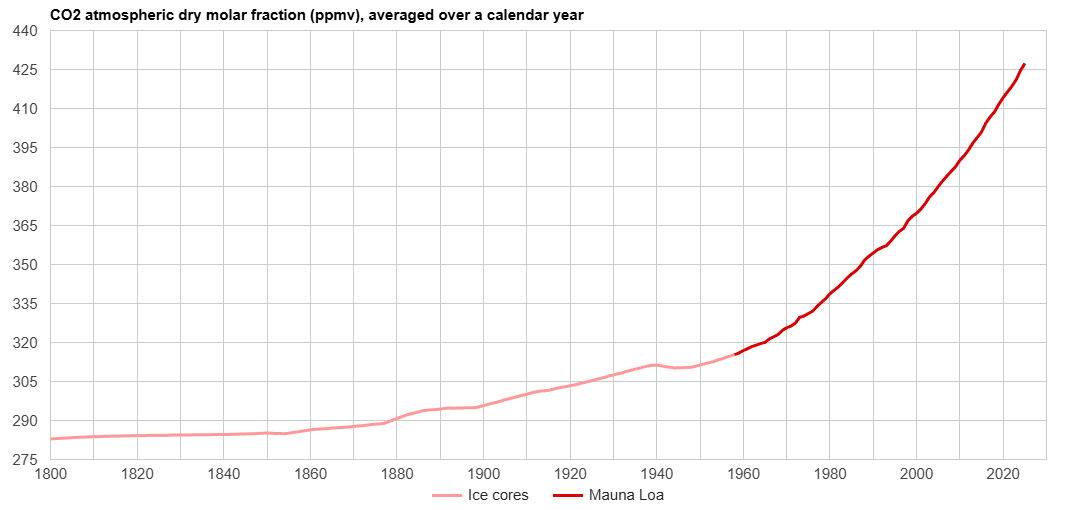
Consider the relative effects on ocean CO2 uptake of a 0.5 °C SST increase (since 1958) and a 35% atmospheric CO2 level increase (also since 1958):
1. We know from the temperature dependence of Henry’s Law that a 0.5°C water temperature increase will reduce CO2 solubility in water by about 2%:
2. But a 35% increase in CO2’s partial pressure in the atmosphere will increase CO2 dissolution into the ocean by 35%. That, in turn, accelerates the migration of carbon from the surface water to the abyss via biological mechanisms and thermohaline circulation, more or less proportionally. Since 35% > 2%, that the net effect of the two changes (temperature and atmospheric CO2 level) must be an acceleration in ocean uptake of CO2.
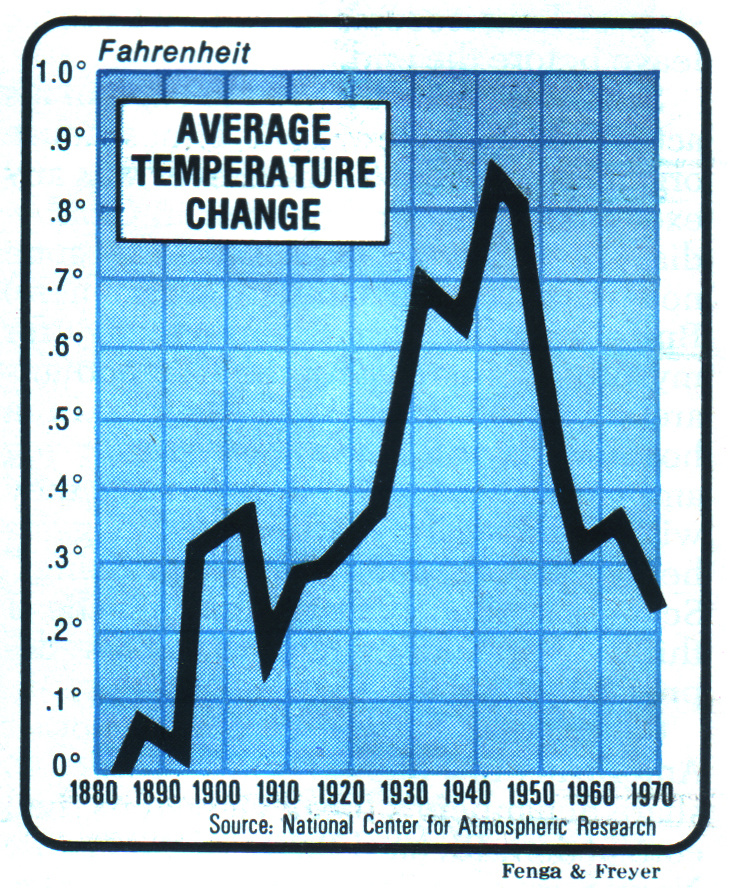
Also, note that global temperatures and presumably sea surface temperatures (SSTs) decreased in the 1950s, 1960s, and early 1970s. Yet CO2 levels nevertheless kept on rising. Obviously rising water temperatures didn’t contribute to rising CO2 levels when water temperatures were actually falling.
https://sealevel.info/newsweek_old.htm
Thank you, Sparta.
The temperature dependence of Henry’s Law has a relatively small effect.
Based on how much CO2 levels changed with temperature changes over glaciation cycles, and also over smaller, more recent temperature cycles like DACP 🡕 MWP 🡖 LIA, both of which are known with reasonable precision from ice core measurements, we could get at most perhaps +10 ppmv of CO2 level change from the amount of warming since 1958. But instead we got +112 ppmv over that 67 years.
Average sea surface temperatures (SST) are believed to have risen only about 0.5 °C over that period. Yet CO2 levels rose by 35%:
https://sealevel.info/co2.html

Consider the relative effects on ocean CO2 uptake of a 0.5 °C SST increase (since 1958) and a 35% atmospheric CO2 level increase (also since 1958):
1. We know from the temperature dependence of Henry’s Law that a 0.5°C water temperature increase will reduce CO2 solubility in water by about 2%:
2. But a 35% increase in CO2’s partial pressure in the atmosphere will increase CO2 dissolution into the ocean by 35%. That, in turn, accelerates the migration of carbon from the surface water to the abyss via biological mechanisms and thermohaline circulation, more or less proportionally. Since 35% > 2%, the net effect of the two changes (temperature and atmospheric CO2 level) must be an acceleration in ocean uptake of CO2.
Also, note that global temperatures and presumably sea surface temperatures (SSTs) decreased in the 1950s, 1960s, and early 1970s. Yet CO2 levels nevertheless kept on rising. Obviously rising water temperatures didn’t contribute to rising CO2 levels when water temperatures were actually falling.
https://sealevel.info/newsweek_old.htm

Sorry, mods, I accidentally posted two copies. My recollection is that I tried to edit the comment to make a one-word typo fix. Somehow both versions ended up posted at 4:44 PM.
I can see that they are not quite identical: the 2nd copy has the typo fix, and the 1st copy does not.
I don’t know what I did wrong. Sorry about that!
BTW, Sparta, the “direction of causality” question has several possible answers:
A⇒B (A affects B)B⇒A (B affects A)A⇎B (neither affects the other; the correlation is coincidental)A⇔B (A and B both affect each other)C⇒A and C⇒B (A and B are correlated because they’re both affected by the same thing)#4 is a “feedback loop.” There are two broad categories:
If an increase in A causes an increase in B, and an increase in B causes an increase in A, that’s a “positive feedback,” which has an amplification effect.
If an increase in A causes an increase in B, but an increase in B causes a decrease in A, that’s a “negative feedback,” which has an attenuation effect.
CO2 and temperature each affect the other, slightly. The temperature dependence of Henry’s Law means that an increase in temperature causes a slight increase in atmospheric CO2 level, and an increase in CO2 has a slight warming effect. The fact that each increases the other makes it a “positive feedback loop,” albeit a very weak one.
Correct and I apologize for the oversimplification.
Hmmm… something went wrong with the formatting, and I didn’t notice it until it was too late to fix it. When I posted it, my comment to Sparta began like this (except that I used the “ordered list” button instead of explicit numbers):
BTW, Sparta, the “direction of causality” question has several possible answers:
1. A⇒B (A affects B)
2. B⇒A (B affects A)
3. A⇎B (neither affects the other; the correlation is coincidental)
4. A⇔B (A and B both affect each other)
5. C⇒A and C⇒B (A and B are correlated because they’re both affected by the same thing)
#4 is a “feedback loop.” There are two broad categories: …
I read somewhere of an EV crash and burn where the doors malfunctioned, fatally trapping the occupant.
That can happen especially when you have a total battery failure on a system that needs functional electricity to operate.
Like Door Locks
Or window opening
Or even door latches.
There have been stories about those.
And such things are putting the manual door release where it cannot be easily reached.
Hybrids are heavier – more likely to lose control. Especially as their acceleration under battery power is a lot greater. And maybe their doors and windows are less likely to open after a collision?
As always, hybrids, or PHEVs? The differences between the 2 are huge.
According to a quick Duck, 52.2% of 2025 new car registrations in the UK were for Petrol, 19.6% were for BEVs (Battery Electric Vehicles), 5% were Hybrids, 1.2% were PHEVs (Plug-in Hybrid Electric Vehicles), 6.3% Diesel, and 15.7% Other.
The Daily Mail article however includes an image of a PHEV with the caption “since hybrids are outnumbered by almost 20 to 1 on Britain’s roads by petrol models, that means hybrids are three times more likely to be involved in a fatal crash,” and has some guy from a road safety charity stating that PHEVs are often heavier and more complex vehicles so cause complex fire scenarios i.e. more lethal. The article also notes EVs the safest type of vehicle.