Guest Post by Willis Eschenbach (@WEschenbach on X)
Napa Valley College is not far down the road from me, a small community college in the wine country of California. So let me lay out the sunny saga of Napa Valley College’s solar field—a green fantasy that was supposed to be a model for the nation, and ended up as a million-dollar weed patch. This is the kind of story that only seems shocking if you weren’t paying attention to how the solar “revolution” actually works: splashy ribbon cuttings, loud political speeches, wild promises…and then, about a decade later, the sound of crickets and the sight of public money quietly composting.

Flash back to 2006. Napa Valley College, fueled by $7.5 million (half from taxpayers via a bond, half from utility incentives paid for by us poor ratepayers), launches what is then the nation’s fifth-largest solar project. Local and national press swarm, a congressman champions the cause, and the administrators beam with pride. This masterpiece was going to power 40% of the campus, save $300,000 a year, run “virtually maintenance-free” for 25 or 30 years, and serve as a postcard for college sustainability reports everywhere.
For a few years, everything hums along. The thing works. Solar output looks impressive in the glossy pamphlets; the college basks in eco-glory.
But then, reality shows up on the ledger. By 2017—barely a decade on—output has cratered, maintenance costs are climbing, and the system is barely limping along. In 2018, SunPower (the system’s new corporate overlord after a straight-out-of-silicon-valley company shuffle) discovers major faults and charges an extra $160,000 to patch the system together. No one seems to know—or wants to explain—when the panels finally gave up the ghost, but sometime between 2019 and 2021, the weeds won. SunPower goes bankrupt and vanishes, leaving the school with zero support, zero warranty, and a $7.5 million monument to wishful thinking.
How did it fail? Let’s count the ways.
- The 25- to 30-year “lifespan” was always a myth, an industry fairy tale pulled out of thin air and sold to unprepared bureaucrats.
- Central inverters—then the industry standard—didn’t have the staying power, leading to cascading technical failures and “planned obsolescence” on the scale of a college football field.
- Maintenance became a patchwork, as installer, module supplier, inverter company, and maintenance contractor all vanished into the bankruptcy fog one by one.
- Regulatory goalposts kept moving: by the time Napa tried to salvage the project, new grid export rules and skyrocketing fuel-cell competition made solar more trouble (and less savings) than ever.
The final insult? The only “fix” on offer is a $1 million bid just to haul the dead system away. No maintenance records, no liability info, no insurance payout, no ability—or apparently even the will—to go after the broken warranty. The school is left pondering its new “fuel cell,” which at least uses technology someone can repair.
And don’t let energy consultants off the hook. Far too few of them truly understand this stuff—and not one of them works for Napa Valley College, or any of the bankrupt companies that lined up for taxpayer cash. The colleges, schools, towns, and small governments caught riding the solar coaster are all learning the same lesson: you may want renewable energy, but you’d better get ready for a decade in the customer-service wilderness when something breaks. You’ll be lucky if there’s even anyone left to answer the phone.
Now, 20 years on, Napa Valley College is looking at new bonds, new consultants, and another round of “studies,” all while its original field rusts—too expensive to remove, too costly to repair, too embarrassing to celebrate, and too much reality for the next round of green-themed PR. They’re told “the new technology is better,” the panels cheaper, the batteries better…and you wonder how this one ends.
The Napa fiasco isn’t just an accident—it’s the logical destination for a sector riddled with hype, corporate churn, regulatory quicksand, and political FOMO. “Build it and they will come” has turned into “build it, and ten years later, call a demolition crew.” If you’re a taxpayer or a trustee, the lesson is simple: demand the receipts, don’t buy the fairy tale, and remember—a $7.5 million solar field looks invincible the day you cut the ribbon, and a total farce the day you lock the gate for good.
Another day, another green “success” sprouting weeds.
My best to all,
w.
PS—When you comment please QUOTE THE EXACT WORDS you are discussing. It avoids endless misunderstandings.
Presumably some of the “consultants” are still around, and failed to hide behind a corporate entity.
“And another one bites the dust.” Dead solar and wind farms will continue to dot the landscapes and seascapes and become elegies to AGW. The builders were promised quick and easy money and the owners “free energy”. Guess which promise was kept.
Just in time for COP30 in Belem, Brazil, we have fresh confirmation, cooling temperatures are resulting in lower than expected levels of atmospheric CO2
So, the whole wind, solar, battery frenzy and Net-Zero to reduced CO2 by 2050 are
impossibly expensive hoaxes that are based on proprietary IPCC “science”..
https://willempost.substack.com/p/just-in-time-for-cop30-in-belem-brazil?r=1n3sit&utm_campaign=post&utm_medium=web&triedRedirect=true
Good to hear from you.
Hope you and yours are doing well.
Agreed, except for the unprepared part. I suspect there is a range of qualifiers, perhaps from naive to bribed, that is more applicable. They were certainly warned, they just didn’t want to listen, and are not accountable. Uncaring might be the better adjective.
Now it can be used as the setting for a post-apocalyptic film.
I’ll get a crew in to haul it away for “Free” the only cost to the college will be a … public apology for “Wasting funds on a boondoggle scam project that was doomed to failure from the start”
… AND …
A very public denouncement of wokism principles with immediate expungement from all curricula of anything WOKE, SOCIAL JUSTICE, ENVIRONMENTAL JUSTICE, EQUITY or LGBTQAA+++ (whatever) as requirements for diplomas.
The school staff eats big old slices of Humble Pie and I’ll get their solar system cleared out.
One Caveat, their very public apology MUST be carried by every major and minor liberal news outlet including all TV News outlets as the 4, 6, 8, 10pm Primetime News Lead Story
“Flash back to 2006…..” At least by 1985 the first, but small, renewable experiment was known to be a failure and a few fossil windmill posts were left for awhile. Of course in Texas and the Netherlands they knew long before that when the wind don’t blow water don’t flow. Solar became understood for certain small applications in the wilderness and on sailboats and recreational vehicles. Maybe they need goats and if enough charge is left sell them for barbecue.
Just did a Google search for Napa Valley College Solar Farm and guess what??? WUWT was the Ninth Hit on the front Google page.
My 1st
https://www.mercurynews.com/2025/11/14/napa-valley-colleges-7-5-million-solar-field-was-once-a-model-now-it-sits-dead-in-the-weeds/
WUWT was 2nd.
I use Duckduckgo.
So do I.
I was simply (can’t make up my mind) either dumbfounded or gobsmacked that GOOGLE actually had the WUWT link on the first page and not some 600 pages down the list.
Fourth on Bing, but not really a surprise. None of the major Left “news” outlets is likely to touch this one with a 200-foot rotor blade.
From the google sat image I’m guessing the solar panel area is about 60 acres – these projects were pretty small back then. As an installation this is peanuts
Would have still cost heaps. As the mass production has lowered the panel costs since 2020.
Plus its a small community college which didnt have large demands. Full time 1200, part time 3000 students. Some figures say 2013 or so was double that overall.
I also looked at it from a 2023 Google Earth overhead photo. The growth wasn’t as large as it is now (as in the picture above), but it was in progress. It would have been a lot easier to clear it out when it was smaller.
And don’t get me started about inverters.
I am guessing that the solar panels stimulate the brush growth by shading the soil and conserving moisture.
They also funnel available moisture into a drip line at the edge of the panels ensuring the space between the rows gets the most water
But clearing it out would negate the “Zero Maintenance” claim.
Willis,
You know the US scene better than this Australian does.
You refer to inaction by interested parties at Napa, a lovely location that we have toured.
Is your inaction like ours?
In the last year or two, the usual response to a communication in the form of a polite reply with useful content, has become less usual. For example, I currently have 7 communications, many of them emails, that await an answer, some now several weeks in the waiting.
There seems to have been a social change that says “It is now quite ok to not answer, the sender will pardon me if I simply do not answer.”
Some of these non-responses are now costing me money because of unfilled contracts. Even follow-ups mentioning money loss remain unanswered. Is this the new way?
Geoff S
Somewhat related things have happened to me and to several friends.
It is the way now. I work equipment maintenance for a living. If I have a warranty issue getting a response can be nearly impossible. Even when asking for parts quotes I often have to send multiple request before I get a response. This is both using the phone to just leave yet another voicemail and via email.
Not positive where the disconnect is but my personal thought is they’ve stripped customer support/sales staff to the point for cost saving they can no longer keep up with demand. I mean I see slow walking warranty issues, that’s 100% a loss of revenue. For them to also ignore sales calls on parts that generally have a decent mark up? That speaks to a deeper issue at the company.
I always place delivery/read receipts on any email with importance.
That way I know it was delivered to their email box (delivery receipt)
And that they saw it (read receipt)
Or that they deleted it without reading it.
They also see that a Read Receipt was sent back letting me know that they opened or deleted without reading the email. Knowing that I know tends to illicit a reply.
I think you mean “elicit”.
Sorry, the Debbil made me do it!<g>
I placed a little order with a Chinese company recently – delivery was expected within 2 weeks to my door. I tracked the order, and there was a delay at a Chinese airport for a few days. Probably going to be late. Oh well, I’ve had worse from American suppliers. No problem.
Just received an email – (in part) –
I’m surprised. Never been late before, so it’s a nice touch. Will I use them again? Probably.
Remember the new mantra, solar will work just fine if we just build enough battery storage to save for use when it gets dark.
And when the batteries burst into flames as they seem to frequently do, we get even more light that cannot be extinquished, all for “free” as tax subsidies and credits.
Of course, we could spin dynamos 24/7 instead, but that would not “save the earth”, which is the whole point of installing solar anyway.
Batteries only economic use is storing grid energy when cheap off peak and using arbitrage selling at higher prices during peak.
Running baseload solar-battery combo is too silly for words. They want to be using power to recharge in the middle of the night not supplying it.
Storing at low cost and selling at high cost, so-called arbitrage, is NOT profitable, if a to z costs are counted.
You have been brainwashed, and repeat nonsense like a parrot!
It may not be profitable, but it is the only possible use that I see.
The emergency backup idea can never work. Covering deficient periods in winter is totally hopeless.
Read my above comment and top URL.
I have been doing such analyses fro 40 years.
No guess work involved
BATTERY SYSTEM CAPITAL COSTS, OPERATING COSTS, ENERGY LOSSES, AND AGING
https://www.windtaskforce.org/profiles/blogs/battery-system-capital-costs-losses-and-aging
by Willem Post
.
Utility-scale, battery system pricing usually not made public, but for this system it was.
Neoen, in western Australia, turned on its 219 MW/ 877 MWh Tesla Megapack battery, the largest in western Australia.
Ultimately, a 560 MW/2,240 MWh battery system, $1,100,000,000/2,240,000 kWh = $491/kWh, delivered as AC, late 2024 pricing. Smaller capacity systems cost much more than $500/kWh
.
Annual Cost of Megapack Battery Systems; 2023 pricing
Assume 45.3 MW/181.9 MWh; turnkey cost $104.5 million; 104,500,000/181,900 = $574/kWh, per Example 2
Amortize bank loan, 50% of $104.5 million, at 6.5%/y for 15 years, $5.484 million/y
Pay Owner return, 50% of $104.5 million, at 10%/y for 15 years, $6.765 million/y (10% due to high inflation)
Lifetime (Bank + Owner) payments 15 x (5.484 + 6.765) = $183.7 million
Assume battery daily usage, 15 years at 10%; loss factor = 1 / (0.9 *0.9)
Battery lifetime output = 15 y x 365 d/y x 181.9 MWh x 0.1, usage x 1000 kWh/MWh = 99,590,250 kWh to HV grid; 122,950,926 kWh from HV grid; 233,606,676 kWh loss
(Bank + Owner) payments, $183.7 million / 99,590,250 kWh = 184.5 c/kWh
Less 50% subsidies (tax credits, 5-y depreciation, loan interest deduction, etc.) is 92.3c/kWh
Subsidies shift costs from project Owners to ratepayers, taxpayers, government debt.
.
Excluded costs/kWh: 1) O&M; 2) system aging, 1.5%/y, 3) loss factor 1 / (0.9*0.9), HV grid-to-HV grid, 4) grid extension/reinforcement to connect battery systems, 5) downtime of parts of the system, 6) decommissioning in year 15, i.e., disassembly, reprocessing, storing at hazardous waste sites. Excluded costs would add at least 15 c/kWh
COMMENTS ON CALCULATION
Almost all existing battery systems operate at less than 10%, see top URL, i.e., new systems would operate at about 92.4 + 15 = 107.4 c/kWh. They are used to stabilize the grid, i.e., frequency control and counteracting up/down W/S outputs. If 40% throughput, 23.1 + 15 = 38.1 c/kWh.
That is on top of the cost/kWh of the electricity taken from the HV grid to charge the batteries
Up to 40% could occur by absorbing midday solar peaks and discharging during late-afternoon/early-evening, in sunny California and other such states. The more solar systems, the greater the midday peaks.
See top URL for Megapacks required for a one-day wind lull in New England
40% throughput is close to Tesla’s recommendation of 60% maximum throughput, i.e., not charge above 80% and not discharge below 20%, to perform 24/7/365 service for 15 y, with normal aging.
Owners of battery systems with fires, likely charged above 80% and discharged below 20% to maximize profits.
Tesla’s recommendation was not heeded by the Owners of the Hornsdale Power Reserve in Australia. They excessively charged/discharged the system. After a few years, they added Megapacks to offset rapid aging of the original system, and added more Megapacks to increase the rating of the expanded system.
http://www.windtaskforce.org/profiles/blogs/the-hornsdale-power-reserve-largest-battery-system-in-australia
Regarding any project, Banks and Owners have to be paid, no matter what. I amortized the Bank loan and Owner’s investment
Divide total payments over 15 years by the throughput during 15 years, to get c/kWh, as shown.
Loss factor = 1 / (0.9 *0.9), from HV grid to 1) step-down transformer, 2) front-end power electronics, 3) into battery, 4) out of battery, 5) back-end power electronics, 6) step-up transformer, to HV grid, i.e., draw about 50 units from HV grid to deliver about 40 units to HV grid. That gets worse with aging.
A lot of people do not like these c/kWh numbers, because they have been misled by self-serving folks, that “battery Nirvana is just around the corner”.
.
NOTE: EV battery packs cost about $135/kWh, before it is installed in the car. Such packs are good for 6 to 8 years, used about 2 h/d, at an average speed of 30 mph. Utility battery systems are used 24/7/365 for 15 years
.
NOTE: Aerial photos of large-scale battery systems with many Megapacks, show many items of equipment, other than the Tesla supply, such as step-down/step-up transformers, switchgear, connections to the grid, land, access roads, fencing, security, site lighting, i.e., the cost of the Tesla supply is only one part of the battery system cost at a site.
Willis, sorry – insufficient data. Is it just incompetent administrators, or real technical problem?
Yes!
How about both?
A one time bill for installation and sold a bill of goods regarding self sufficiency.
Power inverters have long been known to have at best a 10, maybe 15 year life span.
Comparing panels from pre 2010 to anything recent isn’t a good comparison.
Another feel good day dream beaten up by reality and a lack of planning.
The great consolation for these low competency, near zero due diligence hyped projects is they still carry on the appearance of working “models of the future” green credentials even when they’re not working. That is until the weeds get too high.
Five(+) easiest ways to see that such solar-PV installations are just for show:
It is much worse and costlier than that!
HIGH COST/kWh OF W/S SYSTEMS FOISTED ONTO A BRAINWASHED PUBLIC
https://www.windtaskforce.org/profiles/blogs/high-cost-kwh-of-w-s-systems-foisted-onto-a-brainwashed-public-1
.
People are brainwashed to love wind and solar. They do not know by how much they screw themselves by voting for the woke folks who push them onto everyone. Their ignorance is exploited by the woke folks
.
Owned/controlled by European governments and companies, would be a serious disadvantage for the US regarding environmental impact, national security, economic competitiveness, and sovereignty
.
Western countries cajoling Third World countries into Wind/Solar, and loaning them high-interest money to do so, will forever re-establish a colonial-style bondage on those recently free countries.
What is generally not known, the more weather-dependent W/S systems, the less efficient the traditional generators, as they inefficiently (more CO2/kWh) counteract the increasingly larger ups and downs of W/S output. See URL
https://www.windtaskforce.org/profiles/blogs/fuel-and-co2-reductions-due-to-wind-energy-less-than-claimed
.
W/S systems add great cost to the overall delivery of electricity to users; the more W/S systems, the higher the cost/kWh, as proven by the UK and Germany, with the highest electricity rates in Europe, and near-zero, real-growth GDP.
.
At about 30% W/S, the entire system hits an increasingly thicker concrete wall, operationally and cost wise.
The UK and Germany are hitting the wall, more and more hours each day.
The cost of electricity delivered to users increased with each additional W/S/B system
.
Nuclear, gas, coal and reservoir hydro plants are the only rational way forward.
Ignore CO2, because greater CO2 ppm in atmosphere is essential for: 1) increased green flora to increase fauna all over the world, and 2) increased crop yields to better feed 8 billion people.
.
Net-zero by 2050 to-reduce CO2 is a super-expensive suicide pact, to:
1) increase command/control by governments, and
2) enable the moneyed elites to become more powerful and richer, at the expense of all others, by using the foghorn of the government-subsidized/controlled Corporate Media to spread scare-mongering slogans and brainwash people, already for at least 40 years; extremely biased CNN, MSNBC, NPR, PBS, NBC ABC, CBS come to mind.
.
Subsidies shift costs from project Owners to ratepayers, taxpayers, government debt:
1) Federal and state tax credits, up to 50% (Community tax credit 10%; Federal tax credit of 30%; State tax credit; other incentives up to 10%);
2) 5-y Accelerated Depreciation to write off of the entire project;
3) Loan interest deduction
.
Utilities forced to pay at least:
15 c/kWh, wholesale, after 50% subsidies, for electricity from fixedoffshore wind systems
18 c/kWh, wholesale, after 50% subsidies, for electricity from floating offshore wind
10 c/kWh, wholesale, after 50% subsidies, for electricity from largersolar systems
.
Excluded costs, at a future 30% W/S annual penetration on the grid, based on UK and German experience:
– Onshore grid expansion/reinforcement to connect far-flung W/S systems, about 2 c/kWh
– A fleet of traditional power plants to quickly counteract W/S variable output, on a less than minute-by-minute basis, 24/7/365, which means more Btu/kWh, more CO2/kWh, more cost of about 2 c/kWh
– A fleet of traditional power plants to provide electricity during 1) low-wind periods, 2) high-wind periods, when rotors are locked in place, and 3) low solar periods during mornings, evenings, at night, snow/ice on panels, which means more Btu/kWh, more CO2/kWh, more cost of about 2 c/kWh
– Pay W/S system Owners for electricity they could have produced, if not curtailed, about 1 c/kWh
– Importing electricity at high prices, when W/S output is low, 1 c/kWh
– Exporting electricity at low prices, when W/S output is high, 1 c/kWh
– Disassembly on land and at sea, reprocessing and storing at hazardous waste sites, about 2 c/kWh
Total ADDER 2 + 2 + 2 + 1 + 1 + 1 + 2 = 11 c/kWh
Some of these values exponentially increase as more W/S systems are added to the grid
.
Offshore wind full cost of electricity FCOE = 30 c/kWh + 11 c/kWh = 41 c/kWh, no subsidies
Offshore wind full cost of electricity FCOE = 15 c/kWh + 11 c/kWh = 26 c/kWh, 50% subsidies
The 11 c/kWh is for various measures required by wind and solar; power plant-to-landfill cost basis.
This compares with 7 c/kWh + 3 c/kWh = 10 c/kWh from existing gas, coal, nuclear, large reservoir hydro plants.
.
The economic/financial insanity and environmental damage is off the charts.
Europe has near-zero, real-growth GDP. Its economy has been tied into knots by inane people.
Adding tracking adds cost to both construction and maintenance, yet it adds little if any to the amount of energy per acre. The reason for this is that panels that tilt as the sun moves from east to west, have to be further apart so that they don’t shade each other when the sun is not straight over head.
but sometime between 2019 and 2021, the weeds won
Life is a constant struggle for survival. Here we see the struggle of plants against animals. Animals almost unwittingly feeding the plants and they take over.
Imagine the abundance of plant life when CO2 was 1200ppm. Every nook and cranny would spawn plant life and the plant life gradually encroach over every baron rock and convert it into arable land.
Plants are again winning due to human intervention in releasing long sequestered carbon.
The little trees I planted 30 years ago are now solar panels and batteries combined; storing energy in summer for my use through winter.
One hope I have is that the monster tree my neighbour has growing remains intact until I depart. If it comes down in this direction, it could do a lot of damage to our house.
Probably accounts for the vast deposits of coil, oil, and gas. All stored solar energy – free for the taking, organic, and renewable! Ah, bounteous Nature in all her glory!
“riding the solar coaster”….
Yep.
How ironic that a technology (solar) touted to “save the world” from that evil gas, CO2, is defeated by the benefit to the world of increased CO2 (increased plant growth, including the weeds).
The local one on campus is nearly 15 years old and going strong. Weeds are controlled by a flock of sheep that live on the site from spring to fall.
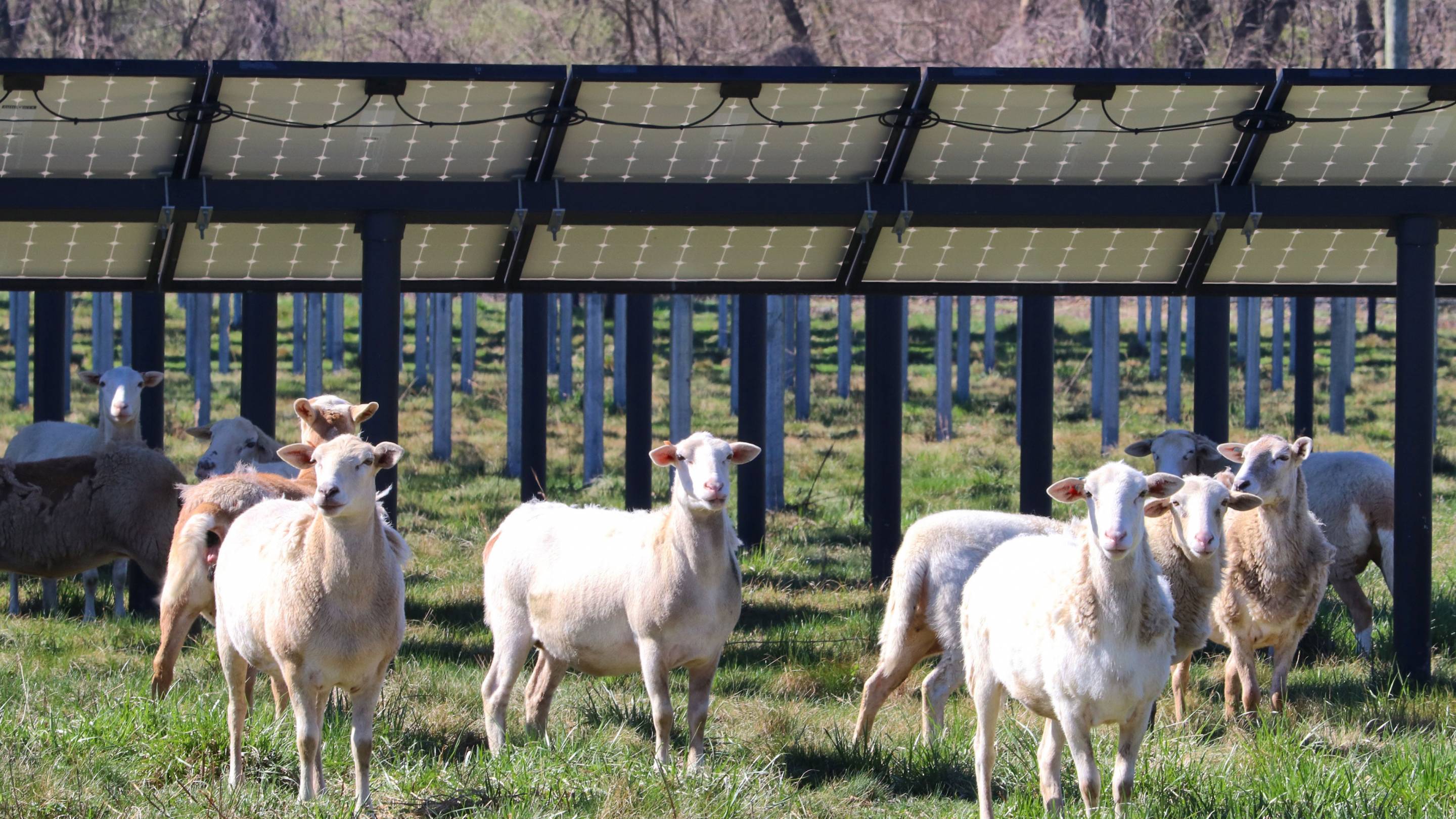 ?itok=k63Xa6cj
But we have to cull the sheep because methane.
because of the methane hoax
Something does not sound right about the size rank of that project even for that early year.
My first solar array cost Aud3000/kWh in 2010 when AUD was above parity with USD.
Could be worse. A couple of billion dollars seems to have “vanished” with the shutdown of Ivanpah.
Willis mentions consultants, who may well be highly intelligent, highly educated, and possessing long experience, and presumably not out-and-out fraudsters.
Unfortunately, none of these attributes confer any protection against ignorance and gullibility.
Just like Willis, who still believes that adding CO2 to air makes thermometers hotter.
Facts are facts – sometimes solar or wind power suits the circumstances. Sometimes it doesn’t. The only way to discover which is which is to try it out. Seriously. The predictions of the best and brightest “experts” do not always come to pass, and are sometimes proven to be laughably wrong – after the passing of time. Other times, their advice is spot on!
The problem arises when your pocket is pillaged to pay for some of these flights of fancy. Whatever happened to the scientist, inventor or entrepreneur who risked all, and took personal responsibility for the outcome of his actions? Just because people like Newton, Einstein, Edison, or Samuel Colt had some quite bizarre convictions, does not detract from their great achievements.
On the other hand, believing experts whose expertise is based on their conviction that adding CO2 to air makes thermometers hotter, is a sure road to ruin – in my worthless opinion, of course. I do my best to keep their thieving fingers out of my pocket. Feel free to give them a bit extra on my behalf. <g>
Michael — Ivanpah actually made sense of a sort. It is/was solar-thermal not solar photovoltaic. Which is to say that it uses all the incoming solar radiation to heat a working fluid — water for Ivanpah, molten salt for Crescent Dunes. Solar PV uses just the 50% or so of solar radiation energetic enough to kick electrons loose to heat a working fluid. The very hot working fluid stores energy until the grid asks for it whereupon the fluid is used to drive steam turbines. That makes it dispatchable power.
There’s nothing intrinsically wrong with solar-thermal for heating domestic hot water in the tropics and subtropics in places where hard freezes are absent or uncommon. The systems are inexpensive, and most repairs can be done by anyone handy with tools.
For grid scale electricity, solar thermal is apparently quite a bit more problematic. Both Ivanpah and Crescent Dunes have failed. On the other hand, China has 20 of these plants in service and is building a bunch more. The Chinese seem to be pretty good at technology and it seems unlikely they’d be building more facilities if the first bunch weren’t doing what they need.
BTW, I ‘m not a big fan of solar PV. Certainly not where I live in northwest Vermont. Sun angles around here are about 20 degrees at noon in Winter. Which is largely irrelevant because the panels would be covered with snow about a third of the year. And it’s also one of the cloudier places in the US. But it might be OK in the desert Southwest of the US or the Sahara, or in much of Australia.
How many birds do these solar-thermal plants burn up every year?
I would think it is comparable to the birds killed by windmills.
Let’s stop killing birds to generate our electricity.
You actually believe China is making solar thermal work???
Fran, I’m sure it will “work”, in the sense of converting sunlight to electricity – albeit in a very complicated, costly, and intermittent way.
I wonder how many golden eagle carcasses it will take to annoy Chinese Taoists, Confucianists and Buddhists (etc), to the point where the benefits of the electricity created are seen to be outweighed by the destruction of natural life?
The religions (or ways of life, if you prefer), I mentioned, all go back about 2,500 years, and have persisted in spite of vigorous attempts to eradicate them. All promote harmony with nature, and reverence for life, one way or the other.
Chinese are people too – just living in different places, appearing different, and with different cultures.
China and the US are roughly the same size (depending on your methodology), but China’s population is ethnically more diverse, much larger, and their civilisation goes back much further,
Who cares? The haters on both sides do, but the future remains unknown, even to them, whether they believe it or not.
The Americans seemed to be “pretty good at technology” too.
I’ve no doubt the Chinese experts believe their projects will work, just as the American experts did. Maybe they’re right this time.
I suspect that the Ivanpah “experts” had convinced themselves that you could “store” heat, if you tried hard enough. The problem is, as another commenter pointed out, that heat is only energy in the process of being transferred, and cannot be “stored” or “accumulated”.
Ivanpah was simply not cost effective. The fantasy collapsed in the face of fact.
Solar energy is fine. Why not use stored solar energy (coil, oil, gas), where it makes economic sense to do so?
There was a pilot solar thermal project at Dagget/Vermo, near Barstow CA, that operated for several years. Somehow, I think its performance, or lack of, was not considered in the decision to push the Ivanpah and Crescent Dunes plants. Such colossal failures, clearly, these weren’t based on compelling engineering assessments.
I’ve no confidence the Chinese efforts will fare any better.
Oddly, one of my childhood friends holds (or held, it’s old) an early patent for using synthetic oil as a high temperature working fluid in solar thermal.
Data shows, it gets warm first, then CO2 from all sources catches up or often not.
Top photo shows multiple “root sprouts” from adjacent trees of the same type. This is like the quaking aspen Pando, the largest clonal organism. I have a small patch of these. Had they consulted me (or a trained tree person) at least trees wouldn’t be part of the problem.
I think there is a large discrepancy between the lifetimes of different solar panels. Not sure of the details involved in your interesting account, but it looks to me like maybe the project became worthless because the original installation used cheap panels (from foreign sources.) I put Sunpower (American made) panels on my house about 13 years ago. Comparing their performance from year to year accurately is impossible, because output is subject to the vagaries of weather. But comparing the figures from 2011 to those from 2021 (the latest I have in summary form) there does not seem to be any significant degradation. Sad to see Sunpower throw in the towel.
Uncompetitive, maybe?
Sunpower designed and constructed the site I illustrated above, completed in 2012 and still going strong, averages about 6% of campus electricity.
As the saying goes: “It’s not nice to fool Mother Nature.”
“solar coaster” Brilliant, Willis! I’m shamelessly stealing that one.
Ah, consultants
When you’re not part of the solution, there is plenty of money to be made prolonging the problem.
Schneider Electric (a French company selling the “green dream”) has been trying to sell a $9.999 million solar boondoggle to a university campus in Texas. The promo is all roses and practically fact free. Staying just under $10 million avoids rigorous engineering and environmental scrutiny for reasons that I cannot elaborate. Last word is that the project is dead, but these have a way of reviving when the spotlight dims. I’m sure this scam is being pushed on universities across the world with much the same fanfare as described here. Willis, your article should be required reading for higher adulation administrators. Of course, proponents will claim that today’s technology is allegedly far better.
They bought my weather company about 13yrs ago but in the end we were not a good fit with them and they set us free (thank God). But I did get a good stock offer from them when they did own us and it has performed well. Known as the GE of France.