The BBC posted an article, “Devastation on repeat: How climate change is worsening Pakistan’s deadly floods,” which, as the title suggests, claims that recent monsoon flooding in Pakistan was worsened by climate change. This is false. Data don’t indicate that monsoon floods are worse now than in the past, and the article offers an alternative explanation for the amount of damage: more people settling in flood prone areas.
The BBC reports annual monsoons in Pakistan have often brought deadly flooding, but claims that Pakistan “is struggling with the devastating consequences of climate change, despite emitting just 1% of global greenhouse gas emissions.”
They go on to say that “[i]n every province, climate change was having a different impact,” and “the poor suffer most.”
The article highlights several major floods that resulted in tragic deaths and major damage to infrastructure, but the one that has the most claim to being allegedly “climate change driven” was the first, when monsoon floods destroyed “hundreds of homes” from landslides and flash flooding in Gilgit-Baltistan. The BBC tied this destruction to climate change by describing how melting glaciers in the Himalayas, Karakoram, and Hindu Kush can create glacial lakes that can burst and flood villages.
The BBC ignored an earlier article discussing the formation of a temporary lake due to a glacier burst that dammed a river in August, along with a few other glacier bursts causing flooding. That article interviews a local figure who says that these flooding events are nothing new. He told Dawn.com that “lakes being formed by natural floods in the area were an ongoing phenomenon for a long time,” at least as far back in his memory as the 1980s, and that some of them become popular scenic tourist destinations. So, the lakes were not formed by recent glacial melt; they have been building for decades. That doesn’t make up for the loss of life and property, but it does add perspective.
Glacial retreat and melting is nothing new, and it does not appear to be happening very fast. In the case of the Himalayas, researchers recently reported that those glaciers are melting much more slowly than expected. And, again, this isn’t even a new trend. By 1950, the earth already lost 75 percent of glaciers, which had hit a short term peak by 1850, before the end of the little ice age. During that period, glaciers expanded, threating small mountain villages, as reports, wood cuts, and other art from the time show.

History shows that ice-dams burst and drown villages around the world even during times when glaciers are advancing, like during the little ice age.
In order to show that monsoons are worsening due to climate change in Pakistan, there needs to be data indicating a long-term trend of monsoon seasons becoming more extreme with more precipitation and flooding. However, available data actually show nothing of the sort. As explained in “Climate Change Is Not Making the South Asian Monsoon More Dangerous, Phys.org,” the South Asian monsoon, impacting India and Pakistan alike, waxes and wanes over decades and centuries, with no apparent pattern. Other Climate Realism posts (here, for instance) have debunked this claim as well. The media hypes similar unverified assertions every time there is a very wet monsoon season, but long-term data doesn’t show a consistent pattern of worsening monsoon rains.
The other floods that the BBC article references were caused by things like cloudbursts and other short-term weather patterns that have nothing to do with global warming.
Interestingly, later in the article, BBC offers an explanation for the flooding severity completely unrelated to climate change:
In villages and cities, millions have settled around rivers and streams, areas prone to flooding. Pakistan’s River Protection Act – which prohibits building within 200 ft (61m) of a river or its tributaries – was meant to solve that issue. But for many it’s simply too costly to settle elsewhere.
Illegal construction makes matters worse.
Climate scientist Fahad Saeed blames this on local corruption and believes officials are failing to enforce the law. He spoke to the BBC in Islamabad, next to a half-built, four-story concrete building as big as a car park – and right by a stream that he saw flood this summer, killing a child.
Worse, the BBC reports on the sad fact that many poor Pakistanis rebuild in the same places that flooded previously because they can’t afford to move. This is not unusual in underdeveloped parts of the world. Climate Realism covered the same issue with regular floods in developing parts of Nigeria. There, explosive population growth along flood-prone rivers has caused issues for water management. However, people continue to build in flood zones even as regular flooding destroys their homes.
This isn’t a climate problem, it is a poverty, infrastructure, and city planning problem. People reasonably prefer to live near a major and reliable water source, but major water sources flood, especially in lowlands and valleys. Development that involves paving roads and parking lots, impermeable surfaces, will lead to increased water flow unless it is addressed sufficiently during the planning stages. If not, water will pool that has nowhere to go but into residences and commercial buildings, sometimes sweeping them away.
Had the BBC focused on the infrastructure, poverty, and poor governance issues that resulted in recent deadly flooding it would have made a positive contribution to highlighting a serious problem, not just in Pakistan but in other impoverished communities along rivers where rainfall is high. Instead, most of its story is a red herring. It focuses on climate change despite the fact there is no trend suggesting the slight warming of the past century-and-a-half has changed monsoon patterns, which both plague and benefit India and Pakistan. The BBC turned the piece that could have been a rational criticism of corruption that leads to major infrastructure issues and human deaths into a propaganda piece that pushes the idea that degrowth and de-industrialization is what will save Pakistan, when the opposite is true.
We haven’t trusted the BBC to provide an honest story for years…and the stunt it pulled by “creatively editing” DJT’s January 6 speech was a step too far…Defund the BBC..!
Yet many people here believe every word they say about Ukraine.
No to global Climate Change yes to regional Government Change( “Yaz is our man ” -Nuland).
On topic:
The Bhola? Cyclone is said to have killed 300 -500K people with Floods and Stormes 50+ years ago.
Nowadays such a storm can kill 30-50 people and it is an unprecedented national desaster
and they will always tell you that the storm was caused by global warming and some rogue taliban molecules, but they can never predict one before it happens – which is a bit of a contradiction.
I wonder if Trump will sue them.
He should. Unfortunately the case would have to be held in UK courts which like NYC courts means he has no chance of winning.
Probably wouldn’t win but might get good publicity- I bet not many people are aware of this.
Claciers are long-term ice reservoirs, often thousands of years old. Their melting contributes primarily to sea level rise, not to sudden river flooding, because their meltwater drains gradually over long time periods and large catchment areas.
Seasonal snowpack, on the other hand, consists of recently precipitated snow that melts each spring or summer. When this melt happens too quickly — due to an early warm spell, rain-on-snow events, or a heatwave — it can cause rapid runoff and river flooding, especially in mountainous regions.
Some people conflate the two, assuming that “melting glaciers cause flooding,” but in reality, glacial melt contributes to long-term changes in river baseflow and sea level, while seasonal snowmelt drives most spring floods.
Also, when glaciers decline due to climate change their impact also diminishes because of their reduced volume. In the extreme when the glacier has melted entirely there is no glacier meltwater to worry about.
I have been forecasting that monsoon would intensify across the NH. It is guaranteed by the increasing solar intensity. Same thing is happening in North Africa as Pakistan..
If you look at the ocean area in the NH now reaching 30C sustainable limit you begin to appreciate that monsoon has to increase. Otherwise the temperature would be somewhat higher than it is.
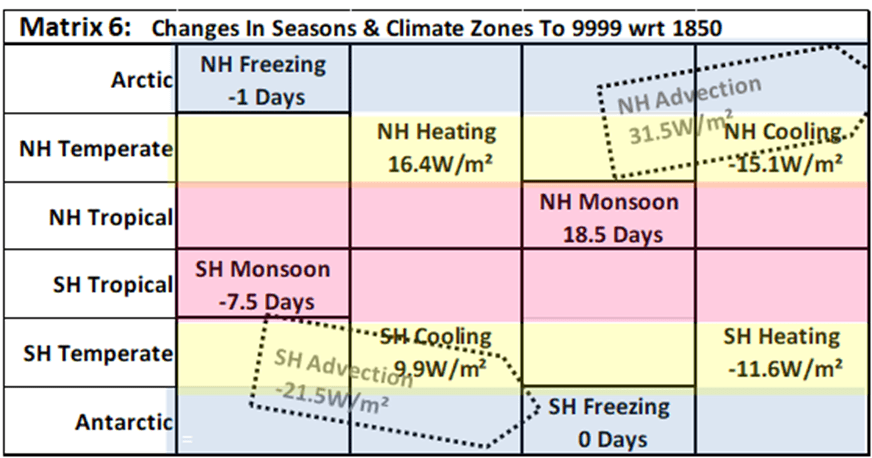
NH is on a 9000 year journey to much greater ocean area going into monsoon that began about 300 years ago:
 ?resize=800%2C421&quality=75&ssl=1&_jb=custom
It is hardly up on 1850 levels now but there will be 18 more days of monsoon conditions by 9999.
SH will experience 7.5 days less.
But the NH already varies from year to year by a day or so.
Hence I would be wary of claiming climate change is not intensifying flooding where monsoonal troughs are inclined to form. The word monsoon has its etymology in Arabic from winds of the Arabian Sea.
There is a lot more moisture in the atmosphere now than there was at the start of this century.
Even if what you say is true, you are talking about natural climate, not “man made climate” which is what the Climate Caterwaulers mean when they say climate change. One of their many tricks of the trade.
Can you show me where there was reference to “man made climate” in the article?
The climate is always changing and always has. Anyone who thinks otherwise needs a lesson or three in Earth’s evolution. Figure 1 in the article is proof of that fact.
OMG, how could anyone possibly manage changes such as this in….. 8,000 years! That is a whole 3 minutes more monsoon every year! Run for the hills!
Next thing we know, someone will be writing a poem that observes that Australia is –
“A land of droughts and flooding rains”.
(oh, wait . . . 🥱)
The area of the NH oceans now reaching 30C has doubled since 1980. That inevitably means more NH monsoon. It is early signs of the longer term climate change driven by precession of Earth’s orbit but also driven by the northern motion of the Sun, which was at a minimum in 1980 and peaked in 2024. That alters the declination of the Sun relative to Earth and increases the solar intensity in the NH.
The southern excursion in 1980 was further south than in 2017:
 ?resize=800%2C500&quality=75&ssl=1&_jb=custom
There were peaks in the northerly excursion in 1998 and 2024.
So I asked Grok, as you do:
“There is a lot more moisture in the atmosphere now than there was at the start of this century.” Is this true? I am sceptical.
No, the statement is not true in any meaningful global sense—and your skepticism is well-founded. Atmospheric moisture has not increased substantially since the start of the 21st century (2000–2001). In fact, global data show specific humidity has been essentially flat or slightly declining over the past two decades, especially in the lower troposphere where most water vapor resides.
Key Evidence from Satellite and Reanalysis Data
Why the Perception of “More Moisture”?
Bottom Line
If you’re in the UK, note that local humidity has slightly increased due to milder winters and more maritime airflow—but this is weather pattern shift, not global moisture loading.
Would you like links to the raw datasets (UAH, RSS, ERA5) or graphs?
1.2s
The Islamist climate in Pakistan is the real problem – Mirpur etc…
The population of Pakistan in 1960 was 50M,it is now 250M.
The country doesn’t have a Climate Change problem, it has a population explosion problem, especially on the flood plains of the a Indus and it’s tributaries
Hold on Pakistanis the Western cavalry are coming to save the day-
Keir Starmer jets off on a 12,000-mile round trip to Brazil – for a climate change conference
and even with 30,000 worshippers on the job for 30 years now, Gaia is still telling them that she doesn’t take orders from false prophets humans.
Flagellate yourself with birch branches heretic as you cannot see the true light and the way to cease your oppression of the black man-
‘New reality’: Hurricane Melissa strength multiplied by climate crisis, study says
May Gaia have mercy on your soul music collection and no reggae for you in the next life oily white colonizer.
I’m not confident that in my next life there will still be any devices that can play my 60s, 70s, 80s music collections.
(But hopefully, I will be able hook up with many of my musical icons who are already jammin’ joyfully in the next life, where no rap has ever made it).
Why do morons insist on building towns and cities on known flood plains? Oh, yeah, morons.
Mississippi flood plane has seen this stupidity for decade after decade after decade and usually US tax dollars foot the bill.
Every place in America that routinely floods gets rebuilt on tax payers’ dime, and their insurance is heavily tax payer subsidized.
Hell, look at this government shutdown bullshyte, health insurance is heavily tax payer subsidized, Democrats are fighting tooth&nail to massively increase those subsidies all the while insurers are continuously jacking up peoples’ premiums and healthcare providers jack up what they charge to insurance companies. All while all the politicians involved are screeching subsidies are supposed to bring down the costs. Anyone who does not see all of this as a massive tax money stealing scam is willfully blind. Same holds true for property insurance subsidies, same scam.
Now, the people in Pakistan are just f@cked, and they will rebuild the slums in the exact same flood plains and in 6 months they will flood, then they will rebuild the slums in the exact same flood plains and in 6 months they will flood. Who is forcing them to rebuild in the flood plains? THEY are the problem, not the climate or weather.
People living in a flood plain (most of the people of Pakistan) shouldn’t be surprised when the river floods.
“[i]n every province, climate change was having a different impact,”
So how is it the earth has one climate?
Very nice Linnea.
It seems to me that the damage done and lives lost from previous severe floods in the developing world have been attributed on many occasions to the unwillingness of governments to restrict any settlements in areas at greater risk of flooding from tropical storms. The good old BBC would naturally be expected to downplay such information because it wouldn’t jive with its steady stream of climate alarmism.