By Vijay Jayaraj
By refusing to play by the EU’s restrictive climate rules, Poland has begun to build one of Europe’s most energy-secure economies. While much of the bloc marches in lockstep towards a self-inflicted economic wound called “net zero,” Poland has chosen a different path – one of pragmatism, national interest and, most importantly, energy security. And this path is paying handsome dividends.
Coal Powers Poland
At the heart of Poland’s defiance is a steadfast refusal to abandon coal, the bedrock of its energy system. In 2024, coal, oil and natural gas accounted for more than 85% of total primary energy supply, the highest share in the EU. Coal alone generated 55% of the nation’s electricity in 2024, powering homes, factories and businesses.
Though news media were excited about renewables’ increased share of power generation in June, the country is actively finding ways to make coal a mainstay. The Energy Policy of Poland 2040 (EPP2040) outlines a plan for major utilities like PGE and Tauron to spin off coal-fired plants into separate entities by 2025.
By isolating coal assets, Poland delays aggressive transition timelines, ensuring that coal assets are spared from EU transition rules. Jakub Jaworowski, Poland’s Minister of State Assets, reinforces this strategy, noting that government analysis found no economic justification for divesting coal assets.
Maciej Bando, Poland’s deputy climate minister, has been unequivocal on this point: “I have no doubt that coal units will be needed in the system until they are naturally replaced by nuclear power plants.”
The idea that you can power a modern industrial economy with intermittent and unreliable sources of energy like wind and solar is a dangerous fantasy. Poland must be careful to not follow the examples of Germany and the U.K., where domination of power grids by wind and solar has resulted in unstable power supplies, surging imports and unaffordable power prices.
Upward and Onward
But Poland’s success story does not end with coal. The country is also blessed with newfound reserves of natural resources that promise to further enhance energy security and fuel economic growth. In early 2025, the state-affiliated Orlen Group announced the discovery of a natural gas deposit in western Poland, with estimated reserves of nearly 250 million cubic meters.
The crown jewel, however, is the July discovery near Poland’s Baltic coast of what has been hailed as the nation’s largest-ever oil and gas find. This deposit rivals or surpasses the Barnówko-Mostno-Buszewo field – previously Poland’s largest, with 400–500 million barrels of oil.
Experts suggest its recoverable reserves could make this one of Europe’s most significant hydrocarbon discoveries in a decade. For Polish families, this translates to lower prices, reduced reliance on imports and billions in royalties to fund public services.
Polish reliance on fossil fuels has not hindered growth; it has fuelled it. From 2022 to 2025, Poland’s gross domestic product grew by an impressive 11.6%, outpacing economic giants like Germany, France and Italy and surpassing the EU average. In 2024 alone, Poland’s projected growth of 2.9% dwarfed the EU’s sluggish pace. Poland’s unemployment rate stood at 5.2%, lower than the EU average.
What if other nations were to abandon the self-destructive dogma of net zero and embrace a more rational approach to energy and climate policy? The results would be nothing short of transformative. We would see a resurgence of economic growth, a decline in energy prices, and a return to a more commonsense approach to environmental stewardship.
The climate industrial complex, which has grown rich and powerful by peddling fear and misinformation, would be exposed for the fraud that it is. And the people of Europe, who have been forced to bear the brunt of this failed experiment, would finally be set free.
This commentary was first published by The Daily Signal on July 29, 2025.
Vijay Jayaraj is a Science and Research Associate at the CO₂ Coalition, Fairfax, Virginia. He holds an M.S. in environmental sciences from the University of East Anglia and a postgraduate degree in energy management from Robert Gordon University, both in the U.K., and a bachelor’s in engineering from Anna University, India.
Very nice Vijay and more power to Poland.
This is just another example of Poland’s willingness to face the reality of the modern world. The first was its intention to devote some 5% of its GDP to defense spending A quick look at the map and a review of the country’s history explains its actions. With Germany and Russia on its east and west sides and the fact that the country has been carved up four times by them and the long-gone Austro-Hungarian empire, defense readiness is paramount. Meanwhile its main concern otherwise is economic growth and energy security along with raising overall living standards. These efforts show that it’s concerned with today’s realities rather than futile attempts at emissions reductions and renewable energies that just cost consumers money without actually delivering what they promise.
That Polish cheery picking of history. The original Polans tribe began as a smaller duchy/kingdom in SE Poland with its capital at Gniezno and later Krakow. There were other groups based around what was later Warsaw and of course Baltic tribes on the coast including the Prussi- which expanded under the Teutonic and Livonian knights. The Poland of the middle ages- called the Commonwealth with an elected king- expanded into neighbouring territories and lost most of it around 1790
The new polish republic in 1918 invaded east into Russia and NE into Lithuania- ignoring the proposed borders decided at Versailles.
Everyone forgets now but in early 1939 the polish dictatorship along side another semi facist dictatorship in Hungary were allied with Germany to carve up democratic Czechoslovakia. In 1920-30s Poland there still were anti semitic pogroms occurring.
Why don’t you just post the Wikipedia link and save yourself all that typing?
Just trying to help, mind you
Every nation has done terrible things. But what’s important is what they’re doing now.
And your point is?
That Polish cheery picking of history.
Can you please provide some context as to how any of this relates to the topic of discussion?
How could Poland have violated the Treaty of Versailles in 1918 when it wasn’t even signed until 1919? Where did you get your information?
“Though news media were excited about renewables’ increased share of power generation in June,”
With reason and data. Here is their graph. Coal is still significant, but in long term decline. Renewables are growing fast.
It’s all about what consumers keep seeing in their electricity bills, Nick.
The “transition” to “cheap renewable power” has turned into a very visible con-job now.
Hand-waving it away is just annoying consumers now.
And consumers are the voters.
So in Poland renewables are rising? Are power bills?
Is that despatchable power from renewables or nameplate capacity? Oh it’s just sources, so nameplate. 😉
It is MWh generated.
To the end of 2025? That’s a great crystal ball there! Wow!
Poland’s power bills are most assuredly higher with the stresses on their electric power system by the addition of unreliable generation instead of reliable, modern power sources. Take it from someone who has actually planned, financed, designed, constructed and operated electric power systems.
This is a typical WUWT discussion. The lead, Vijay, claims that Poland is boosting coal generation, and this is great for the consumar. I point out that the linked facts show that coal is in decline and renewables rising rapidly. So then another line starts up here about how stupid the Poles are to do this and how terrible prices are. And these lines seem to coexist quite amiably.
Not worth the powder.
Not enough wind and solar yet, and they still have all their coal and gas available for the large percentage of time wind and solar don’t provide.
Speaking of coal…
Currently providing 78% of Victoria’s electricity.
Be very glad for that RELIABILITY of supply !
Yes, Poland started wasting money on renewables a couple of years ago.
(the best graph I could obtain without paying), but it tells an obvious story.)
Here’s a slightly better one.
Poland – Electricity prices: Medium size households
Is coal generation declining , or is Polands exports of energy increasing .
Your axis is %
yet the actual GWh has increased in last 10 years
Then renewables must be increasing even faster.
not worth the powder.
Nick, why don’t you show annual electrical energy (MWh) production instead of what I assume to be capacity (MW) figures by year? Unreliables’ capacity factors of about 10% to 30% will not power a modern society.
I showed the plot from Vijay’s link. It is of actual production (MWh, by %), not capacity.
Not worth the powder.
The above graph is misinformation. It has no y-axis scale, but likely shows relative “installed capacity”, not including the natural capacity factor of 15-30% for renewables. As dispatchable energy, reliable coal/NG are far more important to industrial output than the much larger, but intermittent renewable capacity. Insightful Poles now will increase dispatchable coal/NG energy until replaced by nuclear energy. Germany/Britain continue to flounder in irresolution, and the Iberian grid failure underscored the incapability of renewables to stabilize the grid.
It is a plot from Vijay’s link of actual generation. Here it is with the descriptive text:
Thanks for the clarification.
The comment remains unchanged. The graph is now clarified misinformation. I can be more explicit.The natural capacity factor is highly seasonal and depends on site conditions, as I am sure you are aware. Turbine output depends on the third power of the wind velocity, and is progressively throttled above ~12 m/s to preserve the wind turbine. Under high wind conditions, then, the huge installed capacity overage for wind requires the turbines be turned off when output exceeds grid demand – or lose the grid. Wind and solar are NOT dispatchable, just deductible.The high costs remain. Storage for days to weeks is needed (e.g. in Dunkelflaute) but does not exist. Wind/solar do not form a stable grid – any problem can crash the grid as shown in the Iberian Peninsula in April, 2025, Chile in February, 2025, and numerous other countries earlier. Those grid collapses are just the start when base energy disappears. Much worse is ahead.
There is something wrong with that graph and it doesn’t track back to energii properly it goes to financial times.
I ran basic searches on
https://www.forum-energii.eu/en/publications
Here is a zoomed in detail from energii
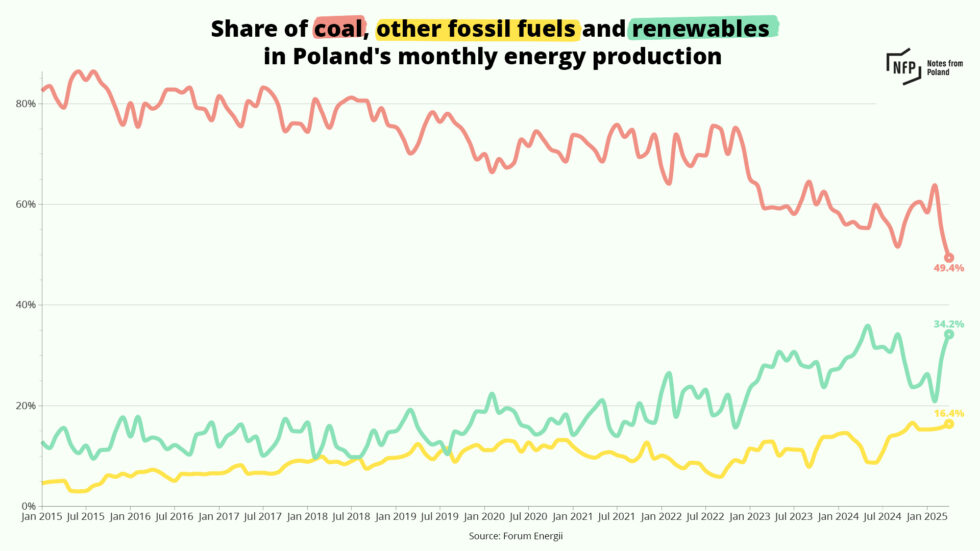
From the article
https://notesfrompoland.com/2025/05/13/polands-monthly-coal-in-energy-mix-falls-below-50-for-first-time/
Those graphs are very different
It’s Vijay’s reference.
The one I showed is electricity. The one you show is total energy.
As I suspected, “renewables” includes hydro. I wonder how much that is of the total in the category – half? Nobody here argues that hydro power can’t provide steady, baseload electricity. It’s solar and wind that are intermittent and unreliable.
No, hydro is small. See the graph in the next comment.
A detailed breakdown of electricity production in Poland.
While slowly decreasing, coal is still dominant by an order of magnitude.
When we say “an order of magnitude” I think a factor of 10. Not close.
Think I’ll find the data and plot it on a nonstacked, chart. Both linear and semilog. I won’t extrapolate to the Xovers, because you can almost do that with your eyeballs…
I wonder what it is that drives this sort of . . . utter stupidity?
In the UK – admittedly lead by a crowd of complete and utter idiots, where scientific and engineering competence is totally absent, this regardless of political complexion, of course – 76% of primary energy is still provided by fossil fuels and, worldwide, it’s 82%.
And, in the UK, from a combined installed wind and solar capacity of 53GW, over the last year, they generated 11.03GW. So these fantastically expensive facilities actually operated at a combined load factor – a measure of efficiency – of . . . 20.8%!!
Meanwhile, none of this expenditure on wind and solar facilities, covered by the taxpayer, was actually necessary.
But, no, the political twerps, devoid of science and engineering, have gone ahead and spent £billions of other people’s money, including mine, in establishing wind and solar facilities . . . BEFORE ANY THOUGHT WAS PUT TO CONNECTING this intermittent asynchronous useless bunch of equipment to the grid!!
And who pays for this utter stupidity?! Yes, the British taxpayer.
A position of rational common sense would be to admit that fossil fuels will eventually reach a point where their extraction will no longer be economic – the real point of depletion. And, although we’re far from reaching that point, to research and plan for the alternatives that will be needed by then is . . . not a difficult concept to grasp, bearing in mind that wind and solar are NOT the alternative – they need 100% backup.
So this mindless and useless dogmatism that I’ve now seen repeated again and again on these pages . . . surely this can’t be the from a functioning pragmatic and rational brain?!!
Not worht the powder.
Poland is also getting richer while the nut zeroes stagnate.
“Net Zero” is a pathological power grab. After hitting 400PPM, CO2 for all practical intents and purposes no longer contributes to “global warming”. Right now we are close to 420PPM of CO2.
And if we get too hot? CO2 only blocks certain frequencies of infra-red radiation. Most actually get past it. Special black paint designed to radiate in those frequencies that get past CO2 can be coated on the surfaces of many things. At night, they will radiate away a great deal of heat.
That is a clever and inexpensive solution, given the assumption that the 15 um IR interaction with CO2 is an actual cause.
Good for them, but I hope they will wise up, and stop the rise of Horrible Ruinables.before it’s too late.
The level of lying is astonishing. Germany had natural gas from Russia removed by the USA through the deliberate destruction of Nordstream II, just as the USA ensured that Poland got natural gas from Norway.
Poland was rewarded by the USA for becoming its chief prostitute in Europe, taking over from the aging old hag, the UK.
None of this is ‘pragmatic energy policy’, it was a reward from US terrorists for supporting their Russophobia and punishing Germany for having built peaceful trade relations with Russia for 60 years and more.
Do Ukrainians have reason for Russophobia? How about Putin’s saying many years ago that the worst thing to happen in the 20th century was the collapse of the Soviet Union? Recently, Russian leaders have said that wherever Russian soldiers go is Russia.
Simple point. Nordstream II explosion happened well after Russia invaded, unprovoked, Ukraine.
UK electricity system used to be prior to 2010, the same as Poland except we had some aging nuclear in the mix. It worked very well.
But it’s not just about abandoning net zero; finding an alternative way to reduce carbon dioxide emissions will prove just as costly, ruinous, and futile. The idea that CO2 is dangerous needs to be confronted directly and vigorously – that’s the only way to resolve this.
CO2 ias not toxic and therefore not an air pollutant.
Note they are now calling it climate pollution, which also is bogus.
If they actually beliefed whaat they say, they would stop breathing.
This is not about the environment. This is about reshaping the world the was a few elites want it.
By keeping their electricity costs down Poland is well placed to gain from Germany’s industrial decline as production moves out of the country.